The 45th Annual International Trumpet Guild Conference begins now! Trumpeters of all ages will find this virtual workshop an opportunity to improve their playing by accessing the Conference content for an entire 60 days! Don’t miss this opportunity to learn from over 200 of the finest players and teachers in our profession. For those students who are on break, this is a great way to stay engaged and maximize progress while away from school!
If you are serious about improving your trumpet playing, this is the resource you have been waiting for. Register today!
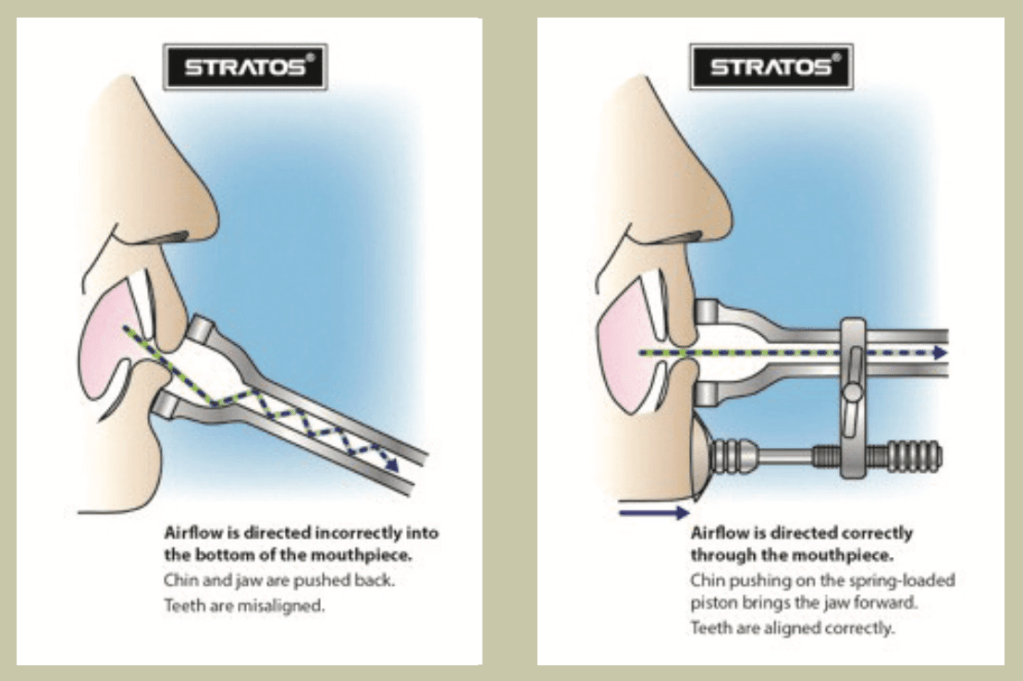
Marcus Reynolds is a clinician and lecturer for the British Association of Performing Arts, and the British Trombone Society. Also the creator of Stratos embouchure system, in this feature article (originally published in ‘Brass Band World’) he unravels more mysteries of the embouchure.
“In my last article [click here to read ‘Power over Pressure’], I explained how whistling against your palm would indicate the trajectory of the air. If the top-lip ventures over the bottom lip, then the air is directed against a metal wall – the side of the mouthpiece. When this occurs, great resistance will be felt. By trying to force the same amount of air through the instrument, the cheeks and all sorts of air cushions could start to inflate, vastly reducing the power of the original articulation.
In my previous article, I mentioned whistling or blowing out candles. This will open the teeth and allow more air to travel to the lips. Here’s a trick that keeps the corners of the lips towards the point of pitch, and keeps the cheeks in and the teeth open. Two tongued whistles and then two ‘blow the candles out’, followed by two tongued buzzes.
Practise these three exercises 20 or 30 times. It sounds laborious, but it really is a short cut to clear and powerful precise notes. I cannot see how you perform these exercises, but if you are not relaxed and there is over tension in the neck, the air will not flow. The sensation is that of blowing candles out.
Now we need to ensure that there is enough air being directed towards the aperture so the lips can vibrate most efficiently. Whistle again, or get as close as you can to the shape, keeping your facial muscles still and breathing through the nose. See if you can fit your little finger into the gap between the teeth. Most times you will not be able to because, as you strive for a greater range, the jaw can go into clenching mode, closing the aperture and stifling the air flow.
Let’s next examine the journey of the air from the back of the throat. It must travel without being choked or diverted. Take a breath and use the lips as a ‘stopper’ to inflate the cheeks. Then force your cheeks in to push out the air, but purse your lips so that the air escapes under pressure. You must practice this many times until you start to hear high-pitch squeaks escaping through the lips. These squeaks are actually unrefined notes from above the stave, whatever instrument you play. This process is used in learning to circular breathe.
This is where the Stratos will help; adjust the chin rest to its extreme setting. Keeping the airstream level as you empty your cheeks, aim those squeaks into the mouthpiece – eventually you will be rewarded with the high note clarity you were seeking. So many players start playing into the higher register without foundation.
Try this: play an octave interval well within your comfort range. Start to move upwards in semi- tones. Take your time, going up say five semi-tones, ensure no strain is felt, then go down to where you started. Place the tip of your finger between your teeth to check the gap, and then buzz through the same exercise. The buzzing won’t sound wonderful, but with perseverance the notes will sound freer and richer when you return to playing them because blood and oxygen have been delivered to the lips, and with the buzzing the capillaries and filtrum (the bit between the bottom of the nose and the top lip) are no longer being crushed.
The beauty of Stratos is that it rids students of the fear of changing their playing technique and allows you, or your mentor, to make micro-adjustments that do not hinder your playing.
Many teachers tell their students to use less pressure, but what is being offered as a substitute? Remove the scaffold too early and the building collapses in much the same way that your mouth muscles will, if the mouthpiece weight is removed too quickly. Stratos incrementally reduces the weight of the mouthpiece from the lips until the new muscle memory is self-supporting. “
SIGN UP HERE FOR NEW BLOG ARTICLES EMAILED DIRECT TO YOUR INBOX:
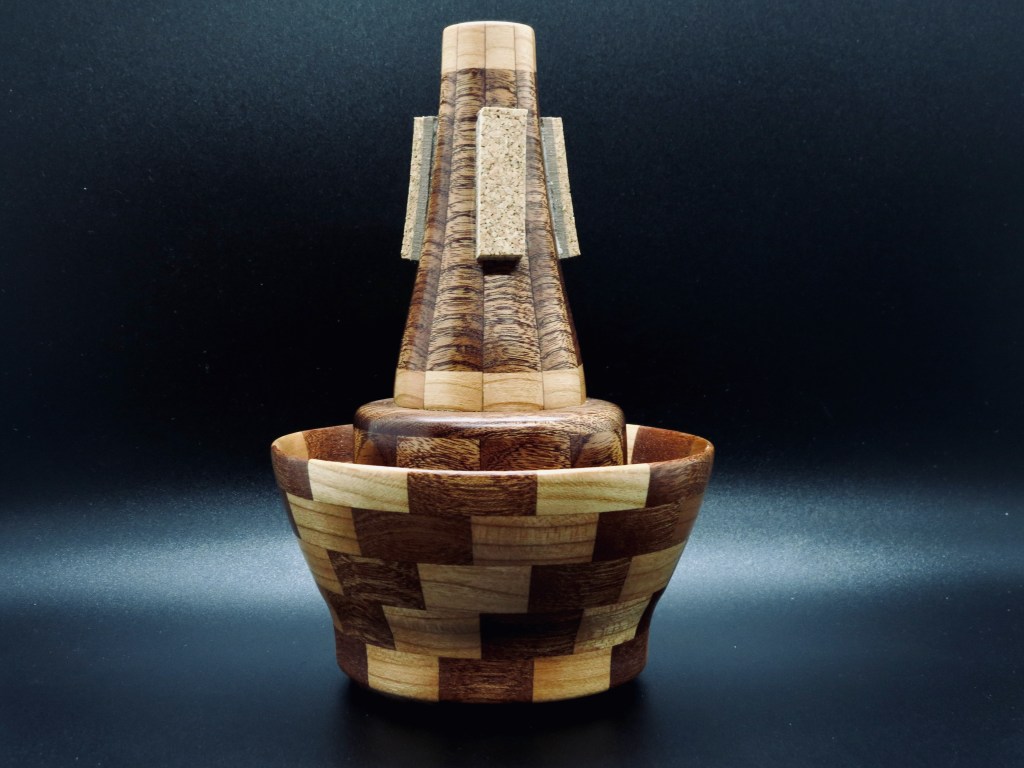
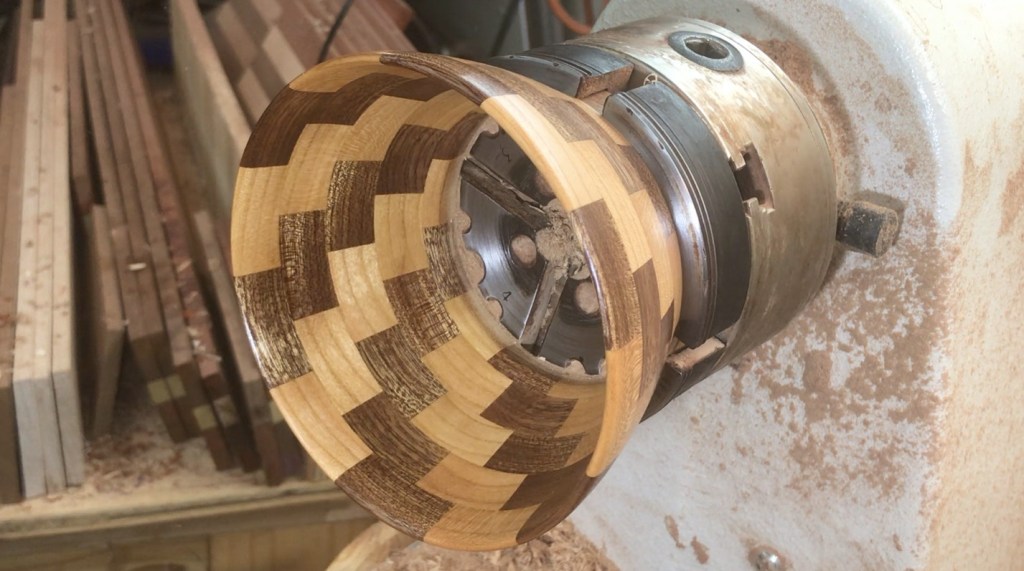
Further to my interview with Tom Clary, the master craftsman behind ‘Clary Woodmutes’ [read it here if you haven’t already!], Tom has kindly sent me a beautiful Kramer Adjustable Cup model to try out. Crafted from gorgeous Sapele and Cherry woods, this model is named after Don Kramer, one of Tom’s former teachers.
The above ‘glamour’ shot of this mute looks pretty great. But trust me, it does not do it justice! The grain of the woods, the beautiful sheen… and the smell. Heaven! As I am admiring the fantastic craftsmanship, it suddenly occurred to me that I should probably try it out, and it does not disappoint. This model has a flat cup rim, but it is also available with a scalloped rim too.
I started off with cup at full extension, and there is immediately a fantastic resonance to the sound. Of course there is the softness that you would expect from a cup mute, but there is a depth of sound that you just do not get with some of your ‘pret-a-porter’ mutes such as H&B and DW.
Sometimes we want a more enclosed sound with mellow to the max, and this is where the adjustable feature comes in. I moved it inwards to give just a 2mm gap to the rim of the bell and it is transformed. There is a lovely added resistance to give you something to blow against. Often, this is the point where the intonation could suffer, but the resonance within the body of the mute allows you to keep that core sound and good tuning alongside the softness and even smokiness that we look for. Incidentally this cup section alone is made up of over 60 individual pieces of wood.
And with the cup removed, this is a resonant and responsive straight mute. Projection is stunning and the response at both loud and soft dynamics is as even as any great mute that I have played. When sent an item for review, I try very hard to give an objective opinion on what I have been sent. And here, I promise that I have, it is just that I can genuinely only find positive things to say!
SIGN UP HERE FOR NEW BLOG ARTICLES EMAILED DIRECT TO YOUR INBOX:
Originally from Venezuela, Kissis Muñoz is now based in Miami and building a reputation for herself as a top trumpet player…
What first attracted you to the trumpet?
What made me fall in love with the trumpet was its sweet sound and also its strength.
Any early musical influences?
Yes, my dad runs a band and from there I was able to start playing music when I was 8 years old.
Favourite musicians to listen to growing up? And now?
When I was a child I liked listening to Maurice Andre, Winton Marsalis and Sergei Nakariakov, then my list of trumpeters got bigger and now I really like Francisco (Pacho) Flores, Yturvides Vilchez, Arturo Sandoval, many styles and all exceptional!
What prompted you to move from Venezuela to Miami?
Leaving aside the situation in the country of Venezuela, what has captivated me about the United States is that we are in a country of opportunities, and thank God everything is going wonderfully so far.
Any highlights of his career so far?
I have had the opportunity to be a soloist in various symphony orchestras in Venezuela in which I have performed several concerts such as Haydn, Arutunian and Vivaldi. I have made a number tours of Europe with the Teresa Carreño Symphony Orchestra of the Venezuelan Orchestra system in which we perform in important musical theatres such as the Konzerthaus in Berlin and the Vienna State Opera. I have a Bachelor of Music in Instrumental Performance from the Royal School of Music.
Here in Miami I began to live new experiences playing and recording Latin Music with different bands and artists such as Tony Succar, Oscar D ‘Leon, Luis Enrique, Raíces Jazz Big Band and finally last year I made a record with the group Make Sound in which we are all female soloists!
Tell me about the new instruments that you are playing on!
It was a lot of fun, I didn’t expect to change instruments until I played the Victory! I immediately fell in love with them, realized that these trumpets helped me to have a special sound. I tested the full range they had and I stuck with the Revelation Series. It gives me the sound I need for both classical music and other styles!
How has the past year been for you with the Covid closures? Obviously, it has been a really difficult time globally, but is there something positive or opportunities that you have been able to take advantage of?
It has been a difficult year for everyone but more so for art, we had to reinvent ourselves to continue doing what we love. In my case I took that time to finish the Make Sound album and reconnect musically with works that I had forgotten.
What interests you outside of playing the trumpet?
At this moment I am separating my mind on music and family since we have a 2 year old daughter and she always needs attention. But outside of the trumpet I love to travel and visit my friends, since they are the family that we have here.
Any advice for young aspiring trumpeters?
Although the road is long, strong and stormy we must continue, because when you look back you will realize that nothing was in vain and you will see how much you have progressed.
For further information about Kissis, please visit her social links below:
Lasse Lindgren is a multi-faceted musician, with a reputation as a great ‘lead’ trumpet player as well as a great ‘jazz’ player. In recent times, he is also responsible for the resurrection of the great Ullvén Mute brand, made famous by players such as Dizzy Gillespie and Maynard Ferguson. Lasse kindly talks to me here about all things trumpet as well as this recent project…
What first drew you to the trumpet?
That’s easy! I heard Louis Armstrong on the radio as a 5 year old boy. That totally blew my mind and made me decide to dedicate my life to playing trumpet. Then I had to wait until I was eight before I got a trumpet, and I still remember that moment as very exciting, after I had to wait for years. I also remember that I was dreaming of making that sound for so long, that when I finally got it, it was a great relief to put the mouthpiece to my lips and blow the sound I had in my head for years. I think that also made it easy for me, I got a good sound right away. I think because I was so eager and had the sound built up inside me, it just came out naturally.
Any early musical influences?
As a young boy I loved the recordings of Louis Armstrong, Glenn Miller, Harry James and the other famous BBs. My mother had an old 78rpm record player at my grandparents’ home. I used to love to sit by myself and listen to the old records – that sound made a deep impression on me.
When I was 15, my trumpet teacher played the record “Message from New Port” with Maynard Ferguson’s orchestra for me. That was another “blow my mind” experience. I loved not only MF playing, but the sound and energy of the music arrangements!! and I still do. I thought playing those high notes MF did was something you learn when you get older, that is how stupid I was))-
But of course I wanted to play the notes of MF and his “sound”, but how? No one to ask? So I had to experiment myself by my own. From age of seventeen to twenty I spend 8-10 hours a day with my trumpet, playing, thinking and trying out how to do this.
I also spent some time playing “Free Jazz/music” as a teenager, that opened my ears and mind, Lester Bowie and Art Ensemble of Chicago!
Who have been your favourite players and music to listen to?
Well, when I went to high school, I started to play with friends in a band, and we played some kind of “Jazz-rock” in the style of “Weather Report” and so on. So I broadened my view of music. Then at that time, I also started to be aware of other great Trumpet Heroes, especially in more “modern” Jazz. Artists like Dizzy, Miles Davies, Clifford Brown, Freddie Hubbard, Woody Shaw, Chet Baker, among others, but also the European players like Palle Mikkelborg, Kenny Wheeler (Canadian in UK) Tomas Stanko (I played a lot with him in Germany) and my Swedish friends and heroes Bosse Broberg, Jan Allan and Rolf Ericsson. I also loved players who were both “Lead” and “Jazz” players – Snooky Young, Benny Bailey, Booby Shew (whom I met and got informed about the Yoga Breathing from when I was 18)…
Today I still listen to them all, the old stars were the genuine originals. There are many new great trumpet players of today, but have to admit, I am not so familiar with them, although Roy Hargrove was fantastic, RIP.
It’s hard to invent the wheel again, and to me, many of the young very skilled and talented players of today, sound as though they are playing “licks” they have practiced and learned. To me, that is actually is not spontaneous soulful improvisations, more than showing that they can play the right “hip” patterns over the chord changes – rather boring to me.
It is not easy to make your own sound and style, and I think too few even try. The exception is Tim Hagans, but he is not so young anymore!!
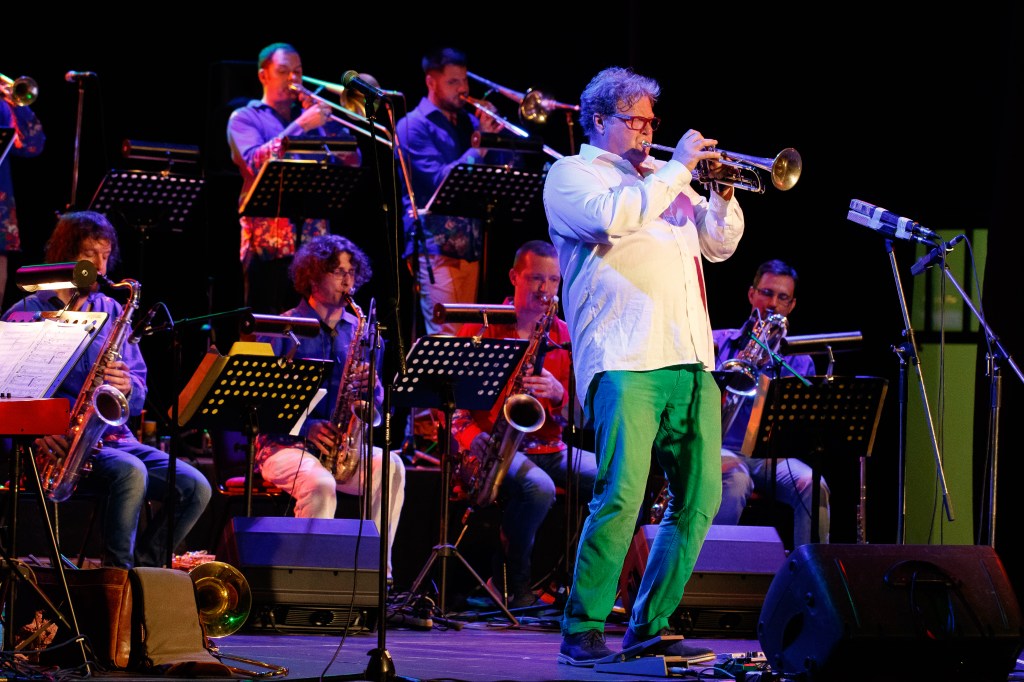
Lasse playing on one of the two Conn Connstellation trumpets that he owns, once belonging to Maynard Ferguson.
Is it a difficult skill to practise, being able to specialize in lead AND jazz? What are the particular challenges? Are there any particular routines that you follow in order to be able to achieve this?
Apart from the physical aspect of these two different ways of playing, the Lead player often has to use different equipment (not always) and play more demanding physical parts, to play with agood sound in the upper register with the endurance required. This takes a lot of work, exercises to keep up the “chops” to handle this, not everyone can do this. The Jazz player, on the other hand, meaning improvised jazz solos, has to learn how to do that… also the techniques. Scales, tunes, and how that music works, most likely Jazz players use different equipment (mouthpiece) compared to the Lead player. A good “lead” player must besides having the control of the instrument in any register, also be able to interpret music, a melodic line that you are asked to play, what the music is about, play it soulful and interesting in the style of the music.
When I play lead, I always ask the composer what the music is about or make my interpretation of the title. I always play as if I were singing the music instead of blowing the trumpet. I think a lead part or a melody also should be played like it was improvised, so it would sound fresh new and spontaneous, but at the same same time consistent the same way each time, so the other musicians can follow and trust in me and the way I play. Lead means to guide, show the way the music should be phrased for the fellow musicians, not only playing high notes. I think you must have an ability to be a leader, a strong personality, not ego, but be a steady and reliable player.
It is also a question of knowledge of style and understanding how to play different types of music. How do you learn to play good “lead”? Listen a lot, sit and play under a good “lead” player for years to get the “Know how”. The same goes for Jazz playing, listen and play with good musicians. So my conclusion is that to play good “Lead” it is good to be able to play some Jazz as well. To play good jazz, one must also be able to present an interesting melody, with respect for the song/tune, and the technique required.
So one difference between “lead” and Jazz is that a leadplayer must sound like the music is improvised but at the same time not. The jazz player should make the music fresh and spontaneous, every time to challenge other musicians and maybe be unpredictable to make it interesting.
I do have my daily routine that I do when warming up, getting my sound in all register together. It takes normally 1-1/2 hours from the first breathing exercise and buzz on the mouthpiece through scales or arpeggios from the deep pedal notes to the high register double C. After this I rest and do other duties. Later if I have time I practice music, Jazz play along records (I still do that with a record player, not with the computer, I’m too old and stupid!) or etudes or music I have to play and need to be practiced.
As well as playing in lots of great bands over the years, you have also been a band leader. When did you realise that you wanted to create music under your own direction?
I remember that I was making drawings of “my own Big Band” when I was 10, so for some reason I always wanted that!
Since I always have been interested in writing music for my band, it was natural to have a group to play my music. For some reason, even though I always loved and listened to “Jazz” old and new, as I mention before, I never hear this in my head when I compose??!! Why? I dont know. So my own music is a little different, I try to make more compositions rather than just a short melody and then the standard for soloists. This is just the way for me, so can my music be called called Jazz??
Is it possible to define what ‘jazz’ is? It is such a broad musical term isn’t it?
Well, Jazz is a name with a history, from mid 19th-century meaning spirit, energy, or courage and other things as well… “semen”… so it has a hot history I suppose! When we talk about what is Jazz today, it covers many “styles”, but for me somehow, it is a rhythm with the swing pattern played on the ride cymbal. As they say triplet groove, swinging eight notes, it is the same as Hip Hop, bebop, dixieland for me. As long as it has that “diiing diiingdidiiiing” groove played on the drums or on the cymbal, it is basic Jazz.
Then there are many other styles that has evolved from this: Free jazz with swing groove or not, Scandinavian sounds of “Jazz”, Latin Jazz… if these are Jazz? Then Funk, more composed music, Charles Mingus wrote as he said – not Jazz, he wrote “Charles Mingus”, even if he was one of the big names in “Jazz”. To me the rhythm and improvisation are important to define Jazz. When I compose it comes out more like my music, which is not so often Jazz, or any typical style. It is hard for me to define my own music which also makes it harder to sell! A lot of my music has more beat grooves or rhythms, straight -jazz eight notes, still it has the other elements in Jazz improvisation. Is it still Jazz?
Any particular career highlights that stand out?
Besides all the gigs and tours with my own groups throughout the years I have some. I did a gig with Ray Charles in Finland once. It was a mix, with a half Finnish band and half Ray Charles orchestra, at a big sports arena, 8-10,000 people. I had some solos and I remember one was 1m in front of Ray Charles. It was a very slow “Georgia” type of song, and I played kind of blusey with some long high notes in the end. I remember it was thrilling and inspiring (goosebumps) to hear Ray’s comments while he was comping me – “yeah man!!” and so on, after that I was offered a job in his band. I didn’t take it however, I already had the gig as lead player in the Danish Radio Jazz Orchestra, and also a family!
In contrast, great moments also happened in smaller situations many times. Like, on tour with my quintet in small villages far up in northern Sweden, at small Jazzclubs in front of 10 people. When some of them, after the concert, come to us with tears in their eyes and thank us for the music. Then I also feel it was a great moment, when I was able with my own music, to touch somebody to tears of joy! Another was when we made a 3 week tour all round Europe with the Danish band. Maria Schneider conducted Gil Evans music with David Sandborn as soloist. We played some of the original scores that Gil wrote for Miles Davies. It was a highlight, especially in Spain. The audience’s reaction in Seville after “Sketches of Spain”, was amazing.
Tell me about the journey bring the great Ullvén brand back to life!
Ullvén Mutes have always been “the Mutes” for me, and I grew up in the same small town of Uddevalla at the west coast of Sweden, where Mr Ullvén had his Workshop. He had also a music shop there were I naturally used to go. Besides that, my mother took care of his bookkeeping, since she worked as an accountant. Mr Gunnar Ullvén used to come home to us every Christmas with gifts, flowers to my mother and a 1 litre bottle of “Popy” Valve lubricant to me. I also remember being in his shop when Dizzy Gillespie called and needed some more mutes – and sometimes as a teenager, I went to Ullvén’s workshop and got some mutes to experiment with. So, when I was offered to take over and restart the company one year ago, it was natural for me, I feel close to this company and its great products.
But, since it has been sleeping for 20 years, it will take some time to get things going, but I do work hard and want to be able to bring these mutes and things available for brass players worldwide again.
All the old tools are still there, and the now old man, who made the mutes by Metalspinning has retired, but he taught his son how to do it, which is great – without them it would have been much harder, maybe impossible for me.
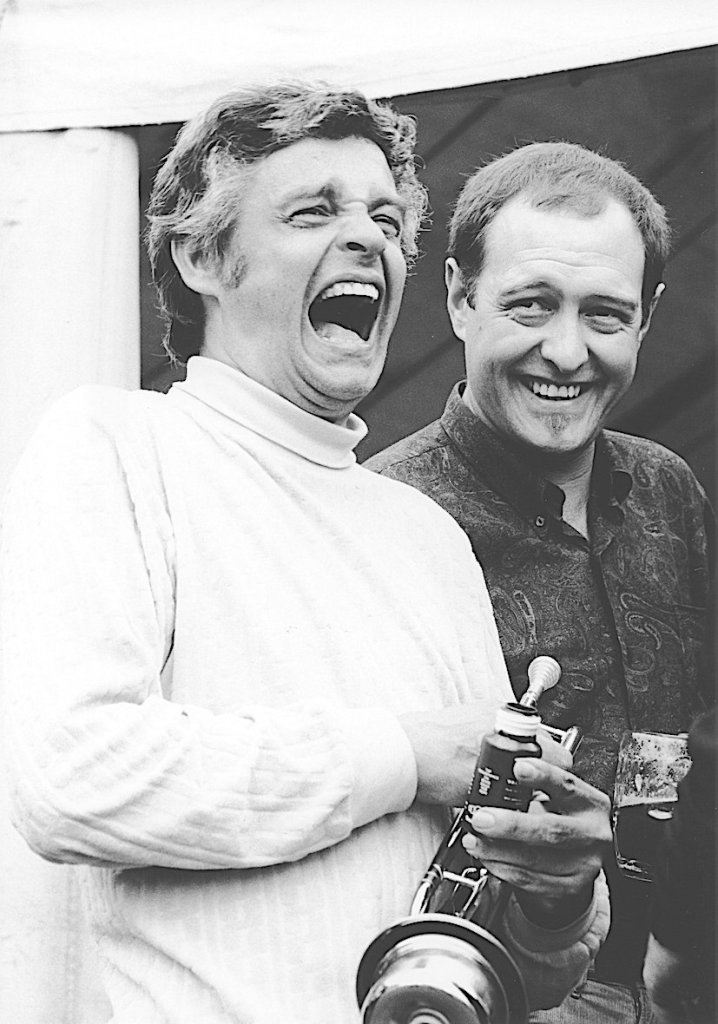
Maynard Ferguson in 1968, with his Ullvén mute and Popy valve oil!
Any particular challenges along the way?
Well, yes, to find suppliers for some of the products I need, like the special Industry felt, Cork, Labels and cardboard can’s for the the mutes. The last time they ordered these things was 25 years ago and most of the suppliers are gone so it takes time to get new contacts. Also for example, getting license to use Dizzy Gillespie’s name – Jon Faddis helped me with that!
What are your plans for the future?
Times are strange in the Era of the Corona Virus!! No gigs last year, but I stay alive with my horns by practising daily as well as possible. I’m of course using the time to get my Ullvén mutes for brass instruments on the market.
Then musically I do have things coming up later this year, but… we don’t know for sure yet.
I have done some recordings that will be out there soon I hope. Two records with the great “Latvian Radio BB”. One released 2 years ago, we should have played concerts with that in 2020, but it was cancelled. Then another with more “standard Jazz” that will also be out soon.
I also made a recording for the Scottish label “Sleepy Night Records” with my own band in Croatia/Slovenia. This is also postponed for better times, hopefully this year!! New arrangements of old “Rock and film” hits, in the style of Maynard Ferguson “Alive and Well in London”.
I have got 25 old arrangements by Slide Hampton, Don Sebesky, Mike Abene, Willie Maiden, and others. Music arranged for Maynard Fergusons Orchestra 1956-65, but never recorded. I will do that with my band here in Sweden as soon as we are allowed to.
Then, once again, I have a third project with the same great “Latvian Big Band” next year. A new album, mostly my own music, arranged by the great Michael Abene, it will be a wonderful adventure.
I will also get a new quartet together, asap, something that I have wanted to do for a long time.
SIGN UP HERE FOR NEW BLOG ARTICLES EMAILED DIRECT TO YOUR INBOX:
Wow, this blew my mind! This “No-Airflow Mouthpiece” demonstration from John Snell and Brett Kendall at Bob Reeves Brass really does make you think about efficiency and what is actually required to make a trumpet work. Enjoy…
SIGN UP HERE FOR NEW BLOG ARTICLES EMAILED DIRECT TO YOUR INBOX:
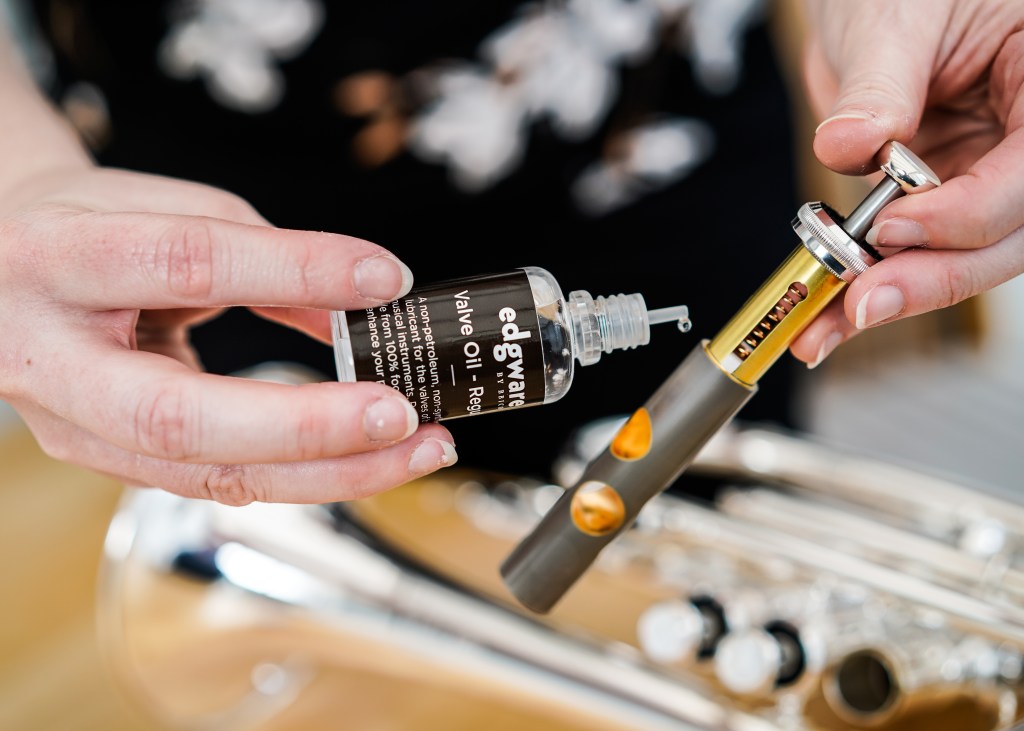
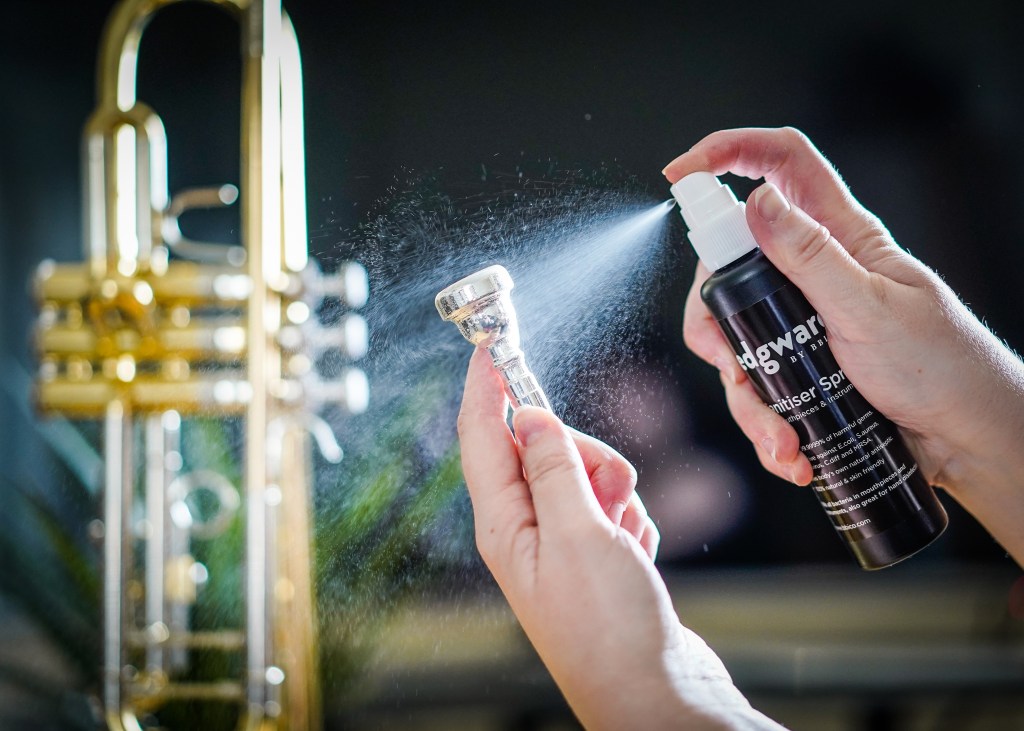
I was recently sent a range of new products to take through their paces from BBICO – the British Band Instrument Company. Their Edgware range (named after their North London home) encompasses an intriguing ethos of sustainability.
Many companies have adopted a toxin and/or petroleum free approach to their designs of cleaning products and brass instrument lubricants, but I am not aware of any others that have gone to as great lengths as BBICO to limit any negative environmental impact. As well as the utmost care in designing, sourcing and manufacturing the products themselves, the packaging is all biodegradable, compostable and recyclable. This even includes the ‘plastic’ bags that are in fact NatureFlex and made in the UK of wood-pulp from managed plantations.
As we move forward, it is surely (hopefully!) a matter of time before this kind of care and attention to packaging waste becomes mandatory across consumer industries, so the developers of the Edgware range deserve huge accolades for leading the way in this.
But of course, we need instrument care products that also do a great job… Here are a few products that really stood out to me:
Brass Soak : Just a small amount of this PH neutral soak mixed with warm water does a great job of degreasing and removing the bio-film from within the instrument and slides. I used this on an instrument that I thought to be pretty clean… but I was obviously wrong!
Valve Oil – Regular : This is a nice lightweight valve oil made from ‘food grade’ ingredients. The action on my newer instruments was nice and smooth and it is always reassuring to know that your valve oil is not poisoning you!
Valve Oil – Vintage : Now this is the oil that I have been seeking for some time! I have an old Cousenon flugel with valves that have seen better days. Until trying this Edgware oil, I had not found one that was thick enough to stay on the valves and provide adequate seal, yet flexible enough to give a smooth and consistent action.
Sanitiser Spray : This is a completely natural anti-bacterial spray, completely free from alcohol, fragrance and harmful chemicals. Particularly at the moment, this is a really important addition to any trumpet case as it can be used on skin as well as your mouthpieces!
Slide Grease : This is a great multi-purpose slide grease that does a good job around the instrument and is so safe that it can even be used as a lip balm!
Please click here to view the full range of brass instrument care products by Edgware.
SIGN UP HERE FOR NEW BLOG ARTICLES EMAILED DIRECT TO YOUR INBOX:
Established 2013 in Philadelphia by Chinese-born bass trombonist Sun He, Ultimate Brass started as a brass instrument repair studio and later became an innovative company that designs and makes brass instrument mouthpieces, trombones, trumpets, and brass instrument accessories. Ultimate Brass Mouthpieces and accessories are being used daily by members of the Chicago Symphony, Philadelphia Orchestra, New York Philharmonic, Aachen Chamber Orchestra, Singapore Symphony, Melbourne Symphony, Beijing Symphony, Shanghai Symphony, Shenzhen Symphony and many other brass musicians across the world. Sun has been kind enough to share some of his thoughts on getting all of this off the ground.
Can you talk a little about the background to getting started on this mouthpiece craftsmanship journey?
Before diving into the music world, I was a engineering student at University of Science and Technology in Beijing, in 2013. When I first move to Philadelphia, I was able to combine my technical skills and musicianship and start my own brass repair shop. At that moment I thought I would never get into the mouthpiece business, it is such a different world than building and repairing musical instruments. Around that time, I was searching for a good mouthpiece for myself, but I still had not thought to start my own project.
In 2014, a friend want me to modify a mouthpiece rim for him, eventually I did, and it was pretty successful. Around the same time, a “modified” mouthpiece can sell for a lot money in China. For example, some teachers and shops ordered stock Bach 1 1/2, drilled to #25 hole and sell to students for over $200USD. I was shocked, and I started to think about how to create a line of high quality product, and sell for a reasonable price. By the way, I still don’t understand why people are so obsessed with “modification”!.
It was Jeff Lang who finally encouraged me to get into this business, we would run into each other in the school lobby. Somehow we started to have a chat about mouthpieces, and he described how he felt about his current set up, and where he thought things could be improve. Then I started to experiment and finally created the Jeff Lang signature model for him.
Who or what were your inspirations?
Every mouthpiece maker I have ever encountered, every teacher I have studied with, and everyone I have collaborated with inspired me in some level, there are always things that I could learn from other people.
Did you set out with ideas of how manufacture could be improved?
Yes, I have a lot ideas, and I am always experimenting with new things – although sometimes the experiment can be expensive!
How do you bring other players into the design process?
I start with sit down with them for a coffee, a nice chat, learn about their personality; listen to their recordings, and recordings of their orchestra, in order to learn the sound concept. Then usually we start with a model from current product line, and tweak it to fit to the players needs.
Are there any unexpected challenges that you have met along the way?
This is a tough question. I am Chinese, and when we first started to promote Ultimate Brass products, some customers automatically connected our products with cheap price and lower quality… which is not true. And I remember when the first time at an exhibition, a customer came to our booth, asked : “What are these copied from?”, I said: “Excuse me? what do you mean?”. He said: ”You are Chinese, right? Everything from Chinese makers is a copy of something.” Then he pointed at another booth of a Chinese “Trombone Maker” and said: ”Look at their beautiful knock off.”
We have closely collaborated with many great brass musicians over the past few years, some of the models took over 2 years of R&D, just to get the product perfect. I wish I could just snap my finger and copy something, and make our artist happy. I could save a lot of time and money in the process!
Running a successful manufacture business takes a lot of time and commitment. How do you balance this with having a life outside of the workshop?
I work on other projects to rest from one project, always keep everything fresh. The most important thing is that you need to know when and where to stop.
Plans and ambitions for the future?
I have a lot other interests, mainly because I want to try out as interesting stuff as possible in a limited life time!
What are you looking forward to post-COVID?
I love to eat, the first thing I do when I arrive in a new place, is to open the local gourmet app, of course I’ll do my homework before arrival.
SIGN UP HERE FOR NEW BLOG ARTICLES EMAILED DIRECT TO YOUR INBOX:
Principal Trumpet with Sinfonieorchester Basel since 2009 having previously held the same post at La Scala, Immanuel Richter has built a reputation for both versatility and virtuosity. He talks to me here about all things trumpet!…
What got you started playing the trumpet?
In my little village in the east of Switzerland, there was a trumpet teacher who formed a trumpet ensemble, consisting of at least 20 trumpet players of all levels. They performed sometimes in the church or at some local concerts – I wanted to be part of it. So my Mum contacted the trumpet teacher and I got my first trumpet lessons with him and was a member of his trumpet ensemble quite soon. I started at the age of 7 and took lessons with him for ten years in a row. My early musical influences were for sure the LP’s of my father. He was no musician, nor my mother, but my father was very fond of classical music. So he had some old recordings of Beethoven Violin concerto (with Wolfgang Schneiderhahn), all the Tschaikowsky Symphonies with Karajan and Berlin Phil and some more, not very much, but very precious. And he always said, that if I want to listen to them, I have to sit on the sofa, keep quite and listen carefully. It was like a holy act to put the record on, and than we both listened to the whole piece in silence. It was a very special moment I remember very well. On the trumpet I was very much attracted by Maurice André, I had almost all his recordings (still have them!) and was a real fan of him. When he played in Zurich or somewhere else in Switzerland, I was in the public.
What styles and genres of music were you into as a child?
At the beginning I listened to almost nothing else other than classical music. From Baroque to Tomasi and Jolivet, but I was not attracted very much by the music that most of my classmates were listening to. Growing up I enjoyed – beside the classical music – also very much some pop-legends like Elton John, Joe Cocker, Rod Steward, Barbara Streisand etc. and I still do… My interest for Jazz music has never been very big, but in the last 15 years, due to my dear friend and colleague in the Basel Symphony Orchestra Marc Ullrich (a outstanding trumpet player both in jazz and classical music), my interest in Jazz increased step by step.
And now? Who are your biggest influences?
Today I take my inspiration mostly not from brass players, but from my “spiritual mentors“ like Andras Schiff, Nikolaus Harnoncourt, Claudio Abbado etc. I listen to a lot of youtube-masterclasses (almost every day…), also violin-masterclasses for example with Augustin Hadelich, and I get so many good ideas out of it, ideas, that are very useful to my trumpet playing and my music-making in general. I often think like a violin-player when I play the trumpet. On the violin, all the technical aspects are so visible, which helps to adapt it on the trumpet, whereas most of the technical aspects of trumpet playing are internal (breathing, tongue, throat etc.). And Andras Schiff is just a big source of inspiration, and his huge and profound knowledge about so many different styles (Bach, Schubert, Schumann, Bartok etc.) is just incredible and so fascinating. I adore him.
When did you realise that you wanted to play the trumpet for a career?
I think it was during grammar school, so maybe between 13 and 17. I always played the piano and the trumpet, but in this period I discovered that my potential for the trumpet was bigger and that playing in a big orchestra would be my dream-job.
Do you have set, regular practice routines that work for you? Do these play a big part when you are teaching too?
This is a large topic. But shortly: my warm-ups are almost the same, every day. And always on the same trumpet. Then, the days can be very different, depending on what the schedule is. In general I try to work always with a good plan, so that I know precisely, what I’m going to to and also why. I divide my working day in 4 parts: first part is always like a concert. Playing through some pieces without interrupting, in order to work on the “concert mode“. Second part are the corrections of the first part. 3rd part is devoted to the new pieces I have/want to learn and on the 4th part, I focus on basic technique but I do these “technical drills“ like scales, arpeggios etc. always in relation to the pieces I have to play. So I invent my own exercises for the pieces. I do not play proper Clarke or proper Arban any more, but I take their ideas and adapt them to the music I have to play. And as I got some good results with this working plan for myself I share these ideas also with my students.
What advice can you offer to aspiring young players, just hopefully starting out on a professional career?
Keep working, be honest to others and especially to yourself and always try to enjoy what you are doing.
Immanuel plays on the model 3 ML, 3, 105 on both Bb and C trumpet. Click on the image above to find out more.
Can you talk a little about the your relationship with Frate Precision and the process of selecting your mouthpieces?
I met Dario first time in Italy during a masterclass I gave at the Milan conservatory. It was actually my dear friend Massimo Longhi (principal trumpet in Verona) who introduced me to him. I tried some of his mouthpieces in Milan and the first feeling was so good that instantly I took one mouthpiece of his big selection at home. Later on I invited Dario to Lucerne to make a little seminar about mouthpieces with my trumpet class at the Musikhochschule in Luzern. And as usually I tried other types and finally I have now quite a number of Frate mouthpieces where I really feel comfortable with. I think the mouthpiece is the most personal part of the material (much more important than the trumpet itself). So what is good for me can be very bad for an other player and vice versa. I choose a mouthpiece according to different aspects, but the most important for me are: response, sound, intonation, range. I play different types of mouthpieces, not only Frate, but for example my last CD with music for piccolo trumpet (“at the peak“, you find it on Spotify) I played all the pieces with the same Frate mouthpiece. I never was so comfortable on Piccolo before I discovered this mouthpiece. Thanks Dario!!!
How has the COVID lockdown affected you and your work? Have there been any positives that you can take at all from this?
Well, I must confess that I really enjoyed this time. For sure it’s hard, that there were no concerts at all, no public etc. But I’m already 46 years old, I played a lot of concerts, so for me this time was much more like a gift. It was a sabbatical, where I could enjoy my big familiy. It was so great to stay with my wife and the 4 children, to have time to spend together, to do things we could not do before etc. The same is true for my trumpet playing. I had so much time that I could focus much more on the music, on the trumpet. And at the end, I decided to record some of the music I was practicing during lockdown for youtube. In June, I recorded 14 different pieces, in 11 hours on 3 days, all played from memory. It was like to run a marathon on the trumpet and I wanted to find out if I can do it. Now I’m quite happy with the result and you can find it on YouTube on my personal channel, if you are interested.
What are your plans and ambitions for the future?
I’m always driven to become a better trumpet player, a better musician, a better teacher. I hope that this internal energy will never end. The more I learn the more I have the feeling there’s even more to learn. And I hope this experience will last for ever because it keeps me alive, young and fresh, despite of all the inconveniences live may bring to me in the future.
Ken Saul is the founder of Ultra-Pure Oils LLC, and talks to us here about getting started with creating his first valve oil product and how that has developed in to the extensive range that we see today.
Can you give a little of your background and your relationship with the trumpet.
I started the trumpet when I was 10 years old as part of our public school band program. Trombone was actually my first choice, but my arm was short and my older brother already played the trombone, so trumpet became my second choice. My main trumpet teacher in high school and college was Joe Alessi, Sr., the father of the famous trombone player of the New York Philharmonic. We were so fortunate to have Mr. Alessi in our town. He was formerly with the Metropolitan Opera Orchestra and a student of William Vacchiano, Harry Glantz, and Max Schlossberg. So Mr. Alessi’s students all got great training on trumpet fundamentals (lots of Arban, Schlossberg, Clarke, etc.). After receiving my college degree in music performance, I went on to study electrical engineering, which had always been my hobby. Even though I had a 30 year career in high tech as an electrical engineer, I never stopped playing the trumpet, and have been principal trumpet in our local university symphony for over 20 years. You can hear me on my YouTube channel .
What led you to start Ultra Pure Oils?
When my son was about 3 years old, he was digging around my trumpet case and I remembered that the bottle of valve oil was hazardous and to be kept away from children. I started looking around for a good valve oil that was not so smelly or hazardous, and was not able to find anything at that time (1990). I was familiar with synthetic oils from my day job, and began to blend oils to produce a good valve oil for trumpet. At that time, it was just a hobby, but I found it to be interesting and rewarding.
What were the first products that you launched and why?
The first product was just a good valve oil. At that time, we really only had kerosene-based valve oils, and these smelled bad and would evaporate quickly. Some even left residues behind which would gum up the valves if not cleaned constantly. I intended Ultra-Pure Professional valve oil to be odorless, long-lasting, super smooth feeling, and to leave no residues behind.
What was the R&D process like for your products? Did you get other people/players involved?
I am trained in design of experiments, statistics, and material science, so I definitely approached product development from an engineer’s perspective. After I was pretty happy with the valve oil, I sent it around to many of my friends and got feedback from them to make any fine adjustments. I began selling it through an ad in the ITG Journal. Remember, this was before the internet was invented! Mostly it sold to people I knew, and it grew slowly by word-of-mouth. In the year 2000, Dave Monette began using Ultra-Pure valve oil on his fine instruments and word spread more quickly about our product and we added a few retail dealers. We then added regular and light tuning slide greases.
Have there been any unexpected challenges along the way?
Keeping oil in the bottle and not leaking in shipment is a definite challenge that every valve oil company has faced. It is difficult to tighten the caps properly by hand, and we gradually added power equipment and automation to properly seal and tighten caps. We have also had to meet all the regulatory challenges involving types of bottles and caps, labeling, and warnings that are required of all consumer products that are light viscosity oils, even if they are food-safe and generally harmless. The most recent challenge was during this COVID pandemic, most of the bottle makers changed their factories over to making only bottles for hand sanitizers, hand soap, and other essential health needs. The bottles we needed took many months to procure instead of the usual few weeks. Fortunately, we did not run out of bottles, but we did have to ship oils in some unusual bottles as a stop-gap measure.
How do you balance running UP with having a life outside of work?!
This is a great question! Ultra-Pure Oils began growing organically, but gradually began consuming all my nights and weekends. Right at the point that it was clear that Ultra-Pure Oils was bringing in enough income on its own, I was offered an early retirement incentive from my employer and jumped at the opportunity. That was nine years ago, and our business has blossomed since my “retirement”. We finally had time to find excellent distributors all around the globe and started working with many instrument makers to provide their private label lubricants. Working for myself in our home workshop is incredibly rewarding and leaves me time to get out for a good walk everyday, practise trumpet, and enjoy gardening.
Any plans or new developments for the future?
We now offer a full line of lubricants for every instrument, including valve oils, rotary oils, trombone slide lube, tuning slide oils and greases, and excellent care kits for brassesand woodwinds. I look forward to travelling to more to trade shows and festivals when we are able to do so again, and to meet many of our customers and dealers.
Contains information related to marketing campaigns of the user. These are shared with Google AdWords / Google Ads when the Google Ads and Google Analytics accounts are linked together.
90 days
__utma
ID used to identify users and sessions
2 years after last activity
__utmt
Used to monitor number of Google Analytics server requests
10 minutes
__utmb
Used to distinguish new sessions and visits. This cookie is set when the GA.js javascript library is loaded and there is no existing __utmb cookie. The cookie is updated every time data is sent to the Google Analytics server.
30 minutes after last activity
__utmc
Used only with old Urchin versions of Google Analytics and not with GA.js. Was used to distinguish between new sessions and visits at the end of a session.
End of session (browser)
__utmz
Contains information about the traffic source or campaign that directed user to the website. The cookie is set when the GA.js javascript is loaded and updated when data is sent to the Google Anaytics server
6 months after last activity
__utmv
Contains custom information set by the web developer via the _setCustomVar method in Google Analytics. This cookie is updated every time new data is sent to the Google Analytics server.
2 years after last activity
__utmx
Used to determine whether a user is included in an A / B or Multivariate test.
18 months
_ga
ID used to identify users
2 years
_gali
Used by Google Analytics to determine which links on a page are being clicked
30 seconds
_ga_
ID used to identify users
2 years
_gid
ID used to identify users for 24 hours after last activity
24 hours
_gat
Used to monitor number of Google Analytics server requests when using Google Tag Manager