Advice · Education · Gear Review

Music Stand Lighting and Your Eyes

Headaches, eye fatigue, or stiff neck or shoulder? It might be your music stand lighting.

Music Stand Lighting and Your Eyes

by Alan Medak

Why is stand lighting so important? People play music because they love it. When you have good stand lighting, you don’t give it a thought, and if you are under 40 years of age, you can probably read music by candlelight. But by the time you reach 40, your eyes begin to change, and if you don’t have good stand lighting, there are all kinds of problems that can ensue. The over-arching problem of bad lighting is that it gets in the way of your ability to read the notes and can lessen the enjoyment of making music. But bad lighting can also lead to other physical problems. Below are the basics of what good music-stand lighting should have, followed by the seemingly unrelated problems that you might be experiencing in its absence. 

The three “Cs” of good music stand lighting are:

  1. Coverage—Good stand lighting provides even illumination, top to bottom and side to side. Many lights provide a hot spot of light either along the top or top/center of the music. If editors only put the important notes at the top center of the page this might not matter, but important notes are located all over the music. Therefore, good stand lighting should provide even illumination over the entire page(s).
  2. Contrasts—Contrasts make it easier to see the notes. Contrasts are the perceived difference between the light-colored background (white or yellow paper) and the black notes. If there is too little (or low) brightness, the lighting doesn’t create enough reflection off the white or yellow background. This is a form of low contrast where the black notes become hard to distinguish. Too much brightness also results in low contrast, this time because the background reflects so much light that it can overwhelm the black notes. This problem of too much reflected light on the music is referred to as glare. Too much surrounding light can also disrupt contrasts.
  3. Color—During the 1980s, US Government scientists at their Lawrence Berkeley Laboratory discovered that certain color temperatures (measured as Kelvin temperature) could activate more nerve receptors in the eye, thereby increasing visual recognition (e.g., notes on sheet music). Imagine using a light meter to measure light levels on the music. At color temperatures similar to what you might have at home (2700 Kelvin) or in your office (4100 Kelvin), the notes look ok. Now imagine the identical light levels, but now you are seeing the notes with almost twice as many nerve endings in the eye. Does that sound crazy? That’s what happens when a good stand light raises the Kelvin temperature at or above 5000 Kelvin. You are now looking at the exact same music, at the exact same light level but with almost twice the number of optical nerve endings. Your eye perceives the notes as being significantly brighter and with better contrasts. The notes almost appear to jump off the page. 

Furthermore, the absence of good music-stand lighting, (good coverage, contrasts, and color), can cause optical conflict. Optical conflicts from poor music stand lighting are common. The most dramatic example of optical conflicts which we have all experienced are, for example, when leaving a darkened movie theater after a matinee and stepping outside on a bright sunny day. To say that this causes extreme discomfort is an under-statement. The bright light often causes us to squint or shield our eyes. Fortunately, this discomfort will pass in a few minutes as the eye adjusts to the brighter outdoor lighting conditions. While not as dramatic as leaving a matinee, optical conflicts and discomfort caused by poor music-stand lighting don’t go away in a few minutes but persist, usually as long as the concert performance or rehearsal lasts which is typically 2-3 hours, or even longer if you have a rehearsal prior to the concert performance or are playing a Wagner opera. 

A music-stand-related optical conflict usually occurs when the brain forces the eye to focus on and read the notes in spite of brightness that is too high or more often, too low. Another type of optical conflict is caused by light sources which are not on the music page, such as stage spotlights or reflections from a shiny metal folding stand. Remember that example from the dark theater, where the iris and pupil adjust for your best night vision but are not prepared for the bright sun? Well in the situation of spotlights or reflections, a similar condition is occurring. When trying to read notes, the iris opens wide and your pupil adjusts for the best visual acuity of the brightness on the music. However, if at the same time you are trying to read notes on a page and a bright light shines into the eye, it causes those same dynamic eye components to want to close and protect themselves from bright and damaging light. Which inclination wins, open or closed optical adjustment? Usually neither force completely wins and instead there is persistent optical conflict.

One final cause of optical strain is visual acrobatics. If the view above the stand is blocked, either by a stand extension or large lamp, the eye must travel further from the music to see the conductor or other musicians. The span of distance between the notes you are reading and the view above the stand becomes greater as you get closer to the bottom of the page. This shift is further complicated because we are not only shifting our focus up and down but going from near to far vision. Even at a slow pace, refocusing causes discomfort after only a few of these shifts. (Also, our peripheral vision is much better side to side than up and down). 

Many musicians experience physical discomfort when playing. In fact, many musicians who I’ve spoken to are so used to these aches and pains they simply accept them as part of playing.  What they didn’t realize was that some of these physical problems were symptoms associated with optical conflict. Headaches and eyestrain are the most obvious problems, often growing in intensity during the second half of a rehearsal or performance. But persistent optical conflict can lead to other migrating pains which are seemingly unrelated to stand lighting. Migrating pain originating from optical conflict can cause pain in the neck, shoulders, lower back, and even extremities, arms, and legs.  Over the years, I’ve heard numerous comments about one or another physical discomfort “miraculously” going away after changing their lighting. After changing her stand light, one pit musician touring with “Phantom of the Opera” had pain-free performances for the first time in years. A busy Los Angeles bassoonist felt relief from shoulder and neck pain after changing her lighting. And while ergonomics and performance stress are important issues in their own right, don’t under-estimate the quiet contribution of poor music-stand lighting. 

In conclusion, whether by improving your note recognition, eliminating optical conflicts and stress, or reducing physical discomfort, good stand lighting will enhance your enjoyment of playing music. Find the right light and get back to enjoying the music.

Alan Medak – besides playing horn and conducting opera, Alan Medak has spent over 35 years as a lighting executive, has written numerous articles on, and taught about emerging lighting technologies. Alan founded Lampcraft in 1998, a company that is dedicated to designing and manufacturing effective portable music stand lighting.


SIGN UP HERE FOR NEW BLOG ARTICLES EMAILED DIRECT TO YOUR INBOX:

[jetpack_subscription_form show_subscribers_total=”false” button_on_newline=”false” custom_font_size=”16px” custom_border_radius=”0″ custom_border_weight=”1″ custom_padding=”15″ custom_spacing=”10″ submit_button_classes=”” email_field_classes=”” show_only_email_and_button=”true”]

Advice · Interview

Trumpet Artist Profile : Alessandro Silvestro

First trumpet with the Philharmonic Orchestra of Calabria (Italy) and Frate Precision artist Alessandro Silvestro kindly shares some thoughts and experiences with us!:

What first drew you to the trumpet?

I was in the fourth grade when my teacher asked a classmate to bring his trumpet in to play it in front of the whole class. It was the perfect day day for me! I immediately fell in love with this instrument. After a few days, in my small mountain village (Acri – Italy) it was a day of village celebration – I saw the band playing in the streets of the village, and I told my parents that I also wanted to join that band.

I enrolled at the age of 8 in the music course, which the Calabria Region organised every year in collaboration with the band. My first teacher was a clarinetist, it was unusual to have an instrument teacher other than the one I fell in love with and want to learn. I did my musical studies, and after the duration of the course he told me that I had talent and why not try to face a more professional and demanding study? I continued my musical studies and then in 1986 I made the admission to the Conservatory of Music of Cosenza. I attended until 1990 when I met at a masterclass in Palmi (RC) – Italy, my teacher Sandro Verzari, First trumpet of the RAI Symphony Orchestra of Rome and teacher of the Conservatory of Music “A. Casella” of L’Aquila. I moved to him to continue my final studies until graduation. I continued to study with him to prepare myself for a future as a musician and began to participate in various auditions and competitions in Italian orchestras.

Who or what were your first musical influences?

I do not come from a family of musicians, so, until I entered the musical field, I did not realize what the world of music was. My first real musical world was the period of study in the Conservatory, I remember that my first Maestro, Mauro Marcaccio, he gave me cassette tapes of Maurice André. I bought my first vinyl record by Maurice André – this was really influential and I remember that I really wanted to play like him, it was my primary goal! It was my dream, I played with the vinyl almost every day with the trumpet having fun. It was Torelli’s concerto, Viviani’s sonata, Vivaldi’s concerto for two trumpets. In short, I tried to imitate him, at least I tried.

There was also another great influence in the 90s, Canadian Brass. I bought their CD and listened to it over and over. After that CD I immediately formed a brass quintet with the other study and class friends of the conservatory, we enjoyed playing together with the desire to grow so much and learn many other musical things, in addition to the usual class studies in the conservatory doing our first concerts.  Other trumpeters who have influenced my musical path a lot were Timofei Dokshizer, Guy Touvron and Wynton Marsalis.

Do you have special practice regimes? Does this change a lot depending on whether you are performing different styles of repertoire?

I have no special regimes, my study day is always the same. I always divide it by studying with the different trumpet models (Bb, C and Eb Trumpet). I like to vary my routine also so as not to get used to the usual study especially when it comes to technique.

I go in search of new stimuli of new techniques and new styles. I am curious about the technique of other instruments in addition to mine to see how they are structured. This helps me to grow both the musical side and the search for new things and experiment with them on the trumpet.

Obviously based on what I have to play I try to concentrate the study and the right technique for the repertoire to do, then the preparation is subjective for each of us, I change a little bit but I do not distort it in the most absolute way, I also believe that it changes according to the different style of playing.

What do you think are the most important elements of music and trumpet playing that young musicians should focus on?

There are quite a few important elements, the music itself is already the most important thing. First of all, beautiful sound and good intonation. These two factors, are the two most important things that a professional musician or young musician must build.

I believe that building a good foundation is the hardest and most important job. I divide study and preparation into three parts: the first part concerns sound, breathing and control; the second part concerns a whole part where we study the coordination of flexibility, intervals, finger technique, scales in all tones both major and minor. The third and final part is the repertoire.

Can you tell us a bit about your Frate Precision mouthpieces?

I became aware of the Frate mouthpieces when I tried one from the authorized dealer in Gragnano (Naples) – Italy, I immediately realised that it was a truly exceptional product. I bought one based on the characteristics of other mouthpieces I use. After studying it and playing it in the orchestra I realised that it was what I had been looking for a long time! I was immediately struck by the precision of the intonation – very defined and easy on flexibility. It also blends well with the other orchestral instruments, but the thing that struck me most is the projection of the sound in addition to the homogeneity it has on the whole register.

In April I recorded my latest work with the record label Movimento Classical with the “MaSiFuLa Quartet” with the 5+M,6,105 Frate Precision mouthpiece.

What are some career highlights to date?

At the age of 16, I had my first master-class with Sandro Verzari, and I performed the Concertpiece Op.12 by W. Brandt. It was my first experience on a big stage, from that performance I understood that you had to sweat 7 shirts if you wanted to pursue a professional career! I started at the age of 18, doing auditions, competitions and also orchestral experiences as first trumpet and in the section, at the Regional Orchestra of Lazio. I then did the T.I.M International Music Tournament and won the first prize. Immediately after I did other auditions such as the National Symphony Orchestra of the RAI of Turin, the Teatro Regio of Turin, the Teatro San Carlo in Naples, the Teatro dell’Opera in Rome, the ORT Orchestra Regionale Toscana where I stayed for almost three years as first trumpet, the Teatro Massimo in Palermo, with the Sicilian Symphony Orchestra where here too I held the role of first trumpet for three years, with the Solisti Aquilani, Orchestra Sinfonica Abruzzese, Chamber Orchestra Officina Musicale di L’aquila, Orchestra città aperta di l’Aquila where I recorded some soundtracks from Film such as Salvo d’acquisto, the boys of via Pal and Ginostra.

Currently I hold the role of first trumpet with the Philharmonic Orchestra of Calabria, with the MaSiFuLa Quartet and I am a professor at the Conservatory of Music “Giuseppe Martucci” of Salerno – Italy.

Like many artists, I imagine that your work has been severely affected by the pandemic? How did you keep yourself playing at a high level and getting back (hopefully) to being much busier now?

Like many of us the pandemic has been devastating, even in other sectors, especially ours, we found ourselves from the stage that was everyday life, to be closed in four walls of the house without being able to live normal life. In addition to the magic of music and theatre, at the beginning I did not really know where to start. It was really difficult, in the end I said to myself, you have to do something to pass this bad nightmare. With colleagues we recorded videos such as the concert in D minor by A. Marcello, the first half “Andante e Spiccato”, other videos with the quartet MaSiFuLa and published on various social networks, YouTube, Facebook, Instagram.

in addition to having recorded in December 2020 with MaSiFuLa Quartet, our first CD, in the immediacy in April 2021 we prepared and recorded the second CD with the record label Movimento Classical.

Can you tell us about the MaSiFuLa Quartet?

The MaSiFuLa Quartet was formed in May 2020, to date we have completed two recorded works. We are already thinking about the third with music by G. Gershwin, L. Bernstein and we are trying to organize the next future concerts. You can listen to the two CDs on YouTube and on Spotify.

What advice do you have for aspiring young musicians?

From my experience as a professional musician and as a teacher all these years, I advise future aspiring young musicians to work hard, but above all to set the right goal and achieve it with the utmost stubbornness, dedication, conviction, tenacity, preparation and face everything always with conscience!


SIGN UP HERE FOR NEW BLOG ARTICLES EMAILED DIRECT TO YOUR INBOX:

[jetpack_subscription_form show_subscribers_total=”false” button_on_newline=”false” custom_font_size=”16px” custom_border_radius=”0″ custom_border_weight=”1″ custom_padding=”15″ custom_spacing=”10″ submit_button_classes=”” email_field_classes=”” show_only_email_and_button=”true”]

Education · Gear Review

Faxx : Mute Review

The Faxx brand may already be known to many of you. It has a reputation for reliable accessories at a reasonable price. I have recommended the Faxx mouthpieces to young students for many years as they offer comfort and quality at a price point that is appealing to parents! However I was yet to try any of their mutes until I was sent a box by American Way Marketing who own the Faxx brand.

Here is a run down on the box’s contents!…

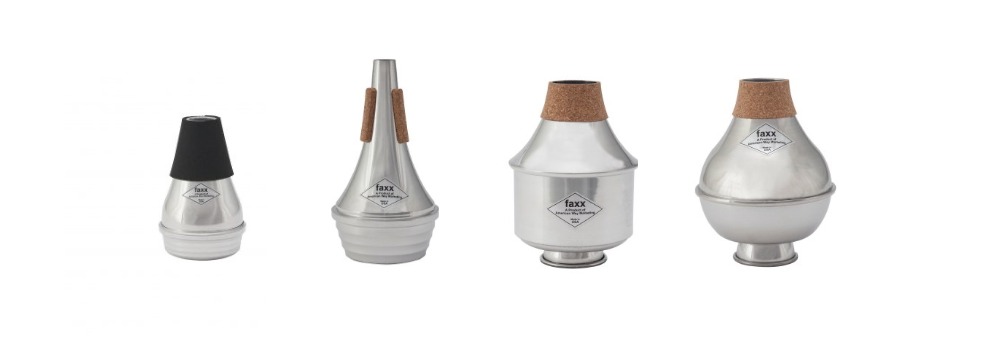
Compact Aluminium Practice Mute

I own quite a few practice mutes and must have tried dozens of them over the years. Each one requires you to make a compromise in some way. I have a favourite mute for playing as softly as possible so that it is barely audible – it is super quiet but the intonation is tough down low. I have another for general practice where I want good tuning and response – it is however too loud for some sneaky blowing at the side of the stage where you don’t want to be heard. This Compact Aluminium Practice Mute from Faxx is brilliant for travelling. It is small enough to store in the bell of the horn without taking up additional space in the case, but it also blows surprisingly well.

The intonation is even across the range and although quite a resistant mute, still allows you to blow in an honest way rather than constantly over-blowing. I like this mute. It is reassuringly robust, clearly well-designed and made and retailing at around $45, gives you the value that you would expect from Faxx.

Aluminium Straight Mute

This is a well-made, sturdy all aluminium mute with great corks. We often underestimate the importance of good corks to the fit in the bell as well as the overall sound. This model is also available with a copper bottom as well as in all copper.

The blow is responsive at quiet dynamics as well as having a lots of lovely bright overtones when playing forte. There is also a really satisfying ‘bite’ to the attack at stronger dynamics, while still keeping the core of the sound. These make a really great addition to any pro orchestral section, but at a price point to suit students and pros alike – around $40!

Aluminium Harmon Mute

There are a number of Harmon style mutes in the Faxx range. This traditional long body mute, a short bodied harmon, and also the bubble style harmon that is reviewed below. All of these are available in both aluminium and copper, and you will now not be surprised to learn that they sell at a fraction of the cost of many of the other brands!

This traditional harmon mute, like the straight and practice mutes above, is well-made, sturdy and fits a variety of bell flares very well. With tube out, it is easy to achieve that smoke jazz club sound and responds particularly well with close miking. With tube in it is a completely different beast! The volume and projection are exceptional and makes a great wah-wah!

Aluminium Bubble Harmon Mute

Until now, I had never really given much thought to how the body shape affects the sound. The difference between this and the model above is huge. Even with tube out, this is an incredible resonant mute, so much so that you can feel the vibrations coming back through your hands while playing. Projection is great and it compares really favourably with my normal aluminium bubble mute from another more expensive brand!

These great value and great performing mutes are now commonly available across the UK, the USA and farther afield in most good music stores. I strongly recommend that you give them a try – these are far more than just student mutes!

To find more information on the full Faxx range and also where you can find a dealer near you, please visit American Way Marketing.


SIGN UP HERE FOR NEW BLOG ARTICLES EMAILED DIRECT TO YOUR INBOX:

[jetpack_subscription_form show_subscribers_total=”false” button_on_newline=”false” custom_font_size=”16px” custom_border_radius=”0″ custom_border_weight=”1″ custom_padding=”15″ custom_spacing=”10″ submit_button_classes=”” email_field_classes=”” show_only_email_and_button=”true”]

Gear Review · Interview

Trumpet Artist Profile : Alexandre Herichon

Alexandre Herichon is an eclectic musician, at home playing lead trumpet, improvising, and as a composer/arranger. He shares some trumpeting thoughts as well his experience with his new Agami trumpet.

What first drew you to the trumpeting the early days?

My parents listened to jazz music when I was a kid, and we saw, sometimes, some jazz bands with horn players, so I think it impacted me, but I can’t say why the trumpet, specifically. One thing is shure, I never quit, even in the hard times, since I began, when I was 10. 

Who or what were your early musical influences?

My teachers of course, who gave me the passion of music, the older musician in the music school orchestras and at the early beginning, the fact to play at church with my family. After came the big names and the jazz records. 

Do you have any particular practice regimes? Does this change a lot depending on whether you are doing more lead playing, or jazz, or funk for instance?

Yes, it changes sometimes, and especially depending on what I have to play. The most important for me is my flexibility. So, I always do tongue flexibility exercices to be shure I’m easy with it. Notice that I say, “tongue”, not lips! I do like a kind of whistle and my lips respond to it naturally. Then, if I’m more on a jazz/improvisation gig, I’ll work the most fingering and harmonic exercises on all the range. If I’m on a lead gig, I’ll work some muscles exercises, like Caruso, and be shure to hit the high notes perfectly. 

What do you think are the most important elements of music and trumpet playing that young players should focus on?

Regarding the trumpet playing, the two most important basics are, the air and the tongue position in the mouth. For the music, you can do the kind of music you like and want, but, in all case, do it seriously, spending a lot of time on details and trying to reach perfection. Play all time at 100% trying to make the band or the orchestra sounds greater as possible. Always be invested in the music and it will gives back to you.

Can you talk a little about your Agami trumpet, why you play it, and the process of selecting it?

Agami trumpet are great horns, really! Love it!I first saw pictures on Instagram (go follow him-> agami_music_france 😉) and said to myself “wow, those horns are beautiful!” So Thierry Sohier (from Agami) contacted me to organize a meeting and invited me to try the trumpets. I directly felt good playing it. Easy, great sound, warm on the low range and bright on the upper register, polyvalent. Anyway, all a trumpet should have as qualities. I tested it some months, on many different gigs and adopted it. I feel I can do what I want on this trumpet!

What are some career highlights to date?

I had and still have the chance to play with many great bands and artists around the world, Electro Deluxe in Japan, No Jazz in India, Etienne M’Bappé in South Corea, Panam Panic in Marocco, Big Funk Brass, Ben l’Oncle Soul and more!

Like many artists, I guess that your work has been badly affected by the pandemic? How have you found keeping up the playing to a high level, and getting back to (hopefully) being much busier now?

Yes it was a strange periode… But I have the chance to be a teacher in jazz music conservatory and private lessons so it kept me in touch with people and music, so it helped me a lot. I began to work on music producing too, and it takes a lot of time so it was on point. Some home recordings and tv sessions happened too in the second part of the pandemic and the work began to come again. Now it’s ok and we hope the worst is behind us now. 

And what projects do you have coming up?

My personal projects, Big Funk Brass and Panam Panic have released their albums not long ago (go check it too 😉) so this year will be a booking and touring year, between the other projects and lessons. I’m beginning to think about my new personal project too, kind of new jazz 5tet. I’ll let you know about that when it’ll be more clear. 


SIGN UP HERE FOR NEW BLOG ARTICLES EMAILED DIRECT TO YOUR INBOX:

[jetpack_subscription_form show_subscribers_total=”false” button_on_newline=”false” custom_font_size=”16px” custom_border_radius=”0″ custom_border_weight=”1″ custom_padding=”15″ custom_spacing=”10″ submit_button_classes=”” email_field_classes=”” show_only_email_and_button=”true”]

Gear Review · Interview

Jon Faddis on Ullvén Mutes

…from Jon Faddis:

Hello, Fellow Brass Players,

I would like to tell you about some really good news, not just for me, but for trumpet and trombone players all over the world.
Swedish trumpeter Lasse Lindgren has acquired the rights to make Ullven mutes, which have been unavailable for many years, and also happen to be my all-time favorite mutes.
Dizzy Gillespie game me my first Ullven harmon and cup mutes in 1972. I’ve been using Ullven mutes exclusively for almost 50 years!

These mutes, plus my Schilke Music Products horns, are “tried and true” for me.
I even remember when that first Ullven harmon was stolen from me: October 21, 1977, at Jazz Showcase, in Chicago. It was Dizzy’s 60th birthday celebration, and I had left the mute on the piano on stage between sets. During that time, I was hanging out with Diz and Muhammed Ali backstage. When I went back on  stage to play the next set, my mute was gone!

So you know: The Ullven harmon mute is perfectly in tune down to low F# and has an exceptionally full and even sound when playing on a microphone.
The Ullven cup mute is adjustable and gives the player the option to change the sound to that which she/he is looking for.
The cup can even be used as a plunger (á la #SnookyYoung, on the gold plated Ullven cup which I gave to him as gift back in the day).

These Ullvens also make great quiet practice mutes.
Because of the functionality in this regard, Ullven cup mutes and Ullven Harmon mutes also are superb as a quiet practice mute when one wants to hone skills without disturbing anyone, even and especially late at night, or if you have pets in your home who pick up frequencies at higher intensity — you spare their ears. You also help protect your own hearing as a musician.
It’s also a really nice gift for students (and their families) as they learn the art of the trumpet.
These Ullven mutes are the real deal and Lasse is making them now.
Get ‘em while you can!

Lasse, tack så mycket!

Jon Faddis Sleeping Cat Music, Inc.
@faddisphere
International Trumpet Guild (Official)
International Trumpet Guild Student Group
Jazz Education Network
Schilke Music Products
Ullvén Mutes for Brass Instrument


SIGN UP HERE FOR NEW BLOG ARTICLES EMAILED DIRECT TO YOUR INBOX:

[jetpack_subscription_form show_subscribers_total=”false” button_on_newline=”false” custom_font_size=”16px” custom_border_radius=”0″ custom_border_weight=”1″ custom_padding=”15″ custom_spacing=”10″ submit_button_classes=”” email_field_classes=”” show_only_email_and_button=”true”]

Advice · Interview

Trumpet Artist Profile : John Foster

John Foster is a leading exponent of performance on historical trumpets and cornetto as well as being a former member of the Sydney Symphony Orchestra. John is a former classmate of mine from the Royal College of Music, and talks to me here about trumpets, trumpeting and his recent collaborations with Pickett Brass.

What first drew you to the trumpet? Any early musical influences?

My earliest musical recollections came from listening to my grandmother singing and playing the organ in far North Queensland, and after that my next encounter with music really came through the primary school system. At school I played piano, violin, recorder, percussion, and then eventually by age 10, I was given a trumpet. Probably the first time I was acutely aware of music for the trumpet was when I was 12 years old and heard my first recording of Maurice Andre.

Can you talk a little about your trumpet education and how that has influenced what you are doing now?

All of my early music education on the Trumpet came through I would say an American style of Trumpet teaching. My teacher at age 12 was Yoram Levy (Israel Philharmonic) a former student of Vincent Cichowitz and Adolf Herseth, and all the usual Trumpet methods that went along with the ‘Chicago school’ including the Arban Method, Cichowitz studies, Rochut, Schlossberg, Louis Davidson, Vassily Brandt and several other methods.
After receiving a thorough grounding in orchestra on solo studies on the modern Trumpet I moved to the United Kingdom, to the Royal College of music in London where I studied baroque trumpet with the wonderful Professor Michael Laird (Academy of St Martin’s in the Field) and Mark Bennett, and further formal, modern trumpet studies with Paul Beniston (London Philharmonic). I also benefitted greatly at this time by taking private studies with Ian Balmain (Covent Garden) and Rod Franks (London Symphony). During these formative years I was also very privileged to spend quite a bit of time with Swedish trumpet soloist Håkan Hardenberger.

What trumpeters do you most admire and enjoy listening to?

What a great inspiration is always been French trumpet virtuoso Maurice Andre, his magnificent sound and sensitive approach to music making always seem to transcend the fact he was even playing the trumpet.
These days Reinhold Friedrich is also one of my favorite players to listen to. In a similar way to Maurice Andre he manages to always ensure that the audience feels the emotions he conveys in his playing.
In the 21st-century we are truly spoiled with choice from so many wonderful artists and so many fine recordings being made in the last 50 years. Some other artists (past and present) that spring to mind are Adolf Herseth, Maurice Murphy, Håkan Hardenberger, Thomas Stevens, Vincent DiMartino, Doc Severinsen, Serge Nakariakov, Giuliano Sommerhalder, David Gurrier, Niklas Eklund, Matthias Hoffs, Yigal Melzer, Marc Ulrich, Gabrieli Cassone, Michael Laird, Mark Bennett, Crispian Steele-Perkins, David Blackadder, Neil Brough, Edward H. Tarr, Friedemann Immer, Geoffrey Payne, Gordon Webb, Omar Tomasoni, Michael Sach, and so many more…..

At what point did you make the decision to move away from an orchestral career to focus on early music?

By the time I reached my mid 30s I had already spent the better part of 20 years playing in professional orchestras (the last 12 years of those with the Sydney Symphony). Whilst I adore the orchestral repertoire and performing orchestrally (and will probably never fully divest from playing in orchestras) my true passion has always been with the trumpet/cornetto repertoire from the 16th – 19th centuries. I’m also very involved in directing and conducting now as well.

I hear that you have quite the instrument collection! Can you tell me about a few highlights?

I have over 100 historical instruments pertaining to the trumpet family. Some highlights would include:

•   Original English Slide Trumpet by F.Besson c.1860
•   Hand-Stopped Natural Trumpet in D by Georg Öttensteiner c.1850
•   MacFarlane’s ‘Clapper Key’ Cornopean by Charles Pace c.1850
•   B flat Keyed Bugle by Charles Pace c.1840
•   E flat Keyed Bugle by George Smith c.1835
•   Coach Horn (House of the Duke of Glouster) by Kohler of London c.1796

How does the future look for period instrument performance?

I think the future for period Instrument performance is incredibly bright. Here in Australia (as like never before) universities and Conservatories are embracing early music and historically informed performance practices by adding resources to the departments in order to properly train young musicians.

Any advice for aspiring players who are interested in getting into early brass?

The classical music industry is both a very challenging and rewarding one. Firstly I would advise any aspiring Brass players to definitely become involved in early brass playing. Fundamentally (particularly in the case of the trumpet and horn) the Natural Trumpet/Baroque Trumpet gives the best possible foundation to any serious brass player’s fundamentals, being that everything you perform is based on the natural harmonic series, sounds must be extremely well-connected, with great support and air-flow, as well as there being an absence of ‘force’ in the blowing. Musically, the playing of historical instruments also gives a wonderful foundation into developing ‘ensemble listening skills’. In particular listening to the other instruments and vocalist (not just the immediate Brass colleagues). The softer dynamic range of early brass instruments allows for much more sensitive listening and acute awareness to other ensemble members, and indeed in many cases it also allows more readily to the imitation of style.
From a practical point of view; with the size of the classical music industry seemily shrinking, and with more and more players graduating from leading universities, being able to except work on historical Instruments only allows for one more avenue of work for players. Anything today I see historical instrument playing seeping more and more into the regular working life of symphonic players as well.

How about ATA? Any plans for future course?

Indeed the Australasian Trumpet Academy hopes to have many more courses in the future, once international travel is readily available again (post the current pandemic).

Can you talk a little about your relationship with Pickett Brass and the process of designing your mouthpieces?

Certainly. I have worked with several instrument makers and mouthpiece designers over the past 20 years but upon meeting Peter Pickett (from Pickett Brass) I was immediately impressed. Peter has a wonderful mind for engineering and matches that with all the skill and precision you would expect from a 21st century mouthpiece maker,however what sets him apart is that Peter Pickett is also a real trumpet player. I found it such a great advantage when describing to Peter what I wanted in my signature John Foster Baroque Trumpet Mouthpiece, that not only did he understand what I wanted from the technical specifications, he also knows forensically from the players point of view what will work. The results speak for themselves I love the mouthpieces Peter makes for me and I’d recommend them to anyone. https://www.pickettblackburn.com/signature-series-trumpet-models-c-107_115_200/john-foster-p-1647.html

What does 2021 hold for you?

Lots of Golf and Trumpet Practice at the moment awaiting the end of COVID 19 lockdowns.

What instruments do you use?

Trumpet in C/D (A = 415hz/430hz/ 440hz) – ‘Foster Model’ (2016), based on an instrument by Johann Kodisch (Nürnberg ca.1700)
Baroque Mouthpiece – ‘John Foster’ Signature Model by Pickett Brass
Tromba di tirasi in C/D (A = 415hz) made by my own construction (reproduction bell after J.W. Haas c.1720)
Cornetto (Soprano A = 440hz) – Phillip McCann (2005)
Cornettino – Christopher Monk (c.1970) Mute Cornetto – maker anonymous (UK)
Keyed Trumpet in E flat (A = 430hz, 440hz) My own construction (2006).
Demilune Trumpet in F/E/Eb/D/C/Bb by Stephen Giordano, based on original instrument by Anon (Strasbourg ca. 1805)
Keyed Bugle in B flat ‘New Improved’ by Charles Pace (ca.1840)
Keyed Bugle in E flat by George Smith (ca.1830)
English Slide Trumpet in F/E/Eb/ D/C by F. Besson (c.1880)
Posthorn in A by Kohler and Sons (c.1880)
Cornet in G/Ab/A/Bb ‘Levy Model’ by Courtois (c.1875)
Cornet in Ab/A/Bb by Thiboulville- Lamy (in high pitch, 1890)

Modern Trumpets
• B flat Trumpet by Vincent Bach Model #37
• C Trumpet by Vincent Bach, 25H leadpipe 229 bell.
• Eb/D Trumpet by Schilke
• Piccolo Trumpet by Schilke P5-4

Books:

•   ‘The Baroque Trumpet Revival’ by John Foster (Publisher David Hickman, Hickman Music)

•   ‘The Natural Trumpet’ and other related instruments. by John Foster (published by Kookaburra Music). 


SIGN UP HERE FOR NEW BLOG ARTICLES EMAILED DIRECT TO YOUR INBOX:

[jetpack_subscription_form show_subscribers_total=”false” button_on_newline=”false” custom_font_size=”16px” custom_border_radius=”0″ custom_border_weight=”1″ custom_padding=”15″ custom_spacing=”10″ submit_button_classes=”” email_field_classes=”” show_only_email_and_button=”true”]

Gear Review

Instrument Review : C Trumpet from Norwich Natural Trumpets

I was recently sent a new C trumpet by Matt Martin from Norwich Natural Trumpets. This was designed in collaboration with Mark Bennett and has arrived with me looking spectacular. These trumpets are custom-built to order, but surprisingly do not have the custom price tag. In fact they are currently less expensive than many people’s favoured Bach or Yamaha models!

This model is based around a medium large .460 bore Hoxon Gakki valve set (the MAW valve set is also going to be an option), a 0.45mm gauge gold brass bell opening out to 125mm, an open Malone-style leadpipe and a D-shaped bronze tuning slide. The bell taper is not too dissimilar to a Bach 239.

Looking at the spec, the first thing that stands out is the medium large bore. Most of us are more familiar with a large (.462 or .464) bore on C trumpets. So I approached playing this trumpet with the preconception that it would feel small, stuffy or restricted in some way. It did not!

Responsive and lively, ‘yes’, but certainly not restricted. The sound is full-bodied with a rich tonal core that I immediately loved. It also feels open, not unlike playing a nice symphonic style Bb trumpet.

The Bb similarities do not end there. The intonation is great across the range as is the sound quality. I have always primarily played Bb trumpet have found the adjustment to C trumpet intonation a challenge. I am pleased to report that this Norwich Natural Trumpets model does not pose the same challenge!

As you may be aware, Matt Martin’s natural and period trumpets have been ever-growing in popularity – It is great to see this craftsmanship and artistry expanding to modern trumpets. There are also some great new developments with the Bb trumpets coming, and I look forward to getting to try these too!

Please visit Norwich Natural Trumpets for further information.

Advice · Education

So You or Your Kid Wants to Play the Trumpet

An article by Estela Aragon, CEO/Founder at TrumpetHeadquarters.com

Ahhhh the trumpet. So many of all ages fall in love with the instrument due to its age- less sound and versatility. The trumpet plays nice with classical, jazz, pop, mariachi, latin jazz, bluegrass, dixieland and many eastern music forms. It’s no wonder that the world is never short of people dreaming of being able to play “What a Wonderful World.”

If you are an adult thinking of picking up the trumpet or if your child wants to learn it stick with me for a bit. We will cover considerations for children and other aspects of diving into this instrument that always take people by surprise. I’ve taught thousands of lessons to people all over the world, and this is what you must know before you or your child become trumpet players.

Age and Size Considerations

For a long time very young children have played the trumpet, and many famous trumpet players started playing around between 6 and 9 years old. Children as young as 4 can play the horn, but they will experience some difficulties during the first few years since their “baby” teeth will still be there, so it is better to start playing trumpet when teeth have become permanent between the ages of 10 and 12. However, many children start younger and that is okay as long as a private teacher supervises their development.

While we’re on the subject of teeth, let’s talk about braces. If you or your child foresees getting braces within 8 months or so of starting trumpet, I recommend to wait until the braces are off. Unfortunately, the mouthpiece sits exactly where the braces are and while it is possible to navigate this change (though not without major hurdles) with students who have been playing for at least 1 to 2 years, it is monumentally difficult to learn how to play the trumpet with braces, especially when they’re freshly installed.

And what about the weight of a brass instrument?

The trumpet, while not particularly heavy, can be quite a monster to hold for children younger than 8 and smaller older children. Due to the weight, weak forearms and wrists, the front of the trumpet (the bell) tends to dip down, which causes prob- lems at the embouchure. Some kids are tall and have longer arms so they could fare well, but most kids under 8 will do better with a cornet instead of a trumpet.

Let’s look at these two instruments.

Cornet vs. Bb trumpet

The cornet is played exactly like the trumpet, it’s also held the same way and sounds almost the same. The cornet is warmer than the trumpet’s brilliant tone. The biggest benefit of the cornet for children is that it is much smaller and the bell won’t dip. It’s a perfect size for young kids.

Some adults prefer the cornet too because of its compact size and tone quality. Culturally, the cornet is more widely played in some countries than others too, such as in the UK, where the cornet is a staple of the British brass band and a common solo instrument.

The decision between a cornet and a Bb trumpet should be in the size benefits and tone preference.

Maintenance and Must-Knows

Many new players and parents are surprised to see so many moving parts on a trumpet. The horn has 3 valves that need oiling and 4 slides that need greasing. Of the 4 slides, 1 is stationary and 3 need to move smoothly and quickly.

How often you oil valves depends on how much you play the instrument and in which conditions, but generally you will want to oil the valves once a week. The slides should be greased as often as needed to maintain smooth movement.

I’d like to stress how important this maintenance is. The trumpet cannot be played properly when the valves are even a tiny bit sticky or slow. The slide must also move freely because we move these slides while we play simultaneously. Yes, we move more than just the valves! So parents, be aware that you will need to learn how to oil and grease the instrument and it is always a good idea to show your child how it’s done.

To learn more about trumpet maintenance and cleaning the instrument visit my guide.

Practice Commitment

This is by far the biggest obstacle in trumpet playing and one that new students find surprising. The trumpet requires a rather significant time commitment to truly ad- vance. This is due to the nature of the instrument and its requirement on our facial muscles.

The trumpet is a brass instrument and it requires a certain strength of facial muscles. That is, you have to exercise (through practicing) your facial muscles in order to gain enough strength and flexibility to be successful. The most apparent proof of this is how children usually puff their cheeks like little balloons when they first pick up the horn. This is because their cheek muscles and the corners of their lips are weak from their age and lack of practice. After about 2 to 4 weeks of practicing most children will gain enough strength to keep the cheeks from puffing.

The same process of gaining strength is true for other parts of the embouchure including the tongue muscle.

Okay, so now we know how demanding a brass instrument is for the face, now we add the size of the facial muscles. Compared to other larger muscles groups, facial muscles are very, very small, which makes them lose their strength very, very fast.

So what does this mean for trumpet playing?

It means that when beginners don’t play for 3 or 4 days in a row they lose a lot of that muscle strength. This is even true for professional trumpet players who can go a few days or a week without playing and be alright, but it will still take 2 or 3 days to get back on track. I’ve been playing for 21 years and if I take 2 weeks off I need 2 weeks to get back to it.

For this reason parents should be prepared to set a practice schedule to ensure that the child gains confidence in their playing and experiences success. At the beginning, practicing 15 to 30 minutes a day is sufficient until they gain enough strength to increase their load.

VISIT THE ‘EDUCATIONAL RESOURCES’ PAGE FOR FREE WORKSHEETS AND LINKS TO PUBLICATIONS

Listening and Understanding a New Language

Let’s say you’re going to learn French. Some things that you have to do is learn how to read and write the new language. You also have to listen to dialogues and mimic sounds. Eventually you gain enough understanding of the language to speak without needing help.

Music, with any instrument, is the same.

Most beginners will focus on learning the notes, the sheet music and the fingerings. What is often forgotten is to listen. This is equivalent of listening to dialogues to learn how to pronounce words in a foreign language. New students must listen to dedicated trumpet music daily to nurture the mind’s ear, to nurture the concept of tone.

Last Words

While the trumpet is a demanding instrument, the rewards are truly remarkable. Dive in with a simple practice schedule and enjoy a lifetime of music.

For more trumpet tips and recommendations follow my Instagram @trumpetheadquarters.


SIGN UP HERE FOR NEW BLOG ARTICLES EMAILED DIRECT TO YOUR INBOX:


Advice · Education · Gear Review

Do Bell Covers help prevent the spread of COVID-19?

OK, so I need to say right off the bat that I have no intention of actually answering this question! I am certainly not qualified. This past year (plus change) has seen it become ok for us all to express ‘opinions’ on science, and for us to have the choice to either agree or disagree, sometimes depending on our political leanings. This confusion has been confusing!

There have been a number of studies (such as this one from Brass Bands England) that support the science-based hypotheses that like face-mask wearing, a cloth covering over the bell of your horn helps to reduce the risk of harmful airborne droplets being dispersed. The use of bell covers, wiping down surfaces such as music stands with alcohol wipes, the regular washing of hands, social distancing and safe disposal of water from the instruments all help reduce risk, without removing it completely of course.

One thing that all musicians agree on is that kids need to be making music again. And a huge part of this is giving each other the confidence that we are all doing everything that can ‘reasonably’ be done to protect each other at the same time. So instead of “do they help?”, the question that we should really be asking ourselves is “are we really prepared to not take every possible step to protect each other?”. And this seems particularly pertinent at a time where we had been starting to feel more relaxed about the future after the early success of the vaccination roll-outs, but are becoming increasingly aware of new variants. It is likely that we will need to approach music in groups with some caution for some time to come.

So now that we have taken the obstacle of answering my initial question out of the equation, what is left to object to?

Sound quality? Well there is a slight change. The sound takes on a slightly softened edge, and there is a slight stuffiness up top. But it is only a small difference and pretty much imperceptible to your school bander.

Cost? Fair enough, everyone has suffered a financial impact to varying degrees over this past 15 months, and what band or school is going to relish the prospect of kitting out a full band with more accessories?

Well there is a solution at hand! Alliance Brass have developed a great quality bell cover that they want to make accessible to schools, community bands and professional groups at rock bottom prices. They retail at just £3.07 each. Here is what the maker has to say:

Alliance has teamed up with a leading Northern textile company to produce stretchable bell covers that reduce the risk of spreading harmful airborne droplets and aerosols produced by brass instruments. The covers are very easy to fit and make hardly any perceptible difference to the sound of the instrument. The player might notice a very slight difference in response in the high register, but the sound remains true from low to high.

This product is aimed at school ensembles, amateur bands and professional brass sections. The safest way to play brass music is outside with the recommended distance between players of 2.00m whilst not facing or playing into another player. If playing indoors with the minimum distance (2m) between players, bell covers can reduce the spread of germs and viruses greatly. Remember that venting water keys can spread germs too, so be careful to have a cloth or some paper to catch any water from the instrument, and to dispose of any paper safely.

Our partners making the bell covers are a traditional family-owned Manchester-based business who started spinning and weaving cotton in the nineteenth century. Last year they were busy making PPE for the NHS. We have designed this range of bell covers which are produced in Greater Manchester using their skills developed in making PPE. We are proud to work with another successful British firm.

Please click here to view or purchase this product.


SIGN UP HERE FOR NEW BLOG ARTICLES EMAILED DIRECT TO YOUR INBOX:

[jetpack_subscription_form show_subscribers_total=”false” button_on_newline=”false” custom_font_size=”16px” custom_border_radius=”0″ custom_border_weight=”1″ custom_padding=”15″ custom_spacing=”10″ submit_button_classes=”” email_field_classes=”” show_only_email_and_button=”true”]

Advice · Gear Review

Alliance Brass : Mouthpiece Review

Alliance Brass mouthpieces were launched in 2006 by Roger Webster, former principal cornet with Black Dyke and Grimethorpe. Initially these were for the brass band world to accompany Besson instruments but in more recent times, there have been some significant developments with their trumpet range.

Stephen Wick from Alliance Brass and Denis Wick Products was kind enough to send me two different models to put through their paces. Before I let you know what I think, here is what Stephen Wick has to say about them:

“The Alliance trumpet mouthpieces were designed with bodies considerably heavier than the standard Bach shape to create a mouthpiece which delivers a powerful sound and can project well. The mass is carefully distributed to achieve this effect without losing responsiveness. Some mouthpieces with extremely heavy bodies can feel very ‘dead’ and lacking in response. The idea behind the Alliance mouthpieces was to have just the right weight for the power and projection needed, but still be responsiveness enough to be enjoyable to play. The cups, bores and backbores are carefully designed to create a harmonious blend and optimal performance.

VISIT THE ‘EDUCATIONAL RESOURCES’ PAGE FOR FREE WORKSHEETS AND LINKS TO PUBLICATIONS

The rims are designed to be super comfortable – round enough to be very easy to play but with a gentle curve which is enough to spread the pressure evenly. The mouthpieces are machined using specialist tooling so that minimal polishing is needed before plating. This ensures that the exact contours of the rim are preserved and not altered at all in the polishing process. The taper of the shank is carefully checked so that optimum ‘gap’ is achieved, resulting in a mouthpiece that produces a resonant sound that is immediately noticeable to the player.”

In this play-testing review, I chose to go in blind without knowing anything of the specifications of the two mouthpieces:

Alliance 4 (WAGR11-4)
The initial feel on the chops is that this is a nice ‘roomy’ classically orientated mouthpiece, reminiscent of a Bach 11⁄2C in feel, but perhaps with a slightly wider inner rim. There is a very quick response with this, and I find myself having to recalibrate my approach having been sucked into the Bach feel of the rim! Though brightly responsive, there is still a depth to the sound that I really enjoy. And after playing for a minute or so, I discover that I do not need to make as many adjustments to compensate for tricky intonation. I am also struck by the great balance of resistance in this mouthpiece, allowing ease of control in timbre and volume.
This is a nice balanced mouthpiece, suitable for classical all-rounders, offering a depth of sound for orchestral playing as well as the flexibility and brightness for chamber or solo contexts.

• Inner cup diameter: 17 mm
• Rim: 5.35 mm
• Bore: 3.7 mm
• Medium deep cup

Alliance 8 (WAGR11-8)
Now this immediately has a classic 7C feel. The rim is extremely comfortable with a medium deep cup. My initial reaction is that this would be the perfect mouthpiece for a beginning player as it is so easy to play and make a nice full sound. However, this is clearly not a typical ‘beginner’ mouthpiece. The sound is full, the intonation is even across the range, and there is an ease of flexibility especially in the upper registers. There is a nice character to this mouthpiece, probably offered in part by the extra outer mass compared to a standard beginner mouthpiece. The
I tried the model with gold rim, but I will certainly be recommending the slightly cheaper all-silver model to my beginner students!

• Inner cup diameter: 16.25 mm
• Rim: 5.63 mm
• Bore: 3.7 mm
• Medium cup


SIGN UP HERE FOR NEW BLOG ARTICLES EMAILED DIRECT TO YOUR INBOX: