Advice · Education

Tone Without Tension

Marcus Reynolds is a clinician and lecturer for the British Association of Performing Arts, and the British Trombone Society. Also the creator of Stratos embouchure system, in this feature article (originally published in ‘Brass Band World’) he unravels more mysteries of the embouchure.

“In my last article [click here to read ‘Power over Pressure’], I explained how whistling against your palm would indicate the trajectory of the air. If the top-lip ventures over the bottom lip, then the air is directed against a metal wall – the side of the mouthpiece. When this occurs, great resistance will be felt. By trying to force the same amount of air through the instrument, the cheeks and all sorts of air cushions could start to inflate, vastly reducing the power of the original articulation.

In my previous article, I mentioned whistling or blowing out candles. This will open the teeth and allow more air to travel to the lips. Here’s a trick that keeps the corners of the lips towards the point of pitch, and keeps the cheeks in and the teeth open. Two tongued whistles and then two ‘blow the candles out’, followed by two tongued buzzes.

Practise these three exercises 20 or 30 times. It sounds laborious, but it really is a short cut to clear and powerful precise notes. I cannot see how you perform these exercises, but if you are not relaxed and there is over tension in the neck, the air will not flow. The sensation is that of blowing candles out.

Now we need to ensure that there is enough air being directed towards the aperture so the lips can vibrate most efficiently. Whistle again, or get as close as you can to the shape, keeping your facial muscles still and breathing through the nose. See if you can fit your little finger into the gap between the teeth. Most times you will not be able to because, as you strive for a greater range, the jaw can go into clenching mode, closing the aperture and stifling the air flow.

Let’s next examine the journey of the air from the back of the throat. It must travel without being choked or diverted. Take a breath and use the lips as a ‘stopper’ to inflate the cheeks. Then force your cheeks in to push out the air, but purse your lips so that the air escapes under pressure. You must practice this many times until you start to hear high-pitch squeaks escaping through the lips. These squeaks are actually unrefined notes from above the stave, whatever instrument you play. This process is used in learning to circular breathe.

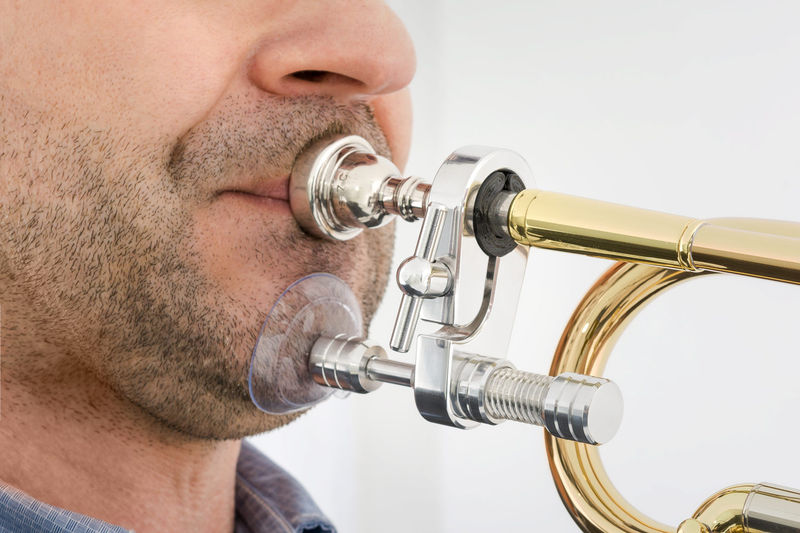
This is where the Stratos will help; adjust the chin rest to its extreme setting. Keeping the airstream level as you empty your cheeks, aim those squeaks into the mouthpiece – eventually you will be rewarded with the high note clarity you were seeking. So many players start playing into the higher register without foundation.

Try this: play an octave interval well within your comfort range. Start to move upwards in semi- tones. Take your time, going up say five semi-tones, ensure no strain is felt, then go down to where you started. Place the tip of your finger between your teeth to check the gap, and then buzz through the same exercise. The buzzing won’t sound wonderful, but with perseverance the notes will sound freer and richer when you return to playing them because blood and oxygen have been delivered to the lips, and with the buzzing the capillaries and filtrum (the bit between the bottom of the nose and the top lip) are no longer being crushed.

The beauty of Stratos is that it rids students of the fear of changing their playing technique and allows you, or your mentor, to make micro-adjustments that do not hinder your playing.

Many teachers tell their students to use less pressure, but what is being offered as a substitute? Remove the scaffold too early and the building collapses in much the same way that your mouth muscles will, if the mouthpiece weight is removed too quickly. Stratos incrementally reduces the weight of the mouthpiece from the lips until the new muscle memory is self-supporting. “


SIGN UP HERE FOR NEW BLOG ARTICLES EMAILED DIRECT TO YOUR INBOX:

[jetpack_subscription_form show_subscribers_total=”false” button_on_newline=”false” custom_font_size=”16px” custom_border_radius=”0″ custom_border_weight=”1″ custom_padding=”15″ custom_spacing=”10″ submit_button_classes=”” email_field_classes=”” show_only_email_and_button=”true”]

Advice · Education

Power over Pressure

Marcus Reynolds is an embouchure specialist and founder of the Stratos Embouchure System. I tells us here about his philosophy of ‘Power over Pressure’.

” I was introduced to brass playing at school and later joined a military band, winning a scholarship to the Royal Military School of Music, Kneller Hall, where I studied under Professor Teskey.

Six weeks after leaving the Army, I turned ‘pro’ and did TV and radio, early BBC Come Dancing sessions, West End shows, big band concerts, jingles and other work. I taught for Surrey schools for 12 years and then disaster struck when I fell from a collapsed stage. This caused a smashed lip and Focal Dystonia, and marked the end of my playing career. I had to spend years retraining the muscles in my mouth before I could play again professionally.

I didn’t set out to become an embouchure expert, but my knowledge of the subject was enhanced greatly as a result of the accident. I now teach students all over the world via Skype, even helping top professionals to stay on top of their game. For example, I recently visited Los Angeles, Ohio and Frankfurt to give individual and group embouchure assessments, plus elementary and advanced training on the Stratos Embouchure System (below), which I developed as a result of my quest to play again. I was looking for something to ‘hover’ over my scar tissue, which of course brass players know is not possible.

Moving on from how I got into embouchure training; what follows is a ‘cheat sheet’ to help you become a world-class brass player. The key is to use the natural physiology of the body at all times. Stay upright, bringing the instrument to you – don’t go to it. Do not move the instrument towards you as you are going forward because the note will start with what I call fusion and this mobility will confuse you to the point where you will not know where the note starts.

Try not to slump over your instrument. There is nothing worse than for a conductor to see a sea of players slumping – keep your shoulders down – stay relaxed and breathe evenly. Before I start on the tips for the embouchure, I must stress that any embouchure that works is fine. It’s only when you want to move your playing up (from third stand to second, from second to first, or even as a first foray as a soloist) that you might feel resistance to what you are trying to achieve. It’s time to examine the finer points of the embouchure.

Almost from day one, some lucky players can just play wonderfully, but even after years of experience, such players are unable to advise others about embouchure problems because they simply do not understand the issues involved. Not all of us have been so fortunate! One of the questions is… where is the air going? Hold your palm about six inches in front of your lips and whistle. If you don’t think you can whistle, simply mimic the shape as if you were blowing out a candle. In many cases, the air will be felt between the last joint of the fingers and the upper palm, as illustrated by the diagram below. Now, keeping the hand there, blow as if you are playing your instrument or you could even buzz. You may think that you cannot now feel the air, but further examination will show you that the air can now be felt at the wrist.

page9image48035504

One of two things could have happened; your chin dropped back, your top lip ventured over the bottom lip, or possibly a little of both. A brief look at the mouthpiece shows that the back-bore hole is in the middle. Moving the air away from that forward direction will incur even greater resistance because the air is now being blown against a wall of metal. How should you remedy this? This is where Stratos comes into play, providing a healthy way to alleviate the amount of pressure being exerted to increase the airflow as you play higher notes. Possibly for the first time in your playing career, you have something for the chin to ease towards and, in doing so, some of the unnecessary weight is removed from the top lip. Through this process, the ‘chin jut’ reaches towards the chin rest of the Stratos, pulling the corners of the mouth forward. By staying in the ‘jut position’, the chin also adds sonority. “


SIGN UP HERE FOR NEW BLOG ARTICLES EMAILED DIRECT TO YOUR INBOX:

[jetpack_subscription_form show_subscribers_total=”false” button_on_newline=”false” custom_font_size=”16″ custom_border_radius=”0″ custom_border_weight=”1″ custom_padding=”15″ custom_spacing=”10″ submit_button_classes=”” email_field_classes=”” show_only_email_and_button=”true”]

Advice · Education

The Collapse of the Embouchure : Marcus Reynolds

Marcus Reynolds is a signed Rath trombone artist, soloist, recording artist, clinician, embouchure specialist, tutor, lecturer for the British Association of Performing Arts Medicine and creator of the Stratos Embouchure System. Here Marcus shares his views on the brass player’s embouchure, what can go wrong and how to avoid the common pitfalls and problems.


Hello and welcome to this discussion of the brass embouchure. The basis of this article is a lecture that I gave during one of my Brass Detox clinics at the Welsh College of Music and Drama at the request of the British Trombone Society. Such was the strong interest and positive feedback that I was asked to contribute it to The Brass Herald and now to Mouthpiece Online.

VISIT THE ‘EDUCATIONAL RESOURCES’ PAGE FOR FREE WORKSHEETS AND LINKS TO PUBLICATIONS

“You missed by a mile,” shouted the disgruntled football fan as the ball failed to hit its target, resulting in his team being relegated. “Oh, you missed!” said his girlfriend when he shot wide on a fairground shooting range, losing them the chance to strut around with the ubiquitous giant cuddly teddy. No, you have not picked up the wrong magazine. Read on, all will become clear.

Simply explained, even if you are only slightly inaccurate at the point of launch the trajection angle will still be such that you will appear to have missed by a mile. When a note you are trying to play is missed, you have in reality only missed it by a fraction. However, human nature being what it is, all sorts of events ensue, for example, the “shock horror” of playing a wrong note encourages the player to beat themselves up, causing val-salva, clenching of the throat muscles, shoulders rising and without question increased weight being applied to the lips. Any one of these factors makes the road ahead more difficult. As many of you will know, if you have not shrugged off the aftermath of playing a note that was not in the right place the next few notes are affected. This can be addressed in your practice.

Tip: When you next practice a piece and you play a note that you wish you hadn’t, don’t stop immediately – play on for a few bars and absorb the fact that the world ain’t gonna come to a standstill, and if you learn not to show a body twitch or facial grimace then most of the time you will be the only one who knows.

Tip: Everyone says: “Practice makes perfect.” I tell my students: “Practice makes permanent.” So play a new piece slowly.

The physiological process to fortify the lips goes like this:

Conversation/communication brain to lips:
“What’s going on?”

“He/she is blowing into that metal thing again – how long is that going on for?”

“Dunno boss, last time it was for two hours. Right, we will send more blood to help the muscles cope.”

Half an hour later: “What now?” says the brain to the lip department. “More blood needed for the muscles.” “We sent loads.” “Yeah, but it’s not getting through.”

Now I know I have made this a little cartoon like, but the facts are these:

Blood and oxygen are sent to reinforce an area that is being constantly exercised and placed under stress until that area, be it with a tennis player, golfer or any athlete, becomes accustomed to that particular activity. That happens where and when the reinforcement (blood and oxygen) have done the job of replenishing the muscle sufficiently.

The dilemma is this: if the area – and in our case a player’s lips – are constantly bombarded with pressure and weight, the blood flow will be held up.

Then the brain receives the message “Can’t get through”. The sad news is that the very antidote to our lips failing to work properly has been ordered by the natural physiology of the body. It is not able to provide the service it has been sent to perform as the lips are being constantly impacted, crushing the capillaries. It is a sort of self-induced tourniquet.

Many teachers tell their students to use less pressure and, yes, many reading this will have heard similar statements. But what is offered as a substitute? If a building is being supported by scaffolding that is then removed before the structure can support itself, the building will fall down.

The beauty of Stratos is that you can control how much of the scaffold you remove until the “internal muscular scaffold” can hold its own. Many players who now use a Stratos have found that there is an alternative to the “Pressure Trap” and are already enjoying playing more. They discover that the pain that is sometimes present while playing is vastly reduced and in most cases disappears completely after a while. While this process is taking place you will not be alone wherever you are in the world. I am only an e-mail away.

While we’re thinking about the collapse of the embouchure, let’s go back to the word trajection. Players sometimes very clearly “crane” their head and neck to enable them a better view of the music, often causing them to be blighted by that same position throughout their playing life. The stylised holding of an instrumentat a slight angle, changing mouthpiece position and adding range by slightly twisting one way or another, is also found. Any gains are very short lived. If you are not careful such unhelpful habits become built into your embouchure.

Tip: Try to keep everything in line. It is easy to monitor – just play in front of a mirror, try to keep your body in line, stand or sit upright then bring the instrument to you. We are all guilty with regard to bad posture at times. Putting it right is a basic requirement no matter what you go on to do with the instrument on your lips.

VISIT THE ‘EDUCATIONAL RESOURCES’ PAGE FOR FREE WORKSHEETS AND LINKS TO PUBLICATIONS

What never ceases to amaze me is when I see band members sitting with instruments about to play a concert and there’s no warming-up going on. Go to a West End show, the opera house or any symphony orchestra and you will hear musicians warming or limbering up for their performance. But the warm-up should start well before the performance. When I have a concert I prepare very early, maybe even up at 7.00am. Then for the first ten minutes I hardly brush the mouthpiece with the lightest buzzing. This is BEFORE breakfast, so that when I return to the instrument the very fine coating on the lips has muscularly dissolved a sort of restrictive “cling-film” that has been left over from the night before. This cling film in effect is lactic acid repairing and comforting your lips that have been compacted by the mouthpiece for so many hours, a coating that is saying “leave me alone I need to rest”.

That brings me to another point. I am aware that at the end of a performance everybody wants to get packed up and out. Instead, try playing a few low notes with flarpy lips, just for ten or twenty seconds. Then while you are packing up, roll the chops to let the blood and oxygen into the capillaries. Then the next day’s lactic acid “cling-film” should not be clinging on so tenaciously and shouldfall away more quickly, so you can get on with what you so love doing – playing.

As a musician, with whatever genre you are being asked to perform, you need to look after yourself and particularly that precious vermillion circle that is the lips. So I am hoping that you will have read something here that might ring true and will help you in the future.

That leads me to the Filtrum, or infranasal depression. What? – I hear you say.

It’s that bit of the mouth between the bottom of the nose and the top lip. I don’t want to get too technical, but it does have a bearing on why the embouchure can collapse. One of the main reasons is because behind the filtrum there are many nerve endings and when playing has been sustained with constant crushing weight on the lips, this causes them to get a little numb as the blood and oxygen has been squeezed away. They just don’t respond.

In performance, to stop playing is not always an option, so just ensure when you have a few bars’ rest, roll your lips to open the capillaries and allow blood and oxygen to enter these tiny blood vessels and renew tired muscles.

After constant bombardment with no break for the lips, the numbness can become so severe that all the feeling disappears and the lip loses all sense of harmonic positioning, playing becomes impossible and the embouchure feels as if it has collapsed. That is where Stratos begins to help, as using Stratos for at least ten to fifteen minutes of your practice time will put sufficient “petrol in the tank” (muscle power) for you not to get this numbness.

However, like all petrol tanks the fuel will run out and you will need to top up with a further session using Stratos. Even if you continue to experience numbness, the symptoms should not be as severe and you will recover more quickly and prevent a total collapse of the embouchure.

Space prevents me sharing many more golden nuggets from my forty years in teaching and performing, but if I was Dr Chops here is my prescription that will help smooth out the bumps of your brass-playing life. I am passionate about helping players to avoid some of the maladies and pitfalls that can cripple even some very proficient performers. With social media and technology via Skype or FaceTime I am constantly presented with students around the globe having problems that could have been spotted earlier (remember the bit about trajection) that have held up their progress and created bigger problems. Don’t just take my word for everything you have read, get into and read The Art of Brass Playing by Philip Farkas, How Brass Players Do It by John Ridgeon and The Encyclopaedia of the Pivot System by Donald Reinhardt. Finally, I will leave you with something to try.

On the subject that whatever you play is the amplifier and the real instrument is your lips – you tune your instrument so let’s now tune the lips.

Tip: When you are working on a new musical passage or phrase that is getting tough – stop playing for a few seconds, then buzz the phrase two or three times even if you don’t achieve a very musical outcome. The lips will thank you for the rest away from the mouthpiece and reward you with more sonority and a much freer sound. After a while you may be rewarded with what my students achieve – what I call “Cerebral Pitching” resulting in the notes starting to float.

Some points to be aware of to avoid a total collapse of the embouchure:

The Vicious Circle:

  • Stiffness in the lips and muscles surrounding them.
  • Swellings on the vermillion circle that take longer to recover.
  • Headaches caused by air not being able to escape through clenched teeth.
  • Mis-pitching in the lower register.
  • Less sonority in your sound.
  • Taking longer to recover from the previous playing session.
  • Declining stamina.
  • Less flexibility.
  • Having to use more and more effort to maintain the standard you usually expect from yourself.

Here’s to safer, healthier and more joyful playing!


This article was originally published in The Brass Herald in 2015.


Sign up here for new blog articles emailed direct to your inbox: