Trumpet Artist Profile : Jeroen Berwaerts

Belgian trumpet soloist Jeroen Berwaerts combines immense technical prowess with beautiful sensitivity across a huge range of styles. His CV is extraordinary, boasting solo appearances with orchestras across the globe, teaching commitments in Hannover and London, as well as a really interesting relationship with Yamaha.

What first drew you to the trumpet? Who or what were your early musical influences?

My father was the key. He played euphonium in the hometown band and brought a trumpet home. He did teach me the first notes. About half a year later I had my first real teacher at a music school, he was a Horn player , very much focused on a nice round and warm sound, that sound idea never left me. I also switched to the cornet at the beginning years because that trumpet was too heavy for me.

You had significant success as a young soloist – at what point did you know that you wanted a career as a trumpet player?

I cannot remember that I ever wanted to become anything else in my life. After hearing and seeing a concert of the Philip Jones brass ensemble in Kerkrade (Holland) I told my father on the way home , that’s what I wanna do. I must have been around 9 or 10 years old.

Your early competition successes must have helped to open some doors for you? How did this success influence the pattern of your current working life?

I realize now that these competitions at young age, as well as concerts or performance situations, are the best base to have for security on stage later on. Due to the fact that I have always performed or competed, the stage as well as the challenge to conquer pieces feel very much like home for me.

You have received critical acclaim for your interpretations of many different musical styles – do you find it difficult to ’switch gear’ between them?

With the right equipment and the correct mindset it’s not really a problem. I find ‘variety’ one of the most beautiful sides of being a trumpet player.We can compare it with being a Decathlon athlete. It’s very challenging to switch between styles, instruments, including many different colors and moods, but it’s never boring 🙂

Do you have any regular practise routines that you use?

Oh yes, I have my favorites like Charles Colin lip flexibilities and vincent cichowicz. But also Caruso, Arban….. some of them are always around and some come and go 🙂 I like the balance between a secure feeling (what we now) and new challenges (the unknown). But most important for me, when I practice I probably sing about 50% of the time and play 50%. I see the trumpet as my own voice-extension.

Do these routines change a lot depending on what repertoire you are working on?

When I am working on a big program or physically demanding works (so practically all the time :-)), I try to never neglect the “sports” aspect of the job.The actual work I am doing is a combination between high-performance sports and musicianship. And yes, there are great routines to support different issues that come up depending on the works we play.

To what extent does your equipment need to change depending on what you are working on?

I have never been too much into trying out thousands of mouthpieces and trumpets, I need equipment that I trust, that’s it. The mouthpiece I play is a 30 year old 1,5c Bach. It’s so old that my friends at Yamaha have to change the head of the lead pipe when I am trying out there newest babies.

What key advice do you have for today’s young and aspiring trumpet players?

Practise, practise, practise ! And read the “ten rules for students and teachers” from John Cage.

Can you please talk a little about your relationship with Yamaha and how you have worked to develop the right instrument and mouthpiece combinations for you?

The most important thing for me, working with Thomas, Timo and Eddy is that they understand my language. Talking about sound is mostly very abstract and at that point you need a good understanding, that works great. Like I wrote before, I was never so much into changing material but last year, we worked on a Bflat and I have never played an instrument that good. It speaks as if I can just sing in it.

What are you currently working towards? Do you have any up and coming projects that you would like to talk about?

My personal challenges are a program in April where I will play Michael Haydn C-Major concerto in combination with a very demanding work by Viennese composer HK Gruber. And in May another challenging program together with Reinhold Friedrich where I will perform rather modern works by Hindemith, M.B.Watkins, Ligeti and Hosokawa.Before these events I’ll have the pleasure to be working with the brass sections of several nice orchestras in Germany, mostly in a “lead/play” function.

We will be performing (mostly streaming for now) original works for brass by Tomasi, Grieg, Britten, Henze and many other composers. Between these soloistic pleasures there is the red wire of education. As much as I love to perform and be on stage, it is always the greatest pleasure to work with my students in Hannover or to come to London to the RAM and work with our students there. I find education such a wonderful field, it’s demanding at one side but you are also able to learn so much yourself continuously. Maybe THE most meaningful profession.

We are living through difficult times in the midst of COVID-19 lockdowns across the globe. How has this affected your preparations and projects?

Of course there was a period where most concerts where cancelled but I tried to re-orientate immediately and see where the possibilities are. I am very grateful and lucky to not needing so much to be motivated. Trying to motivate others is actually the best motivation for me.

And of course being on the road so much it was a new and fantastic feeling to be home and in one place for such a long time, I forgot how that felt.


Sign up here for new blog articles emailed direct to your inbox:

[jetpack_subscription_form show_subscribers_total=”false” button_on_newline=”false” custom_font_size=”16″ custom_border_radius=”0″ custom_border_weight=”1″ custom_padding=”15″ custom_spacing=”10″ submit_button_classes=”” email_field_classes=”” show_only_email_and_button=”true”]

Mental Practice Preparation

Mental practice preparation” – Getting ourselves in the right frame of mind, and then planning and executing our practice goals – an article by Sam Neufeld of ‘Trumpet Warmup’.

2020 was difficult at times to stay motivated to practice. Gigs dried up and so did motivation to keep our chops together. Luckily there are some things we can do to get back on track.

Here are three strategies I am using in 2021 that you can use too:

  1. Set the bar low
  2. Remove distraction
  3. Track progress

Overall the name of the game is to develop consistency.

Let’s break it down…

  1. Setting the bar low for practice time.

A couple weeks ago, my friend mentioned he was going to start working out everyday. Last year he worked out only a handful of times and wanted to change that. I asked him, “how certain are you that you can workout seven days a week? Are you 100% certain that you won’t miss a single day?”

Well, of course the answer was no. He could not say with complete confidence that he’d not miss a single day especially since his previous track record was so different.

I said to him “Instead of attempting to workout everyday, start with something you know you’ll complete with 100% certainty.” 

Set the bar SO LOW that you cannot fail. This is a strategy that’s worked wonders for me in the past and I am using it this year to start practicing consistently again and improve my trumpet playing. I missed somewhere between 30-60 days last year and because of it my playing suffered. In order to get back on track, I’ve set the bar low by pledging to practice everyday for at least 5 minutes. There will be days that I practice 2+ hours, but 5 minutes minimum per day gets me back on track towards forming the daily habit of practicing.

  1. Remove distraction from the practice space.

Where do you practice currently? During Covid-19 times, it’s likely a bedroom or office space. If you’re lucky – an isolated practice space or garage. But, you don’t need a separate/isolated room. What may help you most is a dedicated practice space. Somewhere you have everything needed to complete a successful practice session.

In this space you need:

  • Mirror
  • Tuner
  • Trumpet stand
  • Music stand
  • Chair
  • Water bottle

Optional:

  • Computer or tv
  • Camera
  • Microphone
  • Mutes
  • Coffee
  • Other trumpet gadgets

I treat this like going to the gym. What do you bring with you before leaving for the gym? Water bottle, change of clothes, shampoo, etc… Treat practicing the same way this year. Don’t let the fact that you’re stuck in your apartment next to your tv distract you. Remove the distractions physically if possible, but more importantly – mentally.

  1. Record video and audio to track progress.

Accountability is a great motivator for staying true to your goal. If you have a private teacher, this is one form of accountability. Your teacher adds pressure to practice each week that wouldn’t otherwise be there.

Here’s another form of accountability that you may not already be utilizing: Instagram.

Create an account dedicated to practicing. Post your videos even if they suck. Get over the fear of “what will so-and-so think”. This is about improving over time, not sounding good every single day. You don’t have to like other people’s posts or comment fire emojis if you don’t want to. Although I suspect over time you will end up finding a friendly community of like-minded trumpet players that you enjoy engaging with.

By posting to Instagram, you will have accountability and a practice log. Months or years later you can analyze your past videos to see if you’ve actually improved or not! 

So this is my strategy for 2021. It’s time to get back on track. 

Follow me – @samneufeldtrumpet on Instagram

Follow – @trumpetwarmup on Instagram

Thoughts or questions? Email me at sam@trumpetwarmup.com. I love to chat 🙂


Sign up here for new blog articles emailed direct to your inbox:

[jetpack_subscription_form show_subscribers_total=”false” button_on_newline=”false” custom_font_size=”16″ custom_border_radius=”0″ custom_border_weight=”1″ custom_padding=”15″ custom_spacing=”10″ submit_button_classes=”” email_field_classes=”” show_only_email_and_button=”true”]

Focal Dystonia : Reprogramming your Satnav

Brass players, including those at the top of their professional tree, have experienced Focal Dystonia that has either permanently, or temporarily, halted playing. Marcus Reynolds was a ‘pro’ player who overcame the challenge and here offers his personal (as opposed to medical) perspective on the road to recovery.

“I was inspired to write this for several reasons, not the least of which was an accident when I fell from a stage, which badly damaged my lip. My resultant anxiety about how I was going to play again and continue to make a living led to my own experience of Focal Dystonia (FD). I have learned to play again and it has been a struggle, but I have learned much about FD and embouchure problems along the way, which I’d like to share that with other brass players and teachers.

Dystonia is uncontrollable muscle spasms caused by faulty signals from the brain. Focal refers to a condition affecting a precise area of the body, such as the lips and muscles supporting the embouchure. Experiencing FD is a bit like dealing with a sat-nav that can’t understand that your route is blocked. Progress cannot be made, frustration mounts, only aggravating the situation. The sat-nav may even need to be turned off and the driver resort to basics (eyes and a map!). Similarly, the FD sufferer returns to basics, or in medical terms the brain’s cortical map needs untangling.

VISIT THE ‘EDUCATIONAL RESOURCES’ PAGE FOR FREE WORKSHEETS AND LINKS TO PUBLICATIONS

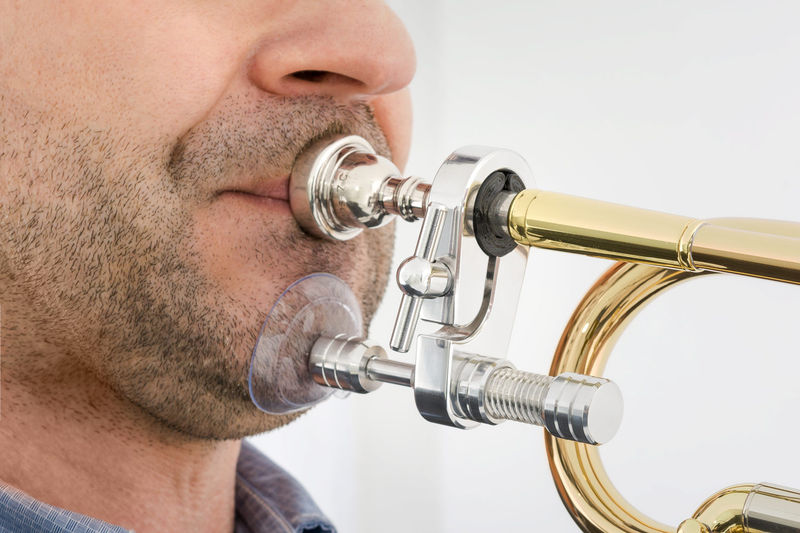
When a brass player visits me with FD, the first thing I aim to do is to change the name of the condition. For some, the mere mention of FD can amplify the associated problems, even triggering involuntary muscle movements, so I try to use a different terminology when discussing their playing. Typically, an FD sufferer is unable to control the lips as needed, so often I start sessions with certain facial exercises, which look like gurning, followed by some gentle buzzing using the Stratos embouchure training aid that I have developed. I set Stratos so the lips are hardly touching the mouthpiece. In that position, the brain does not register an instrument is being played. This avoids full contact on the lips, which would allow the brain to associate the problem with the instrument, thus triggering a rejection of it. Playing with some of the usual weight on the lips removed is difficult at first, but it cheats the brain to the extent that the student does not produce and hear the heavily debilitating ‘bu bu bu’ sound generally associated with the symptoms of FD. After a few repetitions of this exercise, clearer notes appear, almost like magic.

This rehabilitation is about re-routing the cortical map and, to achieve this, I have created a series of mind and muscle distracting exercises. A main aim is to build a new embouchure and the unpolished sounds that the instrument might emit are part of the process of recovery. A beginner’s early, unfocused sounds are similar to those made by an FD sufferer, but I believe that FD sufferers should be treated almost like beginners who often take time to achieve a really nice sound, but do not shun or reject the instrument because they have no ‘history’ to compare a better sound to. Experienced players, however, appreciate a good sound, so are frustrated when they cannot produce it.

Even when a smooth, even-toned note is being produced, FD can suddenly trigger an involuntary spasm resulting in a high-pitched squeak. However, as there will often have been a good quality note before the problem arises, I try to get the player to produce notes in semi-tones, either side of the targeted good note.

Repeating this extensively can achieve a new stability, controlled by a new muscle memory, triggering new synapse messages to the brain. Recovery is partly about breaking what we might call ‘historic spasms’ – that is spasms arising from old ways of playing. For valve instruments, this can be tackled by using different fingering, so in the case of a valve instrument, I get my student to play a scale of C. Then, as we ascend from low C (after pre-pitching an E top space, also thinking downwards and cerebrally pitching, as if you were whistling), I get the G played in 1st and 3rd, the A in 3rd, the B in 1st and 3rd, and the remaining C in 2nd and 3rd. This way, the instrument is raising the pitch and not the lips. Before starting this C scale, I strive for an E top space to be blown with no tongue, and then encourage the player to think the interval to the C in the stave and to play the scale by not changing pitch facially, but by allowing the instrument to take the pitch downwards. This exercise is carried out very calmly. If the ‘bu bu bu’ occurs, show no sign of annoyance or frustration because your student will reflect it – just start again.

The next technique sounds a little crazy, especially as the player may not be very confident using the methods to play any of the notes that I’ve mentioned. Using the Stratos, with its unique adjustment set with the chin-rest piston as far forward as it will go, I encourage the player to reach towards the mouthpiece, sat the same time depressing the chin rest piston spring and closing the gap to the mouthpiece. Although sometimes frustrating, this exercise increases the blood and oxygen to the capillaries, strengthening the mouth muscles. Reaching towards the mouthpiece will feel alien, but will cause no evidence of FD because ‘historic spasms’ won’t be triggered. Maintain this exercise for a full minute, then rest. Return the chin-rest so it is just touching the chin and then play. Results will vary, but I find that the player has better support and, in many cases, plays without the ‘bu bu bu’ effect.

Whistling arpeggios is great, even if a whistle cannot be achieved; just copy the shape as you whistle. Not only does this firm up the oral chamber, but it also encourages the ‘smiling’ muscles to draw forwards towards the point of pitch. Do this exercise very slowly and deliberately, using your mind to picture the travel of the tongue as it arches upwards for the higher whistled notes and then feel the tongue flatten as you descend the arpeggio.

Another strategy is for the player to go into unfamiliar areas, such as striving to pitch above their normal range. The brain won’t know what is happening and so FD won’t be triggered. Once some success has been achieved, work downwards in pitch suspension, not losing sight of the higher note. After descending two or three notes, return to the first note. If these notes feel and sound clear, descend four notes.

Three of my students with FD had never buzzed before, but buzzing keeps the capillaries open, allowing more blood and oxygen into the lips. The brutality of the mouthpiece pressing against flesh needs to be reduced and using the Stratos will achieve this, a little at a time.

Once you’ve made a good start on producing a reasonable sound, you can proceed to rebuilding the embouchure properly. Avoiding old habits is central, but often comes down to basics for a beginner. So progress comes from patient concentration on producing a smooth airflow, correct posture of neck and body, comfortable handling of the instrument and, of course, effective breathing. I recommend looking at the teaching of Kristian Steenstrupp, Professor of Trumpet at the Royal Academy of Music in Aarhus, on this matter.

If the player does not feel that the results are favourable at anytime,
I return to the good notes and start again, which helps to anchor that one good note as a rung on the ladder to eventual success.

Many of the players that I’ve helped are overwhelmed by anxiety to such a degree that they find it immensely difficult to accept there is a way out of their dilemma. It is easy to think ‘why me?’ That attitude, however, only sustains the collapse of the player’s skills and rejection of the instrument that is symptomatic of FD. It is important to recognise that mental attitude to playing is important. I, too, was a ’pro’ making a living as a ‘bone’ player, teaching, conducting and performing for TV and radio. The stress of worrying about how to make a living was the factor that compounded other neuroses that I experienced. The way forward is to try to create different sensations that trick the brain and muscles into re- learning that what they are doing.

I try to create different sensations so that the brain asks what is happening, and, in those moments of confusion by using subterfuge and deception, new and different approaches can be made without rejection. Many alternative avenues are needed for continued progress. For example everything you do to change the feel mentally and sensorily will help this confusion. Even something like wearing gloves, so the instrument feels totally different, can provide a new sensory experience, distracting the brain and aiding progress.

In summary, recovery is possible if the player is patient and works diligently with the tutor.”


This article was originally published in ‘Brass Band World’


You may also be interested to read here about the experiences of Philip Smith (former Principal Trumpet of the New York Philharmonic) with Focal Dystonia.


Sign up here for new blog articles emailed direct to your inbox:


How to transcribe a jazz solo

Transcription is a great skill to develop in itself, but is also invaluable for developing our ears and our general musical awareness. Darren Lloyd from ‘Jazz etudes’ talks here about how to actually go about this and develop this important musical skill:

https://youtu.be/nBH2ryHgPYM

Sign up here for new Mouthpiece Online blog articles emailed direct to your inbox:

[jetpack_subscription_form show_subscribers_total=”false” button_on_newline=”false” submit_button_text=”Sign up” custom_font_size=”16″ custom_border_radius=”0″ custom_border_weight=”1″ custom_padding=”15″ custom_spacing=”10″ submit_button_classes=”” email_field_classes=”” show_only_email_and_button=”true”]