Advice · Education · Interview

Trumpet Artist Profile: Philip Smith

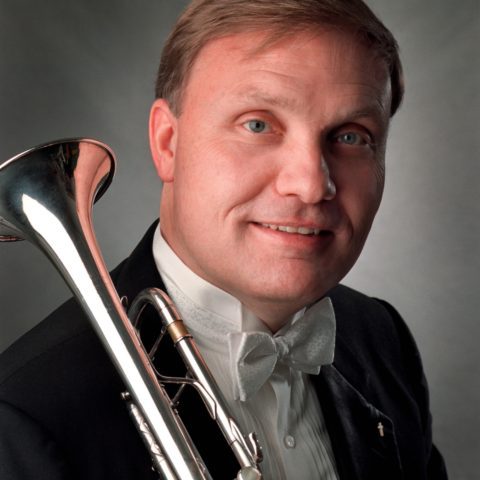
At the ITG Conference 2018 I managed to meet with a number of great people to conduct interviews, none greater than Philip Smith!  Former Principal Trumpet with the New York Philharmonic, Phil shares his approach to both trumpet and cornet, and also speaks candidly about his recent experiences with Focal Dystonia.

How did you come to move from England to the US?

My father was a well-respected and successful Salvation Army cornet player.  In addition, after the war, he was Principal Cornet in the Royal Horse Guards, The Blues.  He had done a solo tour of Canada in the early 50s, and in post-war England, I guess the grass looked pretty green over there for a young family.  So, he moved us over there, and 3 years later we moved down to New York City.  My father worked for the [Salvation] Army and played principal cornet in the New York Staff Band, so I grew up on Long Island.

Was the cornet an obvious choice of instrument for you?

It wasn’t really a choice!  It was like, “This is what you do!”.  As I am sure that you are familiar in England, in the Salvation Army, when you get your second teeth, someone slaps an instrument in your hand and off you go.  It is usually a cornet until they figure out that you don’t have the aptitude, or the instrument doesn’t fit you, and then they start moving you down the band!

The Army is a great movement for maintaining music education isn’t it?  I am lucky where I live in the UK that there is a great youth band setup nearby for my son, but there is next to nothing going on in schools.  You have to know where to seek these opportunities out. Is it a similar situation in the USA?

It has just shifted. In our schools here, music is “dying” in the public education arena, but that is where you have to take up the slack.  Quite honestly that is what the Salvation Army has done in a lot of areas.  They have started teaching music, you are getting kids coming in through that, and hopefully families coming into the church.  Families into the church is the whole point.

At what point did you move from cornet onto the trumpet?

Growing up, all of my music was pretty much playing cornet in the Army and at school.  It wasn’t until 11th grade, when I was encouraged to start to think about my future career, and that music education would be a good fit for me, that I started to play some trumpet as well.  The trumpet that I got in 11th grade, in fact, is the very same B-flat trumpet that I still play today!

So, you are a music store’s worst nightmare then!?

Yes!  I have had it done up many times, including just recently.  It is an “old shoe” and that is what I love.

I then started the audition process, really geared up to look towards music education.  I believe it was Carole Dawn Reinhart – herself a soloist, great educator, and also grew up in the Salvation Army – that spoke to my father and suggested that I should audition for music schools. So I ended up going to Juilliard and that’s how I got started!

And was that totally trumpet from then on?

No, I still played cornet as I had a scholarship through the New York Staff Band.  To encourage students to continue to play in the band they would give small scholarships to help you complete your studies.  Playing with the band while I was at Juilliard was an integral part of my development – I was playing with them every week, and once a month I would be up playing solos with them in concert.  This was a great opportunity that a lot of other kids did not have.

I played trumpet at school, and my teacher’s role as I saw it, was to try to take me from being this sweet, ‘bel canto’, pretty-sounding cornet player, and teach me to be a more masculine-sounding trumpet player, and yet not take away other aspects.  So I was able to learn to play both ways!

How compatible are cornet and trumpet at the highest level?  Would you say that there are big technical differences to creating a great sound on both, or is it more a change in approach?

There is a difference in approach.  There was even a difference in approach between the Salvation Army bands, and the contesting brass bands.  A lot of that had to do with my dad – he had a slower vibrato “golden” tone, and that greatly influenced the tone of cornet playing in the USA.  That was therefore the kind of tone that I aimed for.  I am not saying that it was better than more traditional cornet players, just different.  For other players today, such as Philip Cobb, playing cornet and also playing in the London Symphony Orchestra, it is perhaps harder because they have to swing a little wider.  The difference between what we consider to be traditional cornet and traditional trumpet sound has certainly got wider in terms of concept and approach.

Can it be done?  Yeah, it can.  Should it be done?  Yeah, it should.

I was never more shocked than when I travelled over to London as a young professional, giving masterclasses at some of the colleges, and to see the anti-cornet feeling that I was getting from the trumpet players.

I have always found it strange in the UK that the colleges make students decide at age 18 between a ‘Brass Band’ course on cornet, or a trumpet course, and that the two are completely exclusive. Surely these are related disciplines that can be studied and performed side-by-side?

Yes.  Everything is the same, the overall approach, the technique.  In fact, the beauty of the growth of the British Brass Band movement in the USA at the moment is that we now have orchestral players saying, “Wow, look at this repertoire and the level of technique demanded of it!”.  It can only enhance your trumpet playing.  That was probably a signature of my career in that my sound could be strong and strident and still be “cornetty”.  And so much orchestral repertoire demands those two different styles, just look at those beautiful cornet-style melodies in Mahler, and then “wham” you’re back into the big strong trumpet sounds and “zing”again.

And especially in England where there is a great history of fantastic cornet players becoming great principal trumpets, there should never be that separation.

VISIT THE ‘EDUCATIONAL RESOURCES’ PAGE FOR FREE WORKSHEETS AND LINKS TO PUBLICATIONS

Through your career, how important has the idea of a strict ‘practice routine’ been to you?

When I was younger, I never had one.  I just played.  As I havegrown older, fundamentals have become more important out of necessity.  I think the structure of routine can be really beneficial.  You also need to remain flexible for whatever can be thrown at you.  When I was in the Philharmonic, I always had some outside solo event to plan for and spur me on.  Then there was always new orchestral music.  My practice time was generally spent getting that stuff ready, and I did not think too much about the shift in styles, I just played.  That said, orchestral trumpet and solo trumpet shape are two very different things – it is a little bit like being a jazz player and classical player.  Someone like Wynton could play terrific classical trumpet too, but eventuallyeven he had to make a choice.  It can be very hard to maintain two distinctly different ways of playing and practicing over the long-term.

As to fundamentals, I started to discover various different methods and study books.  It is all wonderful stuff, and it is all definitely helpful at different times.  If you are not careful though, you can get sidetracked from the key aspect which is just to PLAY.

Can you talk a little about your recent experience with Focal Dystonia?

Four years ago, I got hit with it, and I basically couldn’t play a note.  I have had to re-teach myself how to play over the last four years, and quite honestly it has been hell.  I wish I could say what triggered it, but I don’t know. I have had people say to me “I can’t believe that you lost your lip” or “I can’t believe you lost your nerve”, and it was neither of those things.  Something happened that took what I knew and wiped it off the map.  I have had to re-teach myself what to do, and in some ways, I have needed to be more ‘fundamentally’ focused, and in other ways I have had to erase everything that I thought I knew as an experienced trumpet person and approach the instrument like I am 7 years old.  That has been difficult!

You just go through the basics – blow air through lips that vibrate and keep everything else out of the way.  And then not obsessing on finding that embouchure “sweet spot,”but to just place the mouthpieceover the natural aperture.  It didn’t feel anything like my proper embouchure, but I had to erase that thought.  The first note that I got was a huge fat middle C, and I felt that I could stick my pinky through the aperture!  But then the next thought was, “How do I get to a D?”. I have had to approach it like a beginner again and build one step at a time.

Having trumpet-playing taken away from me four years ago was like going through a death.  God and I (well me to God) had some strong words!  Seeing the specialist who told me that I was going to have to find myself a new career, and then going and sitting in my car in shock – it was unimaginable to me.

The process has been a case of learning one very small step at a time.  I have had an internal faith to press on, and I have a certain, quiet stubbornness that says “OK, I am going to keep trying”.  Believe me there has been frustration and depression and all of that, but with Practice, Perseverance, Patience and Prayer, those four elements have moved me forwards day-by-day.  I have swung between wanting to throw the whole thing away, and wanting to keep going even stronger.  My goal is to be better today than I was yesterday, without looking back at the player that I was.

How have the past four years influenced your approach to teaching now?

You know, as a man of faith, I believe God provided at just the right time.  Just as my time ended at the Philharmonic, the opportunity arose to teach at the University of Georgia, and I do not think that was a coincidence.  I have been given the opportunity to share all of the experience and knowledge that I have, with kids that I have grown to love.  At the same time I have been able to spend time on my own, out of the limelight, trying to put Humpty together again.

I have loved it with the kids.  Going through Focal Dystonia has definitely impacted the way that I teach.  One of the main things is that it has given me a little more patience.  You will have to ask them what they think though!

What are the priorities for your students to concentrate on?

The first thing is ‘quality of sound’ and ‘beauty of tone’.  Try to get a tone that is rich and full and free.  Obviously, each student comes in with individual issues, but I start with good fundamental technique.  And this very much mirrors what I have had to do myself recently too.  Technique is important but gets you nowhere without a great sound.  Sitting on audition panels behind a screen, there is nothing like that moment when a player’s first note grabs the whole committee, and you see twelve people suddenly wide-eyed, shaken out of their slumber, and wanting to hear more!

I am imagining this to be a tricky question for you, but are there any particular highlights that really stand out from your illustrious performing career?

I have been blessed, I feel like I have lived a fairy tale.  For a Salvation Army kid to go to Juilliard, knowing very little about the world, not being able to transpose, never getting into any orchestras… I wanted to leave Juilliard after my first year because I didn’t feel like I really fit in and didn’t like all of the competitive ‘peacocking’ that was going on.  And from there, to join the Chicago Symphony and then join the New York Philharmonic, see the world, play with great musicians, great conductors… I can’t tell you how blessed I am.

What advice would you give to young aspiring players?

Think a little less of yourself, listen to as much great music as you can and try to copy all of your heroes. In the process of copying, your own personality will blossom out of you.  Sing… sing… sing, with a beautiful sound.  You have found the gift that you enjoy.  Be willing to share it with other people.


Sign up here for new blog articles emailed direct to your inbox:


Advice · Education

Focal Dystonia : Reprogramming your Satnav

Brass players, including those at the top of their professional tree, have experienced Focal Dystonia that has either permanently, or temporarily, halted playing. Marcus Reynolds was a ‘pro’ player who overcame the challenge and here offers his personal (as opposed to medical) perspective on the road to recovery.

“I was inspired to write this for several reasons, not the least of which was an accident when I fell from a stage, which badly damaged my lip. My resultant anxiety about how I was going to play again and continue to make a living led to my own experience of Focal Dystonia (FD). I have learned to play again and it has been a struggle, but I have learned much about FD and embouchure problems along the way, which I’d like to share that with other brass players and teachers.

Dystonia is uncontrollable muscle spasms caused by faulty signals from the brain. Focal refers to a condition affecting a precise area of the body, such as the lips and muscles supporting the embouchure. Experiencing FD is a bit like dealing with a sat-nav that can’t understand that your route is blocked. Progress cannot be made, frustration mounts, only aggravating the situation. The sat-nav may even need to be turned off and the driver resort to basics (eyes and a map!). Similarly, the FD sufferer returns to basics, or in medical terms the brain’s cortical map needs untangling.

VISIT THE ‘EDUCATIONAL RESOURCES’ PAGE FOR FREE WORKSHEETS AND LINKS TO PUBLICATIONS

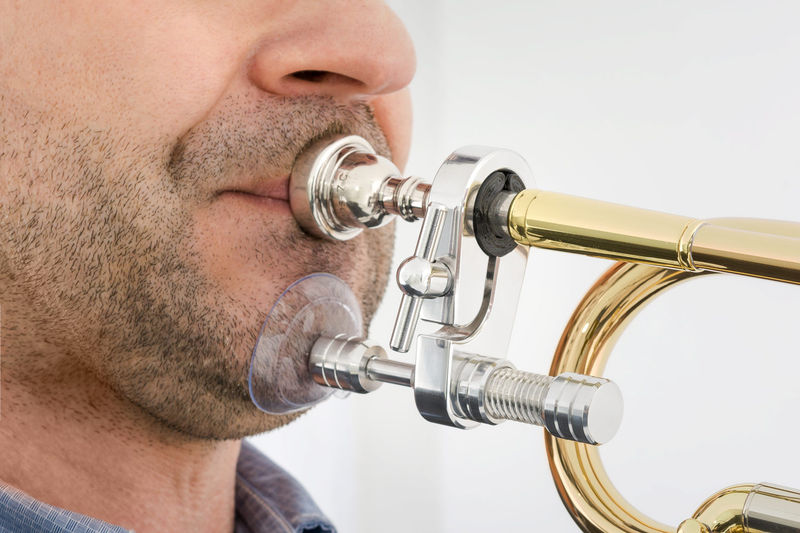
When a brass player visits me with FD, the first thing I aim to do is to change the name of the condition. For some, the mere mention of FD can amplify the associated problems, even triggering involuntary muscle movements, so I try to use a different terminology when discussing their playing. Typically, an FD sufferer is unable to control the lips as needed, so often I start sessions with certain facial exercises, which look like gurning, followed by some gentle buzzing using the Stratos embouchure training aid that I have developed. I set Stratos so the lips are hardly touching the mouthpiece. In that position, the brain does not register an instrument is being played. This avoids full contact on the lips, which would allow the brain to associate the problem with the instrument, thus triggering a rejection of it. Playing with some of the usual weight on the lips removed is difficult at first, but it cheats the brain to the extent that the student does not produce and hear the heavily debilitating ‘bu bu bu’ sound generally associated with the symptoms of FD. After a few repetitions of this exercise, clearer notes appear, almost like magic.

This rehabilitation is about re-routing the cortical map and, to achieve this, I have created a series of mind and muscle distracting exercises. A main aim is to build a new embouchure and the unpolished sounds that the instrument might emit are part of the process of recovery. A beginner’s early, unfocused sounds are similar to those made by an FD sufferer, but I believe that FD sufferers should be treated almost like beginners who often take time to achieve a really nice sound, but do not shun or reject the instrument because they have no ‘history’ to compare a better sound to. Experienced players, however, appreciate a good sound, so are frustrated when they cannot produce it.

Even when a smooth, even-toned note is being produced, FD can suddenly trigger an involuntary spasm resulting in a high-pitched squeak. However, as there will often have been a good quality note before the problem arises, I try to get the player to produce notes in semi-tones, either side of the targeted good note.

Repeating this extensively can achieve a new stability, controlled by a new muscle memory, triggering new synapse messages to the brain. Recovery is partly about breaking what we might call ‘historic spasms’ – that is spasms arising from old ways of playing. For valve instruments, this can be tackled by using different fingering, so in the case of a valve instrument, I get my student to play a scale of C. Then, as we ascend from low C (after pre-pitching an E top space, also thinking downwards and cerebrally pitching, as if you were whistling), I get the G played in 1st and 3rd, the A in 3rd, the B in 1st and 3rd, and the remaining C in 2nd and 3rd. This way, the instrument is raising the pitch and not the lips. Before starting this C scale, I strive for an E top space to be blown with no tongue, and then encourage the player to think the interval to the C in the stave and to play the scale by not changing pitch facially, but by allowing the instrument to take the pitch downwards. This exercise is carried out very calmly. If the ‘bu bu bu’ occurs, show no sign of annoyance or frustration because your student will reflect it – just start again.

The next technique sounds a little crazy, especially as the player may not be very confident using the methods to play any of the notes that I’ve mentioned. Using the Stratos, with its unique adjustment set with the chin-rest piston as far forward as it will go, I encourage the player to reach towards the mouthpiece, sat the same time depressing the chin rest piston spring and closing the gap to the mouthpiece. Although sometimes frustrating, this exercise increases the blood and oxygen to the capillaries, strengthening the mouth muscles. Reaching towards the mouthpiece will feel alien, but will cause no evidence of FD because ‘historic spasms’ won’t be triggered. Maintain this exercise for a full minute, then rest. Return the chin-rest so it is just touching the chin and then play. Results will vary, but I find that the player has better support and, in many cases, plays without the ‘bu bu bu’ effect.

Whistling arpeggios is great, even if a whistle cannot be achieved; just copy the shape as you whistle. Not only does this firm up the oral chamber, but it also encourages the ‘smiling’ muscles to draw forwards towards the point of pitch. Do this exercise very slowly and deliberately, using your mind to picture the travel of the tongue as it arches upwards for the higher whistled notes and then feel the tongue flatten as you descend the arpeggio.

Another strategy is for the player to go into unfamiliar areas, such as striving to pitch above their normal range. The brain won’t know what is happening and so FD won’t be triggered. Once some success has been achieved, work downwards in pitch suspension, not losing sight of the higher note. After descending two or three notes, return to the first note. If these notes feel and sound clear, descend four notes.

Three of my students with FD had never buzzed before, but buzzing keeps the capillaries open, allowing more blood and oxygen into the lips. The brutality of the mouthpiece pressing against flesh needs to be reduced and using the Stratos will achieve this, a little at a time.

Once you’ve made a good start on producing a reasonable sound, you can proceed to rebuilding the embouchure properly. Avoiding old habits is central, but often comes down to basics for a beginner. So progress comes from patient concentration on producing a smooth airflow, correct posture of neck and body, comfortable handling of the instrument and, of course, effective breathing. I recommend looking at the teaching of Kristian Steenstrupp, Professor of Trumpet at the Royal Academy of Music in Aarhus, on this matter.

If the player does not feel that the results are favourable at anytime,
I return to the good notes and start again, which helps to anchor that one good note as a rung on the ladder to eventual success.

Many of the players that I’ve helped are overwhelmed by anxiety to such a degree that they find it immensely difficult to accept there is a way out of their dilemma. It is easy to think ‘why me?’ That attitude, however, only sustains the collapse of the player’s skills and rejection of the instrument that is symptomatic of FD. It is important to recognise that mental attitude to playing is important. I, too, was a ’pro’ making a living as a ‘bone’ player, teaching, conducting and performing for TV and radio. The stress of worrying about how to make a living was the factor that compounded other neuroses that I experienced. The way forward is to try to create different sensations that trick the brain and muscles into re- learning that what they are doing.

I try to create different sensations so that the brain asks what is happening, and, in those moments of confusion by using subterfuge and deception, new and different approaches can be made without rejection. Many alternative avenues are needed for continued progress. For example everything you do to change the feel mentally and sensorily will help this confusion. Even something like wearing gloves, so the instrument feels totally different, can provide a new sensory experience, distracting the brain and aiding progress.

In summary, recovery is possible if the player is patient and works diligently with the tutor.”


This article was originally published in ‘Brass Band World’


You may also be interested to read here about the experiences of Philip Smith (former Principal Trumpet of the New York Philharmonic) with Focal Dystonia.


Sign up here for new blog articles emailed direct to your inbox: