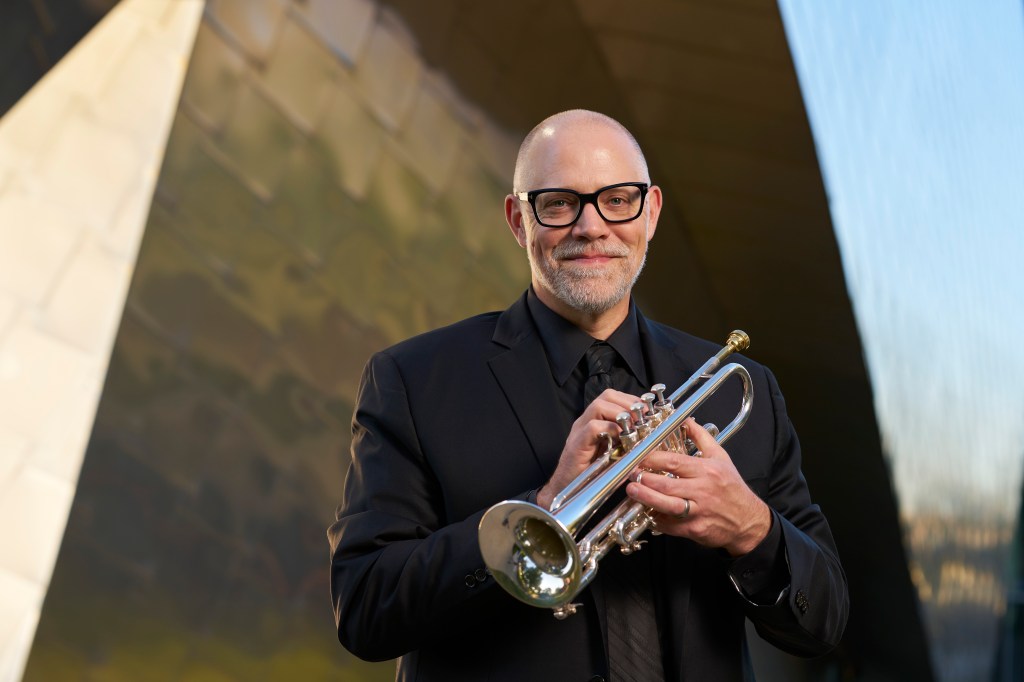
As Second Trumpet in The Cleveland Orchestra, teacher of trumpet at Baldwin Wallace University, and with many other musical projects underway, I am grateful to Jack Sutte for his time in this thoughtful interview.
It looks like you come from a very musical family! Can you talk a little about your early musical influences and your journey to eventually settling on the trumpet?
I am more and more thankful for how my parents and teachers ushered me through those early years of music study. As a parent myself, I look back and am amazed at how they managed everything, especially after my father had a catastrophic stroke when I was 13. My parents sacrificed a great deal for my sisters and I to have music lessons, which included dance, voice, violin, and our choice of a woodwind or brass instrument. Music was always at play somewhere in our home. The branches of my musical tree are not singular, but rather an intertwined network of loving and generous family, friends, and teachers.
Although a bassoonist, my father, John, also played piano and accordion in addition to being a music educator. I remember excerpts from Smetana’s Bartered Bride being whittled away in our living room. He played in the Waukesha Symphony, and I remember attending those concerts with Bach’s sour candies in my pockets. (I learned quickly how loud plastic candy wrappers are!) In retrospect, those concerts impressed upon me a love of symphonic sounds. I also remember playing violin and trumpet duets with my dad with his accompaniments on both keyboard instruments.
My mom, Nayce, whose keen ear and attention to detail were always present, is a retired Wisconsin state-award winning music educator. She taught piano lessons, too. My “Grandma Dot” helped immensely by driving me everywhere when my mom went back to work. Grandma Dot moved in with us following my dad’s stroke and heavily influenced by musical immersion. Michael Sukawaty, who taught music in the same school as my mom, was always present to help and support my musical growth. Michael, who also plays piano, and I often played duets, and he became my de facto dad after my father’s stroke. He has been very influential in my musical journey.
My teachers in Oconomowoc’s Greenland Elementary School were Dwayne Block (band), Mary Petersen (general music with a notable Kodaly influence), and Fred Schwarz (orchestra). They were all super supportive of my violin and beginning trumpet studies. I remember playing the first movement of the Bach Double (BWV 1043) with Mr. Schwarz and wrestling with the bass recorder in Mrs. Petersen’s class. Mr. Block introduced me to my first trumpet solo, but now that I hit 50 years, I cannot remember the name of it. However, I do remember a blue and white cover and a lot of G’s resting at the top of the staff. My middle school band directors were Tanya Broiles-Brouillard, Rick Grothaus, and David Reul. They were supportive and artistically demanding in those awkward teenage years. I wrestled with dental headgear, proving just enough to get some teeth pivoted but avoiding orthodonture. I cried heavily leaving Dr. Bitner’s dental office with the thought of large metal chicklets, wax and flower arranging tape. Nevertheless, I have persevered with slightly crooked teeth! Mr. Reul offered my first opportunities to solo withband and Maid of the Mist remains one of my favorite cornet solos, as does the trio, Bugler’sHoliday.
I had already been studying violin with Patricia Anders, following my Suzuki method beginning with Doris Nadolny, and in addition to the Oconomowoc band program, I played in the Music for Youth (MFY) program which is now the Milwaukee Youth Symphony Orchestra (MYSO). Margery Deutsch, Shelby Keith Dixon, and Fran Richman made great impressions and were incredibly supportive. During my seventh-grade summer, I went to the MFY summer music camp with both my violin and trumpet in tow, just in case, and left with a desire to study only trumpet. The trumpet was my father’s Conn Constellation from his music education classes at college. Not knowing much and unwittingly, I quickly figured out a few things on the trumpet like how to play above the staff. Following the desire to study trumpet with a private teacher, we found Dr. Patricia Backhaus. She was awesome. In addition to modelling a beautiful tone, she introduced me to piccolo trumpet concertos like the Fasch, and French literature, including the Charlier etudes, the Jolivet Concertino and Tomasi Concerto. She also helped me pick out my first professional trumpets.
My high school band directors were A.J. Hoefer and Robert Franzblau. We played inspiring wind ensemble repertoire under Hoefer’s direction and the expectations for top level performances were high. My high school trumpet buddy, Jason Dvorak, was always inspiring and remains a close friend. We were inseparable. I remember our Wind Ensemble sounded exceptional. I also appreciated that while we marched, we were not a marching band perse. Our best work was established in the auditorium where the quality of our collective sound mattered.
It was with Mr. Hoefer that I had my first horse whinny opportunity in Anderson’s SleighRide and the opportunity to perform the first movement of the Tomasi Concerto at Midwest. Dr. Pat supported me through my high school summers at Interlochen, where I studied with J. Craig Davis and Michael Davison. Like my previous teachers, they too were supportive, encouraging, and a lot of fun. Interlochen is where I met the larger-than-life Larry Rachleff, and he suggested that I audition at the Curtis Institute of Music. Being from the Midwest, I naively had not heard of this Philadelphia school, as my focus up to that point was studying at Northwestern with Vincent Cichowicz. I auditioned at the Curtis Institute of Music and began my college studies with Frank Kaderabek. After that, I continued studying for my master’s degree under Raymond Mase at the Juilliard School in New York. Both Kaderabek and Mase were influential teachers, mentors, and at times, surrogate father figures in my life.
Thank you for letting me take a walk down memory lane. There are many more people to give thanks to, but all my musical influencers gracefully led me from my violin studies to trumpet. It became clear that trumpet was ascending, and violin was not. And I am grateful to all those who were part of my musical journey.
Any particular musical or trumpet heroes past or present?
I really admire the recordings of Maurice André, Håkan Hardenberger, and Wynton Marsalis.
I have always enjoyed listening to the recordings of the Chicago Symphony with Reiner, the SanFransisco Symphony with Blomstedt, The Philadelphia Orchestra with Muti, and Cleveland Orchestra recordings with Maazel. I also admire the recorded work of my teachers from Curtis, Juilliard, and Aspen, including Frank Kaderabek, Raymond Mase, and Chris Gekker. They all play with individual style. While studying at Juilliard, the American Brass Quintet (the champions of the brass quintet) became my favorite chamber music group. Alison Krauss and Nora Jones are awesome, too. I really like 1970’s Classic Rock and U2, especially live in-concert. My wife and I were fortunate to recently see U2 perform live at the Sphere in Las Vegas. It was really a compelling and moving musical experience.
You have such wide musical interests with your orchestral playing, chamber music, solo work and composing. How do you manage to juggle this and devote the required time to each discipline?
Ah yes – time management. I am always doing something and am a quintessential list maker.
I really love to practice, especially solo repertoire. The Orchestra calendar is pretty fixed, and all my additional musical interests fit in and around that schedule. I will have to add to the above list: teaching, recording work, parenting, housework, yardwork, dog care, laundry, napping, friendships, family engagements, and husbandry. I do not like being idle, so I try to be efficient and timely in everything I do. If I have a burst of artistic energy pointing to practice or composition, I try to follow it. If I have an idea or musical motif that seems fleeting, I write it down. I keep lists, lots of lists. I like to have a full schedule, but I also know when I need to rest and recharge. I take naps. There is a saying somewhere in literary history that idle hands are the devil’s workshop. I think over time, individual growth is inevitable if we learn lessons from our collective experiences. For me, while it is certainly not a perfect science, I have learned that I am the best version of myself when my life is full in a multitude of areas that are meaningful to me and those who I care about. That being said, it also helps that my wife for the past 20 years, Audra Zarlenga, is my biggest supporter and encourager. We vowed on our wedding day to always continue growing as individuals during our partnership, and to support each other in our professional and personal journeys. Having such a support system is, for lack of a better word, magical. I will be forever grateful.
From a trumpet perspective, do you have to prepare yourself very differently depending on the repertoire and the musical setting? Do you have set practice routines?
I would say my answers to both questions are both yes and no. There are hallmarks of fundamental practice which are necessities, like having all of the playing cards in a deck. I tend to shuffle those practice cards around on a daily, weekly, and monthly basis. I suppose I have my favorites that are in a more regular rotation, but I try to change things up so that I am always listening to my practice in diverse ways. Practicing the same thing every day for me is boring.
For example, practicing softly with a beautiful sound is something I concentrate on, but always in a different fashion or methodology. I enjoy practicing Franquin, Petit, Clarke, Colin, Harris, Thibaud, Irons, Jacobs, Spaulding, Schlossberg, André, Nagel, Vacchiano, etc. – they all have written compelling and inspiring books. I like scales and arpeggiated patterns, slurred and articulated, that extend the registers, ascending and descending. I like to improvise patterns to test my knowledge of the scales. During the pandemic, in order to learn something new, I concentrated on Thibaud’s double pedal tones. I’m still striving for some sort of double C. I do not do a lot of mouthpiece buzzing (except for a few minutes in the car) as I concentrate my time on the horn. I like to practice brass trio music and the solo material I am working on – currently sonatas for trumpet and piano.
As a teacher, what are the main areas that you get students to focus on?
As a professor of trumpet at Baldwin Wallace University, in addition to instructing my students to always strive to produce a beautiful singing sound and become thoughtful musical citizens, I strive to have each student become their own teacher. It’s not about me or my journey, but it is about them and their journey. And each student is unique in their own way. I believe teaching a singing approach through the registers allows my students to ensure that their chops are set up correctly and working efficiently, so that they can enjoy a long career of playing. I aim for the same in my own practice. I also try to get the students to focus on posture, history of the repertoire and its zeitgeist, efficiency (like the concept of resting while you play), breath control, intonation, and overall musical mindfulness (blending, playing with a “warm” sound, and score awareness). Their personal and musical journeys overlap, so I also try to have my students focus on overall wellness and good health.
Jack Sutte
What have been the biggest highlights of your career to date?
Besides getting married and having two aspiring young adult teenagers, the most life changing event prior to the creation of my family was winning the second trumpet job in the Cleveland Orchestra. I am so thankful that Christoph von Dohnányi and the audition committee hired me. Playing with the Cleveland Orchestra has provided me with a wonderful professional career, access to amazing musicians and musical experiences, and frankly, a never-ending platform for planting the seeds of creativity and imagination, which are necessary lifelines for many performing professional musicians, including myself.
In this regard, I would like to mention a few performance highlights during my career. The first is the world premiere of Matthias Pintscher’s Chute d’étoiles for orchestra and two solo trumpets, with The Cleveland Orchestra, music director Franz Welser-Möst, and principal trumpet, Michael Sachs. We performed this work at Severance and Carnegie Hall, and at the Lucerne and Salzburg Festivals. I really enjoy contemporary music, and the opportunity to perform this piece was extremely inspiring.
Two other professional highlights include performing works composed by my friend and Baldwin Wallace Composer-in-Residence, Clint Needham. The first, Fractured Elements, is a concerto for trumpet inspired by the classic elements of nature and their current environmental plight. The second, Resolve, is a concerto for brass trio that was performed by Factory Seconds Brass Trio. The premiers of both FracturedElements and Resolve were conducted by Brendan Caldwell leading the Baldwin Wallace Symphonic Wind Ensemble.I also had the opportunity to perform the Hummel Concerto in E Major and the Neruda Concertoin E Flat as a soloist with CityMusic Cleveland Chamber Orchestra. Both pieces are classics.
Relative to your next question, I played Schilke trumpets for both performances (E trumpet and Eb cornet, respectively) and cannot say enough good things about Schilke’s instruments.
Can you tell me a little about your relationship with Schilke and the trumpets on which you play?
I love Schilke trumpets and everything they stand for in the industry. The company is 100% family run and has been from its inception. Schilke offers a modern look to total attention to both craftsmanship and detail. It is unfortunate that many of today’s instrument makers are owned by foreign and/or conglomerate business entities, which focus more heavily on volume rather than artistry and handiwork.
My first Schilke trumpet was the P5-4, when I was a teenager. One of the craftsmen at Schilke was the grandfather of one of my sister’s good friends. I regrettably forget this gentleman’s name, but he was part of the team that created the Cauffman radially asymmetric parabolic oval mouthpiece. (I have a 1K.) Somehow along the way, we worked out an agreement where Schilke added an additional P5-4 into their manufacturing run. I remember parting ways with my Getzen four-valve piccolo to help pay for the new Schilke. I really love this Schilke piccolo trumpet, and in high school, the P5-4 contributed heavily to my success in concerto competitions.
My second instrument from Schilke was a D/Eb E3L-4. Fast forward to my undergraduate studies at the Curtis Institute of Music, one of my father’s friends from Lawrence University,
Bruce Brown, gifted me this unique trumpet. I still cherish having and using this trumpet today. I use the D/Eb E3L-4 more as my solo and chamber music projects have expanded. The Schilke four-valve instruments sound superb, are eye-catching and unique.
Fast forward to my time in Cleveland and some more backstory… I have known Andrew Naumann, the owner of Schilke, since high school in Wisconsin. Although we were not in the same class, we had many of the same teachers. I am certain we also enjoyed similar high-valued artistic experiences in wind symphony – all of which helped propel us into our careers in music.
Andrew is a person that I admire hands-down. As a young trumpeter, Andrew peripherally showed me that it was possible to aspire to be a professional in music from Oconomowoc.
Andrew and his wife Julie purchased the Schilke company from the Reynold Schilke family and have preserved the quality and thoughtfully expanded the Schilke offerings. Their team is exceptional. Andrew is an excellent craftsman and can regularly be seen in the factory working on Schilke bells or spraying the perfect finishing coat.
I am excited about the new HDII Bb and C trumpets! Andrew and I have been methodically working on their design. Adding a new HD model seemed to fit in the Schilke series of trumpets.
To that end, the new Bb and C expand Schilke design concepts from the HD series of trumpets.The HDII trumpets incorporate an incredible seamless bell. In addition to a great core of sound and superb intonation, they have indestructible low F’s.
Also to mention is the fixed bell B3-4, affectionately known as “The Shredder.” I love it. This is a highly desirable trumpet and a must-have for anyone playing bass clef notes in the orchestra. I use my 4-valve instruments for work in the orchestra, brass trio, and solo work. Vacchiano is quoted as saying, and I will paraphrase, the D trumpet is the trumpet of the future. I think 4-valve instruments (Bb and C, and D!) are the instruments of the future. You heard it here first!
Any exciting new projects in the pipeline?
Yes, there are a few I would like to mention. Beginning in 2019, I wanted to do something new and challenging for my practice and devised the SonataPalooza Project– based on the Sonatenabend (evening of sonatas). The initial idea was to perform and record twelve sonatas over four concerts in ten days. The first two volumes of SonataPalooza I – Mettle, are released on CD and streaming platforms. Volumes I and II include sonatas by Kennan, Pilss, Mittner, Hindemith, Shapero, and Ewazen. Volumes III (Flor Peeters, Halsey Stevens, and George Antheil) and IV (Jean Hubeau, David Loeb, and Leo Sowerby) should be out in 2024.
SonataPalooza II – Regale, which includes another twelve sonatas, will follow in four additional volumes of three sonatas each in 2025. SonataPalooza 2.5 – A Fairly Fanfarish Sonata Set, includes sonatas written for solo trumpet. SonataPalooza III, An American Collection, will obviously feature sonatas by American composers, including my work for trumpet and piano, Travels. This third collection continues to grow. I am also strategizing a SonataPalooza (IV) with organ. I have an audacious goal of recording the sonata canon for trumpet and piano. Who does not love a palooza?!?
Another collection of solo pieces that I recorded during the Covid-19 pandemic, titled Litany ofBreath, after the piece with the same name by David Sampson, is also waiting to be produced.
My dear friend, Robert Pound, who is a fantastic composer, conductor, and professor at Dickinson College, is writing an epic work for trumpet and piano, T’iaxe Salphinx (The Trumpet Shouts/Cries). It is based on Homer’s Iliad using a modern adaptation of Ancient Greek musical principles in a setting of the original text. And finally, Factory Seconds Brass Trio is set to release Regifted, a clever collection of Christmas arrangements for the 2023 holiday season. Please visit www.jacksutte.com and www.factoryseconds.org for more information. Please stream our music on your favorite platform. If you would like to purchase a CD before they become extinct, please contact either website.


 Mouthpiece Online