By guest contributor Justin Comstock
Jazz trumpet for beginners can feel like several challenges arriving at once: making a sound, learning fingerings, keeping time and deciding what to play. You do not have to solve them all in one practice session.
Start with listening, a comfortable sound and three notes you can turn into music.
Begin with a small set of notes you can play comfortably, listen to the music that interests you, and give each practice session a clear purpose. If you already play trumpet but freeze when someone says, “Take a solo,” the same approach can help you start exploring improvisation.
I came to trumpet after 28 years of playing guitar. Listening to Chet Baker and Miles Davis made me curious enough to become a beginner again. My understanding of harmony came with me; the ability to express it through a trumpet certainly did not. Working with small ideas gives me a manageable meeting point between musical knowledge and a new instrument.
The following exercises are original practice examples. They are intended for players who can already produce the notes comfortably, including experienced trumpet players who are new to improvising.
What should a beginner learn first?
Start with sound, comfortable note production and a steady pulse. A trumpet teacher can help you establish the physical fundamentals and choose material that fits your current range. Alongside that work, you can listen, hum melodies and explore simple rhythms from the beginning.
If you cannot yet play several notes reliably, start by clapping the rhythms below or humming their shapes. Move them onto the trumpet as your sound and control develop. Keep your normal fundamentals practice alongside these musical exercises.
Do you need a special trumpet to play jazz?
A standard B♭ trumpet is a suitable starting instrument. Begin with a playable instrument and a comfortable setup; you can explore mutes and other sound choices later. A particular mouthpiece will not supply Baker’s phrasing or Davis’s musical judgment.
Useful practice tools are simple: a metronome, a way to listen to recordings, and a way to record yourself. A teacher can help you decide whether any equipment adjustment is actually needed.
Start with three notes you can play comfortably
Use written C, D and E in a comfortable register. These are the first three notes of the written C major scale. For now, practice without a backing track, using a metronome at a relaxed tempo, such as 60–80 beats per minute.
Keep the sound easy and the rhythm clear. Take a breath between attempts. The goal is a short phrase you can repeat with control.
A note about B♭ trumpet: all note names in these exercises are written trumpet pitches. Written C sounds concert B♭. If you later add accompaniment, use a concert B♭ major chord or vamp for these written C-major examples. A concert C backing track will not match.
Exercise 1: Give three notes a clear rhythm
In 4/4 time, play this two-bar idea:
| Bar | Beat 1 | Beat 2 | Beat 3 | Beat 4 |
|---|---|---|---|---|
| 1 | C: quarter note | D: quarter note | E: quarter note | Quarter rest |
| 2 | D: quarter note | C: quarter note | Quarter rest | Quarter rest |
Count four beats in each bar, including the rests. Repeat the phrase a few times, then change just one feature. Hold the first C for two beats and omit the D, for example. Or replace the final C with E.
This example uses quarter notes, so you do not need to negotiate swung eighth notes yet. Listen for a steady pulse and a recognizable shape. Three notes alone do not define jazz, but limiting the pitches frees your attention for rhythm and phrasing.
Exercise 2: Ask a question, then answer it
Keep the same notes and try a four-bar conversation:
- Bar 1: play C, D and E on beats 1, 2 and 3; rest on beat 4.
- Bar 2: rest for all four beats.
- Bar 3: play E, D and C on beats 1, 2 and 3; rest on beat 4.
- Bar 4: rest for all four beats.
The second phrase answers the first by reversing its direction. On your next attempt, repeat the first phrase as the answer instead. Then invent a different answer while keeping something familiar: the rhythm, the starting note or the direction.
Keep counting through the empty bars. Silence belongs to the form. It also gives you time to breathe, listen and decide what comes next.
Exercise 3: Connect a triad to a phrase
When the first exercises feel comfortable, switch to written C, E and G: the notes of a C major triad. Choose a register in which all three notes speak easily; stay with C, D and E if G is not comfortable yet.
Over a matching major chord, these triad notes give you the root, third and fifth. Try E on beat 1, G on beat 2, and C held across beats 3 and 4. Rest for the next bar.
Repeat the rhythm with a different note order. You are practicing a relationship between a chord and a melodic idea, rather than running an arpeggio automatically. This is a single-chord exercise; it is not a substitute for following the changing harmony of a complete tune.
Listen for one thing at a time
Bring that same focus to a recording you love. On Chet Baker’s Chet or Miles Davis’s Kind of Blue, choose a short passage and listen first for rhythm. Where does a phrase begin? How long does it last? What happens in the accompaniment while the trumpet pauses?
Sing or hum a small idea before trying to find it on the instrument. Start with a fragment you can hear clearly. The aim is to connect your ear with your playing, without turning an entire solo into tonight’s assignment.
Baker and Davis have distinct musical voices. Listening closely to either can offer more than a general instruction to “play fewer notes.” Listen for how the notes relate to the pulse and to the musicians around them.
A short jazz trumpet practice routine
After your usual warm-up, use this roughly ten-minute session, with pauses as needed:
| Time | Focus |
|---|---|
| 2 minutes | Listen to a short passage and hum its rhythm or contour |
| 2 minutes | Repeat the three-note phrase with a metronome |
| 2 minutes | Play a question and answer, counting through the rests |
| 2 minutes | Explore C, E and G over a matching major chord, if comfortable |
| 2 minutes | Record one short attempt and listen back |
On playback, choose one thing to notice: steady time, a clear ending, or whether your second phrase relates to the first. Keep the next practice goal equally small.
You can expand the note choices and harmonic setting later. For today, make one phrase you recognize, repeat it intentionally, and change it in a way you can hear. That is a worthwhile beginning.
Try the building blocks in JazzValve
I built JazzValve during my own transition to trumpet to bring scales, triads, trumpet fingerings and audio playback into one practice resource. You can explore its free material alongside these exercises.
Mouthpiece Online readers can also access the dedicated seven-day JazzValve Pro offer: Explore JazzValve Pro through the Mouthpiece Online reader link.
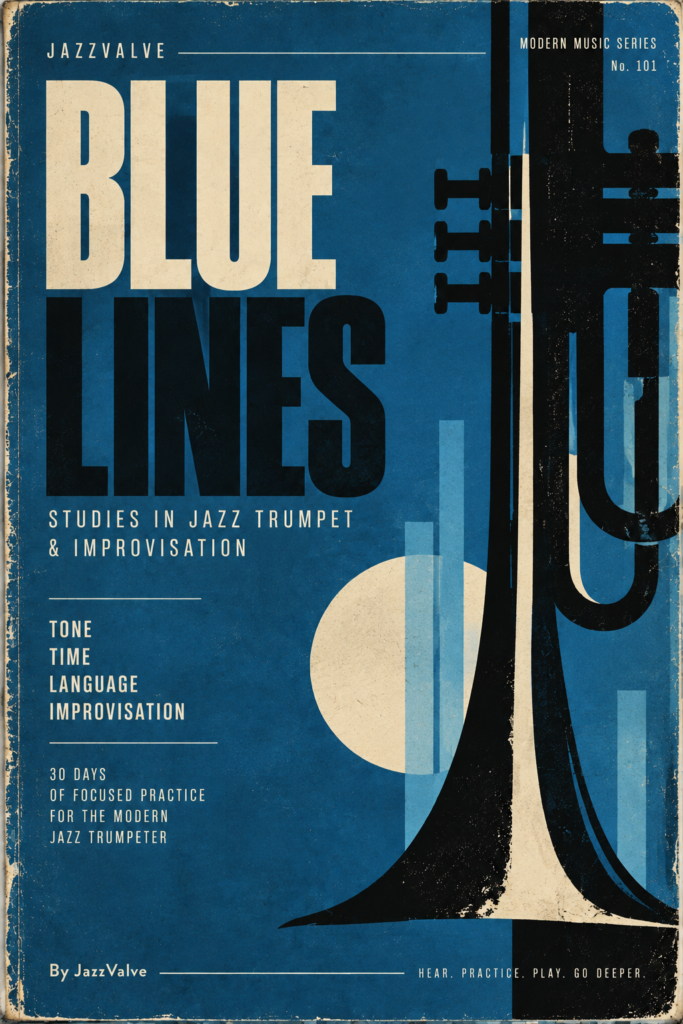
Try the free Jazz Trumpet Workbook “Blue Lines“:
Who It’s For:
B♭ trumpet players beginning jazz improvisation. It is meant to sit alongside your teacher’s fundamentals routine. The core examples stay near written C4–G4, and every example uses treble clef and written trumpet pitch.
How the 30 Day Plan works:
Each day is about five minutes after your usual warm-up: one minute to hear or sing the idea, two to play it slowly with rests, one to change one thing, and one to record or reflect. You don’t need to do 30 days in a row. Repeat a day whenever you need to.

About the author: Justin Comstock is a guitarist of 28 years, an adult trumpet learner and the founder of JazzValve. His interest in jazz trumpet grew through listening to Chet Baker, Miles Davis and the jazz recordings of the 1950s and 1960s.