Advice · Education · Interview

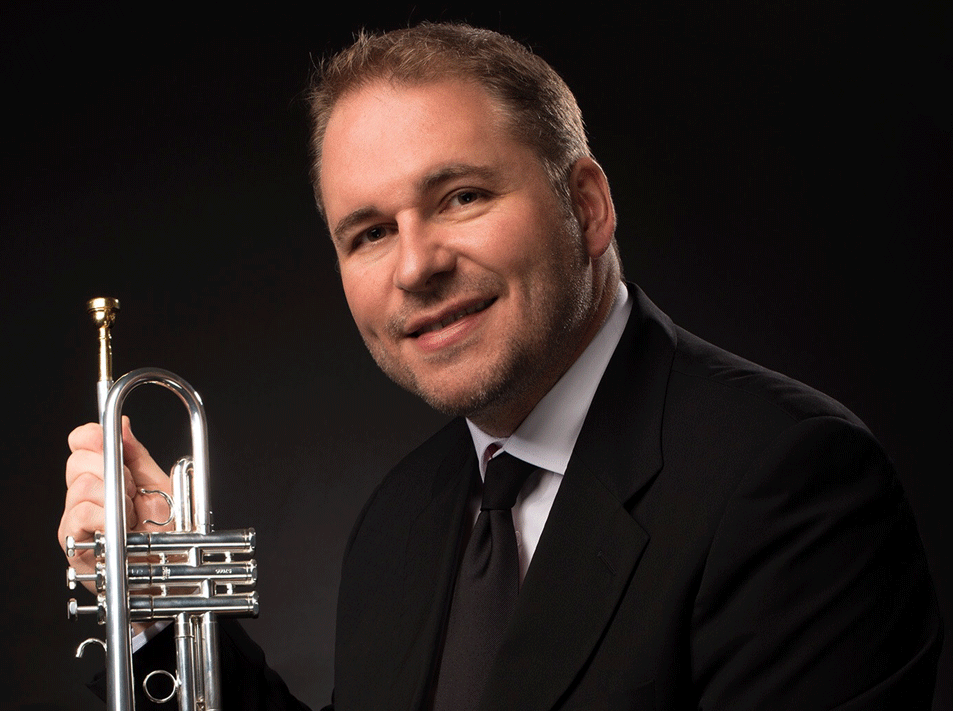
Trumpet Artist Profile : Eric Aubier

A renowned soloist and educator, Eric Aubier is held in the highest regard by musicians around the world. He talks to me here about being a child prodigy and breaking into the industry at a young age, his trumpet heroes, his glittering career so far, and the challenges that we must all face up to as we navigate our way through this global pandemic…

Can you give a little background to your relationship with the trumpet? What were your early influences?

It could be summed up with this statement: “I did not choose the trumpet; it was it who chose me”.

In fact, I started the trumpet by pure chance! I come from a modest background and we lived in a working-class suburb of Paris. My parents were looking for a cultural activity to do during the schoolchildren’s free day in France. It turns out that we had a neighbour in our building who brought his children to our city’s music conservatory, which had just opened. I started doing music theory with my older brother for several months. I was 6. When the principal asked us to choose an instrument, my parents didn’t have the money!

So it was not possible to buy! Luckily, a neighbour had an old Couesnon trumpet in a cupboard at his house and he offered to lend it to us. My brother and I started like this! Also, there was no trumpet teacher and we started with a horn teacher.

At that time, I had no notion of music and was not particularly attracted to it! I just obeyed my father who was rather bossy! The beginnings in music theory were difficult, I did not understand anything, but on the trumpet, it worked straight away! It was easy for me! This is the first contact with the trumpet. So, it was not the trumpet that I liked but more the fact of being highlighted. I saw my father’s satisfaction there. Obviously very early on I was made aware of the great master of the trumpet Maurice André and I started listening to his recordings on vinyl records.

You could say that all my early years were influenced only by Maurice André.

In conclusion, in this time I did not particularly like the trumpet or the music but the importance it gave me. I really discovered the music and the instrument much later.

When did you decide that you wanted a career in music?

It’s very simple, never! It just happened on its own, without having to think about it as if there couldn’t be any other way. This is due to the fact that I joined Maurice André at the CNSM in Paris very early on. I was barely 14 years old. I got my Trumpet award when I was just 16 years old (Masters equivalent today).

In fact, in my youth, I would have liked to do scientific work. I was very interested in sciences like astronomy, molecular biology, nuclear physics, all things in the world infinitely large and small. Later, I almost became a racing driver or restaurateur! But this is another story!

To sum up, I didn’t choose the profession of musician, it’s not that I was against it because it worked pretty well for me, but I would never have dared to tell my father that I would like to do other things. So, the question never really arose.

What styles of music have you listened to most over the years?

My early listening was for years mainly Maurice André but also Sydney Bechet and Louis Amstrong. I actually listened to what my parents bought or liked! It wasn’t until my teenage years, when I attended the CNSM, that I was introduced to other genres of music by my classmates.

It was the heyday of Bill Chase and Maynard Ferguson who became my “secret” idols hahaha. I loved Count Basie and the big bands too.

I can say that I really “discovered” music when I entered the Paris Opera, I was 19 years old. Then I traveled to many countries, entered trumpet competitions and discovered other worlds and other paths that made me who I am today. Now I love the violin, I love lyrical art, jazz in general but especially to compensate for my frustration of not being able to express with my trumpet what can be expressed with a violin, a human voice or a freedom of improvisation whether in phrasing like Clifford Brown, in colour like Chet or Miles or in the humanity in Armstrong who remains for me the undisputed master.

After breaking through into the profession at a young age, were there any particular challenges that you faced? Would you do anything differently if you had your time over again?

The answer is yes, twice! I arrived in an adult world and I was still a child or almost, I only had social relations with my parents or almost and it was very difficult both in my beginnings at the CNSM in Paris and when I started to work in the orchestra. I was not prepared.

As everything had been easy for me at the start, I came up against the “real” world, that of rivalry and competition. There is no empathy but the harsh reality on the ground.  At the time, few very young people like me (as a trumpeter), if any, had faced this kind of situation. Today it’s very different, a lot of young people reach a high level very quickly and have learned from the experiences of people like me.

I found myself without a teacher very early on and suffered greatly from this loneliness. I was set apart. I had to do it myself.

Looking back, yes, I would do it differently now, but I had neither the idea nor the possibility at the time. It was the time when everyone wanted to be Maurice André, to look like Maurice André.

We were considered by foreign trumpeters as privileged to have the chance to rub shoulders with the Master. Of course, I never thought of going anywhere else because we felt like we had the “best” here! Yet this is what I missed in my studies in my opinion.

In demand as a soloist and educator, how do you manage your practice routines? Do these stay the same or do they change drastically depending on what you are working on?

I gradually built my practice routines with my personal experiences and especially with my students. I started teaching at 17! I had time to experiment a lot! In the 1980s I was a colleague of Pierre Thibaut at the Paris Opera Orchestra and as Pierre only spoke of methods, mouthpieces and trumpets, I was able to know a lot of things without asking anything hahaha! That was all that he talked about! As I teach a lot, I mainly work on routines, technical, warm-ups with the students. I don’t change my routine much, but my exercises are numerous and have a wide field of action.

So, I would say that depending on my performance in concert, I manage differently by increasing or decreasing the ranges of certain exercises and choosing the most appropriate.

Can you take us through some of your career highlights?

I have flashbacks coming back to me. I don’t know if these are the most emblematic, but they are the ones that I have not forgotten, and which obviously marked me.

A Christmas mass that my primary school principal had asked me to do with him (he was an amateur lyric singer!) and who gave me some coins at the end of our performance saying “Here is your first fee!”. I was 9 or 10 years old!

My first real solo concert with the conservatory orchestra on April 28, 1972, I played Haydn on C trumpet. In fact, I didn’t have any others …

Concert at the Salle Pleyel in 1974 with the Philharmonic Radio orchestra! I played Hummel still in C!

Recording of my first CD in 1987 with the Paris Bastille Opera Orchestra with Marius Constant.

My recital with percussion (Heptade by Jolivet etc ..) in Santa Barbara at ITG 1989.

My tour of 40 concerts in the USA with a French chamber orchestra in 1988.

Recital with the only piano available completely out of tune in Douala, Cameroon in Africa.

Concert at Theater Colon in Buenos Aires, Argentina in 1995.

My recital at the ITG in Long Beach in 1996

My meeting with James Watson, whom I loved.

My concert with organ (Thierry Escaich) and 235 trumpeters that I conducted at Suntory Hall in Tokyo in 2010

Concert in the El Jem arena in Tunisia in front of thousands of Muslim faithful (Obliged to wait after the 1st movement of Hummel because it was the time of prayer) I ended up without light because the sun had set!

But above all, to have a family in a lot of countries around the world thanks to my students.

Can you talk a little about the horns and mouthpieces that you play, and the process of working with Yamaha to find the right setup?

Music for me it is less a rigid art than a philosophical allegory!

I find this symbolism in the Yamaha instruments that I have been playing for 20 years now. They are technically reliable, potentially full of color and nuance but if they were to have only one quality, I would say they are … unconstrained and liberated, they know how to accompany you in the effort but also know how to be forgotten to allow full artistic expression to develop. However, not everything was perfect at the time, but Yamaha has always had the concern to develop its instruments by synthesizing all the requests of artists on the 5 continents.

We can say that Bob Malone’s commitment was decisive. Yamaha, for example, today has one of the best C-trumpets in the world, if not the best!  Anyway, I sincerely believe they have the best, most consistent and homogeneous line of trumpets in the world. The engineering process really evolved with the artist models of Malone. I did not intervene directly in the development process of the instrument but indirectly asking for years to make me Malone lead pipes for my instruments! They finally heard my requests and Yamaha hired Bob!

Bob had made the trumpet for me in the past and prior to my collaboration with Yamaha I only played instruments that were reworked or made by him. In fact, at the start of my collaboration with Yamaha I continued for a while to play the C Yamaha trumpet with an MC2 lead pipe.

Regarding the mouthpieces, with me it’s very simple! I have been playing the same C and B flat trumpet mouthpiece for 35 years now.

I have recorded almost all of my records with it. It was made by a real master: Toshiaki Kameyama. He was working for Yamaha in Germany at the time.

My first quality criterion for a mouthpiece is above all the homogeneity in the range without any compromise on the sound and whatever the technical difficulty. 

I think this mouthpiece is very multi-skilled, both for orchestral and solo play. It was designed on this basis. It can give a lot for those who know how to demand perfection.

Besides my old mouthpiece, I play new mouthpieces that Kameyama made for me for piccolo, E flat, D trumpets…

How have you managed during this global lockdown? How do you think that musicians are going to need to adapt in the future to deal with may be a very different musical world?

Like the whole world, we have all been surprised by the pandemic and the strictness of the new measures taken by the various governments. In France there is lockdown as in many other countries!

This created a state of bewilderment and putting us into this state unknown to almost everyone.

For us musicians it is clear that our activity was and is still being questioned, leading us to ask ourselves questions about our future.

Paradoxically, this experience could be beneficial in the long term! In fact, I have been wondering for several years about the evolution of our profession. We can see that things have evolved considerably since the 1980s and that our profession is in decline overall. During my studies and in the early days of my career, the world has changed a lot. We can no longer compare the situations of a musician starting his career today and when I started mine for example.

With this pandemic “adventure”, it may well be that we are rushing things because it is certain that the world after will be different.

As in all of human history if we are to survive, we will have to adapt! I think this situation is not new if you look at the history of the world. Regularly, particularly with technological advances, professions must evolve. We have to constantly reinvent ourselves in fact. The problem is that today everything is going very fast, too fast and if we don’t anticipate we can disappear quickly enough! For us musicians and trumpeters, what solutions do we have? Of course, all is not over and that concerts will still exist after this crisis, but it is clear that the trend is towards a certain decline in the performing arts with or without a pandemic! Today it is more complicated to move people, the average age in the “classical” concert is still very high. It becomes very difficult to fill the rooms.

During the lockdown we saw loads of people coming together to create virtual recordings. Videos of this type have invaded the web. I myself have initiated projects and participated in others. We have all done, and even now, lessons by videoconference on Zoom or whatever. Everyone had fun with it! However, is this the future of our profession? I am not sure … 

Today we see flourishing the first virtual concerts broadcast on the net or the broadcast of programs recorded in the form of virtual performances. Is this the future?

For me, this is only part of our future. We still have to reinvent the essentials! Because if we transpose our business “from before” to other broadcast medium without changing anything, the result will not be much different in the end.

This means that for me, with or without a pandemic, the essential remains to be reinvented. As for starting the crisis, I asked my students to do a short essay on the future of our profession with the new components of distancing. Well, none of them did! I think they are not really aware of all of this.

In short, adaptation to technological tools and their uses is necessary, but it is only the means of transmission and not the crux of the matter.

Suggestions: For me the first concern is our teaching methods which are used most of the time to make instrumentalists, technicians, even “musicians”, forgetting that our future could be in the education of the public. The idea is to “build” enlightened people capable of discernment. If we browse the new media (Facebook, Instagram, YouTube) we find anything and everything! However what will determine success is the number of likes or views! Would the great soloists of yesterday turn into a Youtube artist manager? I believe their talents would not be enough!

The profession is therefore transformed into something other than purely artistic musical talent. We are in the world of imaging, 20 or 30 years ago it was almost exclusively the sound business. The technological component takes up a lot of space, but not only that. The business strategy too.

You have to recompose everything taking into account these different parameters. If you look at the “internet artists” who work or succeed today, they are nothing to do with our “soloists” from a few years ago.

Secondly, it is clear that for me, being exclusively a performing is no longer a viable future.

Basically, what interests’ people is to show a universe that is unknown to them. In our profession we reproduce a lot because the majority do what already exists. And finally, few people are able to make a real difference between the performers. The difference no longer makes on the quality because we no longer recognize ourselves in it. It is therefore necessary to evolve and personalize more than before. We must learn to exist not only with our quality of playing the trumpet but to know how to use the components of our personality to include them in our proposals. We must become as much “actors” as musicians. We can see the trend today! The evolution is more based on the looks of the performer. Obviously on a certain side because today we sell images and not just sound.

It would therefore be necessary to evolve knowing not only to offer a good performance but an entire universe in which you will be recognised by everything that makes you unique.

What other advice would you give to young and aspiring trumpet players?

I would tell them:

First, know who you want to be! Obviously for that you already need to have a certain open-mindedness and awareness of the world around you.

If you are looking for yourself, which is okay, start by thinking about who you would like to look like! Often students ask me, (to do a Masters abroad for example) who should I go to see or who could I go to see? I can’t understand this question! I answer them, who would you like to look like? Who do you admire among the existing personalities? Here is the answer! If you want to become a musician “by default”, that is to say, I study to get my diploma and I find a job to live quietly until the end of my career – so change your mind – there will soon be no space for these attitudes!

Think and anticipate! How? Listen to the world around you. Therefore? Travel!

Motivation is the main engine, it’s what starts everything! If you run out, find out why! If you can’t find it, change path!

Take advantage of the time of your studies to try to open yourself to as many things as possible, not just the trumpet and all the theoretical courses that go around. Other disciplines, other art forms or even sports or sciences.

Learn the art of challenging right from the start! Take part in promotional contests.

Know how to spotlight your talents. Be aware of who you are, what are your strengths, your weaknesses!

Have goals, feed on your dreams! Believe in what you are doing. Belief is power! Finally, perhaps the most important: Dare! Everything is impossible until you try!

Summary: 

Dream! Believe! Travel! Dare! 

If you do all this, you will emerge a real personality and a unique being, whatever your modes of expression are.

What are you working on at the moment?

As I mainly play abroad, the concerts have stopped for me not being able to travel at the moment. However, I continue to practice as I hope to be free again soon!

Institutionally I continue to teach mainly at the Haute Ecole de Musique in Lausanne in Switzerland.

I am waiting to be able to travel again to teach at Nagoya University of the Arts in Japan, Shobi College of Music in Tokyo as well as the Royal Academy of Music in London where I am a guest professor.

In private education, I developed my own trumpet institute where I specialize in coaching. I have given so many “classical” master classes all over the world, and today I am trying to evolve. I use my experience, notably acquired as a jury member in a large number of international competitions over the past 25 years, to manage students and prepare them as best as possible for both international and positional competitions. So, coaching to be as close as possible to the control of one’s full abilities.

I’m still recording! I have a CD of “Belle Epoque” style cornet pieces which will be released in a few weeks, a project on the works of Julien François Zbinden and a little later a project around Bach.

For more on Eric, please visit his website: http://www.eric-aubier.com

For more on the range of Yamaha trumpets that Eric plays, please visit: https://europe.yamaha.com/en/products/musical_instruments/winds/trumpets/index.html


Sign up here for new blog articles emailed direct to your inbox:

[jetpack_subscription_form show_subscribers_total=”false” button_on_newline=”false” submit_button_text=”Sign up” custom_font_size=”16″ custom_border_radius=”0″ custom_border_weight=”1″ custom_padding=”15″ custom_spacing=”10″ submit_button_classes=”” email_field_classes=”” show_only_email_and_button=”true”]

Advice · Gear Review · Interview

Marc Geujon and the New Schilke ‘Soloiste’

Marc Geujon is Principal Trumpet of the Orchestre de l’Opéra National de Paris.  As well being a Professor at the Conservatoire de Saint Maur des Fossés, he is growing in reputation as a soloist and educator.  September 2018 will also see Marc take up a teaching position at the Conservatoire National Supérieur de Musique de Paris. I was delighted to be able to catch up with him and also to find out about his latest collaboration with Schilke.

 What drew you to the trumpet as a child?

When I was 11, I asked my parents if I could learn music.  After one year of learning theory and reading notes, I asked the music school if I could try trombone.  The music school director answered, “There are no more trombones available, you will learn the trumpet…!”.  I began with a non-professional teacher in my village.  One year later, I passed an audition to enter the regional conservatory.  The trumpet teacher didn’t want to take me in his class, because my sound and level were so terrible, and he told me to learn the tuba.  I refused…  He said, “Ok… stop playing during the summer and we will start at the beginning in September.  Four years later, I graduated from the conservatory and joined Eric Aubier’s class for 1 and a half years.  After, I entered the Paris Conservatoire.

Were there any particular early musical influences, or any musicians now that you particularly admire?

As with a lot of players, my first recordings were of Maurice André.  And the CD which persuaded me to become a trumpeter was “Great French Trumpet Concertos” from Eric Aubier.

It was the reason why I asked to study with Aubier.  He taught me a lot, especially on stage.  When I was around 20, he asked me many times to play some baroque pieces for 2 trumpets or more with him (Vivaldi, Molter…) and also played the second part in Bach Masterpieces with him.  It was an incredible experience for me.

Now, I’m a big fan of Reinhold Friedrich, Matthias Höfs, Pacho Flores… As orchestral players, I love Gábor Tarkövi, Peter Masseurs, Frits Damrow, David Bilger, Michael Sachs…

https://youtu.be/Tvua70Ctjfc

Do you have a set practise routine that works for everything, or do you have to change it drastically depending on what gigs you have in your diary?  Does your practice change drastically from doing an operatic run, or a recital tour for example?

I have a practice routine that works for most of my days.  Basics from Michael Sachs Daily Routine, Plog Program, Stamp, Arban, Clarke…  It depends on the time I have to practice.  I try to think the trumpet to be as natural and easy as possible…  I work every day in that way.  The only thing very important is that I need to practice in the morning, every day.  I drive my kids to school every morning and begin my warm-up at 8:30am.

How does this change when you are travelling?

The problem is to play in the hotel room, with a practice mute.  And also the jet lag… but I try to keep my routine and to do my best despite the hours, places and climate.

When you are teaching, have you found that your emphasis has changed over the years as your own experiences and playing develops and changes?  Are there particular ‘schools of thought’ or strict ‘methods’ that you like to use with your students?

Yes, I have evolved a lot in my playing and teaching year after year.  I try to be a student in my mind every day.  I listen to a lot of music, I practice a lot of new things, I buy a lot of new books… so I try to share all my experiences with my students.

The most important thing I try to teach is “Trumpet playing must be easy”.  I have the chance to see most of world’s best singers on stage every evening.  The better they are, the easier they sing!  It takes a lot of time and practice to play with easiness, but it’s so important and useful…

Marc Geujon

What are the key things that young aspiring players should concentrate on?

Sound, rhythm, music…and practice!

What has the process been like working on new Trumpets and Mouthpieces with Schilke? Can you tell us a little about how that relationship came about and what the design process was like?

Around 12 years ago, I was in a music shop in Paris to try a Schilke P5-4 piccolo for a colleague.  Andrew Naumann, Schilke owner and president, and Phil Baughman, sales manager, were in the upper floors of the shop.  They heard me playing the piccolo and offered me a Bb trumpet t try, a B1 anniversary model. I wasn’t a fan of that model, but I tested also a C trumpet (a C3) and it was so much easier to play compare to my Bach C.  I bought it, and an X3 Bb one month later.

I met Andrew Naumann and his wife Julie several times after that, and I’m lucky to say that we are good friends now.  I have played Schilke for 12 years now (C3, X3, E3L, G1L, P7-4, C5-4, XA-1…).  When Schilke created their HD models, Andrew asked me to test them.  They were good horns, but too stiff for me.  We developed the C3HD, which was a little bit more flexible and brighter.  It was better, but I was not completely satisfied for my playing style.  Andrew and I discussed a completely new project.  A new line which keep the standard qualities of the Schilke trumpets, but with a more orchestral instrument, with a beautiful rich sound, a lot of core, brilliance, and extremely flexible.

Soloiste-Bb-Silver
The Schilke Soloiste Bb Trumpet

After 18 months of design and research, the Soloiste series was born. A new C and a new Bb trumpet, completely new…  Not an assembly of existing parts, or small modifications on existing horns…  And I can say that these trumpets are the best trumpets I have ever played.

Soloiste-C-Gold
The Schilke Soloiste C Trumpet

In February, I was at the Schilke factory to finalize the Bb Soloiste with Andrew, and I asked Chris Jones, the Schilke mouthpiece production manager for a mouthpiece which fits perfectly with my Soloiste new trumpets. He made an incredible mouthpiece for me, and the Schilke Soloiste MG mouthpiece was born…

Most enjoyable project or gig?

I can say that it’s Christmas every day for me.  I’m a lucky guy! I play in a wonderful orchestra, the Opera National de Paris orchestra, with a very nice and talented brass section.  I play chamber music with the Opera brass quintet.  I play regularly with piano or organ for recitals, and more and more with orchestra for solo concerts.

Every time I play, it is a good moment for me.  And I love to meet other musicians from all over the world to play, discuss and share…

Proudest professional moment?

Perhaps ‘Pictures at an Exhibition’ in Vienna Musikverein with the Paris opera orchestra… a wonderful moment with my colleagues.  It was a change from our usual work in the pit.

https://youtu.be/W0-lJVmsDXg

What have you got coming up that you are most looking forward to?

I would love to record CDs now.  It would be a good time in my life to do that… and I would love to travel more to play and teach French trumpet repertoire.

Thanks for your time Marc, is there anything else that you would like to add?

I would just like to thank very much my family for all the love they give me, Andrew and Julie Naumann with all the Schilke team for all their support and kindness, all the musicians I have met who have taught me something extra, and also, thank you, John for asking me these questions! 😉

Please visit Thompson Music to find out more about the new Schilke Soloiste Trumpets on the links below:

Schilke Soloiste Bb Trumpet

Schilke Soloiste C Trumpet

To find out more about Marc Geujon, please visit his website


Sign up here for new blog articles emailed direct to your inbox:

[jetpack_subscription_form show_subscribers_total=”false” button_on_newline=”false” submit_button_text=”Sign up” custom_font_size=”16″ custom_border_radius=”0″ custom_border_weight=”1″ custom_padding=”15″ custom_spacing=”10″ submit_button_classes=”” email_field_classes=”” show_only_email_and_button=”true”]

Advice · Interview

Trumpet Artist Profile: Matilda Lloyd

There are not many 22-year-olds that made it onto my list of fabulous trumpet players that I wanted to try to interview. Matilda Lloyd’s biography however, is glitteringly impressive and it does not seem possible to have achieved so much in music at such a young age!

Matilda came to prominence in the UK in 2014 by winning both the Brass Final of BBC Young Musician of the Year, as well as the BBC Radio 2 Young Brass Award. A BBC Proms solo debut followed in 2016, and in October last year, Matilda won the inaugural Eric Aubier International Trumpet Competition in France, beating off competition from 53 other top players along the way.

Graduating from Trinity College, Cambridge last year, she is now studying for a Masters at the Royal Academy of Music in London. I am grateful that Matilda could find the time in amongst her studies and trumpet engagements to share some thoughts with us:

What made you choose the trumpet as an instrument? Were there any particular early musical influences?

My Dad played the trumpet while he was at school. As a very curious 8 year old, I was rummaging around in our cupboards one afternoon and stumbled across his very old trumpet. Naturally, I wanted to have a go! As I could make a decent sound on the instrument, which isn’t easy to do, I decided that I wanted to start having lessons and that’s where the story began. My Mum is a piano teacher and accompanist, and she started teaching me the basics on the piano a few years earlier, so my ability to read music and rhythms really helped when I first started to play the trumpet.

What are some of your performing highlights to date?

I think my absolute performing highlight has to be playing as a soloist at the BBC Proms in July 2016. Walking onstage at the Royal Albert Hall to an audience of 6,000 and many thousands more watching when the Prom was broadcast on television, was one of the most memorable experiences of my life. It was absolutely exhilarating, and an experience like no other. Performing with the BBC Philharmonic, led by Alpesh Chauhan, was just incredible as I really felt the support of the orchestra and that they were following me – it felt more like chamber music than a concerto. And I was lucky enough to be able to do it twice! Aside from the Proms, another performing highlight was playing First Trumpet in Bruckner’s Seventh Symphony with Bernard Haitink conducting in his home, the Royal Concertgebouw in Amsterdam. To work with such an incredible conductor in a place that means so much to him with an audience that were so mesmerised by the performance was absolutely unforgettable.

AJM_6050.jpg

What are your long term goals after leaving the Royal Academy of Music?

My ambition is to be an international trumpet soloist. I would love to be able to expand the trumpet repertoire, both through the commissioning of new works and also the revival of forgotten works. Too often, works are performed at their premiere and then rarely played again – and I am trying to re-introduce lost works into the repertoire by recording them and playing them in my recital programmes. I would also like to do more educational and outreach work as a soloist to try and encourage more young people (especially girls!) to take up a brass instrument.

What instruments and mouthpieces do you play on?

I’ve had my Bach Stradivarius LR43 Bb Trumpet for about 10 years now! I originally wanted the more standard 37, but at the time of my purchase the UK warehouse had just burnt down and the shop didn’t have any in stock to sell! Luckily, I decided in the shop that I preferred the 43 anyway and haven’t ever wavered from that decision. I have recently purchased the new Yamaha C trumpet that I absolutely adore – it feels very easy to play. I also have a Yamaha Eb/D trumpet, and a Schilke piccolo. I play on a Warburton mouthpiece – 10* backbore with a 3M top.

You have had success in a number of high profile competitions now, while still very young. How do you manage preparing so many programmes for a gruelling competition week while also continuing with your studies and other engagements?

This is a difficult question as different methods work for different people! What’s best for me is to learn pieces well in advance. If I know I have a quiet period say five months before a competition, I will learn a few of the pieces in the repertoire during that time. This enables me to leave them alone during busier patches when I have more urgent things to prioritise. I also find that this ends up improving how I play those pieces as I always find them easier at the second time of practising them! I also always try to perform the pieces for a competition beforehand, whether in a recital or a masterclass, just so that the competition is never the first time performing the repertoire.

AJM_6435

Do you have any particular advice on keeping your chops in good physical shape during these preparations?

I recommend not doing much more than 3½ to 4 hours of practice a day. And ideally this would be split up into smaller chunks spread throughout the day for the best stamina. It is very tempting in the run up to a concert or competition to panic and do last-minute over practice, where you suddenly increase the amount of practice or the length of practice sessions. This is very bad for the lip so try to avoid this as much as possible! I would recommend tapering down the amount of practice over the few days before the performance to rest the lips and give them a chance to recover and be on top form for the day.

Congratulations on winning the inaugural Eric Aubier Trumpet Competition last October! Can you share with us any insights into what it was like going through that process in particular? 

Thank you very much! The competition was a great experience for me, particularly as I was able to share a flat with a fellow student from the Royal Academy of Music. This was an absolutely fantastic idea and I think my experience of the competition would have been completely different if I had stayed alone. It was great to have company throughout the week as it was a complete rollercoaster. With the quick-fire rounds often on consecutive days, emotions ranged from being nervous before performing, the adrenaline and high after performing, the worry about whether the performance was good enough or not, the anticipation of the results, the elation at finding out I had got through a round, the stress of having to then rehearse with the pianist for the next round on that same day, and then the nerves for that performance in the next round the next day! Having someone to share all of this with made it a whole lot easier, so an enormous thank you to Aaron Akugbo for his company and support. The competition in Rouen was an incredibly enjoyable week for me. All the other competitors were very friendly, and many of them stayed the whole week to support us in the semi-final and final, which was really lovely.

Do you have any general advice for any young players?

I just want to say something that I think will resonate with every brass player in the world! Every single musician in the world has periods or moments of self-doubt, wondering whether they are good enough or not for something, or comparing themselves to other players. So often, people are afraid to enter a competition or put themselves forward for a concert or opportunity because they are afraid that they won’t play as well as they know they can or fear that someone else will play better. All I have to say about this is that you are not alone! The only outcome of not applying for something is that it won’t happen. If you don’t apply for a competition, you can never win it. So the one thing I would encourage all brass players is to put themselves forward for opportunities and embrace them!

Please visit www.matildalloyd.com for further information and for upcoming concerts

You can also follow Matilda on Twitter at @lloyd_matilda and on Instagram as @matildalloydtrumpet 


Sign up here for new blog articles emailed direct to your inbox:

[jetpack_subscription_form show_subscribers_total=”false” button_on_newline=”false” submit_button_text=”Sign up” custom_font_size=”16″ custom_border_radius=”0″ custom_border_weight=”1″ custom_padding=”15″ custom_spacing=”10″ submit_button_classes=”” email_field_classes=”” show_only_email_and_button=”true”]