A school year looming brings with it a fresh start, and a resolution to keep instruments clean and hygienic. If you need any further confirmation of the importance of keeping your instrument clean, please read on!…
Back in August 2016, the BBC and numerous other news agencies were reporting on a journal article written by doctors at Manchester’s Wythenshawe Hospital. They described a rare but fatal case of what they described as “bagpipe lung” in a 61-year-old patient. The deceased man is thought to have developed a bad reaction to mould and fungi lurking inside the moist interior of his bagpipes.
The patient had been struggling with respiratory problems over a number of years, during which time doctors had ruled out all possible environmental causes that they could think of. On a hunch, the doctors sent away the pipes for testing only to reveal that the instrument was riddled with damp-loving mould and fungi – the types that the doctors know can cause serious lung problems.
Sadly, the damage that had already occurred to the man’s lungs was irreversible. His condition deteriorated and he tragically died some weeks later.
There have also been a number of other documented cases of this in the UK with Saxophone, Trombone and Trumpet players. Fortunately in these cases, the cause was identified early enough for the patients to recover.
So what steps do we need to take to prevent the build of yeast and other harmful pathogens in our trumpets?
Fortunately the answer to this is nowhere near as complicated as the problems faced by this patient or his doctors. Regular cleaning. Whether an instrument is being used regularly or not, the damp environment is a perfect breeding ground for all sorts of nasties.
Woodwind instruments where the instrument can be easily swabbed after every playing to remove moisture are pretty straightforward to keep in a hygienic state. Brass on the other hand is not so easily attended on a daily basis, so it is important that we flush them out and clean them thoroughly when we do make the time. I generally suggest to students that this is done monthly.
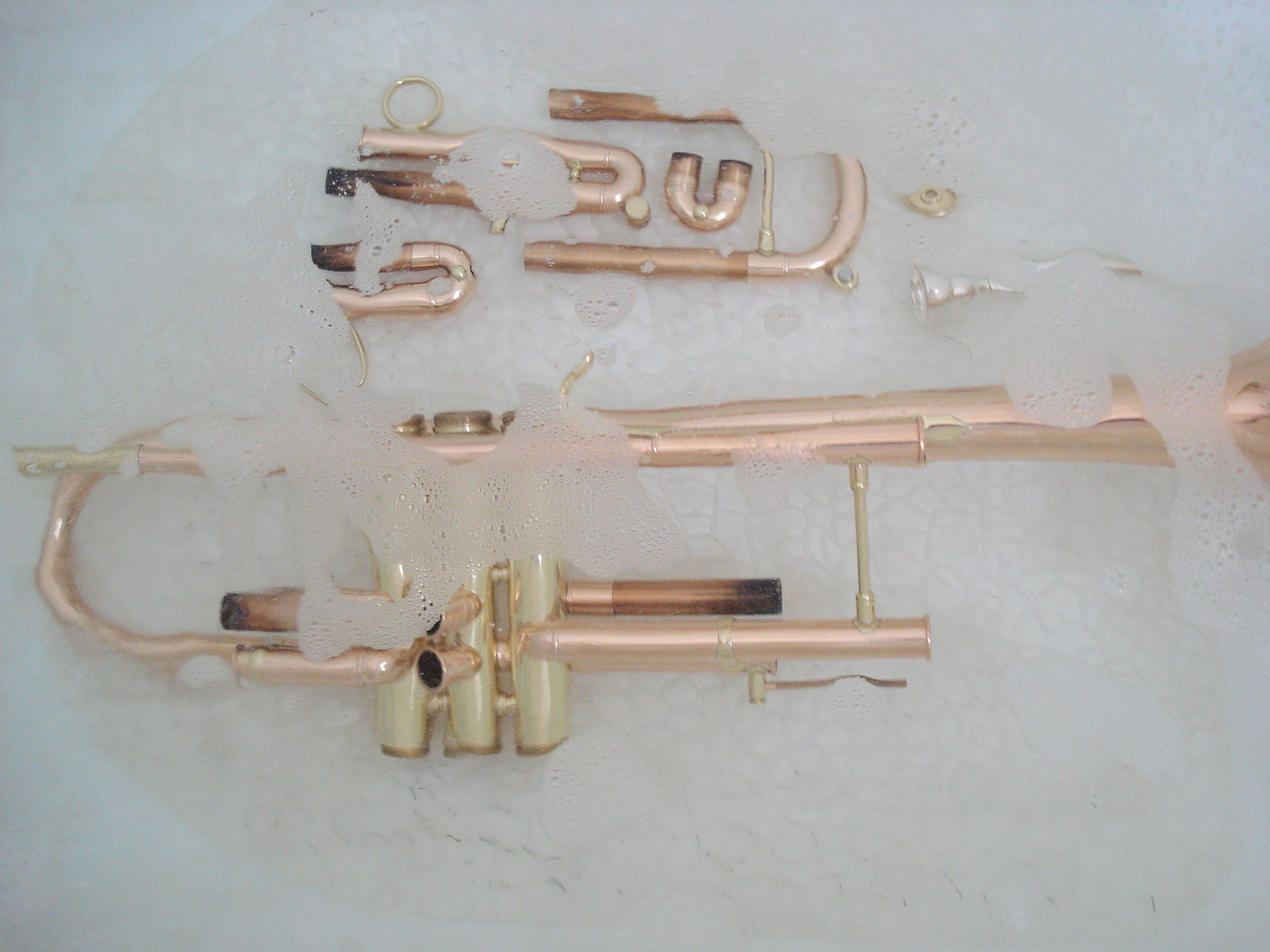
Taking the instrument apart and soaking it in a hot bath with a mild detergent is generally the best starting point to help to loosen dirt and grime.
I would then suggest a good quality brush pull-though and then a sponge pull-through to drag out the offending matter! Finally a rinse through with hot (but not boiling) water should leave your trumpet clean.
The mouthpiece itself often gets overlooked but is the easiest to keep clean on a daily basis. A good all-natural sanitiser spray such is this one pictured again from Edgware is a ‘must’ for daily cleaning of brass instruments. It is alcohol free and kills 99.9999% of all germs in 60 seconds.
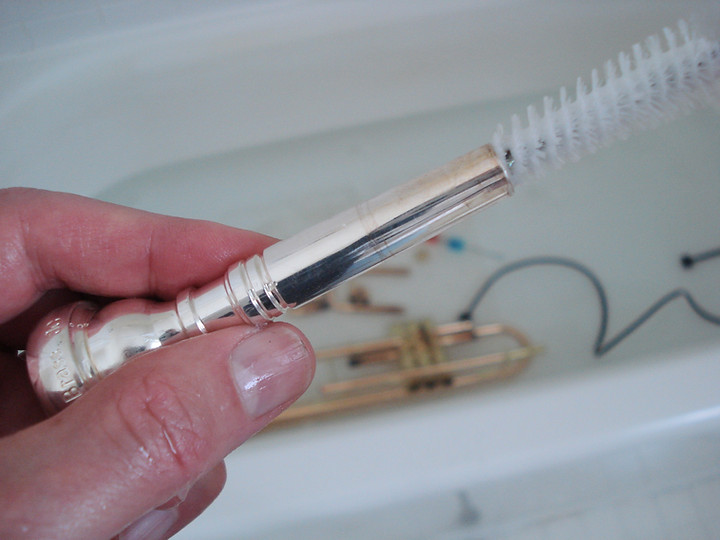
It is also worth making sure that you have a good quality mouthpiece brush. Many a mouthpiece has been damaged by the jagged and twisted wire.
I have spent a lot of time recently (mainly virtually!) working with players who have used this enforced period of time off to look at new and possibly better mouthpiece options for themselves. Many classical, and particularly specialist orchestral players are traditionally very conservative in their choices and often choose to stick to the ‘tried and tested’, even if it is not necessarily completely trusted. Often the rigours and pressures of full-time orchestral playing do not allow time for experimentation!
I have given a summary below of eight Frate Precision models that have worked really well for players looking for a rich and open core sound with great orchestral projection. Each of these eight mouthpieces however have their own unique characteristics:
Cup diameter 16.95mm, Medium deep cup, Throat 3.74mm, Medium-large Backbore #102 : Equivalent: 1-1/2C (26 throat)
This is the new ‘Easy Selection’ model with the #1 rim, and a best seller! The #1 models all have a really comfortable rim and the M (medium deep) cups seem to suit most players that I have encountered. The slightly open throat and the flexible backbore give a nice balance between core sound and flexibility. Great on both Bb and C trumpets.
1 M
Cup diameter 16.95mm, Medium deep cup, Throat 3.66mm, Medium-large backbore #101 : Equivalent: 1-1/2C
This has a similar responsive feeling to the model above, but with a slightly tighter throat and brighter backbore. Particularly good on C trumpets as well as larger Eb instruments such as the Schilke E4. This has also been a really good mouthpiece to recommend to students who have perhaps just moved up to their first ‘larger’ mouthpiece.
1 M, 3, 106
Cup diameter 16.95mm, Medium deep cup, Throat 3.74mm, Medium-large backbore #106 : Equivalent: 1-1/2 C (26-24)
This is my personal favourite, and the model that has really got peoples’ attention here in the UK. It has a nice open feel but with a really rich core sound, great stability and slotting as well as flexibility.
2 M, 3, 102
Cup diameter 16.95mm, Medium deep (V-shape) cup, Throat 3.74mm, Medium-large backbore #102 : Equivalent: 1-1/4C
Although it has the same rim shape, size and contour as the #1 models, the slight V-shape of the cup gives a very different feel and response, more similar to a Bach 1-1/4C. It retains the immense core sound and stability of the 102 backbore, and woks really well across both Bb and C trumpets.
2 M, 3, 106
Cup diameter 16.95mm, Medium deep (V-shape) cup, Throat 3.74mm, Medium-large backbore #106 : Equivalent: 1-1/4C (26-24)
This is a slightly more open feeling and sounding version of the 2 M, 3, 102. The #106 backbore gives that big core sound, but still with the level of control, response and flexibility that players need.
3 M, 3, 106
Cup diameter 16.62mm, Medium deep cup, Throat 3.74mm, Medium-large backbore #106 : Equivalent: 3C (26-24)
For players that like a narrower inside rim, but still an open feel to the mouthpiece. There are a number of well-known makers such as Monette, AR Resonance etc., that use extremely open throats and backbores to get players to fall in love with the sound. However, these infatuations are often short-lived when you realise what you have lost – core sound and flexibility. Both this model and the 1 M, 3, 106 offer the perfect compromise, giving you openness, core sound, response and flexibility.
6+ M, 3, 106
Cup diameter 17.12mm, Medium deep (V-shape) cup, Throat 3.74mm, Medium-large backbore #106 : Equivalent: 1-1/4C – 1C (26-24)
This has a wider inner rim, and a smooth V-shape cup alongside the fantastic power of the #106 backbore. This is a great full-sounding orchestral mouthpiece that has suited players moving from 1, 1C and 1-1/4C style pieces.
5+ M, 3, 106
Cup diameter 17.12mm, Medium deep cup, Throat 3.74mm, Medium-large backbore #106 : Equivalent: 1C (26-24)
The 5+ has the same configuration as the 6+, but with a more traditional bowl-shape medium depth cup. The response is similar, but perhaps with more of a roundness to the sound.
This article was originally published by Ken Saul of Ultra Pure Oils, it is clear and comprehensive so I have re-published it here! Other brands are of course available to use, but I am yet to find any cleaning and maintenance accessories that are as slick and reliable as Ultra Pure.
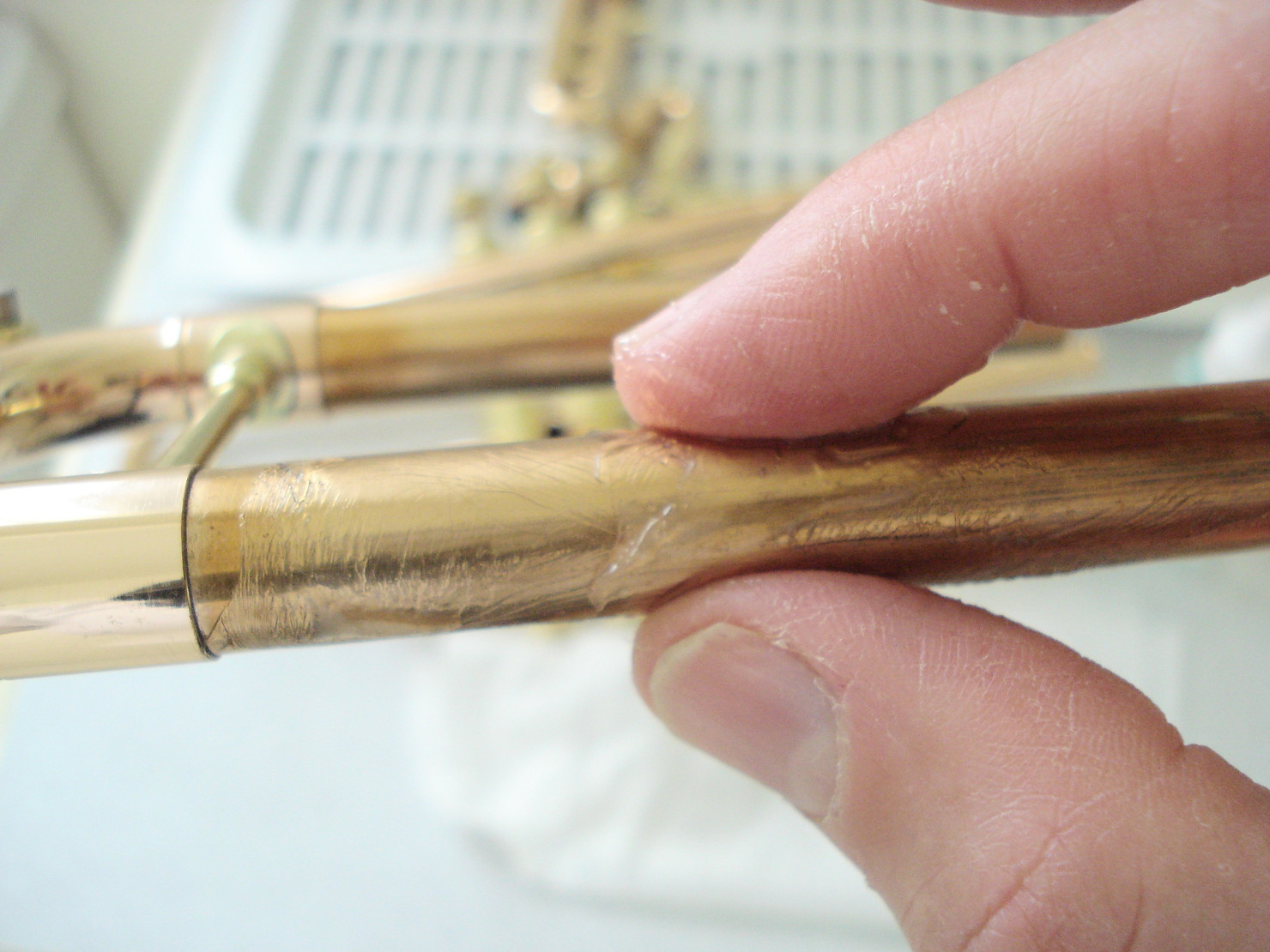
Keep your horn clean and you will never have a problem with sticky valves or slides. Keeping it clean inside also removes bacteria that can build up in the tubing.
You should wipe off your trumpet at the end of each day using the Ultra-Pure microfiber polishing cloth. Gently wipe all the surfaces, especially where you hold the horn. Wipe off any water spots. The microfiber cloth will soak up oils and grease and should be washed once a month. If you have a silver plated trumpet, you can use a silver polishing cloth to remove tarnish about once a week. Use it to wipe the outside of the instrument only.
Wipe the outside of the horn every day to remove fingerprints, water spots and oils.
Bath Time
You should give your trumpet a bath about every month or two to keep it in the best condition. It only takes about 30 minutes to do a good job.
Carefully pull out the main tuning slide and the three valve slides. Wipe off any grease on slides with a paper towel. Remove the bottom valve caps. If they are stuck, try using a rubber jar opener, not pliers. Also wipe off the bottom valve caps with the paper towel. Then remove the three valves. They are numbered 1, 2, and 3. When you pull out the valves, check which way the number faces, the mouthpiece or bell end. When you put the valves back, they will face the same way.
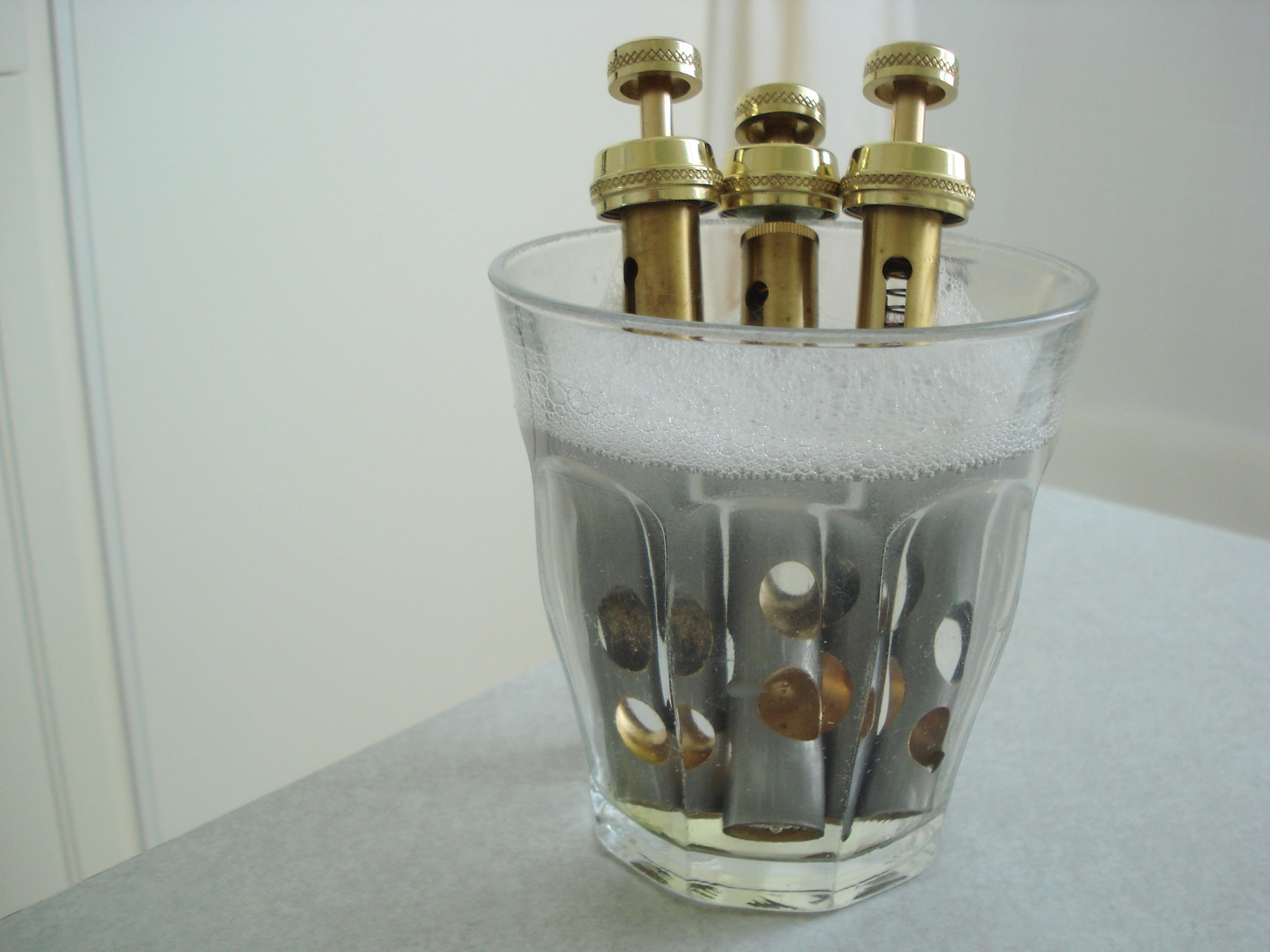
Put a rubber mat or a towel in a tub or large sink and fill it with lukewarm water. Add some lemon-scented dishwashing liquid detergent (about a tablespoon is enough). Gently immerse the trumpet, the slides, the bottom valve caps, and your mouthpiece. Put some of the soapy water in a glass and immerse the valves, keeping the felts dry. Let everything soak for 10 minutes or more.
Take the trumpet apart and soak it in lukewarm (not hot) soapy water.
Soak the valves in soapy water while keeping the felts dry.
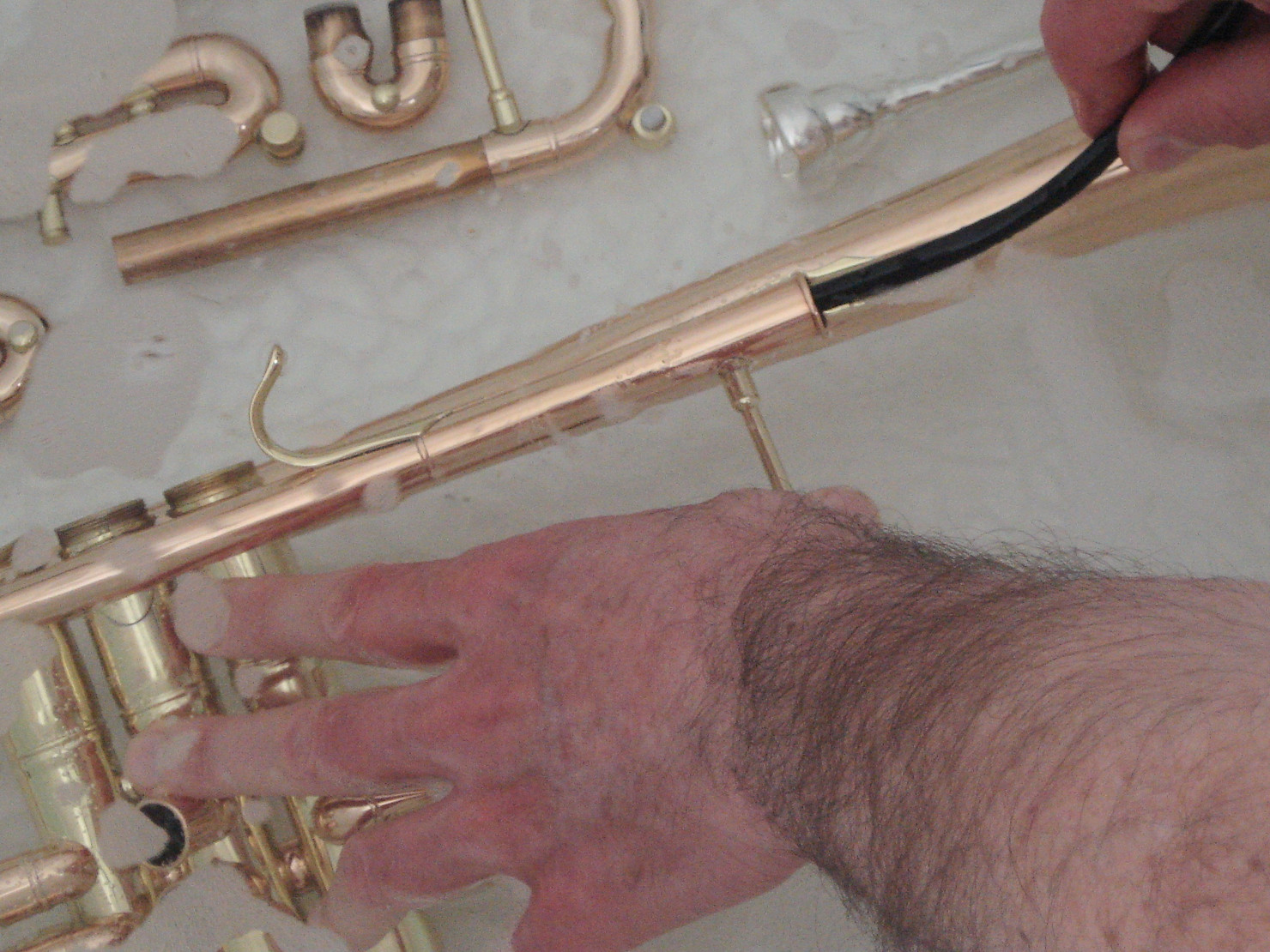
Run the snake through the leadpipe and all the trumpet body tubing several times. Run it down the bell and around the back bend. Use the snake to clean the insides of the tuning slide and the valve slides. Don’t force the snake if it does not bend around the tubing easily.
Use the flexible snake brush to clean all the inner tubing.
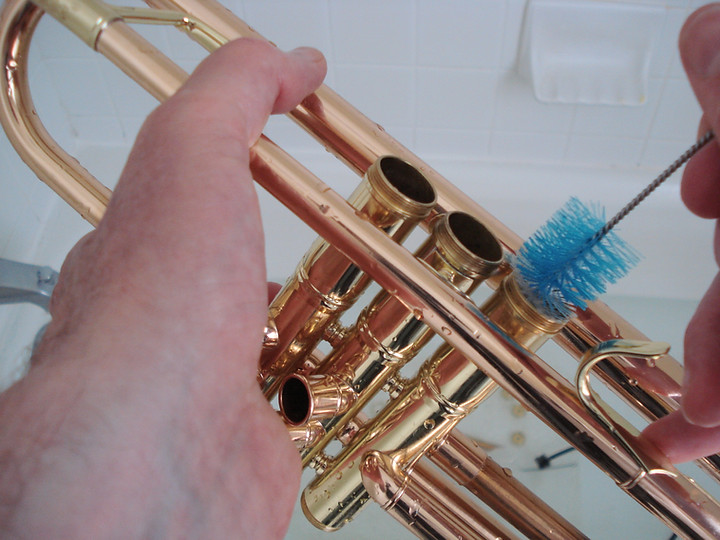
Scrub the valve casings from the top and from the bottom with the valve casing brush. Clean the bottom valve caps carefully to remove all the residues. Finally, clean the mouthpiece with the mouthpiece brush. Drain the tub or sink and rinse all the parts completely. Let them dry on a towel.
Scrub the valve casings with the cylindrical brush.
Scrub the mouthpiece with the tapered brush.
Clean the valves
Gently clean the valve ports with soapy water using the snake brush or the valve casing brush. Scrub the valve surface with soapy water using the valve casing brush or an old toothbrush. Be careful not to scratch the valve surface. Wash the valves with plenty of clean water and let them dry on a towel.
Lubricate the slides
Put a small amount of Ultra-Pure Regular Tuning Slide Lube on your finger and rub it onto the slide. Insert the slide all the way and wipe off any excess lube with a paper towel. If you are used to moving the first and third valve slides quickly for more accurate tuning, you should use Ultra-Pure Light Tuning Slide Lube on these slides. Also, rub a little slide lube on the top and bottom valve casing threads. Slides should be lubed about once a week or two.
Rub a small amount of tuning slide grease on each slide and put it back into the horn. Wipe off any excess grease with a paper towel.
Oil the valves
Hold the valve over a sink, cloth or newspaper and coat it with plenty of Ultra-Pure Professional Valve Oil. Carefully put it back into the casing and make sure the valve “clicks” into place, facing the right direction. When putting the valve back in its casing, do not rotate it since this can cause excessive wear. Screw the bottom valve caps back on. After the valves are in, try blowing some air into the leadpipe while moving the pistons. If air stops, you probably have one or more valves in backward.
Drip plenty of valve oil onto the valve surface to lubricate it.
Reapply valve oil every day or two
You should oil your valves every day or two. Just unscrew the valve and pull it up and out of the casing. Coat the valve with oil and carefully put it back in the casing.
Treat your instrument gently
Be gentle with your instrument. It is dented easily and dents make the instrument harder to play or can cause valves or slides to stick. Keep the horn in your hands, on your lap, or in the case. Not on the bed, a chair, or on the floor. If the instrument gets a dent, or if your mouthpiece gets stuck, take it to a music store to be repaired professionally.
Headaches, eye fatigue, or stiff neck or shoulder? It might be your music stand lighting.
Music Stand Lighting and Your Eyes
by Alan Medak
Why is stand lighting so important? People play music because they love it. When you have good stand lighting, you don’t give it a thought, and if you are under 40 years of age, you can probably read music by candlelight. But by the time you reach 40, your eyes begin to change, and if you don’t have good stand lighting, there are all kinds of problems that can ensue. The over-arching problem of bad lighting is that it gets in the way of your ability to read the notes and can lessen the enjoyment of making music. But bad lighting can also lead to other physical problems. Below are the basics of what good music-stand lighting should have, followed by the seemingly unrelated problems that you might be experiencing in its absence.
The three “Cs” of good music stand lighting are:
Coverage—Good stand lighting provides even illumination, top to bottom and side to side. Many lights provide a hot spot of light either along the top or top/center of the music. If editors only put the important notes at the top center of the page this might not matter, but important notes are located all over the music. Therefore, good stand lighting should provide even illumination over the entire page(s).
Contrasts—Contrasts make it easier to see the notes. Contrasts are the perceived difference between the light-colored background (white or yellow paper) and the black notes. If there is too little (or low) brightness, the lighting doesn’t create enough reflection off the white or yellow background. This is a form of low contrast where the black notes become hard to distinguish. Too much brightness also results in low contrast, this time because the background reflects so much light that it can overwhelm the black notes. This problem of too much reflected light on the music is referred to as glare. Too much surrounding light can also disrupt contrasts.
Color—During the 1980s, US Government scientists at their Lawrence Berkeley Laboratory discovered that certain color temperatures (measured as Kelvin temperature) could activate more nerve receptors in the eye, thereby increasing visual recognition (e.g., notes on sheet music). Imagine using a light meter to measure light levels on the music. At color temperatures similar to what you might have at home (2700 Kelvin) or in your office (4100 Kelvin), the notes look ok. Now imagine the identical light levels, but now you are seeing the notes with almost twice as many nerve endings in the eye. Does that sound crazy? That’s what happens when a good stand light raises the Kelvin temperature at or above 5000 Kelvin. You are now looking at the exact same music, at the exact same light level but with almost twice the number of optical nerve endings. Your eye perceives the notes as being significantly brighter and with better contrasts. The notes almost appear to jump off the page.
Furthermore, the absence of good music-stand lighting, (good coverage, contrasts, and color), can cause optical conflict. Optical conflicts from poor music stand lighting are common. The most dramatic example of optical conflicts which we have all experienced are, for example, when leaving a darkened movie theater after a matinee and stepping outside on a bright sunny day. To say that this causes extreme discomfort is an under-statement. The bright light often causes us to squint or shield our eyes. Fortunately, this discomfort will pass in a few minutes as the eye adjusts to the brighter outdoor lighting conditions. While not as dramatic as leaving a matinee, optical conflicts and discomfort caused by poor music-stand lighting don’t go away in a few minutes but persist, usually as long as the concert performance or rehearsal lasts which is typically 2-3 hours, or even longer if you have a rehearsal prior to the concert performance or are playing a Wagner opera.
A music-stand-related optical conflict usually occurs when the brain forces the eye to focus on and read the notes in spite of brightness that is too high or more often, too low. Another type of optical conflict is caused by light sources which are not on the music page, such as stage spotlights or reflections from a shiny metal folding stand. Remember that example from the dark theater, where the iris and pupil adjust for your best night vision but are not prepared for the bright sun? Well in the situation of spotlights or reflections, a similar condition is occurring. When trying to read notes, the iris opens wide and your pupil adjusts for the best visual acuity of the brightness on the music. However, if at the same time you are trying to read notes on a page and a bright light shines into the eye, it causes those same dynamic eye components to want to close and protect themselves from bright and damaging light. Which inclination wins, open or closed optical adjustment? Usually neither force completely wins and instead there is persistent optical conflict.
One final cause of optical strain is visual acrobatics. If the view above the stand is blocked, either by a stand extension or large lamp, the eye must travel further from the music to see the conductor or other musicians. The span of distance between the notes you are reading and the view above the stand becomes greater as you get closer to the bottom of the page. This shift is further complicated because we are not only shifting our focus up and down but going from near to far vision. Even at a slow pace, refocusing causes discomfort after only a few of these shifts. (Also, our peripheral vision is much better side to side than up and down).
Many musicians experience physical discomfort when playing. In fact, many musicians who I’ve spoken to are so used to these aches and pains they simply accept them as part of playing. What they didn’t realize was that some of these physical problems were symptoms associated with optical conflict. Headaches and eyestrain are the most obvious problems, often growing in intensity during the second half of a rehearsal or performance. But persistent optical conflict can lead to other migrating pains which are seemingly unrelated to stand lighting. Migrating pain originating from optical conflict can cause pain in the neck, shoulders, lower back, and even extremities, arms, and legs. Over the years, I’ve heard numerous comments about one or another physical discomfort “miraculously” going away after changing their lighting. After changing her stand light, one pit musician touring with “Phantom of the Opera” had pain-free performances for the first time in years. A busy Los Angeles bassoonist felt relief from shoulder and neck pain after changing her lighting. And while ergonomics and performance stress are important issues in their own right, don’t under-estimate the quiet contribution of poor music-stand lighting.
In conclusion, whether by improving your note recognition, eliminating optical conflicts and stress, or reducing physical discomfort, good stand lighting will enhance your enjoyment of playing music. Find the right light and get back to enjoying the music.
Alan Medak – besides playing horn and conducting opera, Alan Medak has spent over 35 years as a lighting executive, has written numerous articles on, and taught about emerging lighting technologies. Alan founded Lampcraft in 1998, a company that is dedicated to designing and manufacturing effective portable music stand lighting.
SIGN UP HERE FOR NEW BLOG ARTICLES EMAILED DIRECT TO YOUR INBOX:
The Faxx brand may already be known to many of you. It has a reputation for reliable accessories at a reasonable price. I have recommended the Faxx mouthpieces to young students for many years as they offer comfort and quality at a price point that is appealing to parents! However I was yet to try any of their mutes until I was sent a box by American Way Marketing who own the Faxx brand.
Here is a run down on the box’s contents!…
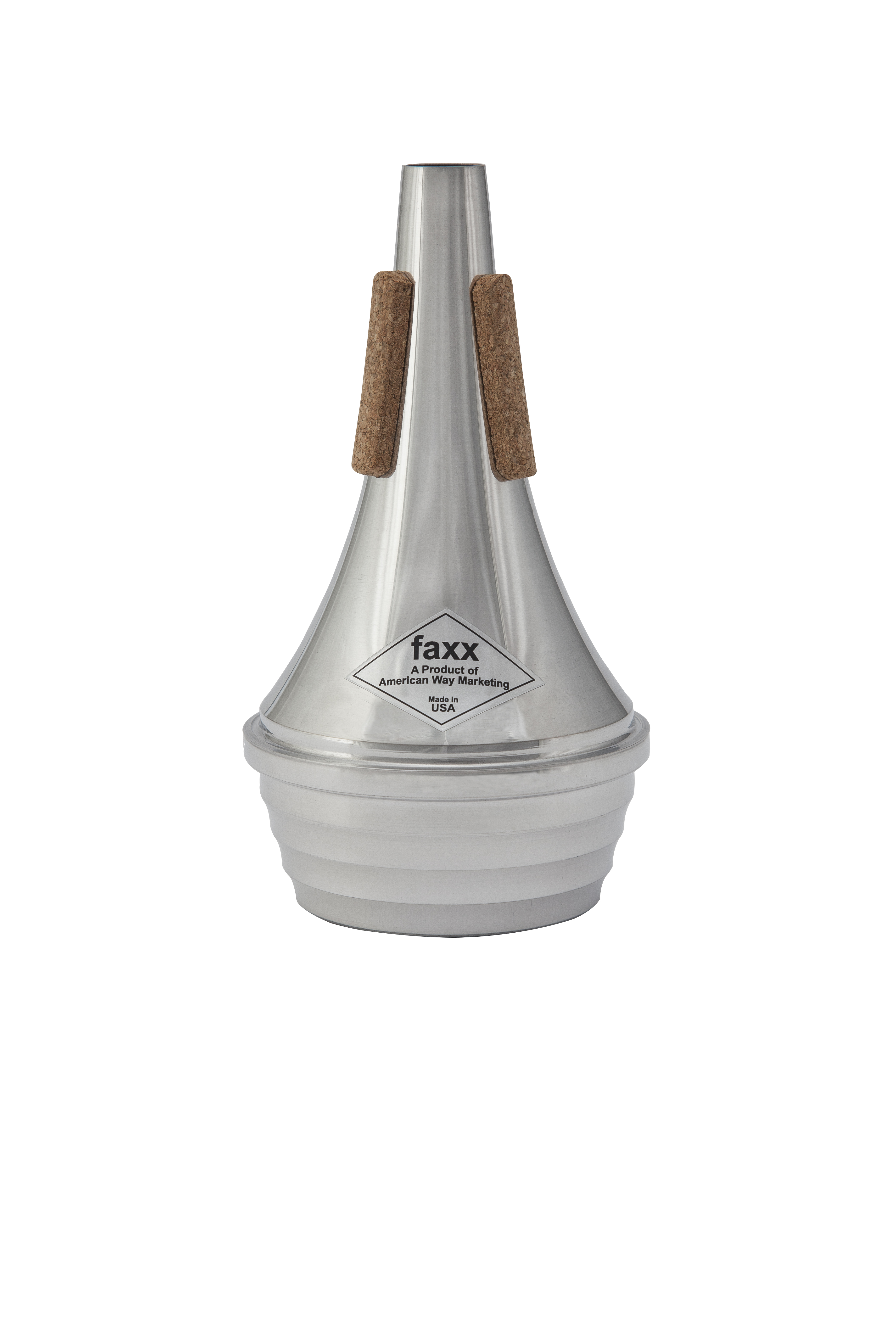
Compact Aluminium Practice Mute
I own quite a few practice mutes and must have tried dozens of them over the years. Each one requires you to make a compromise in some way. I have a favourite mute for playing as softly as possible so that it is barely audible – it is super quiet but the intonation is tough down low. I have another for general practice where I want good tuning and response – it is however too loud for some sneaky blowing at the side of the stage where you don’t want to be heard. This Compact Aluminium Practice Mute from Faxx is brilliant for travelling. It is small enough to store in the bell of the horn without taking up additional space in the case, but it also blows surprisingly well.
The intonation is even across the range and although quite a resistant mute, still allows you to blow in an honest way rather than constantly over-blowing. I like this mute. It is reassuringly robust, clearly well-designed and made and retailing at around $45, gives you the value that you would expect from Faxx.
Aluminium Straight Mute
This is a well-made, sturdy all aluminium mute with great corks. We often underestimate the importance of good corks to the fit in the bell as well as the overall sound. This model is also available with a copper bottom as well as in all copper.
The blow is responsive at quiet dynamics as well as having a lots of lovely bright overtones when playing forte. There is also a really satisfying ‘bite’ to the attack at stronger dynamics, while still keeping the core of the sound. These make a really great addition to any pro orchestral section, but at a price point to suit students and pros alike – around $40!
Aluminium Harmon Mute
There are a number of Harmon style mutes in the Faxx range. This traditional long body mute, a short bodied harmon, and also the bubble style harmon that is reviewed below. All of these are available in both aluminium and copper, and you will now not be surprised to learn that they sell at a fraction of the cost of many of the other brands!
This traditional harmon mute, like the straight and practice mutes above, is well-made, sturdy and fits a variety of bell flares very well. With tube out, it is easy to achieve that smoke jazz club sound and responds particularly well with close miking. With tube in it is a completely different beast! The volume and projection are exceptional and makes a great wah-wah!
Aluminium Bubble Harmon Mute
Until now, I had never really given much thought to how the body shape affects the sound. The difference between this and the model above is huge. Even with tube out, this is an incredible resonant mute, so much so that you can feel the vibrations coming back through your hands while playing. Projection is great and it compares really favourably with my normal aluminium bubble mute from another more expensive brand!
These great value and great performing mutes are now commonly available across the UK, the USA and farther afield in most good music stores. I strongly recommend that you give them a try – these are far more than just student mutes!
To find more information on the full Faxx range and also where you can find a dealer near you, please visit American Way Marketing.
SIGN UP HERE FOR NEW BLOG ARTICLES EMAILED DIRECT TO YOUR INBOX:
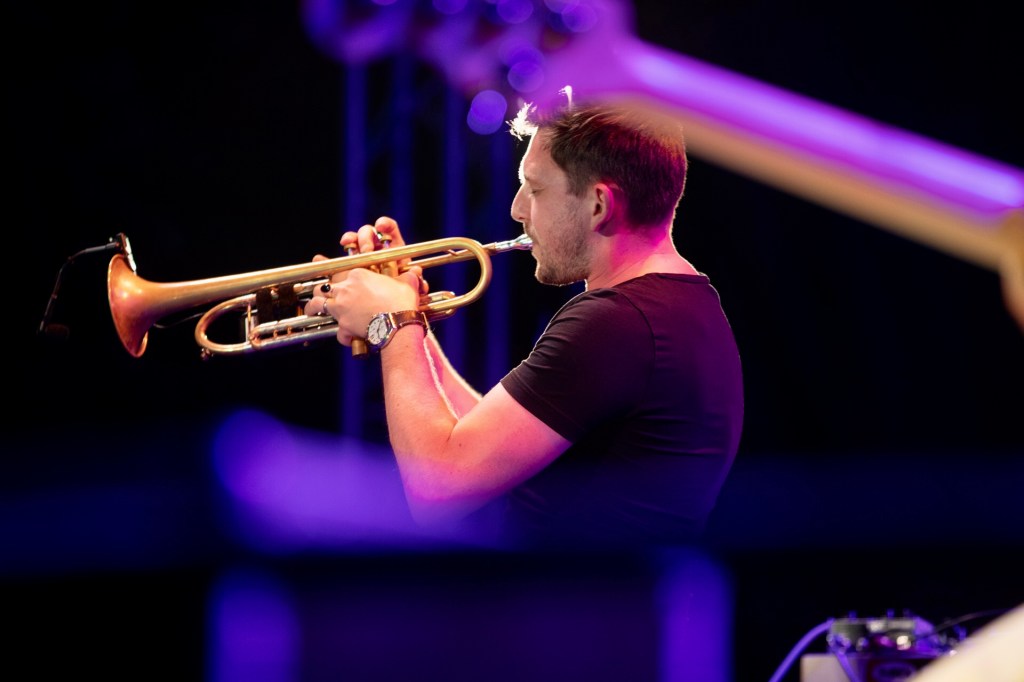
Alexandre Herichon is an eclectic musician, at home playing lead trumpet, improvising, and as a composer/arranger. He shares some trumpeting thoughts as well his experience with his new Agami trumpet.
What first drew you to the trumpeting the early days?
My parents listened to jazz music when I was a kid, and we saw, sometimes, some jazz bands with horn players, so I think it impacted me, but I can’t say why the trumpet, specifically. One thing is shure, I never quit, even in the hard times, since I began, when I was 10.
Who or what were your early musical influences?
My teachers of course, who gave me the passion of music, the older musician in the music school orchestras and at the early beginning, the fact to play at church with my family. After came the big names and the jazz records.
Do you have any particular practice regimes? Does this change a lot depending on whether you are doing more lead playing, or jazz, or funk for instance?
Yes, it changes sometimes, and especially depending on what I have to play. The most important for me is my flexibility. So, I always do tongue flexibility exercices to be shure I’m easy with it. Notice that I say, “tongue”, not lips! I do like a kind of whistle and my lips respond to it naturally. Then, if I’m more on a jazz/improvisation gig, I’ll work the most fingering and harmonic exercises on all the range. If I’m on a lead gig, I’ll work some muscles exercises, like Caruso, and be shure to hit the high notes perfectly.
What do you think are the most important elements of music and trumpet playing that young players should focus on?
Regarding the trumpet playing, the two most important basics are, the air and the tongue position in the mouth. For the music, you can do the kind of music you like and want, but, in all case, do it seriously, spending a lot of time on details and trying to reach perfection. Play all time at 100% trying to make the band or the orchestra sounds greater as possible. Always be invested in the music and it will gives back to you.
Can you talk a little about your Agami trumpet, why you play it, and the process of selecting it?
Agami trumpet are great horns, really! Love it!I first saw pictures on Instagram (go follow him-> agami_music_france 😉) and said to myself “wow, those horns are beautiful!” So Thierry Sohier (from Agami) contacted me to organize a meeting and invited me to try the trumpets. I directly felt good playing it. Easy, great sound, warm on the low range and bright on the upper register, polyvalent. Anyway, all a trumpet should have as qualities. I tested it some months, on many different gigs and adopted it. I feel I can do what I want on this trumpet!
What are some career highlights to date?
I had and still have the chance to play with many great bands and artists around the world, Electro Deluxe in Japan, No Jazz in India, Etienne M’Bappé in South Corea, Panam Panic in Marocco, Big Funk Brass, Ben l’Oncle Soul and more!
Like many artists, I guess that your work has been badly affected by the pandemic? How have you found keeping up the playing to a high level, and getting back to (hopefully) being much busier now?
Yes it was a strange periode… But I have the chance to be a teacher in jazz music conservatory and private lessons so it kept me in touch with people and music, so it helped me a lot. I began to work on music producing too, and it takes a lot of time so it was on point. Some home recordings and tv sessions happened too in the second part of the pandemic and the work began to come again. Now it’s ok and we hope the worst is behind us now.
And what projects do you have coming up?
My personal projects, Big Funk Brass and Panam Panic have released their albums not long ago (go check it too 😉) so this year will be a booking and touring year, between the other projects and lessons. I’m beginning to think about my new personal project too, kind of new jazz 5tet. I’ll let you know about that when it’ll be more clear.
SIGN UP HERE FOR NEW BLOG ARTICLES EMAILED DIRECT TO YOUR INBOX:
I would like to tell you about some really good news, not just for me, but for trumpet and trombone players all over the world. Swedish trumpeter Lasse Lindgren has acquired the rights to make Ullven mutes, which have been unavailable for many years, and also happen to be my all-time favorite mutes. Dizzy Gillespie game me my first Ullven harmon and cup mutes in 1972. I’ve been using Ullven mutes exclusively for almost 50 years!
These mutes, plus my Schilke Music Products horns, are “tried and true” for me. I even remember when that first Ullven harmon was stolen from me: October 21, 1977, at Jazz Showcase, in Chicago. It was Dizzy’s 60th birthday celebration, and I had left the mute on the piano on stage between sets. During that time, I was hanging out with Diz and Muhammed Ali backstage. When I went back on stage to play the next set, my mute was gone!
So you know: The Ullven harmon mute is perfectly in tune down to low F# and has an exceptionally full and even sound when playing on a microphone. The Ullven cup mute is adjustable and gives the player the option to change the sound to that which she/he is looking for. The cup can even be used as a plunger (á la #SnookyYoung, on the gold plated Ullven cup which I gave to him as gift back in the day).
These Ullvens also make great quiet practice mutes. Because of the functionality in this regard, Ullven cup mutes and Ullven Harmon mutes also are superb as a quiet practice mute when one wants to hone skills without disturbing anyone, even and especially late at night, or if you have pets in your home who pick up frequencies at higher intensity — you spare their ears. You also help protect your own hearing as a musician. It’s also a really nice gift for students (and their families) as they learn the art of the trumpet. These Ullven mutes are the real deal and Lasse is making them now. Get ‘em while you can! Lasse, tack så mycket!“
Jon Faddis Sleeping Cat Music, Inc. @faddisphere International Trumpet Guild (Official) International Trumpet Guild Student Group Jazz Education Network Schilke Music Products Ullvén Mutes for Brass Instrument
SIGN UP HERE FOR NEW BLOG ARTICLES EMAILED DIRECT TO YOUR INBOX:
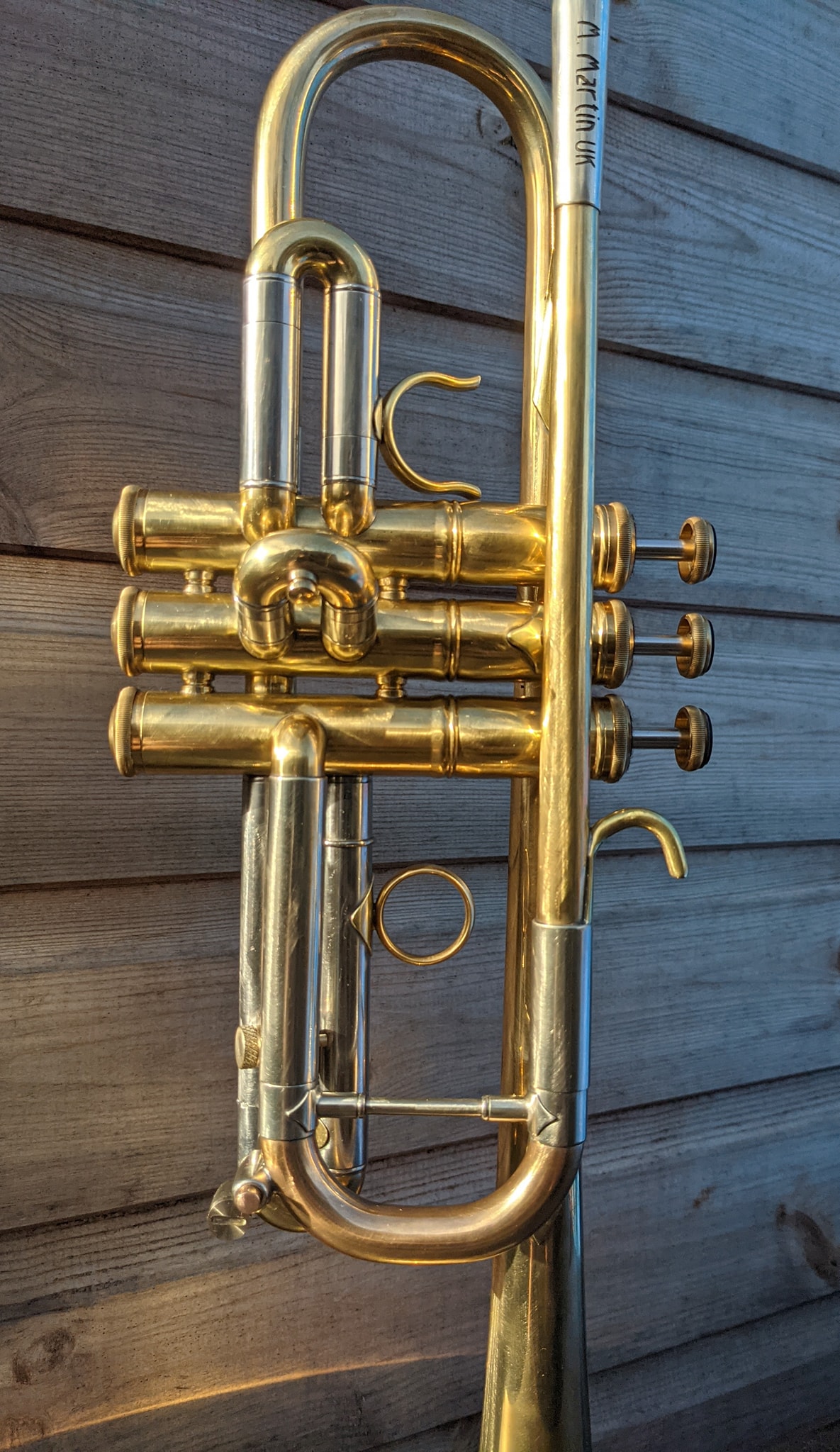
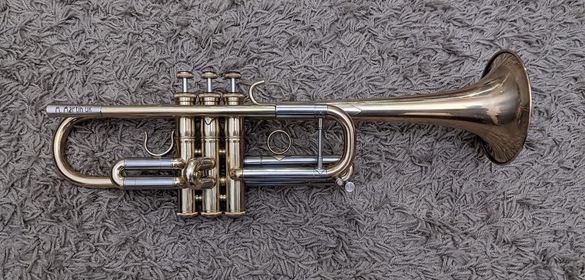
I was recently sent a new C trumpet by Matt Martin from Norwich Natural Trumpets. This was designed in collaboration with Mark Bennett and has arrived with me looking spectacular. These trumpets are custom-built to order, but surprisingly do not have the custom price tag. In fact they are currently less expensive than many people’s favoured Bach or Yamaha models!
This model is based around a medium large .460 bore Hoxon Gakki valve set (the MAW valve set is also going to be an option), a 0.45mm gauge gold brass bell opening out to 125mm, an open Malone-style leadpipe and a D-shaped bronze tuning slide. The bell taper is not too dissimilar to a Bach 239.
Looking at the spec, the first thing that stands out is the medium large bore. Most of us are more familiar with a large (.462 or .464) bore on C trumpets. So I approached playing this trumpet with the preconception that it would feel small, stuffy or restricted in some way. It did not!
Responsive and lively, ‘yes’, but certainly not restricted. The sound is full-bodied with a rich tonal core that I immediately loved. It also feels open, not unlike playing a nice symphonic style Bb trumpet.
The Bb similarities do not end there. The intonation is great across the range as is the sound quality. I have always primarily played Bb trumpet have found the adjustment to C trumpet intonation a challenge. I am pleased to report that this Norwich Natural Trumpets model does not pose the same challenge!
As you may be aware, Matt Martin’s natural and period trumpets have been ever-growing in popularity – It is great to see this craftsmanship and artistry expanding to modern trumpets. There are also some great new developments with the Bb trumpets coming, and I look forward to getting to try these too!
OK, so I need to say right off the bat that I have no intention of actually answering this question! I am certainly not qualified. This past year (plus change) has seen it become ok for us all to express ‘opinions’ on science, and for us to have the choice to either agree or disagree, sometimes depending on our political leanings. This confusion has been confusing!
There have been a number of studies (such as this one from Brass Bands England) that support the science-based hypotheses that like face-mask wearing, a cloth covering over the bell of your horn helps to reduce the risk of harmful airborne droplets being dispersed. The use of bell covers, wiping down surfaces such as music stands with alcohol wipes, the regular washing of hands, social distancing and safe disposal of water from the instruments all help reduce risk, without removing it completely of course.
One thing that all musicians agree on is that kids need to be making music again. And a huge part of this is giving each other the confidence that we are all doing everything that can ‘reasonably’ be done to protect each other at the same time. So instead of “do they help?”, the question that we should really be asking ourselves is “are we really prepared to not take every possible step to protect each other?”. And this seems particularly pertinent at a time where we had been starting to feel more relaxed about the future after the early success of the vaccination roll-outs, but are becoming increasingly aware of new variants. It is likely that we will need to approach music in groups with some caution for some time to come.
So now that we have taken the obstacle of answering my initial question out of the equation, what is left to object to?
Sound quality? Well there is a slight change. The sound takes on a slightly softened edge, and there is a slight stuffiness up top. But it is only a small difference and pretty much imperceptible to your school bander.
Cost? Fair enough, everyone has suffered a financial impact to varying degrees over this past 15 months, and what band or school is going to relish the prospect of kitting out a full band with more accessories?
Well there is a solution at hand! Alliance Brass have developed a great quality bell cover that they want to make accessible to schools, community bands and professional groups at rock bottom prices. They retail at just £3.07 each. Here is what the maker has to say:
Alliance has teamed up with a leading Northern textile company to produce stretchable bell covers that reduce the risk of spreading harmful airborne droplets and aerosols produced by brass instruments. The covers are very easy to fit and make hardly any perceptible difference to the sound of the instrument. The player might notice a very slight difference in response in the high register, but the sound remains true from low to high.
This product is aimed at school ensembles, amateur bands and professional brass sections. The safest way to play brass music is outside with the recommended distance between players of 2.00m whilst not facing or playing into another player. If playing indoors with the minimum distance (2m) between players, bell covers can reduce the spread of germs and viruses greatly. Remember that venting water keys can spread germs too, so be careful to have a cloth or some paper to catch any water from the instrument, and to dispose of any paper safely.
Our partners making the bell covers are a traditional family-owned Manchester-based business who started spinning and weaving cotton in the nineteenth century. Last year they were busy making PPE for the NHS. We have designed this range of bell covers which are produced in Greater Manchester using their skills developed in making PPE. We are proud to work with another successful British firm.
Please click here to view or purchase this product.
SIGN UP HERE FOR NEW BLOG ARTICLES EMAILED DIRECT TO YOUR INBOX:
Alliance Brass mouthpieces were launched in 2006 by Roger Webster, former principal cornet with Black Dyke and Grimethorpe. Initially these were for the brass band world to accompany Besson instruments but in more recent times, there have been some significant developments with their trumpet range.
Stephen Wick from Alliance Brass and Denis Wick Products was kind enough to send me two different models to put through their paces. Before I let you know what I think, here is what Stephen Wick has to say about them:
“The Alliance trumpet mouthpieces were designed with bodies considerably heavier than the standard Bach shape to create a mouthpiece which delivers a powerful sound and can project well. The mass is carefully distributed to achieve this effect without losing responsiveness. Some mouthpieces with extremely heavy bodies can feel very ‘dead’ and lacking in response. The idea behind the Alliance mouthpieces was to have just the right weight for the power and projection needed, but still be responsiveness enough to be enjoyable to play. The cups, bores and backbores are carefully designed to create a harmonious blend and optimal performance.
The rims are designed to be super comfortable – round enough to be very easy to play but with a gentle curve which is enough to spread the pressure evenly. The mouthpieces are machined using specialist tooling so that minimal polishing is needed before plating. This ensures that the exact contours of the rim are preserved and not altered at all in the polishing process. The taper of the shank is carefully checked so that optimum ‘gap’ is achieved, resulting in a mouthpiece that produces a resonant sound that is immediately noticeable to the player.”
In this play-testing review, I chose to go in blind without knowing anything of the specifications of the two mouthpieces:
Alliance 4 (WAGR11-4) The initial feel on the chops is that this is a nice ‘roomy’ classically orientated mouthpiece, reminiscent of a Bach 11⁄2C in feel, but perhaps with a slightly wider inner rim. There is a very quick response with this, and I find myself having to recalibrate my approach having been sucked into the Bach feel of the rim! Though brightly responsive, there is still a depth to the sound that I really enjoy. And after playing for a minute or so, I discover that I do not need to make as many adjustments to compensate for tricky intonation. I am also struck by the great balance of resistance in this mouthpiece, allowing ease of control in timbre and volume. This is a nice balanced mouthpiece, suitable for classical all-rounders, offering a depth of sound for orchestral playing as well as the flexibility and brightness for chamber or solo contexts.
• Inner cup diameter: 17 mm • Rim: 5.35 mm • Bore: 3.7 mm • Medium deep cup
Alliance 8 (WAGR11-8) Now this immediately has a classic 7C feel. The rim is extremely comfortable with a medium deep cup. My initial reaction is that this would be the perfect mouthpiece for a beginning player as it is so easy to play and make a nice full sound. However, this is clearly not a typical ‘beginner’ mouthpiece. The sound is full, the intonation is even across the range, and there is an ease of flexibility especially in the upper registers. There is a nice character to this mouthpiece, probably offered in part by the extra outer mass compared to a standard beginner mouthpiece. The I tried the model with gold rim, but I will certainly be recommending the slightly cheaper all-silver model to my beginner students!
• Inner cup diameter: 16.25 mm • Rim: 5.63 mm • Bore: 3.7 mm • Medium cup
SIGN UP HERE FOR NEW BLOG ARTICLES EMAILED DIRECT TO YOUR INBOX: