
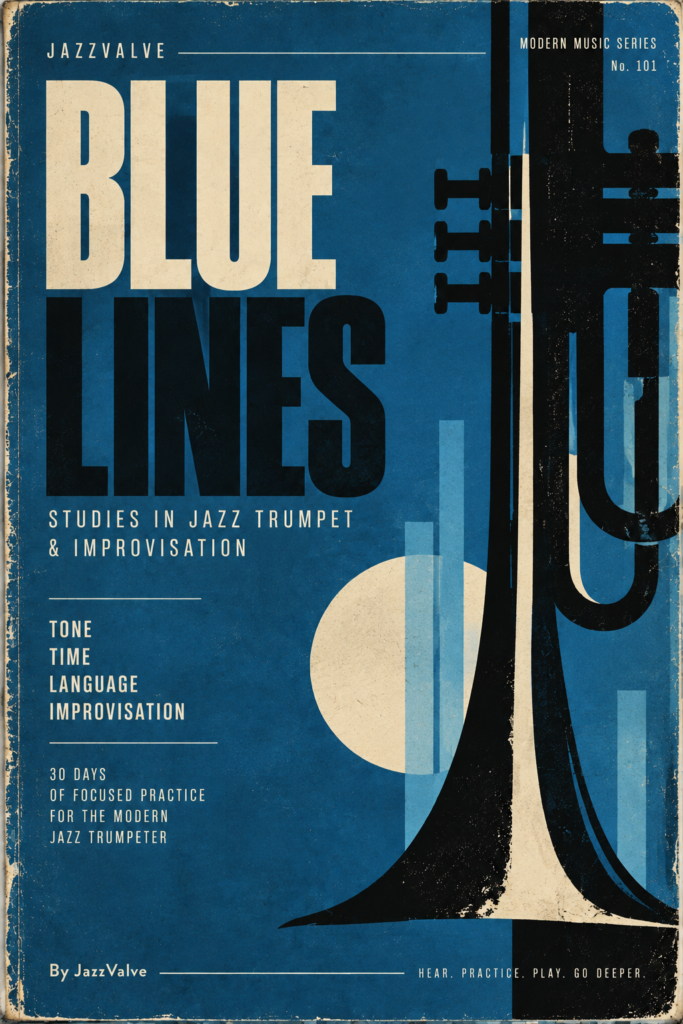
BLUE LINES. Looking for a little direction in your jazz trumpet practice? Blue Lines, a free workbook by JazzValve’s Justin Comstock, provides a month-long sequence of daily studies for B♭ trumpet. Its 23 pages move from sound and phrasing into rhythm, jazz vocabulary, and creating short solos. Written exercises and a practice log give players a way to organize their work and track their progress.
For Mouthpiece Online readers exploring improvisation, it offers a structured starting point for bringing jazz concepts into daily playing. The PDF is available from JazzValve at no charge when you sign up with your email address.
Thirty days of focused practice: one target, one exercise and one thing to listen for each day. Written for B♭ trumpet, so what you read is what you finger.
WHO IT’S FOR
B♭ trumpet players beginning jazz improvisation. It is meant to sit alongside your teacher’s fundamentals routine. The core examples stay near written C4–G4, and every example uses treble clef and written trumpet pitch.
HOW THE 30-DAY PLAN WORKS
Each day is about five minutes after your usual warm-up: one minute to hear or sing the idea, two to play it slowly with rests, one to change one thing, and one to record or reflect. You don’t need to do 30 days in a row. Repeat a day whenever you need to.
DAYS 1–7
TONE
A comfortable, steady sound and simple phrasing — clear beginnings, connected notes and small musical wins.
DAYS 8–14
TIME
Time, rhythm and space — a steady pulse, fewer notes, counted rests and listening for swing.
DAYS 15–21
LANGUAGE
Chord tones and short jazz ideas — triad phrases, target notes, chromatic approaches and learning by ear.
DAYS 22–30
IMPROVISATION
Connect your ideas into short solos — develop a phrase, explore written G blues, record and reflect.