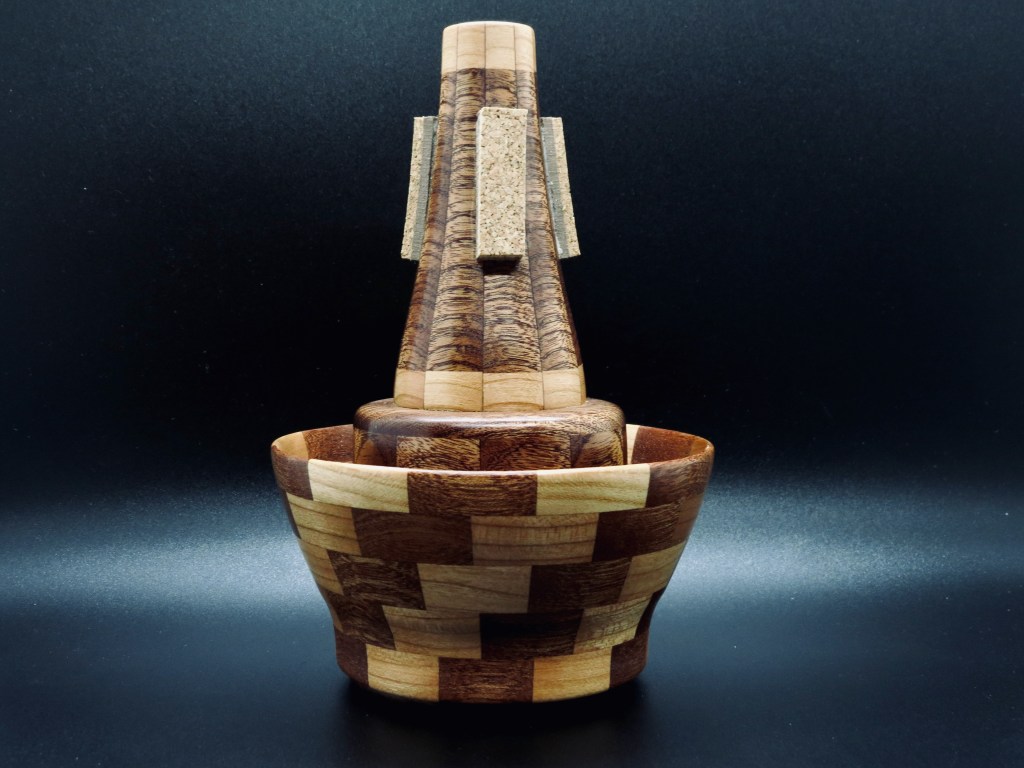
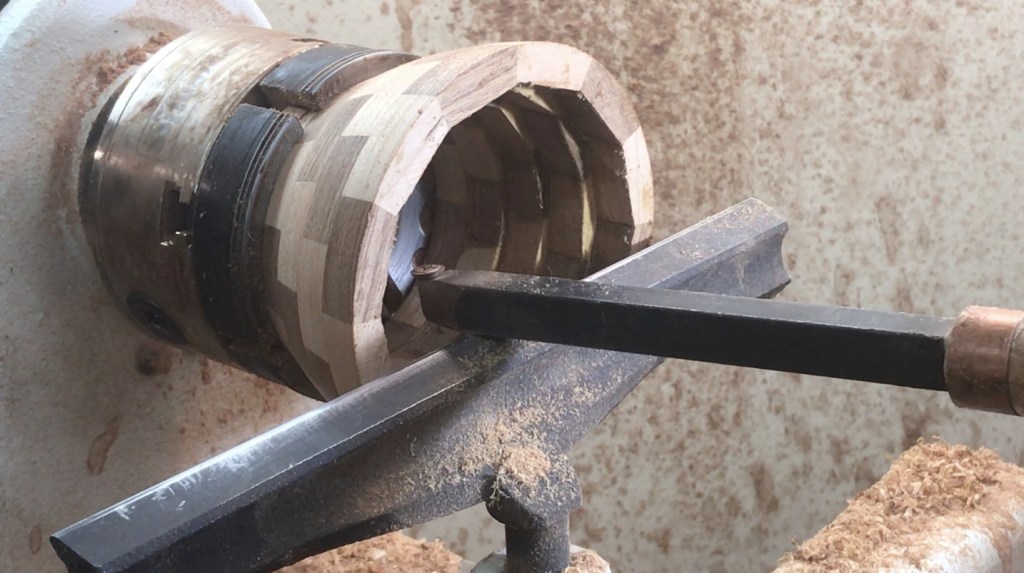
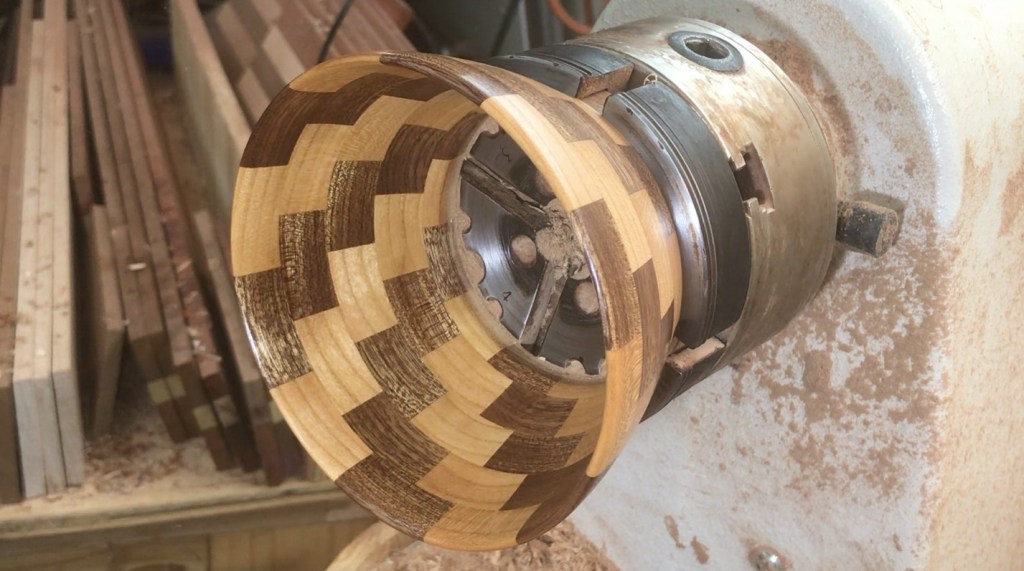
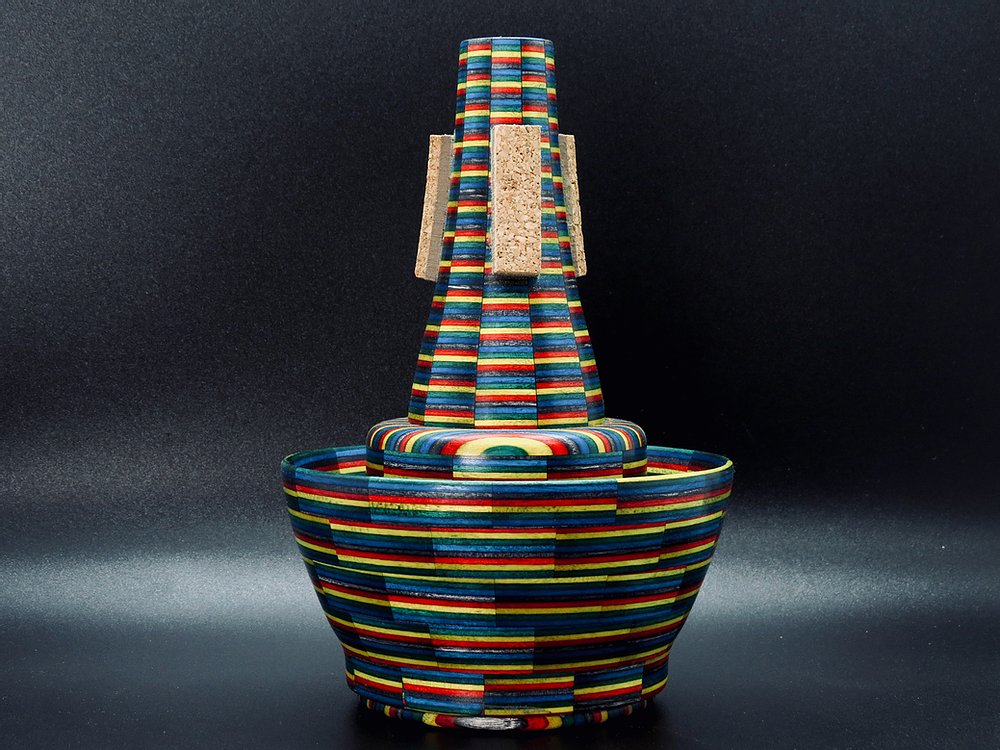
Further to my interview with Tom Clary, the master craftsman behind ‘Clary Woodmutes’ [read it here if you haven’t already!], Tom has kindly sent me a beautiful Kramer Adjustable Cup model to try out. Crafted from gorgeous Sapele and Cherry woods, this model is named after Don Kramer, one of Tom’s former teachers.
The above ‘glamour’ shot of this mute looks pretty great. But trust me, it does not do it justice! The grain of the woods, the beautiful sheen… and the smell. Heaven! As I am admiring the fantastic craftsmanship, it suddenly occurred to me that I should probably try it out, and it does not disappoint. This model has a flat cup rim, but it is also available with a scalloped rim too.
I started off with cup at full extension, and there is immediately a fantastic resonance to the sound. Of course there is the softness that you would expect from a cup mute, but there is a depth of sound that you just do not get with some of your ‘pret-a-porter’ mutes such as H&B and DW.
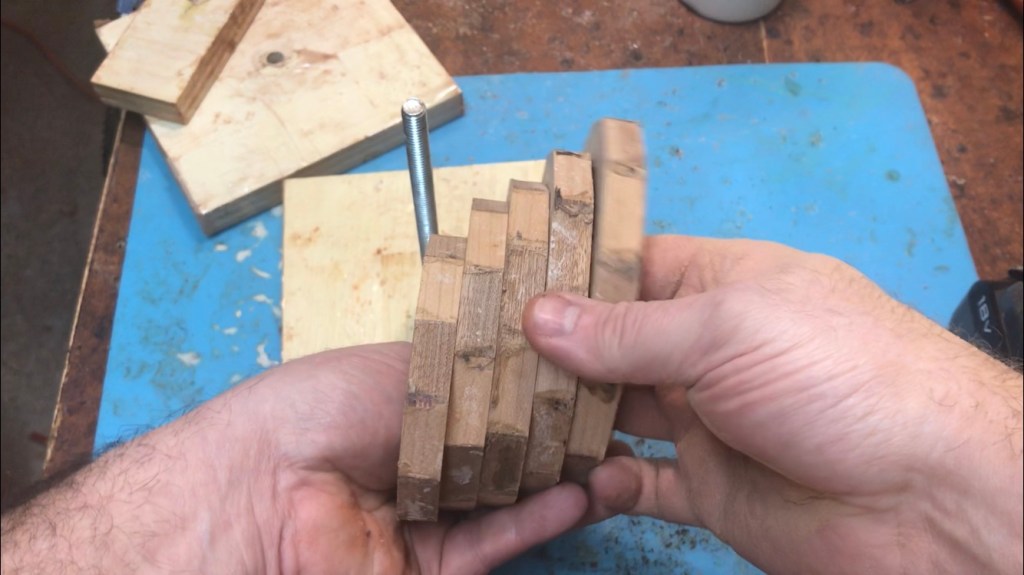
Sometimes we want a more enclosed sound with mellow to the max, and this is where the adjustable feature comes in. I moved it inwards to give just a 2mm gap to the rim of the bell and it is transformed. There is a lovely added resistance to give you something to blow against. Often, this is the point where the intonation could suffer, but the resonance within the body of the mute allows you to keep that core sound and good tuning alongside the softness and even smokiness that we look for. Incidentally this cup section alone is made up of over 60 individual pieces of wood.
And with the cup removed, this is a resonant and responsive straight mute. Projection is stunning and the response at both loud and soft dynamics is as even as any great mute that I have played. When sent an item for review, I try very hard to give an objective opinion on what I have been sent. And here, I promise that I have, it is just that I can genuinely only find positive things to say!
SIGN UP HERE FOR NEW BLOG ARTICLES EMAILED DIRECT TO YOUR INBOX:
Originally from Venezuela, Kissis Muñoz is now based in Miami and building a reputation for herself as a top trumpet player…
What first attracted you to the trumpet?
What made me fall in love with the trumpet was its sweet sound and also its strength.
Any early musical influences?
Yes, my dad runs a band and from there I was able to start playing music when I was 8 years old.
Favourite musicians to listen to growing up? And now?
When I was a child I liked listening to Maurice Andre, Winton Marsalis and Sergei Nakariakov, then my list of trumpeters got bigger and now I really like Francisco (Pacho) Flores, Yturvides Vilchez, Arturo Sandoval, many styles and all exceptional!
What prompted you to move from Venezuela to Miami?
Leaving aside the situation in the country of Venezuela, what has captivated me about the United States is that we are in a country of opportunities, and thank God everything is going wonderfully so far.
Any highlights of his career so far?
I have had the opportunity to be a soloist in various symphony orchestras in Venezuela in which I have performed several concerts such as Haydn, Arutunian and Vivaldi. I have made a number tours of Europe with the Teresa Carreño Symphony Orchestra of the Venezuelan Orchestra system in which we perform in important musical theatres such as the Konzerthaus in Berlin and the Vienna State Opera. I have a Bachelor of Music in Instrumental Performance from the Royal School of Music.
Here in Miami I began to live new experiences playing and recording Latin Music with different bands and artists such as Tony Succar, Oscar D ‘Leon, Luis Enrique, Raíces Jazz Big Band and finally last year I made a record with the group Make Sound in which we are all female soloists!
Tell me about the new instruments that you are playing on!
It was a lot of fun, I didn’t expect to change instruments until I played the Victory! I immediately fell in love with them, realized that these trumpets helped me to have a special sound. I tested the full range they had and I stuck with the Revelation Series. It gives me the sound I need for both classical music and other styles!
How has the past year been for you with the Covid closures? Obviously, it has been a really difficult time globally, but is there something positive or opportunities that you have been able to take advantage of?
It has been a difficult year for everyone but more so for art, we had to reinvent ourselves to continue doing what we love. In my case I took that time to finish the Make Sound album and reconnect musically with works that I had forgotten.
What interests you outside of playing the trumpet?
At this moment I am separating my mind on music and family since we have a 2 year old daughter and she always needs attention. But outside of the trumpet I love to travel and visit my friends, since they are the family that we have here.
Any advice for young aspiring trumpeters?
Although the road is long, strong and stormy we must continue, because when you look back you will realize that nothing was in vain and you will see how much you have progressed.
For further information about Kissis, please visit her social links below:
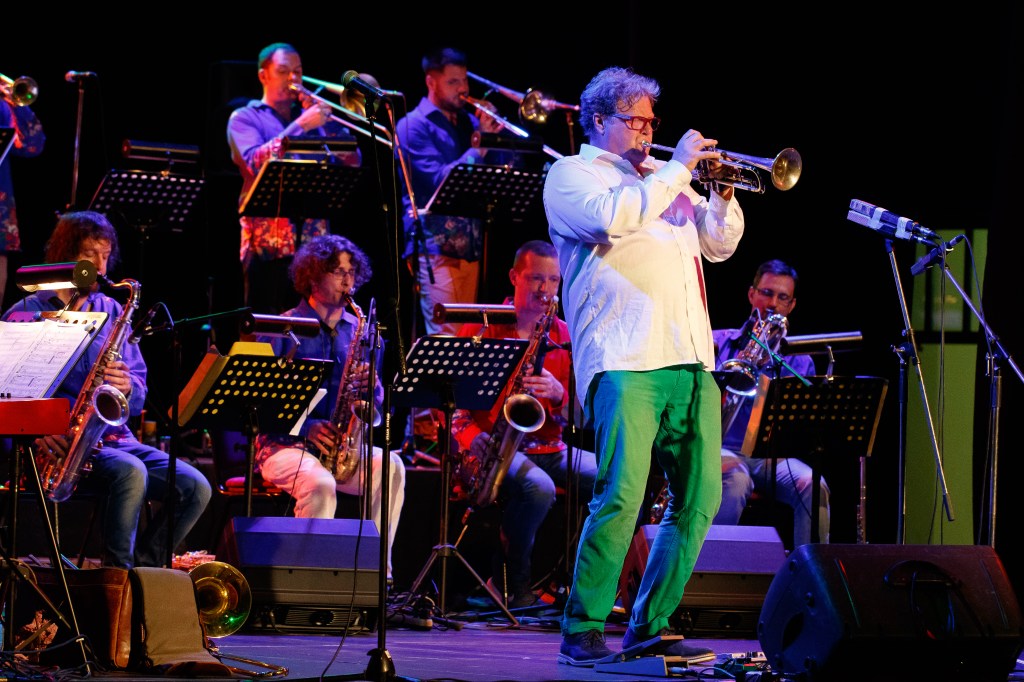
Lasse Lindgren is a multi-faceted musician, with a reputation as a great ‘lead’ trumpet player as well as a great ‘jazz’ player. In recent times, he is also responsible for the resurrection of the great Ullvén Mute brand, made famous by players such as Dizzy Gillespie and Maynard Ferguson. Lasse kindly talks to me here about all things trumpet as well as this recent project…
What first drew you to the trumpet?
That’s easy! I heard Louis Armstrong on the radio as a 5 year old boy. That totally blew my mind and made me decide to dedicate my life to playing trumpet. Then I had to wait until I was eight before I got a trumpet, and I still remember that moment as very exciting, after I had to wait for years. I also remember that I was dreaming of making that sound for so long, that when I finally got it, it was a great relief to put the mouthpiece to my lips and blow the sound I had in my head for years. I think that also made it easy for me, I got a good sound right away. I think because I was so eager and had the sound built up inside me, it just came out naturally.
Any early musical influences?
As a young boy I loved the recordings of Louis Armstrong, Glenn Miller, Harry James and the other famous BBs. My mother had an old 78rpm record player at my grandparents’ home. I used to love to sit by myself and listen to the old records – that sound made a deep impression on me.
When I was 15, my trumpet teacher played the record “Message from New Port” with Maynard Ferguson’s orchestra for me. That was another “blow my mind” experience. I loved not only MF playing, but the sound and energy of the music arrangements!! and I still do. I thought playing those high notes MF did was something you learn when you get older, that is how stupid I was))-
But of course I wanted to play the notes of MF and his “sound”, but how? No one to ask? So I had to experiment myself by my own. From age of seventeen to twenty I spend 8-10 hours a day with my trumpet, playing, thinking and trying out how to do this.
I also spent some time playing “Free Jazz/music” as a teenager, that opened my ears and mind, Lester Bowie and Art Ensemble of Chicago!
Who have been your favourite players and music to listen to?
Well, when I went to high school, I started to play with friends in a band, and we played some kind of “Jazz-rock” in the style of “Weather Report” and so on. So I broadened my view of music. Then at that time, I also started to be aware of other great Trumpet Heroes, especially in more “modern” Jazz. Artists like Dizzy, Miles Davies, Clifford Brown, Freddie Hubbard, Woody Shaw, Chet Baker, among others, but also the European players like Palle Mikkelborg, Kenny Wheeler (Canadian in UK) Tomas Stanko (I played a lot with him in Germany) and my Swedish friends and heroes Bosse Broberg, Jan Allan and Rolf Ericsson. I also loved players who were both “Lead” and “Jazz” players – Snooky Young, Benny Bailey, Booby Shew (whom I met and got informed about the Yoga Breathing from when I was 18)…
Today I still listen to them all, the old stars were the genuine originals. There are many new great trumpet players of today, but have to admit, I am not so familiar with them, although Roy Hargrove was fantastic, RIP.
It’s hard to invent the wheel again, and to me, many of the young very skilled and talented players of today, sound as though they are playing “licks” they have practiced and learned. To me, that is actually is not spontaneous soulful improvisations, more than showing that they can play the right “hip” patterns over the chord changes – rather boring to me.
It is not easy to make your own sound and style, and I think too few even try. The exception is Tim Hagans, but he is not so young anymore!!
Lasse playing on one of the two Conn Connstellation trumpets that he owns, once belonging to Maynard Ferguson.
Is it a difficult skill to practise, being able to specialize in lead AND jazz? What are the particular challenges? Are there any particular routines that you follow in order to be able to achieve this?
Apart from the physical aspect of these two different ways of playing, the Lead player often has to use different equipment (not always) and play more demanding physical parts, to play with agood sound in the upper register with the endurance required. This takes a lot of work, exercises to keep up the “chops” to handle this, not everyone can do this. The Jazz player, on the other hand, meaning improvised jazz solos, has to learn how to do that… also the techniques. Scales, tunes, and how that music works, most likely Jazz players use different equipment (mouthpiece) compared to the Lead player. A good “lead” player must besides having the control of the instrument in any register, also be able to interpret music, a melodic line that you are asked to play, what the music is about, play it soulful and interesting in the style of the music.
When I play lead, I always ask the composer what the music is about or make my interpretation of the title. I always play as if I were singing the music instead of blowing the trumpet. I think a lead part or a melody also should be played like it was improvised, so it would sound fresh new and spontaneous, but at the same same time consistent the same way each time, so the other musicians can follow and trust in me and the way I play. Lead means to guide, show the way the music should be phrased for the fellow musicians, not only playing high notes. I think you must have an ability to be a leader, a strong personality, not ego, but be a steady and reliable player.
It is also a question of knowledge of style and understanding how to play different types of music. How do you learn to play good “lead”? Listen a lot, sit and play under a good “lead” player for years to get the “Know how”. The same goes for Jazz playing, listen and play with good musicians. So my conclusion is that to play good “Lead” it is good to be able to play some Jazz as well. To play good jazz, one must also be able to present an interesting melody, with respect for the song/tune, and the technique required.
So one difference between “lead” and Jazz is that a leadplayer must sound like the music is improvised but at the same time not. The jazz player should make the music fresh and spontaneous, every time to challenge other musicians and maybe be unpredictable to make it interesting.
I do have my daily routine that I do when warming up, getting my sound in all register together. It takes normally 1-1/2 hours from the first breathing exercise and buzz on the mouthpiece through scales or arpeggios from the deep pedal notes to the high register double C. After this I rest and do other duties. Later if I have time I practice music, Jazz play along records (I still do that with a record player, not with the computer, I’m too old and stupid!) or etudes or music I have to play and need to be practiced.
As well as playing in lots of great bands over the years, you have also been a band leader. When did you realise that you wanted to create music under your own direction?
I remember that I was making drawings of “my own Big Band” when I was 10, so for some reason I always wanted that!
Since I always have been interested in writing music for my band, it was natural to have a group to play my music. For some reason, even though I always loved and listened to “Jazz” old and new, as I mention before, I never hear this in my head when I compose??!! Why? I dont know. So my own music is a little different, I try to make more compositions rather than just a short melody and then the standard for soloists. This is just the way for me, so can my music be called called Jazz??
Is it possible to define what ‘jazz’ is? It is such a broad musical term isn’t it?
Well, Jazz is a name with a history, from mid 19th-century meaning spirit, energy, or courage and other things as well… “semen”… so it has a hot history I suppose! When we talk about what is Jazz today, it covers many “styles”, but for me somehow, it is a rhythm with the swing pattern played on the ride cymbal. As they say triplet groove, swinging eight notes, it is the same as Hip Hop, bebop, dixieland for me. As long as it has that “diiing diiingdidiiiing” groove played on the drums or on the cymbal, it is basic Jazz.
Then there are many other styles that has evolved from this: Free jazz with swing groove or not, Scandinavian sounds of “Jazz”, Latin Jazz… if these are Jazz? Then Funk, more composed music, Charles Mingus wrote as he said – not Jazz, he wrote “Charles Mingus”, even if he was one of the big names in “Jazz”. To me the rhythm and improvisation are important to define Jazz. When I compose it comes out more like my music, which is not so often Jazz, or any typical style. It is hard for me to define my own music which also makes it harder to sell! A lot of my music has more beat grooves or rhythms, straight -jazz eight notes, still it has the other elements in Jazz improvisation. Is it still Jazz?
Any particular career highlights that stand out?
Besides all the gigs and tours with my own groups throughout the years I have some. I did a gig with Ray Charles in Finland once. It was a mix, with a half Finnish band and half Ray Charles orchestra, at a big sports arena, 8-10,000 people. I had some solos and I remember one was 1m in front of Ray Charles. It was a very slow “Georgia” type of song, and I played kind of blusey with some long high notes in the end. I remember it was thrilling and inspiring (goosebumps) to hear Ray’s comments while he was comping me – “yeah man!!” and so on, after that I was offered a job in his band. I didn’t take it however, I already had the gig as lead player in the Danish Radio Jazz Orchestra, and also a family!
In contrast, great moments also happened in smaller situations many times. Like, on tour with my quintet in small villages far up in northern Sweden, at small Jazzclubs in front of 10 people. When some of them, after the concert, come to us with tears in their eyes and thank us for the music. Then I also feel it was a great moment, when I was able with my own music, to touch somebody to tears of joy! Another was when we made a 3 week tour all round Europe with the Danish band. Maria Schneider conducted Gil Evans music with David Sandborn as soloist. We played some of the original scores that Gil wrote for Miles Davies. It was a highlight, especially in Spain. The audience’s reaction in Seville after “Sketches of Spain”, was amazing.
Tell me about the journey bring the great Ullvén brand back to life!
Ullvén Mutes have always been “the Mutes” for me, and I grew up in the same small town of Uddevalla at the west coast of Sweden, where Mr Ullvén had his Workshop. He had also a music shop there were I naturally used to go. Besides that, my mother took care of his bookkeeping, since she worked as an accountant. Mr Gunnar Ullvén used to come home to us every Christmas with gifts, flowers to my mother and a 1 litre bottle of “Popy” Valve lubricant to me. I also remember being in his shop when Dizzy Gillespie called and needed some more mutes – and sometimes as a teenager, I went to Ullvén’s workshop and got some mutes to experiment with. So, when I was offered to take over and restart the company one year ago, it was natural for me, I feel close to this company and its great products.
But, since it has been sleeping for 20 years, it will take some time to get things going, but I do work hard and want to be able to bring these mutes and things available for brass players worldwide again.
All the old tools are still there, and the now old man, who made the mutes by Metalspinning has retired, but he taught his son how to do it, which is great – without them it would have been much harder, maybe impossible for me.
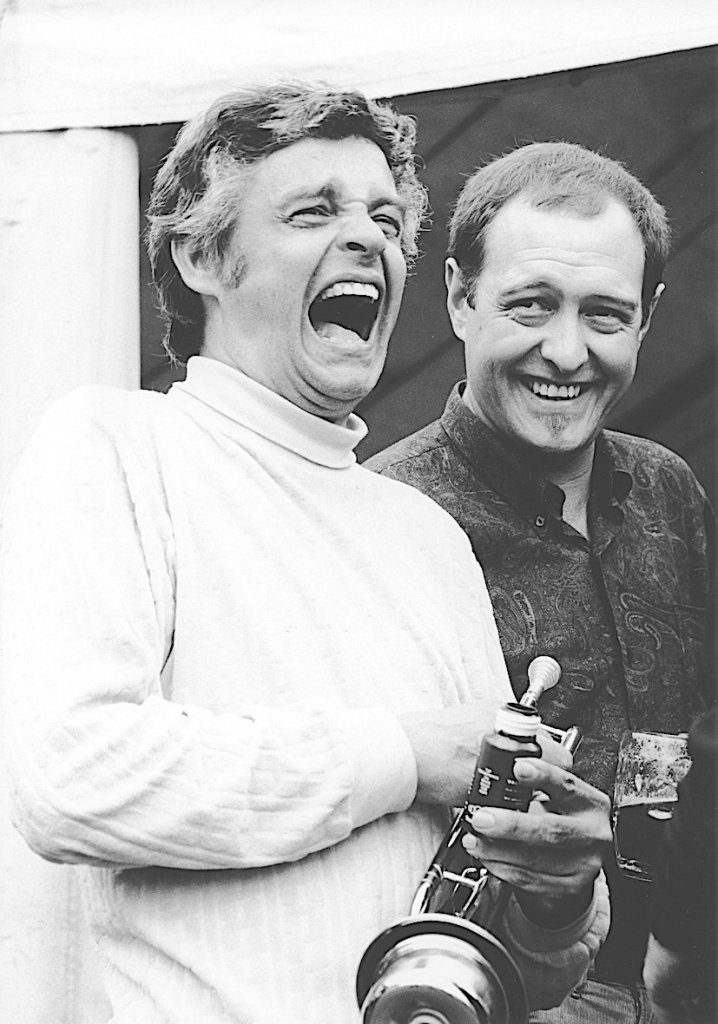
Maynard Ferguson in 1968, with his Ullvén mute and Popy valve oil!
Any particular challenges along the way?
Well, yes, to find suppliers for some of the products I need, like the special Industry felt, Cork, Labels and cardboard can’s for the the mutes. The last time they ordered these things was 25 years ago and most of the suppliers are gone so it takes time to get new contacts. Also for example, getting license to use Dizzy Gillespie’s name – Jon Faddis helped me with that!
What are your plans for the future?
Times are strange in the Era of the Corona Virus!! No gigs last year, but I stay alive with my horns by practising daily as well as possible. I’m of course using the time to get my Ullvén mutes for brass instruments on the market.
Then musically I do have things coming up later this year, but… we don’t know for sure yet.
I have done some recordings that will be out there soon I hope. Two records with the great “Latvian Radio BB”. One released 2 years ago, we should have played concerts with that in 2020, but it was cancelled. Then another with more “standard Jazz” that will also be out soon.
I also made a recording for the Scottish label “Sleepy Night Records” with my own band in Croatia/Slovenia. This is also postponed for better times, hopefully this year!! New arrangements of old “Rock and film” hits, in the style of Maynard Ferguson “Alive and Well in London”.
I have got 25 old arrangements by Slide Hampton, Don Sebesky, Mike Abene, Willie Maiden, and others. Music arranged for Maynard Fergusons Orchestra 1956-65, but never recorded. I will do that with my band here in Sweden as soon as we are allowed to.
Then, once again, I have a third project with the same great “Latvian Big Band” next year. A new album, mostly my own music, arranged by the great Michael Abene, it will be a wonderful adventure.
I will also get a new quartet together, asap, something that I have wanted to do for a long time.
SIGN UP HERE FOR NEW BLOG ARTICLES EMAILED DIRECT TO YOUR INBOX:
I was recently sent a range of new products to take through their paces from BBICO – the British Band Instrument Company. Their Edgware range (named after their North London home) encompasses an intriguing ethos of sustainability.
Many companies have adopted a toxin and/or petroleum free approach to their designs of cleaning products and brass instrument lubricants, but I am not aware of any others that have gone to as great lengths as BBICO to limit any negative environmental impact. As well as the utmost care in designing, sourcing and manufacturing the products themselves, the packaging is all biodegradable, compostable and recyclable. This even includes the ‘plastic’ bags that are in fact NatureFlex and made in the UK of wood-pulp from managed plantations.
As we move forward, it is surely (hopefully!) a matter of time before this kind of care and attention to packaging waste becomes mandatory across consumer industries, so the developers of the Edgware range deserve huge accolades for leading the way in this.
But of course, we need instrument care products that also do a great job… Here are a few products that really stood out to me:
Brass Soak : Just a small amount of this PH neutral soak mixed with warm water does a great job of degreasing and removing the bio-film from within the instrument and slides. I used this on an instrument that I thought to be pretty clean… but I was obviously wrong!
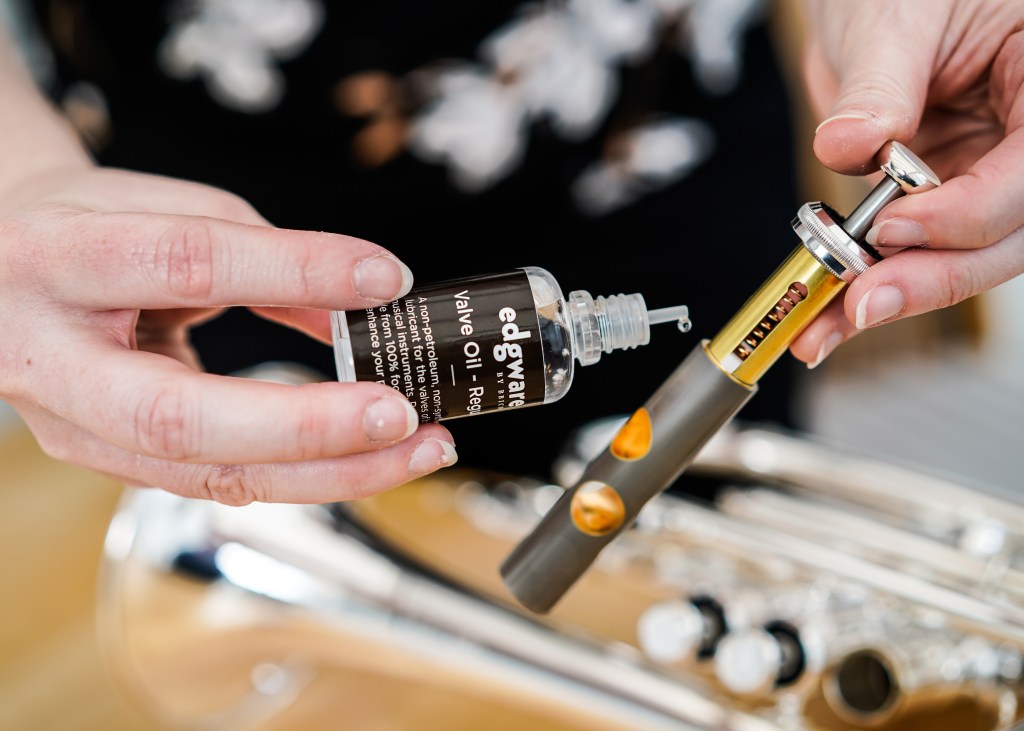
Valve Oil – Regular : This is a nice lightweight valve oil made from ‘food grade’ ingredients. The action on my newer instruments was nice and smooth and it is always reassuring to know that your valve oil is not poisoning you!
Valve Oil – Vintage : Now this is the oil that I have been seeking for some time! I have an old Cousenon flugel with valves that have seen better days. Until trying this Edgware oil, I had not found one that was thick enough to stay on the valves and provide adequate seal, yet flexible enough to give a smooth and consistent action.
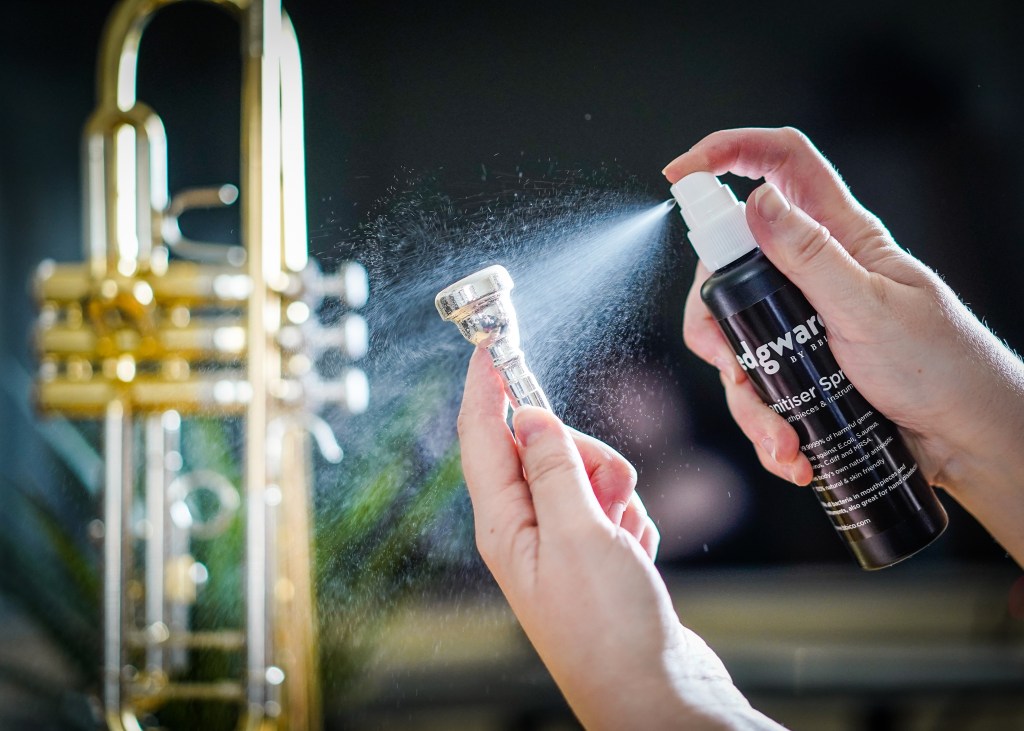
Sanitiser Spray : This is a completely natural anti-bacterial spray, completely free from alcohol, fragrance and harmful chemicals. Particularly at the moment, this is a really important addition to any trumpet case as it can be used on skin as well as your mouthpieces!
Slide Grease : This is a great multi-purpose slide grease that does a good job around the instrument and is so safe that it can even be used as a lip balm!
Please click here to view the full range of brass instrument care products by Edgware.
SIGN UP HERE FOR NEW BLOG ARTICLES EMAILED DIRECT TO YOUR INBOX:
Established 2013 in Philadelphia by Chinese-born bass trombonist Sun He, Ultimate Brass started as a brass instrument repair studio and later became an innovative company that designs and makes brass instrument mouthpieces, trombones, trumpets, and brass instrument accessories. Ultimate Brass Mouthpieces and accessories are being used daily by members of the Chicago Symphony, Philadelphia Orchestra, New York Philharmonic, Aachen Chamber Orchestra, Singapore Symphony, Melbourne Symphony, Beijing Symphony, Shanghai Symphony, Shenzhen Symphony and many other brass musicians across the world. Sun has been kind enough to share some of his thoughts on getting all of this off the ground.
Can you talk a little about the background to getting started on this mouthpiece craftsmanship journey?
Before diving into the music world, I was a engineering student at University of Science and Technology in Beijing, in 2013. When I first move to Philadelphia, I was able to combine my technical skills and musicianship and start my own brass repair shop. At that moment I thought I would never get into the mouthpiece business, it is such a different world than building and repairing musical instruments. Around that time, I was searching for a good mouthpiece for myself, but I still had not thought to start my own project.
In 2014, a friend want me to modify a mouthpiece rim for him, eventually I did, and it was pretty successful. Around the same time, a “modified” mouthpiece can sell for a lot money in China. For example, some teachers and shops ordered stock Bach 1 1/2, drilled to #25 hole and sell to students for over $200USD. I was shocked, and I started to think about how to create a line of high quality product, and sell for a reasonable price. By the way, I still don’t understand why people are so obsessed with “modification”!.
It was Jeff Lang who finally encouraged me to get into this business, we would run into each other in the school lobby. Somehow we started to have a chat about mouthpieces, and he described how he felt about his current set up, and where he thought things could be improve. Then I started to experiment and finally created the Jeff Lang signature model for him.
Who or what were your inspirations?
Every mouthpiece maker I have ever encountered, every teacher I have studied with, and everyone I have collaborated with inspired me in some level, there are always things that I could learn from other people.
Did you set out with ideas of how manufacture could be improved?
Yes, I have a lot ideas, and I am always experimenting with new things – although sometimes the experiment can be expensive!
How do you bring other players into the design process?
I start with sit down with them for a coffee, a nice chat, learn about their personality; listen to their recordings, and recordings of their orchestra, in order to learn the sound concept. Then usually we start with a model from current product line, and tweak it to fit to the players needs.
Are there any unexpected challenges that you have met along the way?
This is a tough question. I am Chinese, and when we first started to promote Ultimate Brass products, some customers automatically connected our products with cheap price and lower quality… which is not true. And I remember when the first time at an exhibition, a customer came to our booth, asked : “What are these copied from?”, I said: “Excuse me? what do you mean?”. He said: ”You are Chinese, right? Everything from Chinese makers is a copy of something.” Then he pointed at another booth of a Chinese “Trombone Maker” and said: ”Look at their beautiful knock off.”
We have closely collaborated with many great brass musicians over the past few years, some of the models took over 2 years of R&D, just to get the product perfect. I wish I could just snap my finger and copy something, and make our artist happy. I could save a lot of time and money in the process!
Running a successful manufacture business takes a lot of time and commitment. How do you balance this with having a life outside of the workshop?
I work on other projects to rest from one project, always keep everything fresh. The most important thing is that you need to know when and where to stop.
Plans and ambitions for the future?
I have a lot other interests, mainly because I want to try out as interesting stuff as possible in a limited life time!
What are you looking forward to post-COVID?
I love to eat, the first thing I do when I arrive in a new place, is to open the local gourmet app, of course I’ll do my homework before arrival.
SIGN UP HERE FOR NEW BLOG ARTICLES EMAILED DIRECT TO YOUR INBOX:
Ken Saul is the founder of Ultra-Pure Oils LLC, and talks to us here about getting started with creating his first valve oil product and how that has developed in to the extensive range that we see today.
Can you give a little of your background and your relationship with the trumpet.
I started the trumpet when I was 10 years old as part of our public school band program. Trombone was actually my first choice, but my arm was short and my older brother already played the trombone, so trumpet became my second choice. My main trumpet teacher in high school and college was Joe Alessi, Sr., the father of the famous trombone player of the New York Philharmonic. We were so fortunate to have Mr. Alessi in our town. He was formerly with the Metropolitan Opera Orchestra and a student of William Vacchiano, Harry Glantz, and Max Schlossberg. So Mr. Alessi’s students all got great training on trumpet fundamentals (lots of Arban, Schlossberg, Clarke, etc.). After receiving my college degree in music performance, I went on to study electrical engineering, which had always been my hobby. Even though I had a 30 year career in high tech as an electrical engineer, I never stopped playing the trumpet, and have been principal trumpet in our local university symphony for over 20 years. You can hear me on my YouTube channel .
What led you to start Ultra Pure Oils?
When my son was about 3 years old, he was digging around my trumpet case and I remembered that the bottle of valve oil was hazardous and to be kept away from children. I started looking around for a good valve oil that was not so smelly or hazardous, and was not able to find anything at that time (1990). I was familiar with synthetic oils from my day job, and began to blend oils to produce a good valve oil for trumpet. At that time, it was just a hobby, but I found it to be interesting and rewarding.
What were the first products that you launched and why?
The first product was just a good valve oil. At that time, we really only had kerosene-based valve oils, and these smelled bad and would evaporate quickly. Some even left residues behind which would gum up the valves if not cleaned constantly. I intended Ultra-Pure Professional valve oil to be odorless, long-lasting, super smooth feeling, and to leave no residues behind.
What was the R&D process like for your products? Did you get other people/players involved?
I am trained in design of experiments, statistics, and material science, so I definitely approached product development from an engineer’s perspective. After I was pretty happy with the valve oil, I sent it around to many of my friends and got feedback from them to make any fine adjustments. I began selling it through an ad in the ITG Journal. Remember, this was before the internet was invented! Mostly it sold to people I knew, and it grew slowly by word-of-mouth. In the year 2000, Dave Monette began using Ultra-Pure valve oil on his fine instruments and word spread more quickly about our product and we added a few retail dealers. We then added regular and light tuning slide greases.
Have there been any unexpected challenges along the way?
Keeping oil in the bottle and not leaking in shipment is a definite challenge that every valve oil company has faced. It is difficult to tighten the caps properly by hand, and we gradually added power equipment and automation to properly seal and tighten caps. We have also had to meet all the regulatory challenges involving types of bottles and caps, labeling, and warnings that are required of all consumer products that are light viscosity oils, even if they are food-safe and generally harmless. The most recent challenge was during this COVID pandemic, most of the bottle makers changed their factories over to making only bottles for hand sanitizers, hand soap, and other essential health needs. The bottles we needed took many months to procure instead of the usual few weeks. Fortunately, we did not run out of bottles, but we did have to ship oils in some unusual bottles as a stop-gap measure.
How do you balance running UP with having a life outside of work?!
This is a great question! Ultra-Pure Oils began growing organically, but gradually began consuming all my nights and weekends. Right at the point that it was clear that Ultra-Pure Oils was bringing in enough income on its own, I was offered an early retirement incentive from my employer and jumped at the opportunity. That was nine years ago, and our business has blossomed since my “retirement”. We finally had time to find excellent distributors all around the globe and started working with many instrument makers to provide their private label lubricants. Working for myself in our home workshop is incredibly rewarding and leaves me time to get out for a good walk everyday, practise trumpet, and enjoy gardening.
Any plans or new developments for the future?
We now offer a full line of lubricants for every instrument, including valve oils, rotary oils, trombone slide lube, tuning slide oils and greases, and excellent care kits for brassesand woodwinds. I look forward to travelling to more to trade shows and festivals when we are able to do so again, and to meet many of our customers and dealers.
It is always intriguing to receive new trumpet gadgets through to try out and review. I have always used mouthpiece buzzing as an important part of my practice as well as my teaching, so the Buzz-R looks like an interesting prospect. Finding an effective embouchure calisthenic aid that can realistically be incorporated into a practice regime is also difficult – could the Lipmaster be the answer?
Both of these products are designed and made in Germany by Markus Arnold and have received great reviews already. You can read the interview that I did with Markus earlier this year here, and also visit his website.
There are lots of buzzing aids on the market. Their general purpose is to try to add a little more resistance and resonance to the mouthpiece so that it gives more like the sensation of playing the trumpet.
The Buzz-R actually has 2 playing settings: The first is with both of the side holes open giving a full sound. The second is with a finger covering one of the holes for a more muted sound.
The first setting is where the real benefits are – the buzzing sensation really is similar to playing the trumpet. There is enough resistance to be able to articulate clearly – I generally discourage students from doing anything other than long notes and slurs on the mouthpiece, but with the Buzz-R you can add in articulation without the tongue moving too far forward in the mouth.
I have tried a couple of prominent brands and found them really useful up to a point. And that point is generally top-of-the-staff G! It becomes so resistant that the sound cuts out with all lip vibration stifled. So an important question that I wanted to ask of the Buzz-R was whether I could play freely across the range – YES!
The second setting with one hole closed is also really useful. It mutes the sound for when your buzzing is going to annoy your locked-down family members!
The Lipmaster is a calisthenic device for strengthening the embouchure while away from the trumpet. I have tried various techniques with students for focusing the embouchure, and my concern with all of these (my favoured one is just to grip a pencil between the lips) is that playing a musical instrument is never as simple as just focusing on just one thing. Whilst said device is between your lips, you can no longer breathe in or out through your mouth. As we all know, this is THE fundamental necessity and I believe that whatever technical aspects you are working on, the flow of air needs to be an important part of the procedure.
So here is the thing… With the Lipmaster, you can! The gaps in the wood allow you to focus on breathing at the same time as gripping with your embouchure. Suddenly these exercises are transformed from stand-alone muscle building, into a more all-round and worthwhile task.
The other big benefit of the flexibility of the wooden strips is that the embouchure aperture remains flexible, as of course it needs to be when we are playing.
Both of these products are really welcome additions to the practice aid market and I am really glad to have had the opportunity to try them.
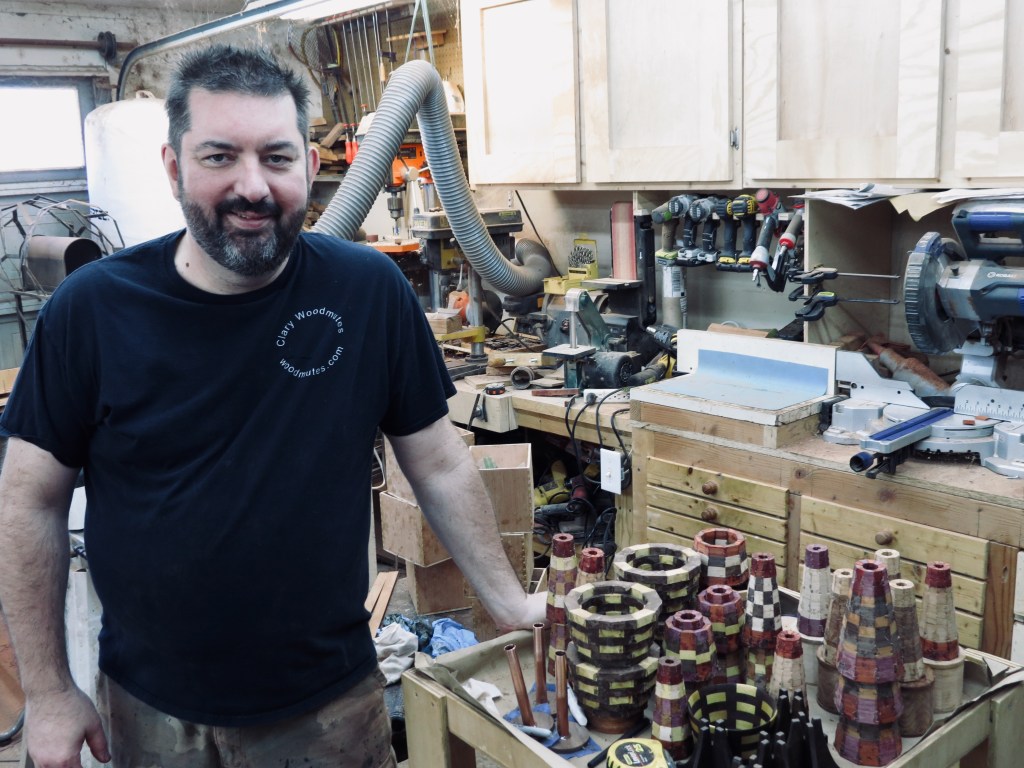
In May 2018 in San Antonio (TX) I had the great pleasure of meeting Tom Clary at the annual ITG conference. Tom is the founder / designer / master craftsman behind Clary Woodmutes, and was there to display his range of beautifully-crafted wooden trumpet mutes.
Two years on, Clary Woodmutes continue to go from strength to strength with a broad range of exquisite looking (and sounding!) mutes – I was delighted to sit down and spend some time with him (socially-distanced over Zoom of course) to chat about this great progress:
So tell us how you got started with the trumpet and making mutes.
After High School, I went to Henderson State University in Arkansas, where I was going to get a music education degree. Then I decided that I would transfer to the University of Memphis to pursue a jazz composition degree – a couple of years into that I started playing around town quite a bit. I dropped out of school to play the trumpet full-time. At that time I was playing at BB King’s blues club in the house band – for a 23 year-old that was pretty cool!
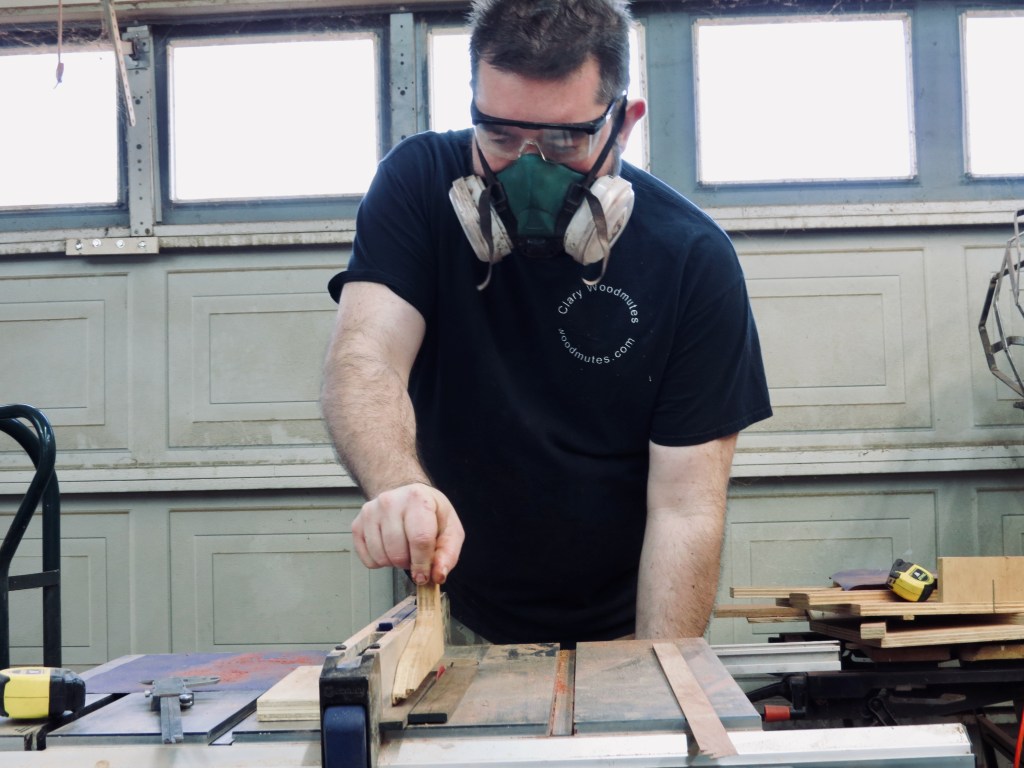
As the years went by, I met my now wife, we had a couple of children, and I decided to ‘get serious’! I went back to finish my music degree and also got a law degree. It was time for me to start thinking about other people! I practiced law for 15 years – I was still playing the trumpet at this time – at the weekends I would look for diversions or hobbies to take my mind off the work. I had always enjoyed carpentry and my dad was into construction – I started wood-working in my garage.
One day I decided to try to make a mute for my own fun, and that is how all of this started! It was just a simple wooden cone, I put corks on it and it kind of worked!
At what point did it move from just being a weekend thing?
It took a little while. I would gradually make more, and experiment along the way to get the sound right. I would take them to gigs and give some away to get feedback from different players. I learned a lot about the mutes, and then slowly I became more ambitious with it, and wanted to expand the range and figure out how to build a website!#00:10:37.18#
I wanted to make sure that they all looked pretty. Wood is beautiful, and I wanted these mutes to be as appealing to the eye as they are to the ear. It was probably 3-4 years from making my first mute to getting the website up and running. That was in February 2018.
When we met at ITG in May 2018, I got to see and try some of your straight mutes. Your range now looks huge! Has this expansion been part of a master plan, or is it more a case of making a custom order and then that making it into production?
Kind of a mixture of both. I’m the kind of person who is interested in lots of different things – I have been a trumpeter, an arranger, a sound engineer, a lawyer… I have changed careers frequently! The fact that I am 7-8 years into this mute adventure, and it still holds my interest is remarkable!! Part of that is coming up with new stuff. If I just confined myself to making straight mutes all of the time I would get super bored. My natural curiosity and need for variety drives me to always look at new things.
That must be an interesting and challenging design process with there not being many wooden mute ranges of this quality and aesthetic on the market? And not many alternatives to compare them with?
I was no acoustician or designer so everything I did was trial and error. I learnt how to work the shapes out of wood on Youtube! The design process was not exactly deliberate, ad some of it was taking an aluminium mute and analysing it, and seeing what I could apply to making a wooden mute. I just went day-by-day figuring it out.
Was there a lot of trial-and-error on the different types of wood?
Yes, that’s what made it really interesting. Learning what subtle differences the different materials make. Last week I made a comparison video of the 4 straight mutes that I make and you can really hear the subtle differences in the wood.
Were there any surprises that you encountered along the way? Any that you hoped would work but ended up in the scrap pile?!
My scrap pile is big! A lot of mutes made it in there, especially when I first started. I found it frustrating when things didn’t turn out as I intended. Along the way I have learned that it is just part of the process. I have learnt from my mistakes and bad choices!
You could say that there is no such thing as a mistake if you have ended up learning from it?
Very true! I think that I have also learned a lot about myself through this whole process – not thinking that you always have to be right or have immediate success. Life is a process!
How have you found building relationships with trumpeters through all of this?
It has been great. I have met a lot of really wonderful people, at shows like ITG and NTC, and also folks reaching out to me on the internet. It is wonderful, I feel extremely lucky to meet all these people and communicate with them. That has been one of the biggest positives – people all the time will suggest things and want to participate in the process. This is great for me, and I also want to get as much feedback on every mute as possible so that they can keep getting better.
As things get busier, how do you juggle everything now?
When I was still trying to practice law, and write music, and play the trumpet… that was challenging. Law school was the point where I really learnt how to manage my time. Ever since this pandemic hit, it has been easier to focus more on what is important. The trumpet playing and music writing has obviously disappeared, and I have had the chance to focus just on the trumpet mutes during this period. It has been positive in this way.
I will get up and drink some coffee with my family, then go into my workshop and make mutes for the day. And about 5pm I will come out and cook some dinner. The pandemic has had a horrible and devastating effect on the world, so it is important to try to acknowledge some positives too.
So what’s next?!
I found this really cool plywood online – thin veneered layers that are sandwiched together – with each layer dyed a different colour. I ordered some of this, and made up some mutes that look really great. I am going to do some limited edition stuff.
Visit woodmutes.com to find out more and to see the full range of great mutes that are available.
Sign up here for new blog articles emailed direct to your inbox:
Hands up, anyone who has wasted a practice session messing around with heavy valve caps and trim in the hope that they will be the answer to all of their problems. And then gone back to what they had on originally. I guess that I am probably not alone.
There are some really attractive options out there and there is no doubting their ability to give you a ‘pimped up’ horn. At first glance, these trim kits from Frate Precision are beautiful. A gold-plated refined Italian design with black onyx set into the finger buttons, and black anodised aluminium stems. They are simply stunning. Ultimately though, what will persuade us to keep them on the horn is how they help or improve the instrument’s performance.
Different weights positioned at different points on the trumpet undoubtedly make a big difference to tonal colour and response. I will go through the 3 different weighted cap options that Frate Precision offer as well as looking at the performance of the upper part of the trim kit.
I have started by putting the trim kit on my Bach LR180ML37. Bach valves are not known for being the smoothest, so I was initially looking for an improvement in the action. These trims use an original dampening system which uses low density rubber washers encased under the finger buttons and positioned on the axis of the stem for a more silent and fluid movement. They certainly made a big improvement to the action of the valves. I then play-tested these using my normal Bach bottom caps and actually found slightly less resistance than normal.
The Frate Precision ‘Light’ bottom caps are 41g and 9mm deep and are a small fraction heavier than my standard Bach caps. There is immediately a greater stability of sound. Slotting is better, but there is still a nice resonance to the sound, which is why I picked out this horn in the first place!
The ‘Medium’ bottom caps are 72g and 13mm deep. They add a real darkness and a silky quality to the focussed sound. This would not be my setup of choice for sitting in an orchestral section and making a blending sound, but I love it nonetheless! Effortless (well, nearly!) power with round and focussed sound – I can see this setup suiting lots of players, classical, jazz and commercial.
The ‘Heavy’ caps are not as extreme as we see from some other makers, at 135g and 20mm deep. I have never really seen the benefits of adding extreme weight to a horn that was not designed with that in mind. The intonation often suffers as well as the original characteristics that presumably led you to pick out that trumpet in the first place! The Frate Precision heavy caps are more ‘civilised’. Yes, they totally change the character of the instrument – dark, compact, forward-facing power – but the intonation and articulation characteristics of the instrument remain intact.
A number of players like to add some additional weight to just one valve. For instance, extra weight to the 3rd valve cap can really help give some extra depth and weight to the sound without compromising the overall resonance of the instrument. Some players like to add that extra weight to the 1st valve which can typically give you a more explosive and immediate attack. Adding a single ‘Medium’ cap to the ‘Light’ kit gave exactly this reaction.
When ordering these kits, you can choose exactly what weights of caps you want (all at the same price), and you can add an additional single heavier one if you like, or even have one swapped over. They are completely customisable.
These trim kits get a ‘highly recommended’ from me! Yes, they look great. But they also give a real and noticeable range of performance enhancements. The full specs and prices are below:
-Refined Italian design
-Disc in Black Onyx set into the finger button
-Black anodised aluminium stem
-Original dampening system
-Available in Gold Plate (£189.95) or Raw Brass (£129.95). An extra bottom cap is £15.95 in Raw Brass and £26.95 in Gold Plate
Matthias Höfs is a trumpet player and musician of the highest order. He is Professor of Trumpet at the University for Music and Theatre in Hamburg, and an acclaimed soloist and chamber musician in his native Germany and around the globe.
Last year’s release of his ‘Bach Trumpet Concertos’ album – beautiful performances of great Bach concertos arranged for the trumpet – led to me being mildly obsessed with any of Matthias’ recordings that I could get my hands on! A truly astonishing feat of music-making [IMHO!]. It was a real privilege to catch up with him here for this article:
Please can you give a bit of background to what got you started playing the trumpet and who your early musical influences were?
As a young boy, I wouldhear stories from my grandmother about my grandfather, who was an avid trumpet player in the church’s brass ensemble. Unfortunately, I never got to know him, but when my parents later asked me (I had just turned 6 years old) if I wanted to learn an instrument, I rememberedmy enthusiasm for the trumpet from those stories. On top of that, I was also fascinated by such shiny gold instruments!
As I had absolutely no musical training (I couldn’t read a single note), I started to learn solely by ear and would try to play melodies from the radio. Unknowingly, it was a very good method to train the ear and feeling for the instrument. Finally, when I was 11 years old and came to learn with my first teacher, Prof. Peter Kallensee, the then solo trumpet player of the Hamburg Philharmonic State Orchestra, my wish was clear: to play solo trumpet in a large symphony orchestra. To this day I still spend a lot of time on stage with friends from my youth orchestra days. Since 1980 I have played together with Christoph Baerwind, Uwe Füssel, and Werner Heckmann, all of whom were also later members of German Brass.
At what point in your career did you realise that solo performance and musical innovation would play an important part for you?
I have always had a desire to play music with my friends. Since there was however, very little chamber music for trumpet, I began very early on to arrange for a wide variety of instruments so that I could also play music with strings and woodwinds. Then, when I was engaged as the principal trumpet of the Hamburg State Opera at age 18, I enjoyed a great support from my chief conductor, who let me regularly perform as a soloist with the orchestra. In 1984 the invitation came to join the newly established ensemble, German Brass. I will never be able to forget the ensemble’s first concert. The trumpet group at the time consisted of Konraden Groth, Günther Betz, Reinhold Friedrich and my humble self! Since then German Brass has been like a family and has strongly influenced my playing.
How do you manage to juggle multiple projects alongside keeping your trumpet playing at the highest level?
When you are passionate about something, you can always find room to consistently pursue what is important to you. So I have, for example, no scruples about a practice session in an empty airport gate before a connecting flight, or to practise in a car park if there is nothing better available. I also enjoy practising outdoors under the open sky. This happens sometimes during tours in the warmer months while we’re travelling by car, we’ll look for a rest area in a remote forest.
Have your practice routines and practice sessions changed much over the years?
I don’t have any ‘Routine’ and don’t like purely technical exercises without a hint of music. For me, a sense of feeling for the body and embouchure is very important. If you can ‘save’ a good feeling, then you can make your warm-ups very compact and save a lot of time.
What are the key things that young aspiring players should concentrate on?
We will make the most progress when we try to play music with the greatest joy, ease and relaxation, and only ask of ourselves the things that we can play in a controlled manner.
Would you say that your approach to trumpet teaching has changed much over the years, and if so, how?
For me, it is very important to see the trumpet as a musical medium and not as a sort of sport. The tone and expression stand in the foreground. Naturally, technique also helps us to implement this and with it to gain assurance. However, the pressure of performing at auditions and competitions has increased enormously over the years. The standard is constantly climbing and there are always more and more better players and fewer jobs. Because of that, psychological aspects play an ever-increasing roll in lessons.
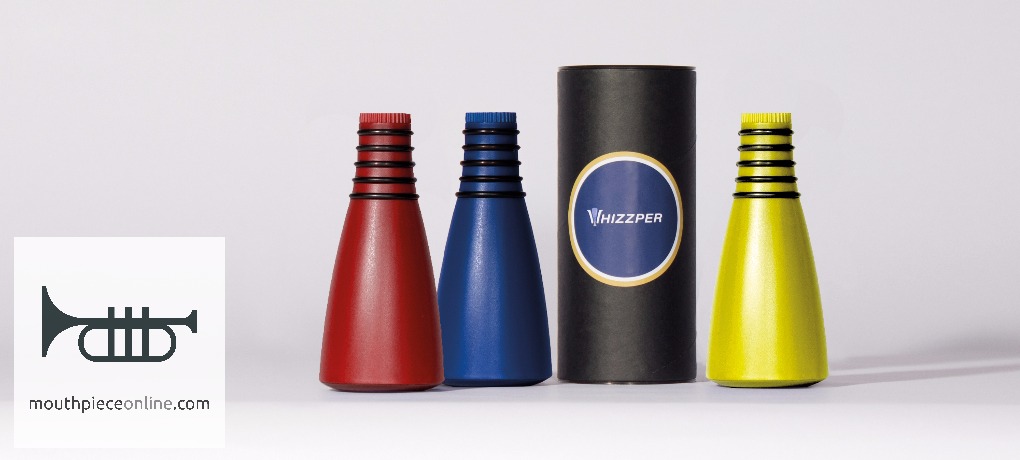
You have worked closely with a number of makers and artisans on helping to develop new and better products. Please can you talk a little on the process of developing the Vhizzper with our mutual friend, Christoph Baerwind?
The Vhizzper Mute is the idea and product of my friend and German Brass colleague, Christoph. I have accompanied and followed the stages of its development through repeated testing and playing. Because we are more or less neighbours and have known each other since childhood, this is very easy, uncomplicated and effective. This practise mute is a great asset for our equipment and another tone colour that we can use for more than just practising.
What has been your most enjoyable project to be a part of?
There are so many wonderful moments for me that I have been able to experience through music over the years, that I find it very difficult to name a single concert or moment. Naturally, it is often the Premiers, the famous ‘first time’, that stays in everyone’s memories: the first concerto with a large orchestra, the first opera, the first German Brass concert…
At the time of writing, we are all in a strange worldwide state of lockdown due to Covid 19. Has this enforced break made you change your perspective or think differently at all on any aspects of life or music-making?
Naturally, these times change all of our thoughts and actions. What we musicians realise, and I think also our audience is there is no alternative to live concerts or operas.This energy can only be freed together with the audience in this special acoustic and atmosphere. Naturally, we are also grateful that at the moment through the internet, we still have the opportunity to convey anything at all. But that cannot at all replace live performances. If there is something positive to see in the situation, it’s the time that we suddenly have with family. You can practise and arrange without the pressure of a deadline, and reflect on the essential things…
What are your ambitions for the future?
Of course, we are all craving to play concerts together again and to be able to bring everything than we are planning now onto the stage. For me, it is something fantastic if it succeeds in bringing our instrument, the trumpet, new works either self-arranged or to be commissioned, where we can show new colours or techniques. The collaboration with my instrument maker Max Thein is also, for me, very inspirational and satisfying when we manage to continue to improve the instrument or to develop new models. For me, to share my experiences and the passion for my instrument and the music with my students at the University for Music and Theatre in Hamburg is very fulfilling. What more could you wish for?!
Contains custom information set by the web developer via the _setCustomVar method in Google Analytics. This cookie is updated every time new data is sent to the Google Analytics server.
2 years after last activity
__utmx
Used to determine whether a user is included in an A / B or Multivariate test.
18 months
_ga
ID used to identify users
2 years
_gali
Used by Google Analytics to determine which links on a page are being clicked
30 seconds
_ga_
ID used to identify users
2 years
_gid
ID used to identify users for 24 hours after last activity
24 hours
_gat
Used to monitor number of Google Analytics server requests when using Google Tag Manager
1 minute
_gac_
Contains information related to marketing campaigns of the user. These are shared with Google AdWords / Google Ads when the Google Ads and Google Analytics accounts are linked together.
90 days
__utma
ID used to identify users and sessions
2 years after last activity
__utmt
Used to monitor number of Google Analytics server requests
10 minutes
__utmb
Used to distinguish new sessions and visits. This cookie is set when the GA.js javascript library is loaded and there is no existing __utmb cookie. The cookie is updated every time data is sent to the Google Analytics server.
30 minutes after last activity
__utmc
Used only with old Urchin versions of Google Analytics and not with GA.js. Was used to distinguish between new sessions and visits at the end of a session.
End of session (browser)
__utmz
Contains information about the traffic source or campaign that directed user to the website. The cookie is set when the GA.js javascript is loaded and updated when data is sent to the Google Anaytics server