Advice · Gear Review

Bagpipe (or trumpet!) Lung

A school year looming brings with it a fresh start, and a resolution to keep instruments clean and hygienic.  If you need any further confirmation of the importance of keeping your instrument clean, please read on!…

Back in August 2016, the BBC and numerous other news agencies were reporting on a journal article written by doctors at Manchester’s Wythenshawe Hospital.  They described a rare but fatal case of what they described as “bagpipe lung” in a 61-year-old patient.  The deceased man is thought to have developed a bad reaction to mould and fungi lurking inside the moist interior of his bagpipes.

The patient had been struggling with respiratory problems over a number of years, during which time doctors had ruled out all possible environmental causes that they could think of.  On a hunch, the doctors sent away the pipes for testing only to reveal that the instrument was riddled with damp-loving mould and fungi – the types that the doctors know can cause serious lung problems.

Sadly, the damage that had already occurred to the man’s lungs was irreversible.  His condition deteriorated and he tragically died some weeks later.

There have also been a number of other documented cases of this in the UK with Saxophone, Trombone and Trumpet players.  Fortunately in these cases, the cause was identified early enough for the patients to recover.

VISIT THE ‘EDUCATIONAL RESOURCES’ PAGE FOR FREE WORKSHEETS AND LINKS TO PUBLICATIONS

So what steps do we need to take to prevent the build of yeast and other harmful pathogens in our trumpets?

Fortunately the answer to this is nowhere near as complicated as the problems faced by this patient or his doctors.  Regular cleaning.  Whether an instrument is being used regularly or not, the damp environment is a perfect breeding ground for all sorts of nasties.

Woodwind instruments where the instrument can be easily swabbed after every playing to remove moisture are pretty straightforward to keep in a hygienic state.  Brass on the other hand is not so easily attended on a daily basis, so it is important that we flush them out and clean them thoroughly when we do make the time.  I generally suggest to students that this is done monthly.

Taking the instrument apart and soaking it in a hot bath with a mild detergent is generally the best starting point to help to loosen dirt and grime. 

I would then suggest a good quality brush pull-though and then a sponge pull-through to drag out the offending matter!  Finally a rinse through with hot (but not boiling) water should leave your trumpet clean.

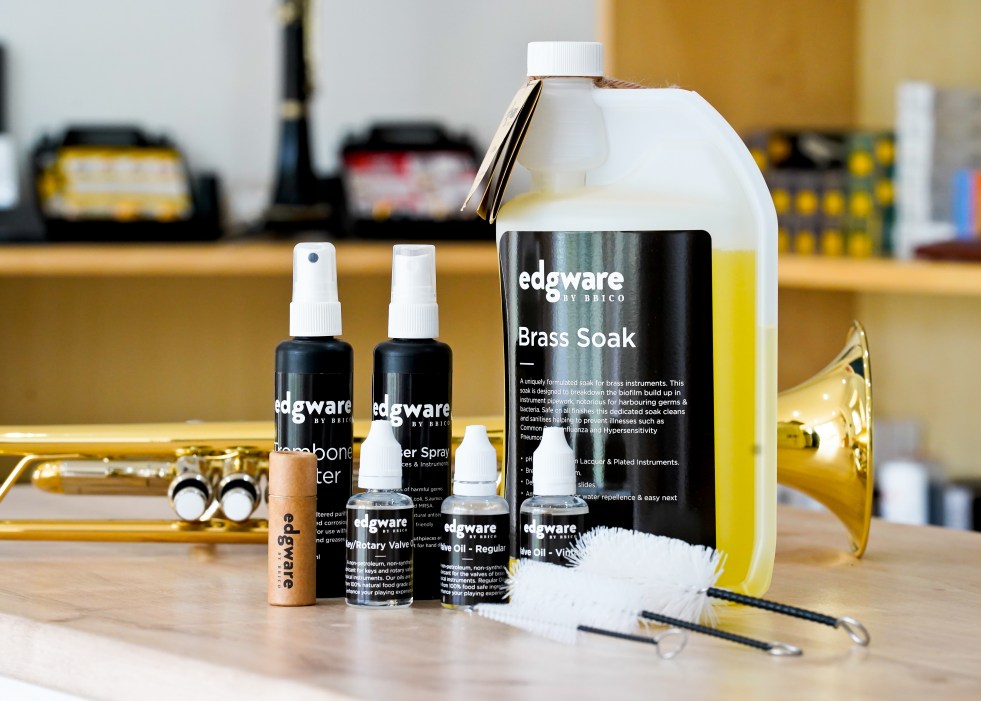
The mouthpiece itself often gets overlooked but is the easiest to keep clean on a daily basis. A good all-natural sanitiser spray such is this one pictured again from Edgware is a ‘must’ for daily cleaning of brass instruments. It is alcohol free and kills 99.9999% of all germs in 60 seconds.

It is also worth making sure that you have a good quality mouthpiece brush. Many a mouthpiece has been damaged by the jagged and twisted wire.

VISIT THE ‘EDUCATIONAL RESOURCES’ PAGE FOR FREE WORKSHEETS AND LINKS TO PUBLICATIONS


SIGN UP HERE FOR NEW BLOG ARTICLES EMAILED DIRECT TO YOUR INBOX:


Advice · Education · Gear Review

How to Clean the Trumpet

This article was originally published by Ken Saul of Ultra Pure Oils, it is clear and comprehensive so I have re-published it here! Other brands are of course available to use, but I am yet to find any cleaning and maintenance accessories that are as slick and reliable as Ultra Pure.

Keep your horn clean and you will never have a problem with sticky valves or slides. Keeping it clean inside also removes bacteria that can build up in the tubing.
VISIT THE ‘EDUCATIONAL RESOURCES’ PAGE FOR FREE WORKSHEETS AND LINKS TO PUBLICATIONS

Daily Wipe Down

You should wipe off your trumpet at the end of each day using the Ultra-Pure microfiber polishing cloth. Gently wipe all the surfaces, especially where you hold the horn. Wipe off any water spots. The microfiber cloth will soak up oils and grease and should be washed once a month. If you have a silver plated trumpet, you can use a silver polishing cloth to remove tarnish about once a week. Use it to wipe the outside of the instrument only.

microfiber cloth and trumpet cleaning
Wipe the outside of the horn every day to remove fingerprints, water spots and oils.

Bath Time

You should give your trumpet a bath about every month or two to keep it in the best condition. It only takes about 30 minutes to do a good job.

Carefully pull out the main tuning slide and the three valve slides. Wipe off any grease on slides with a paper towel. Remove the bottom valve caps. If they are stuck, try using a rubber jar opener, not pliers. Also wipe off the bottom valve caps with the paper towel. Then remove the three valves. They are numbered 1, 2, and 3. When you pull out the valves, check which way the number faces, the mouthpiece or bell end. When you put the valves back, they will face the same way.

Put a rubber mat or a towel in a tub or large sink and fill it with lukewarm water. Add some lemon-scented dishwashing liquid detergent (about a tablespoon is enough). Gently immerse the trumpet, the slides, the bottom valve caps, and your mouthpiece. Put some of the soapy water in a glass and immerse the valves, keeping the felts dry. Let everything soak for 10 minutes or more.

soaking a trumpet for cleaning
Take the trumpet apart and soak it in lukewarm (not hot) soapy water.
Trumpet valves soaking in a glass of soapy water
Soak the valves in soapy water while keeping the felts dry.

Run the snake through the leadpipe and all the trumpet body tubing several times. Run it down the bell and around the back bend. Use the snake to clean the insides of the tuning slide and the valve slides. Don’t force the snake if it does not bend around the tubing easily.

Cleaning a trumpet with a snake brush
Use the flexible snake brush to clean all the inner tubing.

Scrub the valve casings from the top and from the bottom with the valve casing brush. Clean the bottom valve caps carefully to remove all the residues. Finally, clean the mouthpiece with the mouthpiece brush. Drain the tub or sink and rinse all the parts completely. Let them dry on a towel.

scrubbing a trumpet valve casing
Scrub the valve casings with the cylindrical brush.
Cleaning a trumpet mouthpiece
Scrub the mouthpiece with the tapered brush.

Clean the valves

Gently clean the valve ports with soapy water using the snake brush or the valve casing brush. Scrub the valve surface with soapy water using the valve casing brush or an old toothbrush. Be careful not to scratch the valve surface. Wash the valves with plenty of clean water and let them dry on a towel.

Lubricate the slides

Put a small amount of Ultra-Pure Regular Tuning Slide Lube on your finger and rub it onto the slide. Insert the slide all the way and wipe off any excess lube with a paper towel. If you are used to moving the first and third valve slides quickly for more accurate tuning, you should use Ultra-Pure Light Tuning Slide Lube on these slides. Also, rub a little slide lube on the top and bottom valve casing threads. Slides should be lubed about once a week or two.

Grease a trumpet tuning slide
Rub a small amount of tuning slide grease on each slide and put it back into the horn. Wipe off any excess grease with a paper towel.

Oil the valves

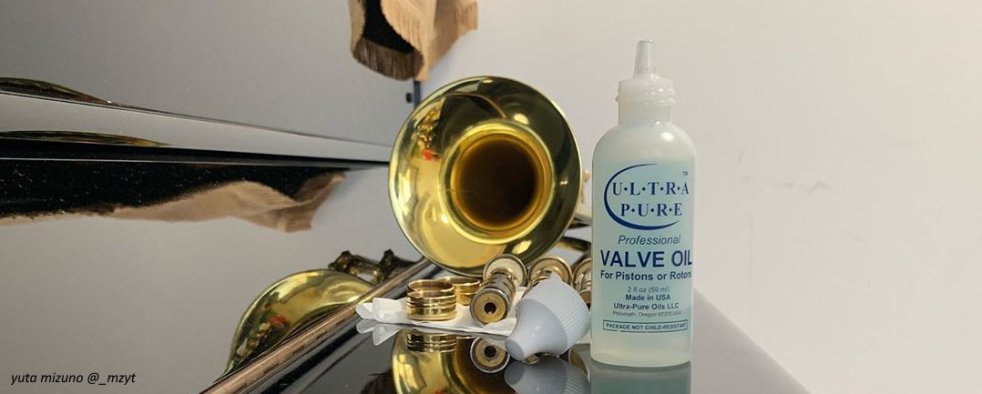
Hold the valve over a sink, cloth or newspaper and coat it with plenty of Ultra-Pure Professional Valve Oil.  Carefully put it back into the casing and make sure the valve “clicks” into place, facing the right direction. When putting the valve back in its casing, do not rotate it since this can cause excessive wear. Screw the bottom valve caps back on. After the valves are in, try blowing some air into the leadpipe while moving the pistons. If air stops, you probably have one or more valves in backward.

Valve oil and a trumpet valve
Drip plenty of valve oil onto the valve surface to lubricate it.

Reapply valve oil every day or two

You should oil your valves every day or two. Just unscrew the valve and pull it up and out of the casing. Coat the valve with oil and carefully put it back in the casing. 

Treat your instrument gently

Be gentle with your instrument. It is dented easily and dents make the instrument harder to play or can cause valves or slides to stick. Keep the horn in your hands, on your lap, or in the case. Not on the bed, a chair, or on the floor. If the instrument gets a dent, or if your mouthpiece gets stuck, take it to a music store to be repaired professionally.

VISIT THE ‘EDUCATIONAL RESOURCES’ PAGE FOR FREE WORKSHEETS AND LINKS TO PUBLICATIONS

You may also be interested to read this article about ‘Bagpipe Lung’ to emphasise the importance of keeping your trumpet clean!


Sign up here for new blog articles emailed direct to your inbox:


Gear Review

Edgware by BBICO

I was recently sent a range of new products to take through their paces from BBICO – the British Band Instrument Company. Their Edgware range (named after their North London home) encompasses an intriguing ethos of sustainability.
Many companies have adopted a toxin and/or petroleum free approach to their designs of cleaning products and brass instrument lubricants, but I am not aware of any others that have gone to as great lengths as BBICO to limit any negative environmental impact. As well as the utmost care in designing, sourcing and manufacturing the products themselves, the packaging is all biodegradable, compostable and recyclable. This even includes the ‘plastic’ bags that are in fact NatureFlex and made in the UK of wood-pulp from managed plantations.

As we move forward, it is surely (hopefully!) a matter of time before this kind of care and attention to packaging waste becomes mandatory across consumer industries, so the developers of the Edgware range deserve huge accolades for leading the way in this.

But of course, we need instrument care products that also do a great job… Here are a few products that really stood out to me:

Brass Soak : Just a small amount of this PH neutral soak mixed with warm water does a great job of degreasing and removing the bio-film from within the instrument and slides. I used this on an instrument that I thought to be pretty clean… but I was obviously wrong!

Valve Oil – Regular : This is a nice lightweight valve oil made from ‘food grade’ ingredients. The action on my newer instruments was nice and smooth and it is always reassuring to know that your valve oil is not poisoning you!

Valve Oil – Vintage : Now this is the oil that I have been seeking for some time! I have an old Cousenon flugel with valves that have seen better days. Until trying this Edgware oil, I had not found one that was thick enough to stay on the valves and provide adequate seal, yet flexible enough to give a smooth and consistent action.

Sanitiser Spray : This is a completely natural anti-bacterial spray, completely free from alcohol, fragrance and harmful chemicals. Particularly at the moment, this is a really important addition to any trumpet case as it can be used on skin as well as your mouthpieces!

Slide Grease : This is a great multi-purpose slide grease that does a good job around the instrument and is so safe that it can even be used as a lip balm!

Please click here to view the full range of brass instrument care products by Edgware.


SIGN UP HERE FOR NEW BLOG ARTICLES EMAILED DIRECT TO YOUR INBOX:

[jetpack_subscription_form show_subscribers_total=”false” button_on_newline=”false” custom_font_size=”16px” custom_border_radius=”0″ custom_border_weight=”1″ custom_padding=”15″ custom_spacing=”10″ submit_button_classes=”” email_field_classes=”” show_only_email_and_button=”true”]

Advice · Interview

Design Innovations : Ultra Pure Oils

Ken Saul is the founder of Ultra-Pure Oils LLC, and talks to us here about getting started with creating his first valve oil product and how that has developed in to the extensive range that we see today.

Can you give a little of your background and your relationship with the trumpet.

I started the trumpet when I was 10 years old as part of our public school band program. Trombone was actually my first choice, but my arm was short and my older brother already played the trombone, so trumpet became my second choice. My main trumpet teacher in high school and college was Joe Alessi, Sr., the father of the famous trombone player of the New York Philharmonic. We were so fortunate to have Mr. Alessi in our town. He was formerly with the Metropolitan Opera Orchestra and a student of William Vacchiano, Harry Glantz, and Max Schlossberg.  So Mr. Alessi’s students all got great training on trumpet fundamentals (lots of Arban, Schlossberg, Clarke, etc.). After receiving my college degree in music performance, I went on to study electrical engineering, which had always been my hobby. Even though I had a 30 year career in high tech as an electrical engineer, I never stopped playing the trumpet, and have been principal trumpet in our local university symphony for over 20 years. You can hear me on my YouTube channel .

What led you to start Ultra Pure Oils?

When my son was about 3 years old, he was digging around my trumpet case and I remembered that the bottle of valve oil was hazardous and to be kept away from children. I started looking around for a good valve oil that was not so smelly or hazardous, and was not able to find anything at that time (1990).  I was familiar with synthetic oils from my day job, and began to blend oils to produce a good valve oil for trumpet. At that time, it was just a hobby, but I found it to be interesting and rewarding.

What were the first products that you launched and why?

The first product was just a good valve oil.  At that time, we really only had kerosene-based valve oils, and these smelled bad and would evaporate quickly.  Some even left residues behind which would gum up the valves if not cleaned constantly. I intended Ultra-Pure Professional valve oil to be odorless, long-lasting, super smooth feeling, and to leave no residues behind.

What was the R&D process like for your products? Did you get other people/players involved?

I am trained in design of experiments, statistics, and material science, so I definitely approached product development from an engineer’s perspective. After I was pretty happy with the valve oil, I sent it around to many of my friends and got feedback from them to make any fine adjustments.  I began selling it through an ad in the ITG Journal. Remember, this was before the internet was invented! Mostly it sold to people I knew, and it grew slowly by word-of-mouth. In the year 2000, Dave Monette began using Ultra-Pure valve oil on his fine instruments and word spread more quickly about our product and we added a few retail dealers.  We then added regular and light tuning slide greases.

Have there been any unexpected challenges along the way?

Keeping oil in the bottle and not leaking in shipment is a definite challenge that every valve oil company has faced. It is difficult to tighten the caps properly by hand, and we gradually added power equipment and automation to properly seal and tighten caps.  We have also had to meet all the regulatory challenges involving types of bottles and caps, labeling, and warnings that are required of all consumer products that are light viscosity oils, even if they are food-safe and generally harmless.  The most recent challenge was during this COVID pandemic, most of the bottle makers changed their factories over to making only bottles for hand sanitizers, hand soap, and other essential health needs.  The bottles we needed took many months to procure instead of the usual few weeks. Fortunately, we did not run out of bottles, but we did have to ship oils in some unusual bottles as a stop-gap measure.

How do you balance running UP with having a life outside of work?!

This is a great question! Ultra-Pure Oils began growing organically, but gradually began consuming all my nights and weekends. Right at the point that it was clear that Ultra-Pure Oils was bringing in enough income on its own, I was offered an early retirement incentive from my employer and jumped at the opportunity. That was nine years ago, and our business has blossomed since my “retirement”. We finally had time to find excellent distributors all around the globe and started working with many instrument makers to provide their private label lubricants. Working for myself in our home workshop is incredibly rewarding and leaves me time to get out for a good walk everyday, practise trumpet, and enjoy gardening.

Any plans or new developments for the future?

We now offer a full line of lubricants for every instrument, including valve oils, rotary oils, trombone slide lube, tuning slide oils and greases, and excellent care kits for brassesand woodwinds.  I look forward to travelling to more to trade shows and festivals when we are able to do so again, and to meet many of our customers and dealers.  

Please visit the Ultra-Pure Oils website for further information.

You may also be interested to read this article written by Ken on how to clean the trumpet.


SIGN UP HERE FOR NEW BLOG ARTICLES EMAILED DIRECT TO YOUR INBOX:

[jetpack_subscription_form show_subscribers_total=”false” button_on_newline=”false” custom_font_size=”16″ custom_border_radius=”0″ custom_border_weight=”1″ custom_padding=”15″ custom_spacing=”10″ submit_button_classes=”” email_field_classes=”” show_only_email_and_button=”true”]

Education

What’s the story behind Trump Street?

Visitors to the City of London (London’s main financial district) will be accustomed to the glass-fronted homes of high finance and over-priced coffee. They may well have also come across the interestingly named ‘Trump Street’ and thought it to be a nod to our friends over the pond. They would however be wrong!

I recently came across this informative article written by Katie Wignall on the ‘Look Up London’ website:

” In the City of London, one street name has been causing a lot of pointing and smirking recently…

But despite this street’s uncanny resemblance to the US President, it actually dates from the early 18th century, before America even became an official country.

SO WHAT’S THE STORY?

It sits just off Cheapside, the market centre of Medieval London, which is littered with street names hinting at their historic function; Milk Street (for dairy products), Poultry (for buying chickens), Bread Street (you get the idea) and – just to catch you out – Cannon Street, which was originally Candlewick Street and the home of candle makers, not canons.

So it makes sense that ‘Trump’ has something to do with a trade.

The first record of Trump Street is mentioned on this map of London by Rocque dating from 1746

More solid information comes from HT Riley’s 1868 work; ‘Memorials of London and London Life in 13th, 14th and 15th Centuries.’

Riley talks about a Mr William Trompeor (a trumpet-maker) and says “The persons who followed this trade mostly lived, in all probability, in Trump Street … near the Guildhall.”

He also says the trumpets were usually made for the nearby watchmen, who guarded the City and who might need to sound the alarm for intruders trying to breach the *ahem* large City of London walls.

Later historians seem to agree with Trump Street being the home of Trumpet makers; Pevsner’s City of London Architectural Guide (published 1997) also notes an inn called ‘The Trumpeter’ used to stand on Lawrence Lane which “is thought to be commemorated in the post-fire Trump Street.”

So there you have it. Trump Street = Former Trumpet Maker’s Street.

IT GETS WEIRDER…

To really hammer home that truth is stranger than fiction, Trump Street leads onto Russia Row. It’s name is also trade-related, probably a reference to the ‘Muscovy’ or ‘Russia’ Trading Company established near here in 1555.

Find Trump Street here. “

Many thanks to Katie Wignall for her permission to republish this article and images. To view the original article, and to find out more about London’s hidden corners, please visit lookup.london


Sign up here for new blog articles emailed direct to your inbox:

[jetpack_subscription_form show_subscribers_total=”false” button_on_newline=”false” submit_button_text=”Sign up” custom_font_size=”16″ custom_border_radius=”0″ custom_border_weight=”1″ custom_padding=”15″ custom_spacing=”10″ submit_button_classes=”” email_field_classes=”” show_only_email_and_button=”true”]

Gear · Teaching techniques · Trumpets

Bagpipe Lung

A New Year brings with it a fresh start, and a resolution to keep instruments clean and hygienic.  If you need any further confirmation of the importance of keeping your instrument clean, please read on!…

Back in August 2016, the BBC and numerous other news agencies were reporting on a journal article written by doctors at Manchester’s Wythenshawe Hospital.  They described a rare but fatal case of what they described as “bagpipe lung” in a 61-year-old patient.  The deceased man is thought to have developed a bad reaction to mould and fungi lurking inside the moist interior of his bagpipes.

The patient had been struggling with respiratory problems over a number of years, during which time doctors had ruled out all possible environmental causes that they could think of.  On a hunch, the doctors sent away the pipes for testing only to reveal that the instrument was riddled with damp-loving mould and fungi – the types that the doctors know can cause serious lung problems.

Sadly, the damage that had already occurred to the man’s lungs was irreversible.  His condition deteriorated and he tragically died some weeks later.

There have also been a number of other documented cases of this in the UK with Saxophone, Trombone and Trumpet players.  Fortunately in these cases, the cause was identified early enough for the patients to recover.

So what steps do we need to take to prevent the build of yeast and other harmful pathogens in our trumpets?

Fortunately the answer to this is nowhere near as complicated as the problems faced by this patient or his doctors.  Regular cleaning.  Whether an instrument is being used regularly or not, the damp environment is a perfect breeding ground for all sorts of nasties.

Woodwind instruments where the instrument can be easily swabbed after every playing to remove moisture are pretty straightforward to keep in a hygienic state.  Brass on the other hand is not so easily attended on a daily basis, so it is important that we flush them out and clean them thoroughly when we do make the time.  I generally suggest to student that this is done monthly.

Taking the instrument apart and soaking it in a hot bath with a mild detergent is generally the best starting point to help to loosen dirt and grime.  I would then suggest both a brush pull-though and then a sponge pull-through to drag out the offending matter!  Finally a rinse through with hot (but not boiling) water should leave your trumpet clean.

I have found some really good quality pull-throughs etc for this purpose, links to a few are listed below this article.

You may also be interested in a few of these simple products that I have found that can be useful for keeping your instrument free of grime on a daily/weekly basis, meaning that you can perhaps do the “full flush” slightly less frequently.

Spitballs from Herco have been around for years, seemed to fall out of favour, and have now made a big comeback.  These are specially treated pieces of moist foam that are blown right through the instrument.  On their own, they will not take the place of a thorough flush, but used regularly reduce the need for frequent full cleans.  These are really popular with trumpet players, although not so popular with anyone who is on the receiving end of one exiting a trumpet bell at speed!  The link to the manufacturer’s webstore is here, although it is also available from most good music stores.  http://store.jimdunlop.com/p/he185si-sm-spitballs-18-jar

There has been a huge drive towards using natural and/or non-toxic ingredients in oils and cleaning materials recently.  One interesting company that I have come across are B Sharp Brass.  Their Virtuoso Cleaning Kit includes a really good instrument soak that you dilute to clean your instrument – the residue from this also helps to prevent build up in the instrument too.  http://www.bsharpbrass.com/products

There are loads of good brush pull-throughs around, too many to list here, but I generally favour ones without too much bare wire to scratch the inside of the instrument.  In addition to these, I like the following kit from Reka which has perfectly sized spheres on the end of the cleaning cord and bars, perfect for dragging out any last bits of dirt.  http://www.reka-web.com/228/