Gear Review

Instrument Review : C Trumpet from Norwich Natural Trumpets

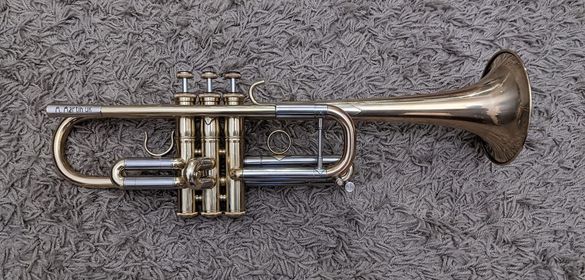
I was recently sent a new C trumpet by Matt Martin from Norwich Natural Trumpets. This was designed in collaboration with Mark Bennett and has arrived with me looking spectacular. These trumpets are custom-built to order, but surprisingly do not have the custom price tag. In fact they are currently less expensive than many people’s favoured Bach or Yamaha models!

This model is based around a medium large .460 bore Hoxon Gakki valve set (the MAW valve set is also going to be an option), a 0.45mm gauge gold brass bell opening out to 125mm, an open Malone-style leadpipe and a D-shaped bronze tuning slide. The bell taper is not too dissimilar to a Bach 239.

Looking at the spec, the first thing that stands out is the medium large bore. Most of us are more familiar with a large (.462 or .464) bore on C trumpets. So I approached playing this trumpet with the preconception that it would feel small, stuffy or restricted in some way. It did not!

Responsive and lively, ‘yes’, but certainly not restricted. The sound is full-bodied with a rich tonal core that I immediately loved. It also feels open, not unlike playing a nice symphonic style Bb trumpet.

The Bb similarities do not end there. The intonation is great across the range as is the sound quality. I have always primarily played Bb trumpet have found the adjustment to C trumpet intonation a challenge. I am pleased to report that this Norwich Natural Trumpets model does not pose the same challenge!

As you may be aware, Matt Martin’s natural and period trumpets have been ever-growing in popularity – It is great to see this craftsmanship and artistry expanding to modern trumpets. There are also some great new developments with the Bb trumpets coming, and I look forward to getting to try these too!

Please visit Norwich Natural Trumpets for further information.

Advice · Interview

‘Meet the Maker’ : Peter Pickett

Many top players have already turned to Pickett Brass and Blackburn Trumpets for mouthpieces and trumpets. At the helm is Peter Pickett who has kindly given up his time to answer some questions…

Can you talk a little about the background to getting started on this trumpet craftsmanship journey? 

This entire journey to date in hindsight appears elegant and neat when laid out on paper, but rather, has been quite challenging.  I’ll look back one day on life and say that all the pieces were laid out and it was such a natural progression, but the truth is that opportunities came and went, but with some luck, I was able to latch onto key ones along the way.  For example, when Cliff Blackburn approached me in 2009 on working with him to carry forward Blackburn Trumpets, I happened to have been in the right place at the right time.  Having said that, most of the company’s significant forward steps have hinged on being in the right place at the right time, and paying attention to see and take advantage of fortuitous timing.  You must always be aware of what’s going on around you and have the imagination to envision the possibilities at all times, even as impossible as it may sound at the moment.

My internal, irrational, and unconscious drive to bring this all to life has been a result of combining the joy of playing trumpet and of my engineering background and manufacturing.  What could be a better combination of those interests?  So much of the company’s progress and progression has been driven by brute force and pure work ethic, powering through significant inefficiencies and unawareness, to accelerate learning and progress to get ahead of the learning curve and not settling for what was easy or simply sufficient in the moment.  We’ve worked through a number of these headwinds, but out of the gate, you just have to execute and work regardless of what it takes to get it done.

When Pickett Brass officially started in 2003, I did not have all the skills necessary to do what we do today.  But this didn’t stop me from stepping forth to see if all of this could work.  Stumbling through numerous issues having nothing to do with the actual parts in the beginning really woke me up to the sheer number of obstacles that would need to be overcome.   

Who or what were your inspirations?

Most of my inspiration comes from wanting to actually make something meaningful, bringing something to life.  Being able to create something from raw materials, from almost nothing, that act of creating is what fuels me the most.  This coupled with music and creating something that contributes to the creation of music only reinforces the inspiration.  The incredible variety of artists that I get to meet and work with is humbling.  Ultimately it’s a privilege to be a part of this music making community –  which is not something to be taken lightly.  When we are actively part of something larger than ourselves, and can contribute to the greater good, it’s not an opportunity to boast or brag, but rather to quietly contribute to the growth of all in the community together, creating community strength.

Did you set out with ideas of how manufacturing could be improved?

Absolutely – when any process becomes elegant and efficient, it is more fun and enjoyable.  This applies to any endeavor – for example, we don’t play trumpet because it’s hard, no fun, and produces unpleasant sounds.  No – instead, when we become adept and efficient at playing the instrument, it is more fun and enjoyable – and the end product is all that much better.  Wanting the business processes, the design processes, and production processes to be elegant and efficient has always been a significant driving force.

How and why did you branch out from valve trim-sets to the excellent custom mouthpieces that you now produce?

When all of this started in 2001, I was only aiming to make 1 set of trumpet buttons for myself.  They were made by hand, nothing special, but just made by me, for me.  This was followed by stems, top caps, and bottom caps and as far as I could tell at the time, this was all it was going to be.  Mouthpieces eventually followed as a natural progression around 2007.  I had the machines to do them and as every trumpet player knows, no one mouthpiece is going to be ‘it’ for any player.  The unlimited possible variations for brass instrument mouthpieces allows for numerous designers and manufacturers all around the world to take part and participate in this industry.  This was exciting to know despite “everything has been invented already”, I could still produce unique mouthpieces that work like no other for players and that had never been made before.  

Are there any unexpected challenges that you have met along the way?

Absolutely – seemingly endless and absolutely overwhelming at times.  Most people don’t realize what goes into creating and running a complete business.  Making actual mouthpieces is only one small aspect and can be challenging into itself, but ultimately it takes so many other steps to get that freshly made mouthpiece out the door to a player.  So overcoming the challenges of running a business from the financial processes, to ecommerce development and management, taxes, payment processing, facilities, and numerous others, have all been challenges.

Running a successful manufacturing business takes a lot of time and commitment. How do you balance this with having a life outside of the workshop?!

Running a small business is all life-encompassing and a lifestyle choice.  Some say it’s a curse, others a privilege, but there is nearly no time in any day that the business isn’t being worked on or thought about.  So life balance in the traditional sense is fleeting and fairly non-existent. The variety of activities that the business offers is one outlet though – from manufacturing to meeting with customers, there is a wide range of involvement and autonomy.  For example, trade shows give me a fantastic opportunity to meet new people, hear new music, and see new areas outside of the shop.  

Can you talk a little about your work with Cliff and taking on the Blackburn trumpets brand?

Cliff and I have been friends for a long time – starting by meeting him in 2004 at the ITG conference in Denver, Colorado.  He probably doesn’t remember that initial introduction, but it was the first opportunity for me to talk to him and his wife, albeit briefly.  Since that early introduction, through the years, we’ve seen each other often and talked at conferences, and eventually worked together on manufacturing the Blackburn trumpet mouthpieces.  After years of collaborating with Cliff on the manufacturing of various trumpet components for Blackburn Trumpets, he approached me at the ITG Conference in Harrisburg, Pennsylvania in 2009 asking if I’d be interested in working with him in carrying the Blackburn Trumpets company forward after his retirement.  Of course the answer was yes, but little did I know that it would take an additional 7 years to work through the details.

We worked together through that period on training, learning, and exploring what made the Blackburn Trumpets what they are so well known for.  And even after we acquired the company in 2016, we had an incredible amount of learning and work still left to do.  It has been an incredibly overwhelming exercise, but has ultimately proven to be worth the work and challenges.    

What are your plans and ambitions for the future?

As it turns out, making trumpets from scratch is hard – the entire process of making a trumpet from scratch is mind boggling when you consider all the details along the way.  And details matter.  So we are working hard towards complete documentation and process improvements so that the Blackburn brand continues well into the future with strength and a strong succession plan.

I would like the Blackburn team to expand as our space continues to expand.  By having a solid group of craftsmen that are ingrained with the quality and technical expectations, we can produce like no other.  With this solid knowledge base, the Blackburn brand can be expanded into numerous other areas.In regards to the mouthpiece side of the business, we continue to expand our capabilities and improve processes.  It may not sound significant, but when you reduce the number of steps you take to accomplish the tasks it takes to produce a mouthpiece or any other product, the entire process becomes better, easier, and much more enjoyable.  This type of work is difficult in itself and is hard to do while working through day to day business.  However, we strive to take time to study how we do things and to try new approaches, so to maintain our relevance and avoid destructive complacency.

At the moment, the world is in the midst of the Covid-19 pandemic. How has this affected you?

The Covid-19 pandemic and uncertainty has all but fully consumed everyone.  Our business, like many others, has been shut down for a while to stem the spread of the virus, bringing to a halt the production of mouthpieces and trumpets like never before.  In addition, the economic fallout from the significant job disruptions and losses worldwide is incredibly disheartening.  Despite the day to day challenges facing us, I am optimistic that we will get through this together.  This period of time offers an unprecedented opportunity for self reflection and a pause – a universal “time-out” persay.  The challenge has been that this has all progressed so quickly and it’s hard to appreciate the sudden change in routines and ‘normal’ and do the self-reflection and evaluation.  Herein lies the present challenge – and the chance for the once in a lifetime opportunity.  


Sign up here for new blog articles emailed direct to your inbox:

[jetpack_subscription_form show_subscribers_total=”false” button_on_newline=”false” submit_button_text=”Sign up” custom_font_size=”16″ custom_border_radius=”0″ custom_border_weight=”1″ custom_padding=”15″ custom_spacing=”10″ submit_button_classes=”” email_field_classes=”” show_only_email_and_button=”true”]

Education

What’s the story behind Trump Street?

Visitors to the City of London (London’s main financial district) will be accustomed to the glass-fronted homes of high finance and over-priced coffee. They may well have also come across the interestingly named ‘Trump Street’ and thought it to be a nod to our friends over the pond. They would however be wrong!

I recently came across this informative article written by Katie Wignall on the ‘Look Up London’ website:

” In the City of London, one street name has been causing a lot of pointing and smirking recently…

But despite this street’s uncanny resemblance to the US President, it actually dates from the early 18th century, before America even became an official country.

SO WHAT’S THE STORY?

It sits just off Cheapside, the market centre of Medieval London, which is littered with street names hinting at their historic function; Milk Street (for dairy products), Poultry (for buying chickens), Bread Street (you get the idea) and – just to catch you out – Cannon Street, which was originally Candlewick Street and the home of candle makers, not canons.

So it makes sense that ‘Trump’ has something to do with a trade.

The first record of Trump Street is mentioned on this map of London by Rocque dating from 1746

More solid information comes from HT Riley’s 1868 work; ‘Memorials of London and London Life in 13th, 14th and 15th Centuries.’

Riley talks about a Mr William Trompeor (a trumpet-maker) and says “The persons who followed this trade mostly lived, in all probability, in Trump Street … near the Guildhall.”

He also says the trumpets were usually made for the nearby watchmen, who guarded the City and who might need to sound the alarm for intruders trying to breach the *ahem* large City of London walls.

Later historians seem to agree with Trump Street being the home of Trumpet makers; Pevsner’s City of London Architectural Guide (published 1997) also notes an inn called ‘The Trumpeter’ used to stand on Lawrence Lane which “is thought to be commemorated in the post-fire Trump Street.”

So there you have it. Trump Street = Former Trumpet Maker’s Street.

IT GETS WEIRDER…

To really hammer home that truth is stranger than fiction, Trump Street leads onto Russia Row. It’s name is also trade-related, probably a reference to the ‘Muscovy’ or ‘Russia’ Trading Company established near here in 1555.

Find Trump Street here. “

Many thanks to Katie Wignall for her permission to republish this article and images. To view the original article, and to find out more about London’s hidden corners, please visit lookup.london


Sign up here for new blog articles emailed direct to your inbox:

[jetpack_subscription_form show_subscribers_total=”false” button_on_newline=”false” submit_button_text=”Sign up” custom_font_size=”16″ custom_border_radius=”0″ custom_border_weight=”1″ custom_padding=”15″ custom_spacing=”10″ submit_button_classes=”” email_field_classes=”” show_only_email_and_button=”true”]

Gear Review · Interview

Van Laar Trumpets : Interview and Instrument Overview

Interview with Hub Van Laar (June 2018 @ ITG Conference, San Antonio)

What made you want to play brass in the first place?

As a child you had 2 options in my village. I began by playing football, and in my first game I scored 3 goals… in the wrong direction! It was then decided that I should go to the ‘Fanfare’ and play an instrument! I mainly played trombone and got to a very high level. I stopped playing however because of stage-fright. The nerves affected me so badly, and after trying hard to overcome this, I pursued the repairing.

Hub_crop

What made you want to get started with designing instruments?

It was funny – when I was 8, I said I wanted to be a trumpet-maker. I always had that goal. I don’t know why! I wanted to be a trumpet-maker and a farmer. I played in the local brass band, and I was thinking, “Somebody has to make these instruments”. The military band were looking for someone to repair. After that I went to work for a large Dutch manufacturer, and then had the opportunity to work for a small manufacturer in Stuttgart as part of a team of just 4 people. There you had to do everything, it was a great experience.

I have always loved my work and have never been a person that likes to have a day off. I am always happiest when I am busy. The workshop is just 46 seconds from my house!

What were the first models that you designed and built from scratch?

You start working out of necessity and repairing to earn money. I then started to adjust and adapt instruments and would get lots of players to play them to hear what they thought. I started with the flugelhorn because in Holland and Belgium we have ‘Fanfare’ groups with 10 or 15 flugelhorns. This was my market! The trumpets came after that, then the cornet, and now this year the piccolo trumpet is ready.

You have to be very careful bringing a new model onto the market, as if it is not quite ready, before you know it you have a bad reputation. I have to be 100% sure that it is perfect.

You have a number of very well-established models in your range now. Where they all designed with a particular sound or style in mind, or developed more for particular players?

In the beginning I worked with a number of players. The difficulty is that everybody tells you something different! The one unstable factor in an instrument setup is the player him or herself. With lots of players around me, I found that the quality got worse because you are constantly having to change things.

I now do most of the testing myself, and then take it to various players once I am completely happy with the design and setup. Listening to the customers is really important. I start a design by listening to what players need, I then go away and work on the technical stuff to create it. You learn this by doing it, it is not a case of reading a book and then knowing what to do. I believe this is a great strength.

Would you say that all of your trumpets across your entire range have particular characteristics that set them apart from many other makers?

They play in tune! It is also important to me that they look good. People’s first contact with my instruments is with their eyes so I need this to be good. The second thing people are interested in is the valves – if they are not perfectly smooth and responsive, they will put the instrument back down again. The third thing is when they start playing!

So, what’s next?!

Life is like sitting on the bullet train in Japan. Everything goes by so quick! At 40, I never worried about that, but after I hit 50, I think about that a lot. I intend to enjoy life more and work slightly less. I have a plan in place for 10 years’ time, for the company to go to a trusted friend who works with me, so that the good work can continue, and the name does not get lost!

Are there any new models that you are keen to explore?

The most important thing for me is that every new model and design is better than the last one. I am not able to spend a lot of money on marketing, so I have to make sure that the quality of my instruments speaks for itself. We just concentrate on one model at a time to ensure that everything is as good as it can be.

We have been working hard on the piccolo, and we have another C trumpet model, that I worked on with a player at the Concertgebouw. Our next investment is going to be in a CNC machine which will help a lot with our design processes. The most important thing for the future is maintaining the high quality that we have now.

Is there anything else that you would like to add?

It is not possible to make these instruments alone. Without Heidrun who deals with the business side, none of this would be possible. I cannot deal with that side of things, I just want to make great instruments.

Instrument Overview with Jesse McBee of Thompson Music:

“At Thompson Music, we are proud to be a dealer for Van Laar trumpets. Particularly, we’ve been impressed by the versatility of their product line, as well as the Van Laar team’s attention to detail, quality, and customer service. From their line of Bb trumpets, the most popular horns we sell and usually stock are the B1, B2, B4, B5 and B7, as well as the Oiram II and Oiram III.  From the flugelhorn line, we see much interest in the B2, B3, and Oiram Fresu.

As aforementioned, the Van Laar line is diverse enough to have an offering for every player’s performance demands. From lead trumpet, to chamber music, to solo playing, to small group jazz, there is a horn to fit that player’s needs. Additionally, several models serve as great all-around instruments should the player need an instrument for various playing demands. Van Laar’s attention to detail is impeccable, combining the benefits of a handmade product with modern quality control tolerances.  Our customers are consistently impressed with the quality and presentation of the product, as we have been when our orders arrive in the store.”

To see the full range of Van Laar trumpets and flugelhorns, please visit the Thompson Music website.


Sign up here for new blog articles emailed direct to your inbox:

[jetpack_subscription_form show_subscribers_total=”false” button_on_newline=”false” submit_button_text=”Sign up” custom_font_size=”16″ custom_border_radius=”0″ custom_border_weight=”1″ custom_padding=”15″ custom_spacing=”10″ submit_button_classes=”” email_field_classes=”” show_only_email_and_button=”true”]