Advice · Education · Interview

How To Be a Versatile Trumpeter

D.H. Lawrence writes: “Never set a child afloat on the flat sea of life with only one sail to catch the wind.”  The same could easily be said about trumpet students and the importance of developing versatility in not only their playing but also their outlook on life.

To discuss how we achieve this, I have been fortunate to have the thoughts and experience of 2 fantastic trumpet players who have both made careers out of crossing musical boundaries, genres and pigeon holes.

Mike Lovatt is primarily a commercial player (John Wilson Orchestra, BBC Big Band and session and show extraordinaire) although classically trained, who is often asked to guest on principal trumpet with the major orchestras. www.mikelovatt.co.uk

mike-lovatt_pr042

Shaun Hooke is a classically trained player, now Principal Trumpet with the RTE Concert Orchestra in Dublin and regularly also plays lead trumpet with the RTE Big Band. www.dublintrumpetacademy.com

shaunhooke

They both have some fascinating insights into approaching very similar problems and challenges, but from different perspectives.

Can you tell us a little about your background as a player, and what you got you into the trumpet in the first place?

Mike: I was born into a musical family. My Dad was head of music at a secondary school and my Mum was a fine amateur singer with the local choral society. Early in his career my Dad began to collect instruments and taught himself to play them. There were no peripatetic teachers in those days and he wanted to be able to teach well enough to form a youth orchestra within the school. By the time he retired he was conducting an orchestra of about 70 children! The trumpet was one of the many instruments lying around the house. I really wanted to play the trombone but at the age of eight my arms weren’t long enough.

Around that age on a shopping trip to the local supermarket, I was drawn to the record carousel and saw a record with a picture of a trumpet player on the front. It was Eddie Calvert ‘The Man with the Golden Trumpet’ I immediately asked if I could have it and after listening to the album I tried to play along with it using an old Selmer. I was hooked! Trumpet playing was all I wanted to do.

I began to play in my Dad’s youth orchestra and eventually the Staffordshire youth orchestra. I really wanted to be a professional and every day I would rush from school to try to play along to all sorts of records. I would pretend I was doing a concert with the Syd Lawrence Orchestra or that I was Maurice Murphy with the London Symphony Orchestra or a member of the PJBE, or the great Kenny Baker. This developed my ear not only for pitch but also for sound, style, articulation, placement of time and phrasing.

Disaster struck when aged 14; I was involved in a serious cycling accident. I lacerated my top lip and lost several front teeth. I thought my playing days were over. Thanks to the skills of the plastic surgeons of the North Staffs hospital I healed and began to try to play again. At first it was terrible, I could not produce a sound. Eventually I got it working again enough to do my grade 8 and I then auditioned for the music colleges. The range I previously had didn’t come back however and it wasn’t until I discovered the Maggio system some 10 years later that finally my chops came together.

I was fortunate to study at Trinity College of Music in the 80’s. My teacher was Norman Burgess, formally principal trumpet of the BBC concert orchestra, and later co-principal in the BBC Symphony.  He taught me to be as versatile as possible with a view to being employable in the future. He also encouraged me to attend the extra-curricular college big band rehearsals run by the great Bobby Lamb.  There were no Jazz courses available at music colleges back then, so I was lucky to be able to learn from these two great musicians who between them had a wealth of experience from all sides of the profession. I quickly realized that whatever style you play, a good solid technique on the instrument is essential. With a strong technical foundation and embouchure, it is possible to cope with the demands of all styles of playing.

Shaun: I grew up in Leicestershire in England.  I was enormously lucky to be able to avail of free trumpet lessons provided by our County Music Service. Particularly Don Blakeson, who was taught by David Mason who in turn apparently could trace back teacher to teacher all the way back to Handel’s time! I’m doing the Messiah next week so hopefully something has worn off on me. I was also heavily involved with Enderby Silver Band. I started with them as they reformed in ’77 when I was a nipper and enjoyed many happy years growing up with so many wonderful people to mentor me.

I decided to do Chemistry at Oxford University rather than going on to music college, but I had the trumpet bug and after completing a doctorate I knew I wanted to at least give pro trumpet playing a go. Jon Holland and Wes Warren at the CBSO taught me orchestral skills and still now I put myself back in their presence the moment before I play something.  What did Jon say to do here?  What was Wes’s trick for this?…

Quite quickly I was appointed to Principal Trumpet in the RTE Concert Orchestra but to this day I’m still thinking about how these guys coached me and I’m passing it on to my own students.

Your job involves you constantly switching styles – do you have a regular practise routine that encompasses everything, and what are the most important things to concentrate on?

Mike: I believe production is key across all types of trumpet playing. In commercial music, big bands and some Jazz playing the style requires a more defined articulation and sometimes brightness and sizzle in the sound. I always maintain that under that brightness there should be a full broad tone across the entire register. High notes are expected in lead trumpet playing and some areas of commercial music and so should be developed. However, they must never be the be all and end all at the expense of a good sound and considered playing. Super C is almost normal range these days but it’s important to have a full rich centered sound. You should always use your ears and listen to all types of music… try playing along with the music you listen to and copy it. You could also record yourself playing different styles and listen back and compare. For a particular style to come across to the listener, it needs to be exaggerated.

Shaun: I don’t really have a set practice routine. As a full time performer, I think it’s important to have some time away from the trumpet. I try to have one day a week where I’m neither playing or studying repertoire to help clear the head and relax the muscles. My emphasis on preparation is looking after the basics. Generally, I always have plenty of strength, stamina and range because I’m working pretty constantly. There are skills however that might not be required week in week out, and these are the ones that I’m careful to maintain at home. Flexibilities and double and triple tonguing can get rusty pretty quickly if you don’t end up being asked to produce them, particularly valve/tongue coordination so these are the things I always make sure stay sharp. The other golden rule is “practice what you’re NOT doing currently.”  If I’ve been doing lead big band charts at work I try to make sure I play something at home on my regular orchestral mouthpiece and something on the piccolo trumpet – choose something for my own pleasure rather than something coming up in the schedule. Vice versa, I always try to do 15-20 minutes on my lead mouthpiece, 2-3 days before I start a project that is going to need that. Other than that, I try to listen to recordings of stuff I have coming up. Not really to familiarise or learn repertoire but more to guard from getting “stuck in your ways”.

It’s nice to be inspired by others and try to do repertoire differently the next time it comes around. I listen to lots of players from the 20s,30s and 40s and try to emulate their styles. There are lots of transcriptions of their solos and I like to collect the original recordings.

Do you have a basic instrument and mouthpiece setup that covers most things, or is it very different depending on what the schedule brings?

Mike: My basic trumpet and mouthpiece set up is the same for most of the works I perform. I play my own signature model Mike Lovatt Smith-Watkins Bb Trumpet exclusively. It is a 460 bore. The bell is similar in size to a Bach 37 except that is a heavy weight.  I have two gold plated instruments and one that is silver-plated. I use my own range of signature mouthpieces of which there are three models: Studio, Lead and Classical.

The majority of my playing is done on the Studio mouthpiece. On this set up I play first Trumpet in the John Wilson Orchestra, perform lead on the West End show 42nd Street and the BBC big band, and when on first trumpet in Studio sessions.  Mouthpieces are very personal and what works for me may not work for someone else. Lip formation and lip thickness determine what might work and feel comfortable to the individual.  My mouthpieces are perfect for the various styles required of me. It seems other players like their ability to be used in different settings. When playing in the high register, I find the Lead with its large back bore, medium shallow cup and the comfy 5ish Bach diameter rim enables me to produce a bright sound I need, and stamina is helped by the resistance being transferred to the trumpet through the large back bore. I use my classical piece (more or less a Bach 3C) for studio sessions sitting down the line, my practice and occasionally on first trumpet if I require a broader darker sound.

My instruments have different qualities because of the plating. The silver ML Smith Watkins trumpet enables me to produce a cutting bright sound not only useful in Lead but also certain styles of orchestral music too. I don’t change lead pipes for different styles of playing. I could if I wanted, as the trumpet features an interchangeable leadpipe system. However, I like to keep the feel (resistance) of the instrument the same regardless of the genre of the music I am playing to help me with my production and familiarity in supporting the notes and sound. I use the ML designed pipe that comes with the trumpet as it balances perfectly with the 37-size bell and the bore size of the instrument. The most important thing here is sound quality whether it is classical, jazz, lead in a big band, pop horn section or solo.

Shaun: To be honest, kit is everything in my job. We try of course to perform in the correct style, but the range of sounds and timbres required is so varied that it really means you need some different equipment to achieve that. At the beginning of my career I did that mostly by playing on my beloved Bach (then later Yamaha) B-flat and using quite a variety of mouthpieces. It had a degree of success, but it is hard work on the embouchure, chopping and changing rims, cup depths, throats, backbores etc… and I certainly felt that my tuning and accuracy suffered.

For the past number of years I have had a different approach. My responsibilities at RTE were putting more emphasis on my role as lead trumpet in the RTE Big Band and I felt I needed a dedicated lead instrument. I tried great gear from Shires, Smith-Watkins and Schilke but I fell in love with B&S’s JBX trumpet. When I’d decided to buy this, the store asked if I’d like to try the B&S Challenger II trumpet (their standard classical model). Well I loved it. So now I have two B flat trumpets, one for classical work and one for light repertoire. The huge advantage for me is that the reverse leadpipe is almost the same on both, the bore is the same, the bell profile is the same, so the tuning slots and the way it “blows” feels entirely similar, making it so easy to switch back and forth.

But the JBX bell is lightweight and has a French bead giving it a really exciting live fizzing sound. Whilst the Challenger II bell (a 43) is much more solid and rounded sound much like the Bachs I’d been playing for the previous 30 years. Since then I have B&S C  and E-flat trumpets both light and heavyweight bells. As to mouthpieces I use a Bach 1 1/4c on both of my B-flats for orchestral (Challenger II) and “Show” work (JBX). For lead work I use a Marcinkiewitz 3/3C.  I turned up at work once without my old lead mouthpiece and was loaned this by my excellent co-principal Eoin Daly – I liked it so much I bought 2 so I could keep one at home and one at work and therefore wouldn’t be caught out again. I have a Schilke piccolo that I use for recording work but have recently just bought a Scherzer rotary valve piccolo for baroque and orchestral repertoire.  Again, it’s all about making the right sound. I use a Marcinkievitz 7s mouthpiece on the piccolo. I found one in 1989 in an “odds and sods” box at a band competition thinking it would be a good “screamer” mouthpiece but it didn’t work for that. It got me through a tour of Brandenburg 2 though so I’ve stuck with it.

How has the versatility that you require affected the way that you approach teaching? Do you recommend that advancing students work on a wide variety of playing styles or concentrate on fundamentals?

Mike: The versatility that I have developed over the years is something I try to pass on to my students.  I encourage listening to all types of music. This is essential for stylistic development.  Occasionally this is done in lessons but I encourage listening to be done on a regular basis to keep ones ear in tune with different styles. A couple of years ago I gave a trumpet class at a major conservatoire in London and when I asked if anyone had listened to any music recordings or attended concerts recently, not one of the 12 classical trumpet students had. One of them admitted to listening to Bruno Mars three days previously!

I teach fundamental trumpet techniques. First and foremost, I make sure the student has a solid embouchure formation and can make a good basic sound. I’m a stickler for note production and articulation so there are exercises based around those techniques using Arban and Schlossberg. I use Caruso, Stamp, Maggio and my own ideas to develop the embouchure. I try to instill playing with reverence for the music. Long notes are important to develop resonance and to find the ‘soul’ of the note and the core of ones playing. When you have control of the sound, this can be adapted and applied to whatever style you are playing. I teach different vibrato techniques and ways to help note projection whether at the back of an orchestra, in a west end pit or in a studio microphone technique to record well.

Shaun: The music business is hard and getting harder. I always encourage my students to be flexible even if you’re pretty sure that you will be going in one particular direction. Make sure you have the skills to be able to say ‘yes’ to the next call and go in and do a good job. It is a wonderful way to earn a living but at the outset, you need to be out there making contacts and proving your professional credentials. One of my colleagues in the RTE CO was a regular in a German Beer band to put money on the table while he was trying to break into the orchestral scene. Work hard but don’t be over focused is my advice.

What is easier, a classically trained player playing light music or a commercial player playing in a classical orchestra section?

Mike: As someone who has dipped my toe into both sides of the profession, I am inclined to say that both styles are as difficult as the other to play convincingly. You need to apply yourself honestly to the style and exaggerate it enough to come across to the listener. I have always had the view that trumpet playing is trumpet playing and that the most important quality to have is solid musicianship built from listening. Always listen carefully to your sound and the music going on around you. If you’re playing third trumpet in a classical section on a film soundtrack recording, you then respect that and whoever is on first trumpet. Try to blend with them and above all support the sound style they are playing. The same goes for an orchestral player playing big band repertoire on a symphonic pops date. I have played with orchestras from San Francisco Symphony, the Concertgebouw Amsterdam, CBSO, BBC Symphony, LSO, LPO, Philharmonia, BBC Scottish, BBC Philharmonic, RTE Concert, Gothenburg Symphony, BBC Concert and many more. On many of these occasions my role is to help shape and lead classical players into becoming commercial big band section players in a three-hour rehearsal followed by a concert. Some seem more capable of giving up to the music and using their ears more than others. If they have a solid technique and command of their instrument, then they are more able to adapt successfully.

To quote John Wilson “anyone who can play good lead trumpet in a dance band can play first trumpet in a symphony orchestra”.

I think it can be difficult for ‘classical’ players to get used to playing swing quavers, combined with the way in which articulation changes in commercial playing. I always try to help by singing the phrasing to them and making them feel confident they can do it. It’s also important to tell the players to articulate and play the shorts and longs accurately.

Shaun: I think that it is not always right to pigeon hole people like that, but there are people who specialise of course. I remember taking the chance to have Tony Fisher come over to cover a James Bond concert for me when my wife was about to pop with our first child. Of course, I waxed lyrical to our management – he was interviewed for RTE radio about the very first Bond sessions including of course the original theme track – it was a brilliant week. Then the baby was born, and I was gone for a few weeks and they asked him to come and do a week of Mendelsohn… he gracefully declined – although it would have been interesting I expect!

I come from a classical background, trained over the years and “on the job” to do light repertoire, and I have local guys here that slot in well in the RTECO and RTE Big Band, but similarly we have guys who mostly do commercial work who are fine sitting down the line on orchestral repertoire. We have lots of mixed programmes where this is required. All the “classical” guys have plenty of “light” experience and the commercial guys are for the most part classical trained so have orchestral skills and can TRANSPOSE.  That is the key!

What challenges and projects have you got coming up?

Mike: I’m so happy I’ve managed to carry on doing many varied projects, gigs and recordings with orchestras, bands, groups and big bands all over the world. My future projects include my first solo album with the amazing Fodens Brass Band, directing the Stockholm Radio Symphony Brass in a concert of Billy May’s Big Fat Brass music, big band lead trumpet sessions for Gary Barlow, UK jazz festivals this summer with the Skelton Skinner all-stars, concerts with the John Wilson Orchestra, concerts and broadcasts on lead trumpet with the BBC Big Band, continuing on lead trumpet for 42nd street and as guest first trumpet for the Symphony in Antwerp. I am fortunate to be looking forward to such a stylistically varied schedule.

Shaun: A few highlights of upcoming stuff are: The Classical Series at the National Concert Hall featuring Mozart, Mendelssohn and Beethoven; studio work with Irish singer/songwriters for rock station RTE2FM; Giselle with visiting English National Ballet, Bartok’s Bluebeard’s Castle with the Irish National Opera. Up to our summer holidays we are also doing 4 sell-out shows at the Donnybrook Dublin Rugby Stadium and The Marquee in Cork with RTE2FM of 90s dance anthems! Hopefully we will tour this show in Australia in the autumn.

For further information about Mike Lovatt, please visit www.mikelovatt.co.uk

Mike’s signature ML Smith-Watkins trumpet is reviewed here if you would like to read more.

For to find out more about Shaun Hooke, please visit www.dublintrumpetacademy.com

Shaun is a B&S Artist and you can view the trumpet range here.

You may also be interested to read a review here of good all-round B-flat trumpets.

For a great range of trumpets, mouthpieces and specialist advice, please visit Thompson Music


Sign up here for new blog articles emailed direct to your inbox:

[jetpack_subscription_form show_subscribers_total=”false” button_on_newline=”false” submit_button_text=”Sign up” custom_font_size=”16″ custom_border_radius=”0″ custom_border_weight=”1″ custom_padding=”15″ custom_spacing=”10″ submit_button_classes=”” email_field_classes=”” show_only_email_and_button=”true”]

Gear Review · Interview

Freddie Gavita: Interview & Instrument Review
Freddie Gavita is a young trumpet player at the top of his game. The trumpet category winner at the 2017 British Jazz Awards is receiving critical acclaim for his debut album ‘Transient’ as well universal admiration for his stunning playing with the Ronnie Scott’s Club Quintet alongside many other projects.

I have caught up with him here to find out a little more about him, and also his new role as an Adams Performing Artist and his work with Adams and Fultone Brass to settle on a new Adams A4 Bb Trumpet. I have also had the opportunity to get hold of a couple of different A4 models from Fultone Brass to include a review of this trumpet range below.

Fultone Brass

Freddie, can you tell me a little about your musical background and what led you to play the trumpet? Any particular influences?

So I was brought up in Norwich, and started learning the trumpet in primary school aged 7. Back then you got free lessons and a free instrument, and I was lucky to have a teacher in David Amis who had a great knowledge of the physical side of brass playing, a deep love of all styles of jazz (even free!) and was an excellent communicator. I would put a large part of my career down to him, he was my only teacher from 7 – 18 years old. My mum was quite proactive as well, so she bought me a Louis Armstrong cassette which I really took to, and still love his music. My dad was the one that encouraged me to practice until I actually started enjoying practicing!

What trumpet and mouthpieces do you use?

I play a Monette B6 mouthpiece that I bought from eBay when I was 17, and an Adams A4 Custom Series ML with Gold Brass bell.

How did you find the process selecting your new horn? Can you describe the process?

So I was lucky enough to go on the Blue Note Cruise from Miami with the Ronnie Scott’s Quintet and Natalie Williams, and there were about 40 of the greatest jazz musicians on the planet on this boat! I met a great trumpeter called Keyon Harrold who works with Gregory Porter and has just released a brilliant new album of his own, he was playing an A4. As soon as I tried one I knew I wanted to delve deeper as I’d been looking for something like this for years. For me it’s about excitement, which might be dangerous, but I want to feel inspired when I pick up a trumpet and the Adams does this for me! I tried a few other models (A4 LT, A8 etc) with Neil Fulton at Fultone Brass, play testing the horns in the BBC Maida Vale studios! He had a good listen up close and far off, we recorded a few bits so I could hear what it’s like from the other side and then took it away to try it on some gigs, which is the main test any horn has to pass!

I have obviously played a lot of other people’s instruments on gigs, but this had the characteristics I’d always wanted. I can play acoustic gigs with a rhythm section and still not feel like I’m having to over blow to be heard, the slots are wide so you can bend notes and get sounds and tones from the trumpet that you never knew existed. It plays beautifully at a whisper and you can get a big, thick sound from it when you open it up. The valves are amazing as well!

IMG_4403

Your album ‘Transient’ has had a great reception from critics and musicians alike. Was it a difficult process getting this album together?

Thanks! It was difficult in one sense, that I’ve not done it all myself before. It does mean you have more control over what happens, who you use and where you record etc, the music was the least of my worries in a way! I also crowdfunded the album, which was very encouraging; not having to worry too much about the financial side of it does help you relax a little and think about the playing side of things more. We recorded 13 tracks in one day (10 made it onto the record) which for a trumpeter is probably a little silly, I’m happy with the results but I’d definitely do two days next time.

How do you find striking that balance between working on and progressing your own projects, and working with other bands and artists?

I think you have to be strong in your practice more than anything. Fortunately, I’m not much of a lead player, so I can focus on more jazz orientated practice which keeps me in good enough shape to play most of the gigs I do without being too knackered! I should probably do more reading practice as that’s one thing that I feel I’ve neglected a little over the last few years, but I’m ok! Having your own band and project gives you a stronger sense of the way you want to play and sound, so I guess when I have to sound like other trumpet players for different situations I’m trying to access a place where it’s still me, but bringing out their influence in my playing. I’d love to do more with my band, as its where I feel happiest and most at home, but it’s hard getting promoters to take you on playing original music sometimes.

Any top tips or preferred materials for technique preservation etc.?

I try to take at least one day off a week! I’ve fallen in love with the Cichowicz flow studies again recently and I regularly use material from Flexus (Laurie Frink) and Gerard Presencer’s book. I try to practise in my head as much as possible (often singing in my head and moving my fingers), so my mind is ready for the trumpet when I play. Especially when improvising, it really helps to have a clarity of idea in your head before you try to play it on the horn! I always feel the benefit when I get the chance to warm down as well, even if it’s just a few pedal notes. I love the Vizzutti Response and Rejuvenation exercise from New Concepts for this.

Do you have any advice for young aspiring players?

I would encourage any young trumpeters or musicians in general to go out and see as much live music as they can! Whatever style, hearing the best people play gives you such inspiration and a better idea of what you might want to sound like. I fully believe that you make the sound on the instrument that you hear in our mind, and the better the sounds you’ve listened to closely, the better the sound you’ll make!

Mouthpiece Online review of the Adams A4 Trumpet range:

The A4 is one of the most popular in the Adams range. Developed in conjunction with Amik Guerra, it is one of their heavier models with a heavy bronze and nickel silver valve block and a heavy 140mm bell. I had two popular options to try – The first, Adams’ Selected Series with the most popular option of a large bore (12mm) valve section and a 0.45 gauge gold brass bell. The second model is a custom instrument, similar to the standard Selected Series, but with a lighter 0.40 gauge yellow brass bell.

A4_Selected2

My first impression is that these are fabulously designed and constructed instruments. Nothing has been left to chance, and every curve and nuance in the design is there for a technical purpose… and it looks pretty smart too!

I started by blowing the Selected Series gold brass bell model, which I would describe as a real nice combination of silky and solid. The large bore valve section gives you a lovely open feel through the middle of the horn, which is balanced out well with the responsive leadpipe and the larger bell. The harmonics still slot really naturally, yet you are not held back from creating the richness of sound that players want from this style of heavyweight trumpet.

Fultone Brass

The custom model with the yellow brass bell gave me a similar feel. You can continue to make that rich, dark sound at softer dynamics, yet you get a little more sizzle to the sound when you open in the higher registers particularly.

Customisable options on this model include ML (11.7mm) or L bore (12mm), 4 different gauges of bell and 4 different bell materials. It is easy to see why this model has become such a popular one in the Adams range as it offers the remarkable feature of versatility alongside the tonal characteristics that one would expect from a heavier instrument.

To find out more about Freddie Gavita, please visit www.freddiegavita.com

To find out more about Adams Trumpets, please visit www.fultonebrass.co.uk

US readers, please visit Thompson Music for further information on Adams.


Sign up here for new blog articles emailed direct to your inbox:

[jetpack_subscription_form show_subscribers_total=”false” button_on_newline=”false” submit_button_text=”Sign up” custom_font_size=”16″ custom_border_radius=”0″ custom_border_weight=”1″ custom_padding=”15″ custom_spacing=”10″ submit_button_classes=”” email_field_classes=”” show_only_email_and_button=”true”]

Gear Review

Instrument Review: New Bach B-flat Trumpet Models

The past few years has seen a number of new Bb models enter the Vincent Bach catalogue. Below is a summary…

LT1901B Commercial

LT weight #1 bell with French bead 5” bell, standard weight 2-piece valve section with bronze upper, custom #43 pipe.

This model was a long time in coming. After much experimentation, the #1 bell (so numbered because it is believed to be the first bell design that Vincent Bach drew) was used in lightweight bronze. One of the biggest features is the 2-piece lightweight valve section with a bronze upper, that really adds a lot of brightness to the sound, particularly when you ‘give it one’! The custom #43 leadpipe has a later taper than the standard #25, but opens out quickly through a nice open-feeling tuning slide section. It is available in both ML and L bore.

Lightness of response, dark tone in mid-register and mid to low dynamics, contrasting with real zip and zing for higher register work make this a real Marmite trumpet. For US readers, Marmite is a disgusting, sticky brown product that a vast number of sick people like to spread on their bread – it is not possible to be indifferent to it, you love it or you hate it!

For the record, I really enjoyed playing this horn. I have spoken to some players who have described this model as like playing on a Yamaha LA only without the good intonation! I do not agree. The LT1901B is an individual instrument with some wonderful characteristics that I have not found in other horns.

VISIT THE ‘EDUCATIONAL RESOURCES’ PAGE FOR FREE WORKSHEETS AND LINKS TO PUBLICATIONS

LR19043B Mariachi

Bronze 5” #43 bell with flat bell wire, lightweight 2-piece valve block with nickel upper, LR25 pipe

This custom model for the incredible Jose Hernandez was Bach’s first real success in putting an instrument together for the more commercially minded. Great jazz and commercial players over the years have played and loved their Strads, but there had never been an option for that natural brightness in an instrument.

What I like about this model is it still feels like a Bach. This may sound like a stupid point to make, but it has that natural bite and depth to the attack that makes Bach trumpets different. For a primarily legit player like myself, it feels very comfortable with a natural soft and dark sound, but then opens up as you go through the gears. In the right hands, this trumpet sounds spectacular! My colleagues in the UK and many around the world will already be familiar with Simon Gardner, who uses this model to great effect for warm jazz as well as spectacular full-bodied lead playing.

R180ML37/43 London

Standard weight 1-piece body, LR25 pipe, gold trim, yellow or gold brass bell.

This has been available and popular as a special order for a number of years, especially in the UK. It is basically a reverse leadpipe 180 model, but mounted on a standard rather than a lightweight valve section. This has now been launched for the UK market as a standard model with added gold bling and a price tag to match! It is now just available as special order if you want it to look like a ‘normal’ trumpet!

I was working with Conn-Selmer at the time of its launch in 2015 and had the opportunity to blow on a dozen of these models, mainly 37s but also a couple of 43s. They give a combination of the slightly more open feel of the reverse leadpipe with the solidity of tonal core that you get from a standard leadpipe configuration. I had always been intrigued to try this model as I was always unsure how much genuine difference in feel the reverse leadpipe on a 180 Bach actually made. I always put down the difference in response more to the lighter weight valve section that it was mounted on.

What I found was that this model does actually have its own distinct feel and sound and holds its own within the Bach catalogue. Bach marketing material tells us that it is designed with the brass band heritage and style of many top UK orchestral trumpet players in mind. I am not sure that I completely buy this, but it does certainly give a richer core to the sound. One point to note is that out of the many instruments that I tried, there was a huge variation between them all. We all know that the Bach bell-making process deliberately allows for some variation from instrument to instrument, and we are advised to try a selection before making our minds up. The variation between these London models was even greater however, so I would definitely recommend visiting a stockist who is able to keep a good range in store.

I believe that for most US players, this model would still be a special order – contact Thompson Music for further information.

19037 50th Anniversary Model

Side seam, round steel bell wire, 2-piece valve block.

This is a natural progression from what Bach have learnt from the design of the Artisan range a few years back. Looking to the past to develop something new is not something that happens too often in this industry, but is something at which Bach excels.

The spec above tells you what is different about this model from the 18037 so I will not rehash it here. There is even more natural resonance than the standard 180, and a more focussed tonal core. There is a fraction more weight in the hand compared to the 18037 which adds to the richness of natural sound and also improved slots. I initially found this disconcerting as I am accustomed to having plenty of room to bend notes in tune, particularly the top of the stave E, Eb, D which are generally very flat. The tuning is slightly better on this model, so having that room to manoeuvre was not necessary!

An interesting point that I learnt from a Bach insider is that they save production costs on the Strad 180 models in silver plate by actually using brass outers to the slides instead of the nickel silver which you can clearly see on the lacquered models. The silver plate hides it, so we can’t tell! I have had assurances that there is none of this cost-cutting on the 190 Anniversary Model!!!

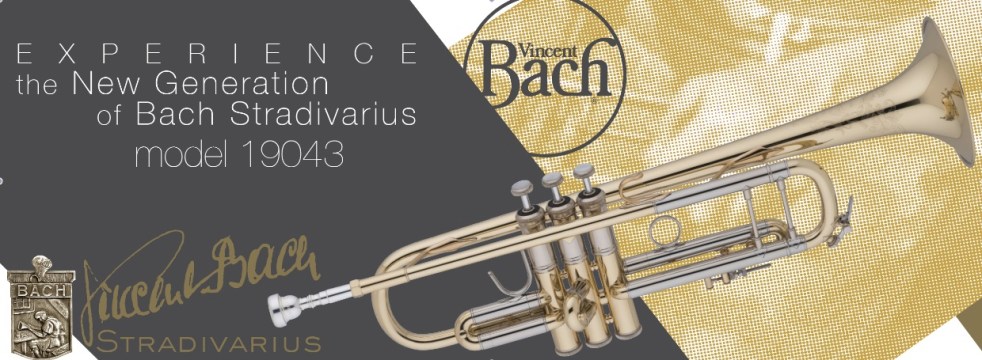
19043 (52nd Anniversary Model!!!)

Side seam, round steel bell wire, 2-piece valve block

This is a model that I have not yet been able to get hold of to assess, so I have been kindly helped out by my friends at Thompson Music! Please see Mike’s video tour of both the 190-37 and 43 below.

VISIT THE ‘EDUCATIONAL RESOURCES’ PAGE FOR FREE WORKSHEETS AND LINKS TO PUBLICATIONS


Sign up here for new blog articles emailed direct to your inbox:


Advice · Gear Review

What difference does mouthpiece material make?

This is too a broad question and also very difficult to judge!  I ask it because I came across a now-discontinued Sterling Silver Yamaha 14B4 trumpet mouthpiece a short while ago and was very interested to find out…

1. What difference the silver makes…and

2. Why they were discontinued.

Question 2 is probably pretty straightforward to answer. Where they are still showing as available in the UK, the retail cost of them is around £300, which is most certainly not a price bracket that we are accustomed to with Yamaha.

What difference the silver makes requires some playing and listening, so I have lined up 3 mouthpieces that are all advertised as having the same rim and cup profiles from Yamaha and will test them on a Xeno 8335RGS and a Bach 180ML37:

Standard 14B4 Trumpet Mouthpiece

Custom GP (heavyweight) 14B4 Trumpet Mouthpiece

Custom 925 Sterling Silver 14B4 Trumpet Mouthpiece

I played each mouthpiece on both trumpets at a range of dynamics and registers using a variety of attacks and articulations. I took notes based on how they ‘felt’, and also recorded them closely-miked to get an idea of how they would perform for me in the studio. I also asked a trumpeter friend (although they may not be for much longer after the racket that I subjected them to!) to listen from the other side of the room and take their own notes.

The whole lot makes for a long (and not particularly interesting) read, so I have done a summary below and would very much welcome thoughts from other players (and indeed designers and manufacturers) on these and any other mouthpieces made from non-brass.

The Standard mouthpiece gives a nice even sound across the range, although it gets overly bright for me in the upper register and doesn’t really open out enough for my taste in the lower registers.  This is probably partly to do with the fact that although I generally have always played on 14 style (Bach 3) rims, I have also always opened out the throats to give less resistance.  The brightness and ‘edge’ that I was experiencing was also picked up on by my audient and to a lesser degree by my close-miked recording.

The Custom GP mouthpiece is also brass and has more mass around the outside of the cup.  Immediately I felt a huge tonal difference.  The sound was much more centred and had a richer and more solid tonal core across the registers.  I could not however get a brightness of sound (even on the 8335RGS) at louder dynamics that I would want.  Interestingly, my listener at the other side said that there was not much difference at louder dynamics to the standard model.  This was also the case listening back to the recording, suggesting that the biggest difference with the GP model is in feel and comfort from a playing perspective rather than necessarily in sound.

The Sterling Silver model has a similar volume to the standard (a bach-ish style blank) but is certainly a few grams heavier than the standard due to the material.  It felt instantly different – more tonal core (quite similar to the heavier GP), but surprisingly also a massively quicker response.  Unlike the GP model, what I was feeling as a richer sound did actually come across to the audience and the difference could clearly be heard on the recording.  Generally you would expect this from a tighter or shallower-cupped mouthpiece, but not necessarily from something like the 14B4.  The rim and cup profiles, the throat and backbore should all be the same as the standard model, however this mouthpiece responded completely differently.

I mentioned earlier that I generally open out my mouthpieces to a 25 or 26 throat. This silver model has a standard narrower 27 throat, yet has a strange combination of the open sound that you associate with a larger mouthpiece with the quick response and overtones that you can get from a smaller more resistant piece.

What do my fellow trumpeters think? I would be really interested to hear what you have thought about non-brass mouthpieces.  There are obviously a lot of options now available made out of synthetic materials and plastics. Has anyone experimented with metals other than brass, and is there scope and/or a financial viability for designers and manufacturers to explore this further?

Numerous mouthpiece options are available along with specialist advice from Thompson Music.


Sign up here for new blog articles emailed direct to your inbox:

[jetpack_subscription_form show_subscribers_total=”false” button_on_newline=”false” submit_button_text=”Sign up” custom_font_size=”16″ custom_border_radius=”0″ custom_border_weight=”1″ custom_padding=”15″ custom_spacing=”10″ submit_button_classes=”” email_field_classes=”” show_only_email_and_button=”true”]

Advice · Education · Gear Review · Interview

Mike Lovatt: Interview and Instrument Review

Mike Lovatt has one of the most heard and recognisable trumpet sounds in the world right now.  If you do not think that you have heard him play before, you are probably wrong!  Starring on more movie soundtracks than I can even begin to list, he is instantly recognised by his signature scintillating yet full, rich sound and his smooth, understated style.  His versatility means that he is equally at home in his lead trumpet chairs with the John Wilson Orchestra and Superbrass as he is as guest principal with all of the UK’s major symphony orchestras.  He is also sought after by the biggest names in the pop and commercial sectors and is a true A-lister of the trumpet world.  I never had the opportunity to sit in a section with Mike in my trumpet playing days, but was fortunate enough to work as producer on some Superbrass sessions that he was involved in.  I got to see first hand his incredible skill, musicianship and professionalism.

This incredible level of versatility requires an instrument to match it, which has led to Mike’s latest project, a collaboration with trumpet builder Richard Smith to design a new instrument capable of fulfilling all of these varied requirements.  The ML Smith-Watkins is the result of this partnership.  My review of the new model follows these thoughts and insights on the design process that Mike has kindly shared with me:

Mike:The process of designing was quite slow as Richard Smith is in York while I am in Hertfordshire, which meant a lot of bits of trumpet being sent backwards and forwards as well as trips up there for me to tweak and try things.  

I wanted to improve all of the things that that weren’t quite right for me on the original SW models which Richard designed in consultation with the late, great Derek Watkins.  After nearly 30 years of playing one of those models I felt that I was in a position to develop them further for my needs.  I always liked the way those trumpets blew though, and wanted to keep the interchangeable lead pipe system.  I think that this part of the design (dual lead pipe) is key to the feel of the instrument and helping the resonance and efficiency of the energy going through the horn.  

We started off by choosing a valve block – I had about 4 different ones to try just as they come (a valve block and slides). I was looking for good compression yet good mechanical movement of the valves.  I sat in front of the TV wiggling valves for hours on end and ended up choosing a .460 bore which had good compression and worked really well !

Next was a bell to balance it up.  I tried a different bell in lots of different settings on a trumpet all taped together!  I tried lots of bells of different sizes and gauges.  In the end I settled (not knowingly)  for something equivalent to a Bach 37 – the only thing was that I thought it sounded a bit bright and wanted to have the full picture range of sound from dark to bright when pushed!  After trying the bell in standard gauge metal we tried a heavyweight version.  This was perfect.  At this stage I still hadn’t tried the instrument soldered together! 

Lastly and importantly we worked on developing a leadpipe to be adaptable in lots of different styles of playing and one which lent itself well to the smaller bore and smaller bell than I’d been used to.  After the ‘core’ of the trumpet was sorted, we addressed little things like a new style finger hook and water key position.

Since the launch of the new trumpet in Summer 2016, demand has vastly outstripped supply.  Interestingly, they are not only proving a hit with jazz/commercial players but can also be seen in a number of symphony orchestras across the UK and Ireland.  I was therefore very keen to get my hands on one to review and see what all of the fuss has been about!

The trumpet has a .460” medium large bore valve section, heavyweight yellow brass bell and is supplied with the custom ML leadpipe.  A lovely distinguishing feature is the laser-etched titanium finger buttons. It is supplied in silver plate as standard, but gold plate is an optional extra.

I was immediately struck by the ML model’s response.  Most of the Smith-Watkins trumpets that I have played in the past have required a tighter feeling late-taper leadpipe to give you that delicate and immediate response.  I found that with this model, I could get that immediacy yet combined with a rich full sound even at quieter dynamics.  The tonal core feels really stable across the range and dynamics, and there is a lovely sizzle to the sound when you open up the throttle.

In short, I was not disappointed!  For my own interest, I also tried this model with #10 and #32 leadpipes.  For quality of sound and general versatility, the supplied ML leadpipe definitely wins the day though, and I can certainly see why this trumpet’s appeal seems to have reached out of the commercial sector.

To find out more about Mike Lovatt, please visit www.mikelovatt.co.uk


Sign up here for new blog articles emailed direct to your inbox:

[jetpack_subscription_form show_subscribers_total=”false” button_on_newline=”false” submit_button_text=”Sign up” custom_font_size=”16″ custom_border_radius=”0″ custom_border_weight=”1″ custom_padding=”15″ custom_spacing=”10″ submit_button_classes=”” email_field_classes=”” show_only_email_and_button=”true”]

Advice · Gear Review

The ‘All Rounder’

There is a multitude of great pro trumpets currently on the market, and some wonderful manufacturers working alongside players and teachers to develop instruments for every style of music, approach and player. In a previous post I have discussed finding the right balance of resonance/resistance for you. Here I am going to be less specific!…

At some point in every player’s development, there comes a point where you are looking for that first pro-level instrument. In most cases we are advised to get something as flexible as possible and suitable for a variety of styles and settings. It is this ‘all-rounder’ that I am talking about here.

I have lined up Bb trumpets to try from Bach, Yamaha, B&S, Conn & P.Mauriat. I have played on a number of other good all-round Bb trumpets over the years from Stomvi, Getzen, Schilke, Jupiter XO and Kanstul among others, and would welcome your thoughts and opinions on these and any other instruments that fit into this category that I have not been able to line up here. Schilke I know in particular is really loved by a lot of my US colleagues. Unfortunately the full range of Bbs is not easily available in the UK so I may have to arrange a visit to Chicago in the future to finish this article properly!!!

Bach Stradivarius 180 Series

This has been the reference instrument for players across the globe for many years now. It is characterised by lots of overtones around a warm rounded-core. The bells are designed to be individual – the positive of this is that there is likely to be a trumpet available somewhere to suit most players. The negative of course is that it is advisable to try a large number of these to get one that feels right for you.

The 2 most popular are the 180ML37 and the LR180ML43. The 180ML37 has been considered the go-to 1st pro trumpet for generations. The late taper #37 bell is the one that manufacturers such as Yamaha and B&S have tried to emulate in their models over the years. The LR180ML43 is a lighter instrument with reverse leadpipe and an early taper #43 bell. This has been popular particularly in Europe with players who cover a wide variety of musical styles and genres.

Intonation is generally pretty good on Bachs, however some instruments can be very flat at the 5th Partial (top space E, Eb and D) and quite sharp at the 6th (G, F# and F) meaning that it can take some adjustment for a student to get used to it. They also for this reason generally work best when combined with a larger fuller-cupped mouthpiece so that the pitch can be adjusted easier.

Current prices in the UK are around £2,500-£2,900 (including tax) and in the US around $2,600-$3,100.

Yamaha Xeno YTR8335RGS

I have picked this instrument from the range, as although it is not the ‘basic’ model, I believe that it is the most versatile. Bach loyalists over the years have criticised Yamaha instruments for their lack of character. The RGS has a more open and less resistant leadpipe configuration paired with a gold brass bell. This gives a lovely combination of a warm even sound across lower and medium dynamics, but has a great bright ‘sizzle’ when you give it some welly!

For years, the Yamahas have been considered the cheaper and lesser alternative to the Bachs, however the improvements to this model in particular make it a good and viable option. Intonation is pretty even across the range with a much livelier response than other models in the Xeno range.

Prices however have risen a lot recently so they are no longer the ‘cheap’ alternative. £2,000-£2,300 in the UK and $2,400-$2,700 in the US.

B&S Challenger II 3137

A number of pro orchestral players have moved onto this trumpet or versions of it in recent years, most notably Philip Cobb at the London Symphony Orchestra. The Challenger II is considered to be a good Bach-copy at an excellent price. It also has elements of the Yamaha in its smooth transition across the registers, even sound and decent intonation. There is a little something missing with regard to overall resonance for my personal taste, but you cannot deny that this model proves exceptional value for money (in Europe at least!) and is a very good trumpet for someone who is just starting to take their playing and progress really seriously.

UK prices are around £1,300-£1,700. Prices in the US are $2,000-$3,300. By this from the UK people!

P.Mauriat PMT-71

Now this is an interesting one. P.Mauriat trumpets are not widely available in the UK, but are well represented across mainland Europe and the USA. I worked with P.Mauriat a few years ago so fortunately had the opportunity to try a wide variety of their models.

Their first moves into the trumpet market included some interesting designs of primarily jazz models – both heavy 600 series and lightweight 700 series instruments.

Their recently launched 71 (and 72 with a gold brass bell) have a lot of the lively and responsive characteristics of the original PMT-700, but with much more depth of sound making this a really versatile instrument. I am yet to see one ‘on the market’ in the UK or Europe yet, but I believe that some of my American colleagues are starting to be able to see them over there. Worth checking out if you get the opportunity – time I suppose will tell whether P.Mauriat make a significant impact in an area that already has some steep competition!

I imagine that prices will be around £2,000 and $2,300 respectively.

Conn Vintage One 1BS

I have selected the sterling silver bell model from this range – the resonance and brightness is astonishing. It is not necessarily your typical ‘all-rounder’, however I have selected it here because I have come across probably an even split of classical players on this as I have jazz/commercial.

I was knocked out by the ease of making a full and rounded sound on this horn, and also at how it really takes off in the louder passages with relatively little effort. The downside for me however was the intonation: Low C sits a fraction sharp for my setup and 3rd-space C is slightly flat. Not having a clean octave here takes some getting used to.

UK prices are around £2,200-£2,400. US is around $2,800-$3,200.

As I have been talking to players while putting this together, people keep raving to me about their perfect Bb trumpet from X, Y and Z manufacturer. There is wonderful research, design and craftsmanship around the globe going into trumpet manufacture at the moment, including a number of smaller specialist trumpet-builders that I will be featuring in coming weeks. Again, my emphasis here is on that FIRST PRO TRUMPET PURCHASE that generally needs to be a good all-rounder and blend easily with friends and colleagues.

I very much welcome your thoughts and comments on any of the instruments featured here, and indeed any of the multitude that are not!


Sign up here for new blog articles emailed direct to your inbox:

[jetpack_subscription_form show_subscribers_total=”false” button_on_newline=”false” submit_button_text=”Sign up” custom_font_size=”16″ custom_border_radius=”0″ custom_border_weight=”1″ custom_padding=”15″ custom_spacing=”10″ submit_button_classes=”” email_field_classes=”” show_only_email_and_button=”true”]

Advice

Resonance vs. Resistance

It has become an almost daily occurrence that I speak to trumpeters who believe that they are either looking for an instrument with natural open resonance OR a closed resistance. The title of this blog post is a deliberate misnomer as I do not believe that these two factors are mutually exclusive. In fact I would say that every horn for every player needs the perfect balance of the two.

The question should not be “do I want an open or resistant horn?” but instead “where in the horn do I want to feel that resistance and resonance?”. These two elements are absolutely essential in a trumpet to give the player their perfect blend of tone colour and projection.

Working with Vincent Bach a few years ago, I spent a lot of time travelling around UK conservatoires giving presentations to students and teachers on how to try to communicate the sound and response that they want to achieve, and what technical variables in a trumpet they should look for based on this and their playing style.

Some examples of popular horn setups:
A player that likes the feel of a really open horn mid-section will need to balance this out by finding resistance elsewhere in the horn in order to achieve that perfect resonance. The standard Bach 180 Stradivarius large bore Bb Trumpet for instance uses a fairly middle-of-the-road leadpipe at the start of the horn, and a relatively compact late taper #25 bell to allow the sound to really connect and blossom. This has typically suited players with a broad airstream who like that openness through the horn, and that feeling of ‘connection’ late on.

Another (yet totally different) large bore example is the approach championed by the late, great Derek Watkins. With a fast and narrower airstream, the sound really ‘connects’ immediately with a resistant leadpipe, and then is allowed to blossom through an open valve section and early taper bell.

With M and ML models, most players tend to use the valve section as a pivot with either an open (or reverse) leadpipe or a more open feeling early taper bell depending on whether you want to connect early or late on in the instrument. For players who like that mid-section connection (please forgive the corny cadence!), models such as the Bach LR180ML43 are very popular – an open reversed #25 leadpipe with an open feeling #43 bell.

In the interests of brevity here, I have focused on the most common variables and used Bach purely as a reference point as these models are familiar to most players. There are of course other ways of achieving this connection at the desired point by adding weight or varying the materials at crucial spots for example.

The crucial question again in approaching what setup is right for the individual player is “where do I want to feel the sound connecting?” Once you have an answer to this, you are all set to go and find your perfect trumpet!


Sign up here for new blog articles emailed direct to your inbox:

[jetpack_subscription_form show_subscribers_total=”false” button_on_newline=”false” submit_button_text=”Sign up” custom_font_size=”16″ custom_border_radius=”0″ custom_border_weight=”1″ custom_padding=”15″ custom_spacing=”10″ submit_button_classes=”” email_field_classes=”” show_only_email_and_button=”true”]