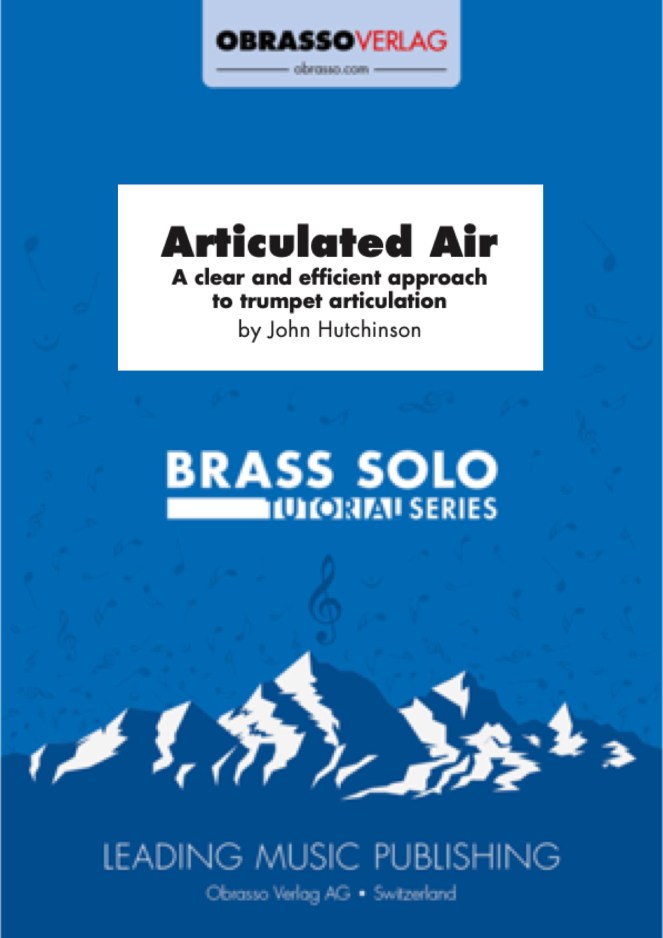
So, what does Articulated Air mean? Some teachers may refer to articulation or tonguing as an isolated discipline in trumpet playing. The reality is that everything comes back to the way that we control our flow of air through the trumpet. This is nothing new, of course, we know that the air is what fuels the machinery of our music-making. So why, do we as teachers so often talk to students in terms that can be confusing and take the emphasis away from the only truly crucial element?
The use of language in teaching, particularly with younger and developing minds is crucial to give clarity of message and to make sure that the correct mental triggers are in place to help them in their development. This is a concept in which I have a great interest and have worked extensively with students and teachers to develop a way of communicating sometimes complex ideas in a simple and straightforward way.
The relaxed and full breath at the start of any phrase is always crucial and should be foremost in the player’s mind, no matter how challenging the exercise may appear. A beautiful sound is only possible from a sense of relaxation and should always be aspired to. I try to avoid words such as blow and push, as they automatically trigger a sense of tension in the mind and body. Instead, we think about releasing the air through the trumpet, and setting up a steady flow of air.
Articulated Air is a concept that adds the tongue (in various shapes and positions depending on what you are playing) to your airstream. The focus as ever is on the breath in and supporting the flow of air out. We set up the air to flow and allow the tongue to articulate as the icing on the cake.
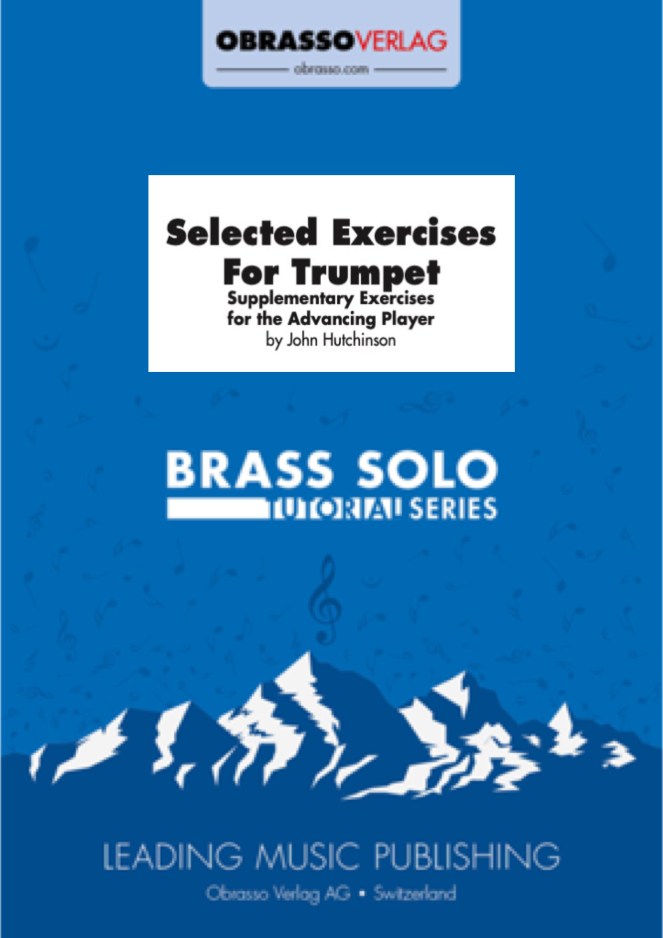
In this publication, I have developed several exercises that encourage this natural use of articulated air. Many of them also include aspects of traditional airflow and flexibility work to make sure that the emphasis remains on this. In our standard repertoire of standard methods and study books (including Arban, Clarke, Schlossberg, Vizzutti etc.) there are many excellent exercises that can and should also be used. It is important though to always focus on this relaxed air. This can easily be forgotten during an intense practice session.
Below are 4 chapters from the book (Articulation Slur Warm-ups, Circle of 5ths Articulation Patterns, Dotted Rhythms and Irregular Patterns) which you are welcome to download and use for free:
At the ITG Conference 2018 I managed to meet with a number of great people to conduct interviews, none greater than Philip Smith! Former Principal Trumpet with the New York Philharmonic, Phil shares his approach to both trumpet and cornet, and also speaks candidly about his recent experiences with Focal Dystonia.
How did you come to move from England to the US?
My father was a well-respected and successful Salvation Army cornet player. In addition, after the war, he was Principal Cornet in the Royal Horse Guards, The Blues. He had done a solo tour of Canada in the early 50s, and in post-war England, I guess the grass looked pretty green over there for a young family. So, he moved us over there, and 3 years later we moved down to New York City. My father worked for the [Salvation] Army and played principal cornet in the New York Staff Band, so I grew up on Long Island.
Was the cornet an obvious choice of instrument for you?
It wasn’t really a choice! It was like, “This is what you do!”. As I am sure that you are familiar in England, in the Salvation Army, when you get your second teeth, someone slaps an instrument in your hand and off you go. It is usually a cornet until they figure out that you don’t have the aptitude, or the instrument doesn’t fit you, and then they start moving you down the band!
The Army is a great movement for maintaining music education isn’t it? I am lucky where I live in the UK that there is a great youth band setup nearby for my son, but there is next to nothing going on in schools. You have to know where to seek these opportunities out. Is it a similar situation in the USA?
It has just shifted. In our schools here, music is “dying” in the public education arena, but that is where you have to take up the slack. Quite honestly that is what the Salvation Army has done in a lot of areas. They have started teaching music, you are getting kids coming in through that, and hopefully families coming into the church. Families into the church is the whole point.
At what point did you move from cornet onto the trumpet?
Growing up, all of my music was pretty much playing cornet in the Army and at school. It wasn’t until 11th grade, when I was encouraged to start to think about my future career, and that music education would be a good fit for me, that I started to play some trumpet as well. The trumpet that I got in 11th grade, in fact, is the very same B-flat trumpet that I still play today!
So, you are a music store’s worst nightmare then!?
Yes! I have had it done up many times, including just recently. It is an “old shoe” and that is what I love.
I then started the audition process, really geared up to look towards music education. I believe it was Carole Dawn Reinhart – herself a soloist, great educator, and also grew up in the Salvation Army – that spoke to my father and suggested that I should audition for music schools. So I ended up going to Julliard and that’s how I got started!
And was that totally trumpet from then on?
No, I still played cornet as I had a scholarship through the New York Staff Band. To encourage students to continue to play in the band they would give small scholarships to help you complete your studies. Playing with the band while I was at Julliard was an integral part of my development – I was playing with them every week, and once a month I would be up playing solos with them in concert. This was a great opportunity that a lot of other kids did not have.
I played trumpet at school, and my teacher’s role as I saw it, was to try to take me from being this sweet, ‘bel canto’, pretty-sounding cornet player, and teach me to be a more masculine-sounding trumpet player, and yet not take away other aspects. So I was able to learn to play both ways!
How compatible are cornet and trumpet at the highest level? Would you say that there are big technical differences to creating a great sound on both, or is it more a change in approach?
There is a difference in approach. There was even a difference in approach between the Salvation Army bands, and the contesting brass bands. A lot of that had to do with my dad – he had a slower vibrato “golden” tone, and that greatly influenced the tone of cornet playing in the USA. That was therefore the kind of tone that I aimed for. I am not saying that it was better than more traditional cornet players, just different. For other players today, such as Philip Cobb, playing cornet and also playing in the London Symphony Orchestra, it is perhaps harder because they have to swing a little wider. The difference between what we consider to be traditional cornet and traditional trumpet sound has certainly got wider in terms of concept and approach.
Can it be done? Yeah, it can. Should it be done? Yeah, it should.
I was never more shocked than when I travelled over to London as a young professional, giving masterclasses at some of the colleges, and to see the anti-cornet feeling that I was getting from the trumpet players.
I have always found it strange in the UK that the colleges make students decide at age 18 between a ‘Brass Band’ course on cornet, or a trumpet course, and that the two are completely exclusive. Surely these are related disciplines that can be studied and performed side-by-side?
Yes. Everything is the same, the overall approach, the technique. In fact, the beauty of the growth of the British Brass Band movement in the USA at the moment is that we now have orchestral players saying, “Wow, look at this repertoire and the level of technique demanded of it!”. It can only enhance your trumpet playing. That was probably a signature of my career in that my sound could be strong and strident and still be “cornetty”. And so much orchestral repertoire demands those two different styles, just look at those beautiful cornet-style melodies in Mahler, and then “wham” you’re back into the big strong trumpet sounds and “zing”again.
And especially in England where there is a great history of fantastic cornet players becoming great principal trumpets, there should never be that separation.
Through your career, how important has the idea of a strict ‘practice routine’ been to you?
When I was younger, I never had one. I just played. As I have grown older, fundamentals have become more important out of necessity. I think the structure of routine can be really beneficial. You also need to remain flexible for whatever can be thrown at you. When I was in the Philharmonic, I always had some outside solo event to plan for and spur me on. Then there was always new orchestral music. My practice time was generally spent getting that stuff ready, and I did not think too much about the shift in styles, I just played. That said, orchestral trumpet and solo trumpet shape are two very different things – it is a little bit like being a jazz player and classical player. Someone like Wynton could play terrific classical trumpet too, but eventually even he had to make a choice. It can be very hard to maintain two distinctly different ways of playing and practicing over the long-term.
As to fundamentals, I started to discover various different methods and study books. It is all wonderful stuff, and it is all definitely helpful at different times. If you are not careful though, you can get sidetracked from the key aspect which is just to PLAY.
Can you talk a little about your recent experience with Focal Dystonia?
Four years ago, I got hit with it, and I basically couldn’t play a note. I have had to re-teach myself how to play over the last four years, and quite honestly it has been hell. I wish I could say what triggered it, but I don’t know. I have had people say to me “I can’t believe that you lost your lip” or “I can’t believe you lost your nerve”, and it was neither of those things. Something happened that took what I knew and wiped it off the map. I have had to re-teach myself what to do, and in some ways, I have needed to be more ‘fundamentally’ focused, and in other ways I have had to erase everything that I thought I knew as an experienced trumpet person and approach the instrument like I am 7 years old. That has been difficult!
You just go through the basics – blow air through lips that vibrate and keep everything else out of the way. And then not obsessing on finding that embouchure “sweet spot,” but to just place the mouthpiece over the natural aperture. It didn’t feel anything like my proper embouchure, but I had to erase that thought. The first note that I got was a huge fat middle C, and I felt that I could stick my pinky through the aperture! But then the next thought was, “How do I get to a D?”. I have had to approach it like a beginner again and build one step at a time.
Having trumpet-playing taken away from me four years ago was like going through a death. God and I (well me to God) had some strong words! Seeing the specialist who told me that I was going to have to find myself a new career, and then going and sitting in my car in shock – it was unimaginable to me.
The process has been a case of learning one very small step at a time. I have had an internal faith to press on, and I have a certain, quiet stubbornness that says “OK, I am going to keep trying”. Believe me there has been frustration and depression and all of that, but with Practice, Perseverance, Patience and Prayer, those four elements have moved me forwards day-by-day. I have swung between wanting to throw the whole thing away, and wanting to keep going even stronger. My goal is to be better today than I was yesterday, without looking back at the player that I was.
How have the past four years influenced your approach to teaching now?
You know, as a man of faith, I believe God provided at just the right time. Just as my time ended at the Philharmonic, the opportunity arose to teach at the University of Georgia, and I do not think that was a coincidence. I have been given the opportunity to share all of the experience and knowledge that I have, with kids that I have grown to love. At the same time I have been able to spend time on my own, out of the limelight, trying to put Humpty together again.
I have loved it with the kids. Going through Focal Dystonia has definitely impacted the way that I teach. One of the main things is that it has given me a little more patience. You will have to ask them what they think though!
What are the priorities for your students to concentrate on?
The first thing is ‘quality of sound’ and ‘beauty of tone’. Try to get a tone that is rich and full and free. Obviously, each student comes in with individual issues, but I start with good fundamental technique. And this very much mirrors what I have had to do myself recently too. Technique is important but gets you nowhere without a great sound. Sitting on audition panels behind a screen, there is nothing like that moment when a player’s first note grabs the whole committee, and you see twelve people suddenly wide-eyed, shaken out of their slumber, and wanting to hear more!
I am imagining this to be a tricky question for you, but are there any particular highlights that really stand out from your illustrious performing career?
I have been blessed, I feel like I have lived a fairy tale. For a Salvation Army kid to go to Julliard, knowing very little about the world, not being able to transpose, never getting into any orchestras… I wanted to leave Julliard after my first year because I didn’t feel like I really fit in and didn’t like all of the competitive ‘peacocking’ that was going on. And from there, to join the Chicago Symphony and then join the New York Philharmonic, see the world, play with great musicians, great conductors… I can’t tell you how blessed I am.
What advice would you give to young aspiring players?
Think a little less of yourself, listen to as much great music as you can and try to copy all of your heroes. In the process of copying, your own personality will blossom out of you. Sing… sing… sing, with a beautiful sound. You have found the gift that you enjoy. Be willing to share it with other people.
The following article was originally written by Jeff Purtle and published in The Brass herald in 2009. Jeff Purtle is a private teacher, clinician, and trumpet player with international clientele. As a protégé of Claude Gordon he continues the traditions of Claude Gordon and Herbert L. Clarke with effortless playing and productive practice. Please visit purtle.comfor a fabulous range of educational content.
A practice routine is a tool to become an excellent and consistent player. It also gives a scientific way to understand how to improve specific skills. These qualities are essential for a long successful career. Claude Gordon believed anyone could be a “virtuoso” if he knew how to practice.
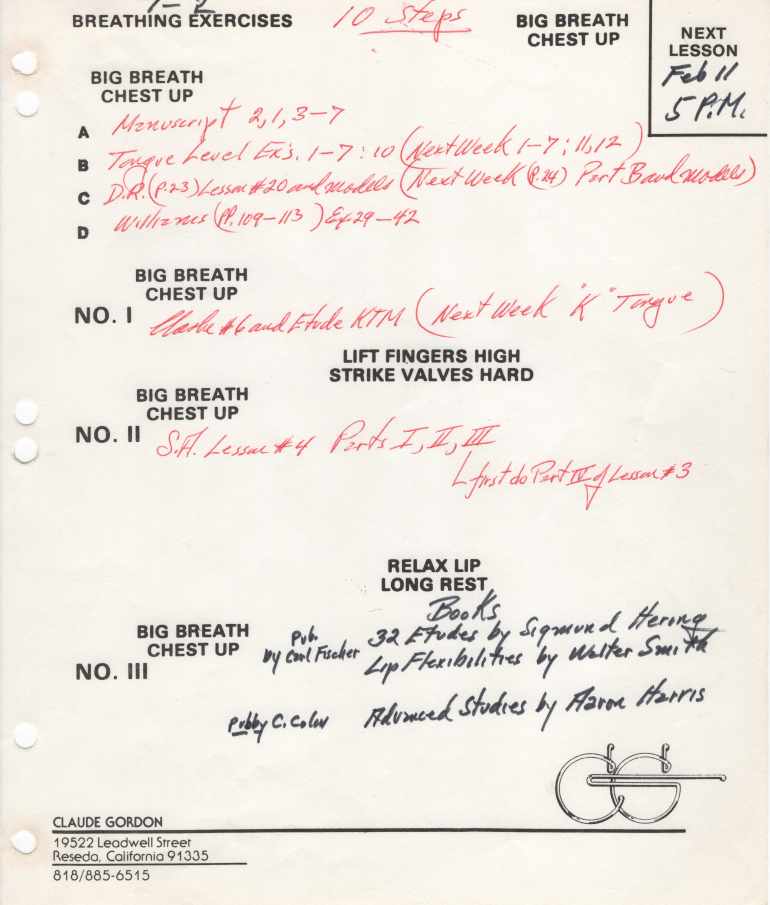
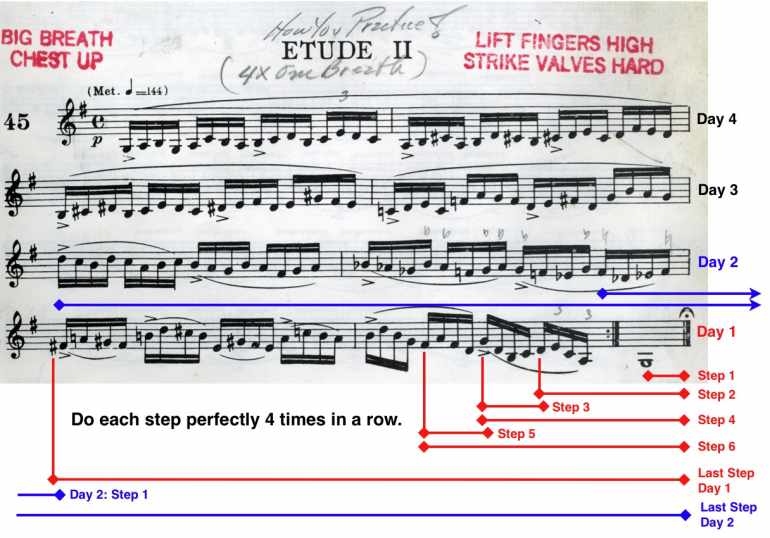
Gordon took Herbert L. Clarke’s principles and applied them with more structure. My previous article defined the content and this article is about the practical application. The assignments serve to set goals and understand what causes the progress. Refer to the pictured assignment from Gordon and the explanation below. Even Gordon improved his teaching over the years by using this method.
Breathing Exercises are always the first item. The focus is on taking a “Big Breath” and maintaining the chest in an “up” position during both inhale and exhale. Forget about the stomach or diaphragm. If the chest stays up you cannot breath incorrectly. The first exercise is 5 sets of 10 breaths standing in place. The second exercise is called “5 Walking,” which is 5 equal sniffs-inhaling while walking, 5 holding-full, 5 puffs-exhaling, and 5 holding-empty, then repeating this cycle walking a square city block. Each month it progresses one more step, then after 10 walking it moves to 5 jogging until finally reaching 10 jogging. Another form of breathing exercise is the “long hold” in the “Range Study” section.
Order
Sections A through D of the CG assignment were usually flexibility studies, intervals, tonguing and scales. Tongue Level studies should usually be the first thing to play. Gordon said, “The air does the work; the tongue channels the pitch.” They develop flexibility and ease in navigating the instrument. It is similar to stretching before a physical sport to be flexible. Gordon’s Daily Trumpet Routines book is excellent to use with all the models. Other flexibility books like Colin, Irons, Walter Smith and Staigers may be used in this area too. The point is to “watch the tongue” and learn how to coordinate the wind power and tongue level to discover how to “let the air do the work”, as Gordon said, and not be focused on the lip. Collect all possible material in this category even from other instruments as Gordon did.
Section I of the CG assignment is where the fingers and breath control are developed while working on Clarke’s Technical Studies. The first priority is to “strike the valves hard and lift the fingers high”, which is mandatory. Do each study with seven days of each of the following: single tongued, K tongued, double (or triple) tongued, and finally slurring as written. Practice accurately to play accurately. Things should then be prioritized as follows: accuracy, evenness, speed, whisper soft playing and finally repetitions in one breath. Never play softer than you can get a secure sound. Other scales and arpeggio studies fit in this area too, but Clarke’s book should be reviewed at least annually. Refer to Gordon’s Systematic Approach book for the some of the fingerings from Clarke that were passed down to Gordon. These are mandatory to train the fingers to function independently of each other with speed and control.
How You Practice
“How You Practice” was Gordon’s label for a way of practicing technical etudes and problem passages. It involves starting on the last beat of the music and progressively working backward one beat at a time with four perfect performances in a row before moving to the next step. (Use diagram with steps.)
Range Study
Down Routine
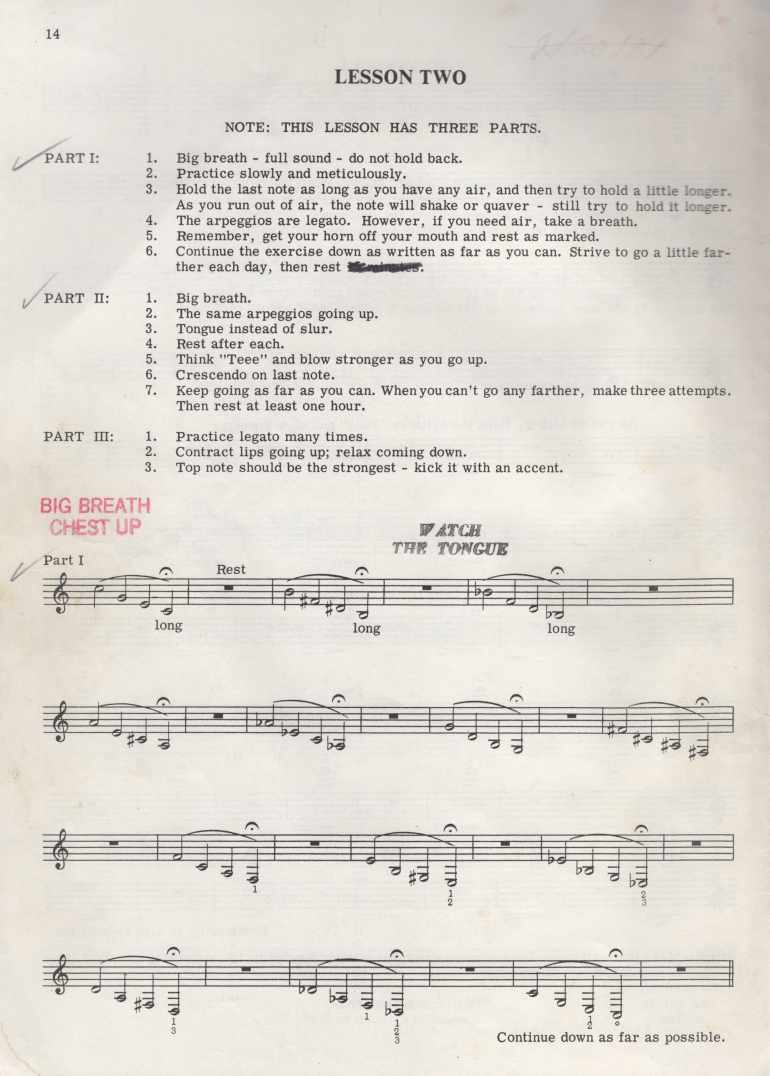
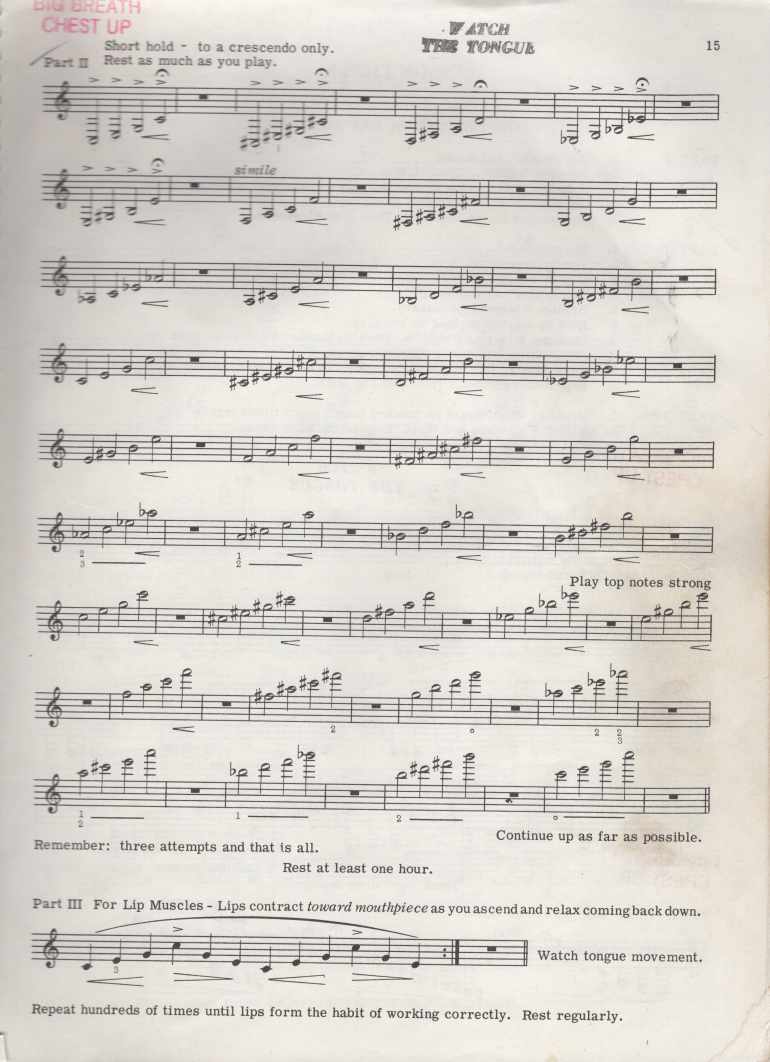
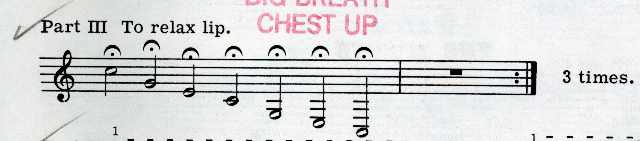
Section II of the CG assignment is the Range Study area. This takes the player first into the pedal tones (i.e. “Down Routine”), followed by a 5-10 minute rest, then to the high register (i.e. “Up Routine”), followed by a brief warm down (i.e. “Relax Lip”) and an hour long rest. All the other routine elements work along with the Range Study to increase the player’s range. The goal is a more playable range, usable in all situations.
Up Routine
The “long hold” in the Down Routine is held until the sound stops and all the air is expelled. This is an isometric type of exercise that strengthens the muscles used for blowing. You never do a hold like that on high notes. The Down Routine played before the Up Routine helps the player discover how to play high with ease as opposed to tightness. Playing from pedals to the high register can be effortless if worked on systematically. The rests are not literally four beats, but you must rest as much as you play with the mouthpiece off the lips to avoid fatigue and bad habits that come from playing when tired. Gordon said, “If you rest properly you can play all day.” This also develops endurance by learning the knack of playing with ease instead of by brute force. “Watch the tongue” meant to visualize the tongue and feel it’s unique vowel position for every note. This is how you learn to play accurately. The “Eee” syllable must be in the very front of the tongue for faster air speed. Gordon said, “Let the air do the work and let the air save the lip.” This means to blow stronger when ascending to get the right feel. Pedal F through C# should be played in tune. Pedal C through Pedal F# are initially very flat for most people, but the pitch will come up in time. It is possible to play to the third pedal C or lower. The pedals help improve a free vibration of the lips and indirectly help many aspects of playing. Care must be taken to not play them too loud.
Start the Up Routine in the pedals. On the first arpeggio leave pedal C below pitch, but play pedal E in tune by sounding the note 8va to get a reference pitch before playing the arpeggio. This fermata should only be a brief hold with a crescendo. Rest between each key. Continue up as far as possible. Remember this is a calisthenic exercise more than a musical exercise. Work up as high as possible, making only make three attempts at the highest note and then stopping to avoid developing bad habits.
Relax Lip
“Relax Lip” was a brief warm down to be played 3x after the Range Study. It can also be played other times. After the Range Study and “Relax Lip” the player shouldn’t play a note for an hour in order to completely recover. It is also wise to not do the Range Study before a demanding performance.
Technique Applied
Section III of the CG assignment is where solos, etudes, orchestral excerpts and other music is placed. The Range Study can also be placed at the very end of the routine with the etudes before it.
There are other variations that can be made to the routine, but this is the normal way. See the article What To Practice on www.purtle.com for a list of books to use in the routines. The practice routines are how the player can learn that brass playing is no harder than deep breathing. It’s not luck or natural talent. After playing the routine you should feel better than when you started. The goal of the routine is to learn to play with ease.
There is a balance between staying too long on an exercise and loosing focus vs. not staying long enough for the exercise to accomplish the desired result. Sometimes the same items can be worked on with variations. A teacher can spot things we ourselves don’t notice.
Personal Use
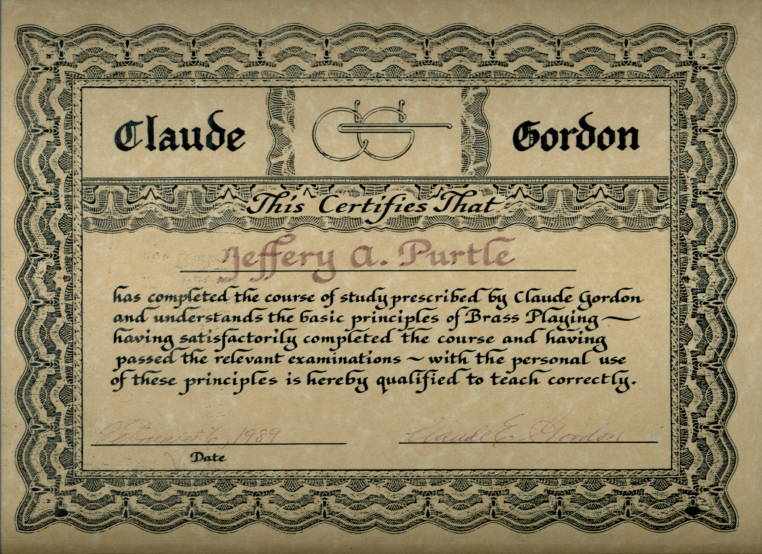
In order to teach correctly you have to play correctly and understand it. Gordon said the following on my pedagogy certificate from 1989, “…with personal use of these principles is hereby qualified to teach correctly.” Gordon knew that the teacher must be in tune with his own playing and practice in order to take students along the road to improvement.
Anthony Prisk has been the 2nd trumpet in the Philadelphia Orchestra since 2013, after previously spending eleven seasons with the Houston Symphony. Tony is an Ultimate Brass and Yamaha artist, and kindly shares his thoughts with us here:
What first drew you to the trumpet in the early days?
I distinctly remember listening to my Dad’s Star Wars soundtrack over and over again. When I went to my elementary school’s band program I was drawn to the cornet and was successful at making a sound. Then as I went along, I really began to enjoy practicing and hearing improvement and performing for my friends and family. It was the ultimate trill to eventually work with and study with Maurice Murphy and John Williams. It came full circle for me!
Who or what were your early musical influences?
My biggest influence in the early days was my high school band directors, Ross Kellan, Greg Cunnigham and Steve Hoffman. Ross was such a positive and encouraging teacher, he instilled pride and artistry in everything we did. I went to the University of Illinois with the goal to follow in his footsteps and influence students in a positive and inspiring way. Eventually, Ray Sasaki took over with this great influence and encouraged me to pursue a life in musical performance and supported my goals and progress. To this day, he is still supportive and helpful in my development as a player and teacher.
Anthony Frisk
Do you have any particular practice regimes? Does this change a lot depending on what repertoire you are covering in the orchestra?
I am an avid practicer. I have a daily fundamental routine including many concepts from the Sach Daily Fundamentals to Stamp, Schlossberg, Cichowicz, Plog, Vizzutti, Bai Lin, Zauder, Gekker, and more. I do try to stay in shape away from the orchestral repertoire playing etudes and solos from Bousquet, Arban, Concone, Snedecor, Brandt, Charlier, Bitsch, etc…to Bohme, Tomasi, Jolivet, Arutiuinian, etc…If we are playing big rep I will prepare for the week by blowing down Bordogni/Rochut, Brandt, or Smith Top Tones to get ready and then the week of, focus on fundamentals and lighter repertoire to balance my playing. When I am doing a lot of low playing in the orchestra I will turn to playing more piccolo at home and softer solo repertoire. I keep a daily practice log most weeks to keep track of my routines and progress. This also allows me to take notes on what is working and what isn’t. I bring this into my teaching to help students achieve their daily, weekly and life goals.
What do you think are the most important elements of music and trumpet playing that young players should focus on?
First of all, SOUND! Finding a Resonant, Brilliant, Rich, Warm, Complex, Flexible, Dominant, Sweet, Singing sound or tone that moves a listener is most important. Finding an efficient way to do this should be a daily goal. Then, for the music, it’s great TIME! Not just playing the correct rhythm but feeling the music and creating the style out of time feel and pulse. If you have these two things, the others will come. Everyone wants great range and speed and loudness but Sound and Time come first.
How have different teachers through your life shaped the way that you teach?
I have studied with more teachers I can count but every single lesson had something in it that was helpful. I can remember little tips from each lesson from Bud Herseth showing me how he practiced Arban’s and Bobby Shew showing me his wedge breath. There are endless amounts of tools to help students solve issues and achieve their goals. I try to get them to hear the issue, figure out what might be causing it and then create a routine or practice regiment that will nip it in the bud. I also encourage my students to work on their fundamentals to serve the music. For instance, if they are working on Mahler, then play your Concone with a Mahler like sound or work on the Gekker Articulation drills in the tempo and style of Ravel. This all comes from the many teachers that help me along the way. Thanks to Ray Sasaki, Dr. Mike Ewald, John Hagstrom, Paul Merkelo, Charlie Geyer and Barbara Butler, Mike Sachs, Ray Mase, Chris Gekker and so many more.
Can you talk a little about your Ultimate Brass mouthpieces, why you play them, and the process of selecting them?
Sun He and I worked on finding a replacement for my longtime Parke mouthpiece. The mouthpiece was wearing out and I always thought it was leaving something on the table for me and my playing. I needed a mouthpiece that was flexible in sound production in my role as second trumpet but also allowed me to step out of the ensemble and lead at times or play solos with brilliance. The mouthpiece line we came up with takes the mouthpieces I played and improved the playability and resonance by finding a better balance of throat and back bore along with adjusting dimensions of the mouthpiece. They are derived from Bach, Parke and Reeves elements but really are unique to Ultimate Brass. We spent a couple years of testing in the orchestra and sending videos back and forth to land on our final product. We are also continuing to develop better versions and more horn specific sizing.
Can you also tell me a little about your relationship with Yamaha?
Ever since Yamaha introduced the Gen 1 Chicago C trumpet I have been playing Yamaha trumpets. I actually had a Yamaha Piccolo way before but I really switched around 2005 or 2006 cold turkey to mostly Yamaha trumpets. Now I am a Yamaha Artist and I play exclusively Yamaha trumpets. The support you get from Bob Malone, Wayne Tanabe and all the folks at Yamaha are unmatched. They are in constant development of new instruments to serve the needs of their customers and artists. It’s a pleasure to work with and represent Yamaha. And the Ultimate Brass mouthpiece works very well with my Gen 3 instruments.
What are some career highlights to date?
Playing for John Williams was an absolute highlight. I had goose bumps when he walked out on stage the first time. But I really have to say, almost every concert I play with the Philadelphia Orchestra, something special and moving happens on stage. I am absolutely lucky to be playing with so many great and inspiring colleagues, highlights happen every week. I’m looking forward to making more career highlights as we start this new season!
I guess that there were some periods of long lay-off through the pandemic? Is working life starting to get back to normal now? Are there any lessons that you can take out these past 18 months?
The lessons I learned from the past 18 months are many. Mainly, to appreciate your friends and colleagues. Learn from everyone around you. Take the good and leave the bad. Positive influence and encouragement goes a long way to help others rather than negative talk and thoughts. I learned a lot about how to be a better colleague, teacher and friend. On the trumpet side of things, I experimented with different ways of playing, warming up, equipment, etc. It was time to reflect on weakness in my playing and coming up with new ways of tackling those issues. I also created lots of online content that you can see on my Facebook/Instagram and YouTube Channel. I actually didn’t take any time off the trumpet…I looked at the pandemic as an opportunity in the middle of my career to practice like I was in college again and try to develop better habits for second half of my career. It was a productive time for me that helped me to stay in a positive and productive mindset.
Any projects that you have coming up that you would like to talk about?
I continue to work on projects for social media and my YouTube tutorials. I am looking forward to a more regular performance schedule and teaching in person. I get so much energy from teaching, sharing my knowledge and inspiring younger students. My hope is to transition from performing to full time teaching in the next 10 years. So my goals currently are to get the most from my playing experiences and build a great trumpet studio at Peabody and Temple University.
Thank you for asking me to contribute. I enjoy sharing my experiences and stories with the music world. I want people to know I am accessible for questions on social media and look forward to hearing from everyone. Let me know what you think of the Ultimate Brass mouthpieces…I’d love the feedback.
Ahhhh the trumpet. So many of all ages fall in love with the instrument due to its age- less sound and versatility. The trumpet plays nice with classical, jazz, pop, mariachi, latin jazz, bluegrass, dixieland and many eastern music forms. It’s no wonder that the world is never short of people dreaming of being able to play “What a Wonderful World.”
If you are an adult thinking of picking up the trumpet or if your child wants to learn it stick with me for a bit. We will cover considerations for children and other aspects of diving into this instrument that always take people by surprise. I’ve taught thousands of lessons to people all over the world, and this is what you must know before you or your child become trumpet players.
Age and Size Considerations
For a long time very young children have played the trumpet, and many famous trumpet players started playing around between 6 and 9 years old. Children as young as 4 can play the horn, but they will experience some difficulties during the first few years since their “baby” teeth will still be there, so it is better to start playing trumpet when teeth have become permanent between the ages of 10 and 12. However, many children start younger and that is okay as long as a private teacher supervises their development.
While we’re on the subject of teeth, let’s talk about braces. If you or your child foresees getting braces within 8 months or so of starting trumpet, I recommend to wait until the braces are off. Unfortunately, the mouthpiece sits exactly where the braces are and while it is possible to navigate this change (though not without major hurdles) with students who have been playing for at least 1 to 2 years, it is monumentally difficult to learn how to play the trumpet with braces, especially when they’re freshly installed.
And what about the weight of a brass instrument?
The trumpet, while not particularly heavy, can be quite a monster to hold for children younger than 8 and smaller older children. Due to the weight, weak forearms and wrists, the front of the trumpet (the bell) tends to dip down, which causes prob- lems at the embouchure. Some kids are tall and have longer arms so they could fare well, but most kids under 8 will do better with a cornet instead of a trumpet.
Let’s look at these two instruments.
Cornet vs. Bb trumpet
The cornet is played exactly like the trumpet, it’s also held the same way and sounds almost the same. The cornet is warmer than the trumpet’s brilliant tone. The biggest benefit of the cornet for children is that it is much smaller and the bell won’t dip. It’s a perfect size for young kids.
Some adults prefer the cornet too because of its compact size and tone quality. Culturally, the cornet is more widely played in some countries than others too, such as in the UK, where the cornet is a staple of the British brass band and a common solo instrument.
The decision between a cornet and a Bb trumpet should be in the size benefits and tone preference.
Maintenance and Must-Knows
Many new players and parents are surprised to see so many moving parts on a trumpet. The horn has 3 valves that need oiling and 4 slides that need greasing. Of the 4 slides, 1 is stationary and 3 need to move smoothly and quickly.
How often you oil valves depends on how much you play the instrument and in which conditions, but generally you will want to oil the valves once a week. The slides should be greased as often as needed to maintain smooth movement.
I’d like to stress how important this maintenance is. The trumpet cannot be played properly when the valves are even a tiny bit sticky or slow. The slide must also move freely because we move these slides while we play simultaneously. Yes, we move more than just the valves! So parents, be aware that you will need to learn how to oil and grease the instrument and it is always a good idea to show your child how it’s done.
To learn more about trumpet maintenance and cleaning the instrument visit my guide.
This is by far the biggest obstacle in trumpet playing and one that new students find surprising. The trumpet requires a rather significant time commitment to truly ad- vance. This is due to the nature of the instrument and its requirement on our facial muscles.
The trumpet is a brass instrument and it requires a certain strength of facial muscles. That is, you have to exercise (through practicing) your facial muscles in order to gain enough strength and flexibility to be successful. The most apparent proof of this is how children usually puff their cheeks like little balloons when they first pick up the horn. This is because their cheek muscles and the corners of their lips are weak from their age and lack of practice. After about 2 to 4 weeks of practicing most children will gain enough strength to keep the cheeks from puffing.
The same process of gaining strength is true for other parts of the embouchure including the tongue muscle.
Okay, so now we know how demanding a brass instrument is for the face, now we add the size of the facial muscles. Compared to other larger muscles groups, facial muscles are very, very small, which makes them lose their strength very, very fast.
So what does this mean for trumpet playing?
It means that when beginners don’t play for 3 or 4 days in a row they lose a lot of that muscle strength. This is even true for professional trumpet players who can go a few days or a week without playing and be alright, but it will still take 2 or 3 days to get back on track. I’ve been playing for 21 years and if I take 2 weeks off I need 2 weeks to get back to it.
For this reason parents should be prepared to set a practice schedule to ensure that the child gains confidence in their playing and experiences success. At the beginning, practicing 15 to 30 minutes a day is sufficient until they gain enough strength to increase their load.
Let’s say you’re going to learn French. Some things that you have to do is learn how to read and write the new language. You also have to listen to dialogues and mimic sounds. Eventually you gain enough understanding of the language to speak without needing help.
Music, with any instrument, is the same.
Most beginners will focus on learning the notes, the sheet music and the fingerings. What is often forgotten is to listen. This is equivalent of listening to dialogues to learn how to pronounce words in a foreign language. New students must listen to dedicated trumpet music daily to nurture the mind’s ear, to nurture the concept of tone.
Last Words
While the trumpet is a demanding instrument, the rewards are truly remarkable. Dive in with a simple practice schedule and enjoy a lifetime of music.
For more trumpet tips and recommendations follow my Instagram @trumpetheadquarters.
SIGN UP HERE FOR NEW BLOG ARTICLES EMAILED DIRECT TO YOUR INBOX:
Education is a lifelong journey, and a journey that often starts in schools around the world that suffer from a lack of funding in music. It is more important than ever to find good quality and reliable resources to help children on their musical journey, as well as adults and advanced learners too. Trumpet Headquarters is a wonderful resource set up by Estela Aragon who was kind enough to talk to me here.
Can you give a little background to your relationship with the trumpet and your professional background?
Do I have a story for you! I began playing trumpet in 6th grade entirely by accident. Back then we had “the wheel” which was a system in which first semester 6th grade students would try an elective for two weeks at a time and then decide which one they wanted to continue for their second semester and on. I tried band for a couple of weeks and during that time we all got trumpets, because it was just to try music, but I thought that meant I had been assigned the trumpet.
See, I didn’t speak English yet as I had recently moved to the United States from my home country Peru, and I was under the impression that I had to play the trumpet! Now, the tryout went great and I was the only student who was able to make a sound on the first try. So, I took that and rolled with it. It was the first time I felt comfortable anywhere, like I belonged, especially in a country where I felt lost due to a language barrier.
That small moment eventually grew into an obsession and passion, which of course became a life-long learning experience. Fast-forward 10ish years and like most musicians in school, I performed as many gigs as possible, and started teaching private lessons in my first year of undergrad. I had a lot of very fulfilling playing experiences from orchestras to weddings to even country music gigs, locally and abroad. It wasn’t until my master’s degree that I decided to focus on private and non-institutional trumpet education. That led me to found my private studio MusicFit Academy, through which I continue to teach full-time today and of course, TrumpetHeadquarters.com, or THQ, was founded shortly after.
What prompted you to setup Trumpet Headquarters?
About 5 years ago I was a in a place of innovation having just wrapped up my master’s degree. I found myself teaching a lot, figuring out life outside of school, and as I grew my private studio I began to run out of times to teach. More and more often I was turning down perfectly good candidates due to time constraints. That’s when I had the “aha” moment to setup some sort of online trumpet lessons course where my prospective students could learn the ropes while they waited for a slot to open.
I also wanted to provide professional and reliable information to counter the massive amount of erroneous guidance floating on the internet. Thus, as the idea was refined, it eventually morphed into not only the trumpet course, but also into an open educational resource for trumpet rated topics. THQ provides a great amount of information for anyone willing to learn.
It’s worth noting that all the resources outside of the trumpet course are free of charge. Want to know about trumpet cases? Mouthpieces? Books for musicians? Best apps for practicing? Notable trumpet players? I have provided all of that information and more. My goal was and will continue to be to educate.
Who is it aimed at?
Simply put; anyone with a trumpet and a hunger to learn how to play it! I approach the course like I approach my private lessons…no fuss, no complications, just simple and easy to understand explanations. I made sure to present the content in a very step-by-step manner.
Absolute beginners will see helpful lessons in posture, breathing, trumpet anatomy and other basics. There is also an introduction to reading sheet music and all the basic techniques and tips for novices, such as how to clearly articulate, slur and change notes evenly. The course goes on to cover intermediate topics such as dexterity, multiple tonguing, range, pitch bending…etc, and of course the advanced lessons delve into even deeper concepts like musicality, lip trills and more.
I have students ranging from ages 9 to 70+, so I think it’s safe to say that the course is well-suited for all ages and skill levels.
What are the key elements that readers should know about it, that sets it apart from other platforms?
As I mentioned, my approach is very simplistic and that alone is an important factor in why the course works. Twisted and over-complicated teaching result in a frustrating learning experience. I also provide a student- only forum where I answer daily questions from them and tend to their needs. They can post pictures and videos of their progress and I reply promptly with my feedback. They really love being able to get that one-on- one attention since naturally, that is a huge setback in self-paced learning.
I have also written over 100 pages of original sheet music with drills and exercises for the course, and I provide other helpful resources such as a fingering chart with all the alternate fingerings; something I haven’t found anywhere else online. Each video features a bullet point list of what I call “Pro Tips”, video chapters, picture-in-picture capabilities and speed change settings. At the bottom of each lesson page, I also provide 3 suggestions for related topics throughout the rest of the website which could be blog entries, a resource page or even a link to another lesson that covers a similar concept.
The bells and whistles are everywhere to ensure a smooth experience for the students as well as an environment to focus on learning. No distractions!
Are there any elements of music education generally that you feel are genuinely lacking at the moment? What can we do to help with this?
Right now, trumpet students all over the world are doing their band classes on Zoom, which of course causes a myriad of drawbacks on its own, but it also highlights the problems in music education that were already there before Covid.
In my professional experience, it is simply impossible for a single band teacher to shape and look after each student. When it comes to brass, and naturally other instruments, we know how important the early few months are. During that time the player will inevitably form habits for the rest of their lives, and if those are bad habits, now you’ve got a player who is struggling, working much harder than they need to and likely will continue to have that experience until they finish high school. Due to the lack of personal attention, students end up with problems such as: incorrectly placed mouthpieces, air control issues, severe tension problems, a lack of tone concept, efficiency and endurance problems, and many more. But what can we really do about it?
It is simply not realistic to expect band teachers to know the in and outs of every instrument, or to know how to precisely diagnose problems and even if they did, there is not enough time for them to guide 80+ students individually. For this reason I advocate bringing specialized artists into the classroom and now that we are so accustomed to Zoom, there is really no barrier for who you can bring in your student’s radar. Bringing in artists helps more than just the students; it also lightens the load for the band director and contributes to the flow of jobs for musicians.
I do understand that there is a cost involved and not all band programs have the means, so that is a hoop that some have to jump through and find creative solutions for. At THQ I also offer a hefty discount for band programs who want to get all of their trumpet players on the same page by signing up for the course as a section. This could also be a more cost- effective solution for when hiring an artist to teach weekly masterclasses is not possible.
While this is a big gap in music education, and solutions are difficult to afford, we can all work together to come up with affordable options. So if you’re an artist, I encourage you to come up with a group class blueprint, put an attainable price tag on it and pitch it to schools. It’s a great way to make an impact and an income.
What new developments are you currently working on?
I have so many plans for this year I don’t even know where to begin! I just finished adding 18 beginner duets in response to a poll from my students asking for play-along material. I now plan on adding duet content for the intermediate and advanced levels as well. We can learn so much from playing duets of course, so I’m excited to provide this layer of education to the course.
Naturally, more content is coming for all levels. As I come across topics in my private lessons and with colleagues I write them down to bring them into the course as tutorials on many different concepts from playing, to practicing to mental preparation. Prospective students can certainly look forward to a growing a library of trumpet lessons.
I do have something big in the works for this year…and I mean big. I can’t give away too many details, but I will say that it will provide a solution to the greatest setbacks self-taught trumpet players have; accountability and overwhelm of what to practice. This will be part of the course later this year and I’ll be back to talk about it when it’s almost out of the oven!
Thanks for your time Estela. Is there anything else that you would like to add?
I’d like to welcome trumpet players, from beginners to pros, to come visit TrumpetHeadquarters.com. The site provides a lot of useful content for teachers, curated lists of books, apps and so much more I can’t list here. It really is the headquarters of all things trumpet and I love to share it with everyone.
For those interested in learning, just sign-up for the course! If you have any questions feel free to email me directly at trumpetheadquarters@gmail.com, and if you just want to keep in touch or wait for the next big sale make sure you sign up for the free newsletter on the homepage.
Thanks for this fun interview John!
SIGN UP HERE FOR NEW BLOG ARTICLES EMAILED DIRECT TO YOUR INBOX:
Brass players, including those at the top of their professional tree, have experienced Focal Dystonia that has either permanently, or temporarily, halted playing. Marcus Reynolds was a ‘pro’ player who overcame the challenge and here offers his personal (as opposed to medical) perspective on the road to recovery.
“I was inspired to write this for several reasons, not the least of which was an accident when I fell from a stage, which badly damaged my lip. My resultant anxiety about how I was going to play again and continue to make a living led to my own experience of Focal Dystonia (FD). I have learned to play again and it has been a struggle, but I have learned much about FD and embouchure problems along the way, which I’d like to share that with other brass players and teachers.
Dystonia is uncontrollable muscle spasms caused by faulty signals from the brain. Focal refers to a condition affecting a precise area of the body, such as the lips and muscles supporting the embouchure. Experiencing FD is a bit like dealing with a sat-nav that can’t understand that your route is blocked. Progress cannot be made, frustration mounts, only aggravating the situation. The sat-nav may even need to be turned off and the driver resort to basics (eyes and a map!). Similarly, the FD sufferer returns to basics, or in medical terms the brain’s cortical map needs untangling.
When a brass player visits me with FD, the first thing I aim to do is to change the name of the condition. For some, the mere mention of FD can amplify the associated problems, even triggering involuntary muscle movements, so I try to use a different terminology when discussing their playing. Typically, an FD sufferer is unable to control the lips as needed, so often I start sessions with certain facial exercises, which look like gurning, followed by some gentle buzzing using the Stratos embouchure training aid that I have developed. I set Stratos so the lips are hardly touching the mouthpiece. In that position, the brain does not register an instrument is being played. This avoids full contact on the lips, which would allow the brain to associate the problem with the instrument, thus triggering a rejection of it. Playing with some of the usual weight on the lips removed is difficult at first, but it cheats the brain to the extent that the student does not produce and hear the heavily debilitating ‘bu bu bu’ sound generally associated with the symptoms of FD. After a few repetitions of this exercise, clearer notes appear, almost like magic.
This rehabilitation is about re-routing the cortical map and, to achieve this, I have created a series of mind and muscle distracting exercises. A main aim is to build a new embouchure and the unpolished sounds that the instrument might emit are part of the process of recovery. A beginner’s early, unfocused sounds are similar to those made by an FD sufferer, but I believe that FD sufferers should be treated almost like beginners who often take time to achieve a really nice sound, but do not shun or reject the instrument because they have no ‘history’ to compare a better sound to. Experienced players, however, appreciate a good sound, so are frustrated when they cannot produce it.
Even when a smooth, even-toned note is being produced, FD can suddenly trigger an involuntary spasm resulting in a high-pitched squeak. However, as there will often have been a good quality note before the problem arises, I try to get the player to produce notes in semi-tones, either side of the targeted good note.
Repeating this extensively can achieve a new stability, controlled by a new muscle memory, triggering new synapse messages to the brain. Recovery is partly about breaking what we might call ‘historic spasms’ – that is spasms arising from old ways of playing. For valve instruments, this can be tackled by using different fingering, so in the case of a valve instrument, I get my student to play a scale of C. Then, as we ascend from low C (after pre-pitching an E top space, also thinking downwards and cerebrally pitching, as if you were whistling), I get the G played in 1st and 3rd, the A in 3rd, the B in 1st and 3rd, and the remaining C in 2nd and 3rd. This way, the instrument is raising the pitch and not the lips. Before starting this C scale, I strive for an E top space to be blown with no tongue, and then encourage the player to think the interval to the C in the stave and to play the scale by not changing pitch facially, but by allowing the instrument to take the pitch downwards. This exercise is carried out very calmly. If the ‘bu bu bu’ occurs, show no sign of annoyance or frustration because your student will reflect it – just start again.
The next technique sounds a little crazy, especially as the player may not be very confident using the methods to play any of the notes that I’ve mentioned. Using the Stratos, with its unique adjustment set with the chin-rest piston as far forward as it will go, I encourage the player to reach towards the mouthpiece, sat the same time depressing the chin rest piston spring and closing the gap to the mouthpiece. Although sometimes frustrating, this exercise increases the blood and oxygen to the capillaries, strengthening the mouth muscles. Reaching towards the mouthpiece will feel alien, but will cause no evidence of FD because ‘historic spasms’ won’t be triggered. Maintain this exercise for a full minute, then rest. Return the chin-rest so it is just touching the chin and then play. Results will vary, but I find that the player has better support and, in many cases, plays without the ‘bu bu bu’ effect.
Whistling arpeggios is great, even if a whistle cannot be achieved; just copy the shape as you whistle. Not only does this firm up the oral chamber, but it also encourages the ‘smiling’ muscles to draw forwards towards the point of pitch. Do this exercise very slowly and deliberately, using your mind to picture the travel of the tongue as it arches upwards for the higher whistled notes and then feel the tongue flatten as you descend the arpeggio.
Another strategy is for the player to go into unfamiliar areas, such as striving to pitch above their normal range. The brain won’t know what is happening and so FD won’t be triggered. Once some success has been achieved, work downwards in pitch suspension, not losing sight of the higher note. After descending two or three notes, return to the first note. If these notes feel and sound clear, descend four notes.
Three of my students with FD had never buzzed before, but buzzing keeps the capillaries open, allowing more blood and oxygen into the lips. The brutality of the mouthpiece pressing against flesh needs to be reduced and using the Stratos will achieve this, a little at a time.
Once you’ve made a good start on producing a reasonable sound, you can proceed to rebuilding the embouchure properly. Avoiding old habits is central, but often comes down to basics for a beginner. So progress comes from patient concentration on producing a smooth airflow, correct posture of neck and body, comfortable handling of the instrument and, of course, effective breathing. I recommend looking at the teaching of Kristian Steenstrupp, Professor of Trumpet at the Royal Academy of Music in Aarhus, on this matter.
If the player does not feel that the results are favourable at anytime, I return to the good notes and start again, which helps to anchor that one good note as a rung on the ladder to eventual success.
Many of the players that I’ve helped are overwhelmed by anxiety to such a degree that they find it immensely difficult to accept there is a way out of their dilemma. It is easy to think ‘why me?’ That attitude, however, only sustains the collapse of the player’s skills and rejection of the instrument that is symptomatic of FD. It is important to recognise that mental attitude to playing is important. I, too, was a ’pro’ making a living as a ‘bone’ player, teaching, conducting and performing for TV and radio. The stress of worrying about how to make a living was the factor that compounded other neuroses that I experienced. The way forward is to try to create different sensations that trick the brain and muscles into re- learning that what they are doing.
I try to create different sensations so that the brain asks what is happening, and, in those moments of confusion by using subterfuge and deception, new and different approaches can be made without rejection. Many alternative avenues are needed for continued progress. For example everything you do to change the feel mentally and sensorily will help this confusion. Even something like wearing gloves, so the instrument feels totally different, can provide a new sensory experience, distracting the brain and aiding progress.
In summary, recovery is possible if the player is patient and works diligently with the tutor.”
This article was originally published in ‘Brass Band World’
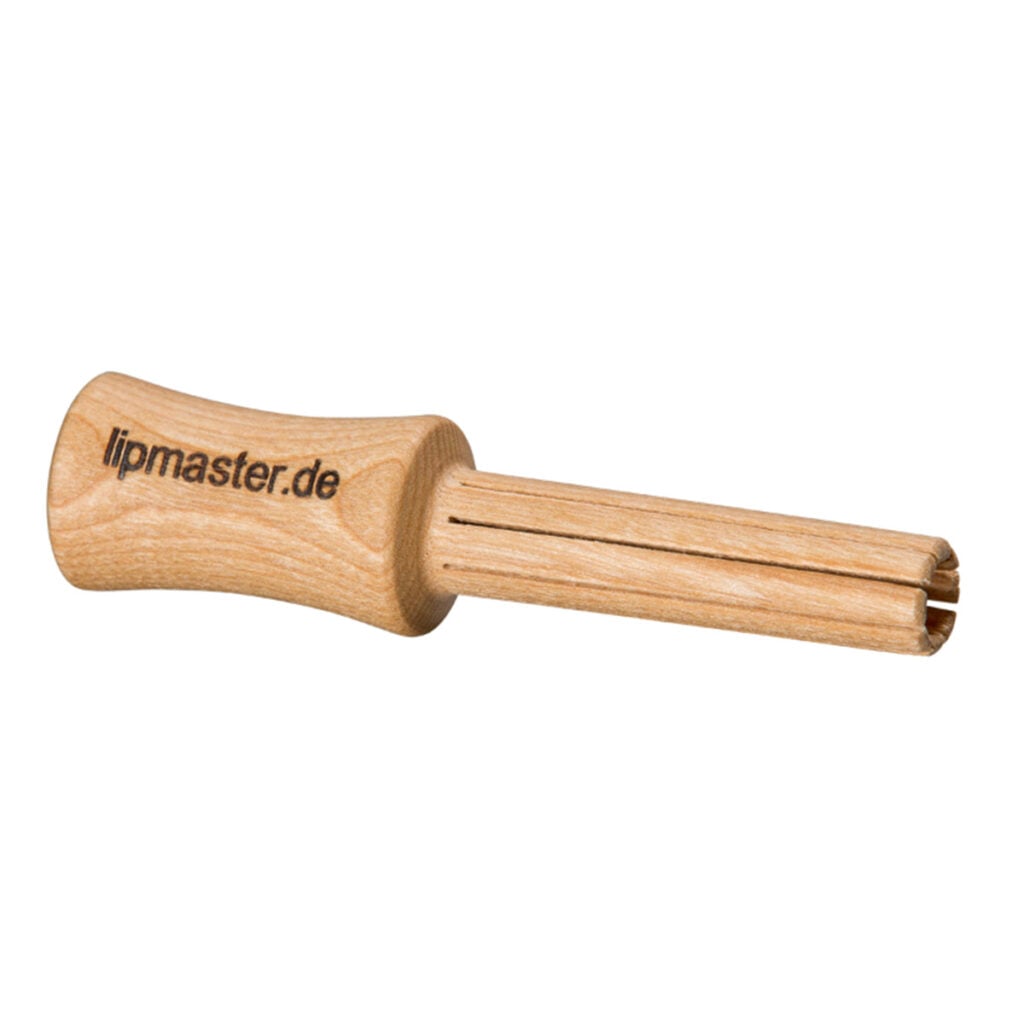
It is always intriguing to receive new trumpet gadgets to try out and review. I have always used mouthpiece buzzing as an important part of my practice as well as my teaching, so the Buzz-R buzzing aid looks like an interesting prospect. Finding an effective embouchure calisthenic aid that can realistically be incorporated into a practice regime is also difficult – could the Lipmaster be the answer?
Both of these products are designed and made in Germany by Markus Arnold and have received great reviews already. You can read the interview that I did with Markus earlier this year here, and also visit his website.
There are lots of buzzing aids on the market. Their general purpose is to try to add a little more resistance and resonance to the mouthpiece so that it gives more like the sensation of playing the trumpet.
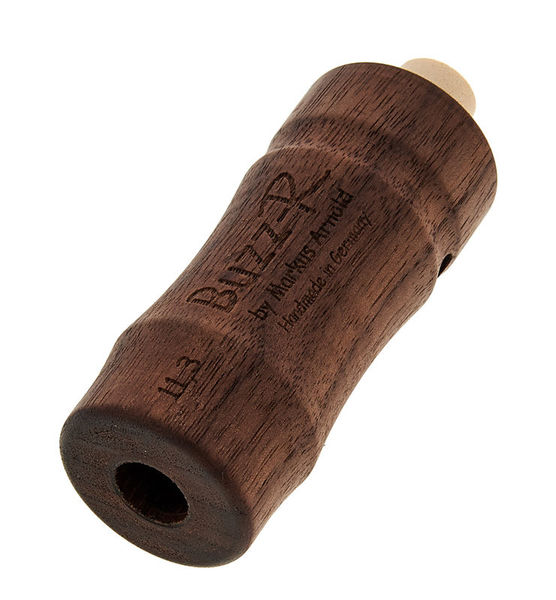
The Buzz-R actually has 2 playing settings: The first is with both of the side holes open giving a full sound. The second is with a finger covering one of the holes for a more muted sound.
The first setting is where the real benefits are – the buzzing sensation really is similar to playing the trumpet. There is enough resistance to be able to articulate clearly – I generally discourage students from doing anything other than long notes and slurs on the mouthpiece, but with the Buzz-R you can add in articulation without the tongue moving too far forward in the mouth.
I have tried a couple of prominent brands and found them really useful up to a point. And that point is generally top-of-the-staff G! It becomes so resistant that the sound cuts out with all lip vibration stifled. So an important question that I wanted to ask of the Buzz-R was whether I could play freely across the range – YES!
The second setting with one hole closed is also really useful. It mutes the sound for when your buzzing is going to annoy your locked-down family members!
The Lipmaster is a calisthenic device for strengthening the embouchure while away from the trumpet. I have tried various techniques with students for focusing the embouchure, and my concern with all of these (my favored one is just to grip a pencil between the lips) is that playing a musical instrument is never as simple as just focusing on just one thing. Whilst said device is between your lips, you can no longer breathe in or out through your mouth. As we all know, this is THE fundamental necessity and I believe that whatever technical aspects you are working on, the flow of air needs to be an important part of the procedure.
So here is the thing… With the Lipmaster, you can! The gaps in the wood allow you to focus on breathing at the same time as gripping with your embouchure. Suddenly these exercises are transformed from stand-alone muscle building, into a more all-round and worthwhile task.
The other big benefit of the flexibility of the wooden strips is that the embouchure aperture remains flexible, as of course it needs to be when we are playing.
Both of these products are really welcome additions to the practice aid market and I am really glad to have had the opportunity to try them.
Chris Still is a renowned musician and educator, and I was delighted that he was able to find time to do this interview. He is currently a member of the Los Angeles Philharmonic and the founder of ‘Honesty Pill’.
In THIS feature, Chris talks about all things trumpet! …
Please can you give a bit of background to what got you started playing the trumpet and who your early musical influences were?
My father was a really big early influence for me. He was an amateur trumpet player in the local fire Department band and would often take me along with him for rehearsals. Actually, one of my earliest musical memories was of him playing an old Shelton Brooks Dixie land tune, “The Darktown Strutters’ Ball”. I’m sure I still have that sheet music lying around in a box somewhere.
He also had a pretty extensive record collection including the Phillip Jones Brass Ensemble, and too many Herb Albert and the Tijuana Brass records to count.
Like every other teenager growing up in the 80s, I also thought I was going to become the next Maynard Ferguson, but luckily, I realized at an early age that probably wasn’t a really good career path for me.
At what point in your early trumpeting did you realize that an orchestral job would be your aim?
I actually did not set out to become an orchestral trumpet player, but initially thought I would become a band teacher. In fact, I did my undergraduate double major in music education and performance at the Crane School of Music SUNY Potsdam in NY. And I think that undergraduate degree in education was one of the best things that ever happened to me. It made me a better performer, clearly a better teacher, and has helped me become a better coach as well.
I think that every performer should do some teaching, and every teacher should still get up and perform regularly. That is one of the strongest takeaways from my early career.
It wasn’t until a performance of Stravinsky’s “The Soldiers Tale”, that I realized I wanted to switch my focus to orchestral performance. I ended up going to do a Master’s degree at the New England Conservatory in Boston and that sort of set my trajectory towards orchestral performance.
How do you manage to juggle all of your other projects alongside keeping your trumpet playing at the highest level?
Other projects aside, I think the best way to answer this question is to first address how to just keep your playing at a high level in any case. And that comes from being efficient and effective in the practice room. I think this is an area most people could improve a lot. I mean, think about it. One of the biggest questions i get is how long should I practice something? This would dictate how much time you have leftover afterwards right? And there are several ways to answer this. Number one, when your mental focus begins to fade and it becomes diminishing returns, it’s time to move on. Or, if you have become physically exhausted to the point of diminishing returns that’s another good indication it’s time to move on to something else.
But the number one way to be efficient in the practice room and know when to stop, is when you have achieved your goal for that session. The problem is most people don’t actually set goals or have any metric to know if they’ve improved or achieved anything. Most musicians just spend their wheels in the practice room. So how would you ever know it’s time to move on? And that’s the problem with efficiency right there.
So to get back to your original question, I have found I have time for other projects in my life by becoming efficient with the work that I have to do for the Los Angeles Philharmonic. Of course sometimes I realized that I’ve taken on too much and I have to put a project on the backburner for a while. Developing some skills to balance work life as another area I think most musicians could improve a lot.
I guess the last point to make answering this question is that the trumpet section of my orchestra is a pretty efficient machine. Everyone pulls their weight and everyone has the skills and mindset control to be effective and efficient and get the job done. When you are surrounded by people with that type of work ethic, it makes it really easy to stay in stride.
Have your practice routines and practice sessions changed much over the years?
Oh completely. My practice routines change regularly depending on what type of challenge I need to face. A great tip here is to try and practice the opposite types of challenges at home then you have to do at work. For example, if we are playing a lot of Beethoven on Rotary trumpets for a week or two, I will be sure to practice some high horn work like piccolo. Or, if we are playing some world premiere with a ton of really loud playing, my practice sessions at home look a lot more soft, low and relaxing.
But to answer the question in more of a big picture, I think it’s important to know why you are practicing a certain thing or using a certain tool in the practice room. If you understand the “why”, then you can switch up what you do whenever you want and still accomplish the goals. I think when people don’t know the purpose of a particular approach or exercise, their practice becomes a little mindless, and certainly can become boring or routine.
Another thing i should mention here is, as the years go by my level of awareness continues to rise. Every five years or so I realize that I could probably be doing something even more efficiently than I have been doing it. So I make adjustments. This is good news though because this means I am on an upward trajectory with my playing. And the only other option is to be on a downward trajectory, and I’m really not interested in that.
What are the key things that young aspiring players should concentrate on?
This is a big question. And it depends on the context. However if I were to answer generally, if I were to give you the number one thing that would fast track your improvement, is to record yourself. And I don’t mean once in a while. I mean record yourself every day, for a very short period of time, and then listen back right away while you still remember what it felt like. That is how you improve quickly. That is how you raise your levels of awareness. That is how you swallow the honesty pill and deal with the things in your playing that need to be dealt with for you to improve.
Also, take your work seriously, but don’t take yourself seriously. Musicians are really good at forgetting why they started playing an instrument in the first place…because it brought us joy. That is something that we all need to remember to connect to as we strive to become better musicians. And that is something you can do when you’re first starting out or if you’re a seasoned pro. Find the joy.
Would you say that your approach to trumpet teaching has changed much over the years, and if so, how?
One of the things I’ve noticed having been a coach and teacher for so long, is that everyone tends to make the same exact types of mistakes. In fact, in the study of excerpts, many people make the exact same mistakes over and over. So when someone comes in to study with me, my default is that i already know most of what they’re probably going to do wrong. This has saved me a lot of time and made me become a much more effective teacher.
However, one of the things that has evolved and my teaching over the past 10 years or so, is I try to create more of a thinking space for my students. I am letting them find these solutions themselves with my guidance, instead of just telling them what they’re doing wrong. I think I have realized that my number one job as a teacher is to help my students do their own best independent thinking. That is what will give them the tools to solve problems when I am not around. And that’s sort of the point of teaching isn’t it?
Trust me, I still call my students out when they make mistakes, but I have been making an effort to lead them more than just tell them what’s wrong. Funny thing is, when they record themselves, they hear their mistakes right away anyway, so I normally don’t have to say anything.
You have worked closely with a number of makers and manufacturers in making sure that you are playing gear that is best suited to you. Please can you talk a little about your relationships with any of these?
I have been a Yamaha performing artist since I was the principal trumpet of the Colorado Symphony, and can’t say enough great things about the support I have gotten from Bob Malone and my colleagues at Yamaha. The equipment is unparalleled in my opinion, and the support network that comes with it is really aligned with my needs.
Joining the Yamaha family was a really easy decision for me because i already loved their equipment and it just keeps getting better.
What has been your most enjoyable project or concert to be a part of?
That’s a tough question to answer. I’m lucky to work in an orchestra that experiments with a wide variety of genres and types of projects, so it’s hard to pick just one. I’ll narrow it down to three.
• Mahler 9 with the Los Angeles Philharmonic and Gustavo Dudamel at the Musikverein in Vienna. It doesn’t get much better than that for me. • Anytime John Williams conducts the LA Phil at the Hollywood Bowl for 18,000 screaming, light saber waving fans • Playing with Herbie Hancock at Walt Disney Concert Hall and talking to him about his dogs after the concert.
What are your trumpeting ambitions for the future?
Happily, the trumpet section of the LA Phil is pretty ambitious and we are always pushing each other to improve and discover things about our playing. So I guess my ambition is to keep contributing and supporting that mission in every way I can.
Sign up here for new blog articles emailed direct to your inbox:
Educator, clinician and coach (and also a trumpet player with the Los Angeles Philharmonic!) Chris Still has a really fascinating project that can benefit ALL musicians. I am extremely grateful for his time to chat about “Honesty Pill”.
Can you give a brief rundown of what Honesty Pill is all about?
Sure. Honesty Pill is an online resource that helps people teach themselves to be better musicians. I like to talk about auditions a lot because they require such complicated and focused effort, and because those same techniques apply to all areas of musical performance and practice. I chose the name “Honesty Pill” in reaction to a common issue with performers and artists—people are afraid to take a close look at what they’re doing wrong, even if they desperately want to succeed. My goal is to help people to tackle their issues, so they can achieve their goals. I like to call my approach “swallowing the Honesty Pill.” I offer practical courses, informative articles, and activities to help you ditch your excuses and really improve.
Did you come to a lot of these improvement processes from your own learning or teaching experiences, and if so, how?
In all of the years I’ve been coaching and teaching, I’ve definitely noticed that everyone is making the exact same types of mistakes. All of us. Which is actually really good news, because if we are all making the same mistakes, that means that we can all solve those mistakes. In other words, you are not the first person to have an unfocused sound, or issues with your time or rhythm.
Basically, I get paid to watch people think, and that has informed my coaching and teaching and certainly helped me design the programs that I offer today.
And I should be clear, I have personally made all of those mistakes I’m talking about, and also figured out the solutions to them. So if I can do it, so can you.
What are the most common misconceptions that even the most ‘diligent’ of musicians come to you with?
This is an easy one. Whether we’re talking about audition strategy, improving practice habits or creating an online business, even the most diligent musicians don’t start the process early enough, and they wait until it’s “perfect” until they let anyone else hear what they are doing.
And this is understandable, since we are trained to lock ourselves in a practice room seeking perfection. Newsflash––perfection does not exist. Everything is a work on progress, and the only way to really improve is to fail and learn. But most musicians are afraid to do that.
At the time of writing, we are in a worldwide Covid 19 lockdown – a lot of people are finding that they have time to reflect on a lot of things including perhaps addressing musical, technical, emotional and mental barriers to their success. Are there any basic tips or general advice that you can give to help people analyze and address what needs to be worked on?
Obviously, the pandemic has been devastating on so many levels. But I am remaining optimistic, because I believe the bigger the problem is, the bigger the opportunity that comes with it. And that goes for practicing too. We spend so much of our musical lives running around staying “busy” that we never stop to reflect on what’s actually happening in our lives. It’s like one of those snow globes with a little village scene inside…we shake it up and the snow swirls around covering everything. And just when it starts to settle, we shake it all up again.
The lockdown has forced us all to let everything settle, and then stare right at it for a really long time. I’m not sure I have any advice, but I would say that this is a great opportunity to get used to slowing down, to being more mindful in the practice room as well as in our daily lives.
Can you talk a little about how your coaching process works? And has this changed a lot since we have all now moved online?
My coaching hasn’t actually changed much at all since Covid-19. I started coaching online three years ago when I realized I could reach a much wider audience that way, and help more musicians achieve their goals.
If I had to notice one change, it would be that so many online barriers that existed before the pandemic have been completely torn down. Three years ago most people had never logged into a digital classroom in their lives, and now that has completely shifted. Which I think is one of the silver linings in this situation.
What are the areas that you have addressed yourself by taking the Honesty Pill?
Great question. Full confession here––there is nothing in my teaching or coaching that I don’t do myself, every day. I still record myself. I still have a practice buddy. I still use a practice chart. These tools and skills are for life, not just for while you are in school or trying to get a job.
The idea that we can ever be “done” mastering something is misguided. It’s not like one day there is a knock on the door of your practice room and someone hands you a certificate that shows you are finished working on your rhythm or articulation.
All of this is to say, the fun part of mastery is the journey, and while we’re all on different points along the way, we are all on it together.
ID used to identify users for 24 hours after last activity
24 hours
_gat
Used to monitor number of Google Analytics server requests when using Google Tag Manager
1 minute
_gac_
Contains information related to marketing campaigns of the user. These are shared with Google AdWords / Google Ads when the Google Ads and Google Analytics accounts are linked together.
90 days
__utma
ID used to identify users and sessions
2 years after last activity
__utmt
Used to monitor number of Google Analytics server requests
10 minutes
__utmb
Used to distinguish new sessions and visits. This cookie is set when the GA.js javascript library is loaded and there is no existing __utmb cookie. The cookie is updated every time data is sent to the Google Analytics server.
30 minutes after last activity
__utmc
Used only with old Urchin versions of Google Analytics and not with GA.js. Was used to distinguish between new sessions and visits at the end of a session.
End of session (browser)
__utmz
Contains information about the traffic source or campaign that directed user to the website. The cookie is set when the GA.js javascript is loaded and updated when data is sent to the Google Anaytics server
6 months after last activity
__utmv
Contains custom information set by the web developer via the _setCustomVar method in Google Analytics. This cookie is updated every time new data is sent to the Google Analytics server.
2 years after last activity
__utmx
Used to determine whether a user is included in an A / B or Multivariate test.
18 months
_ga
ID used to identify users
2 years
_gali
Used by Google Analytics to determine which links on a page are being clicked