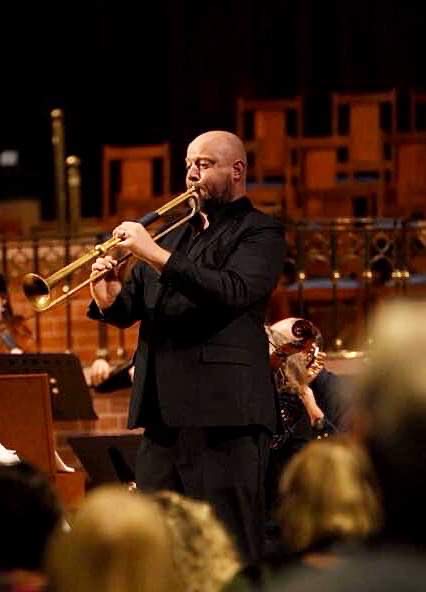
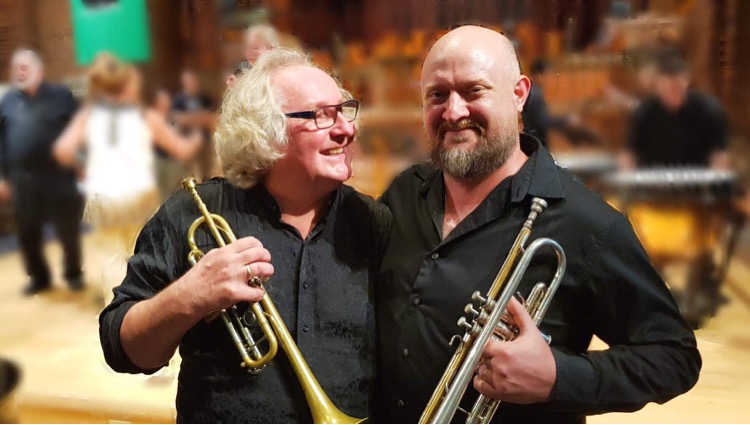
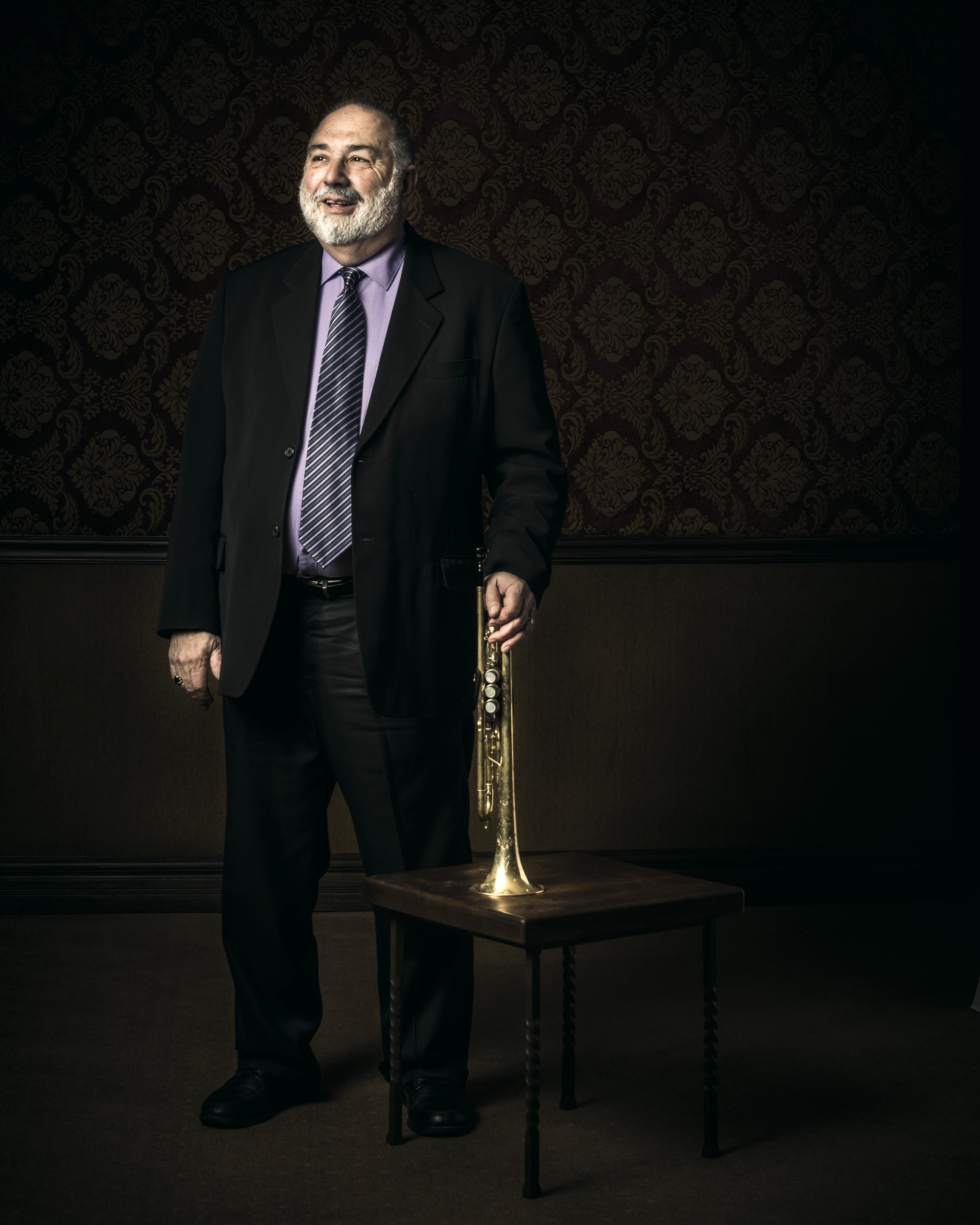
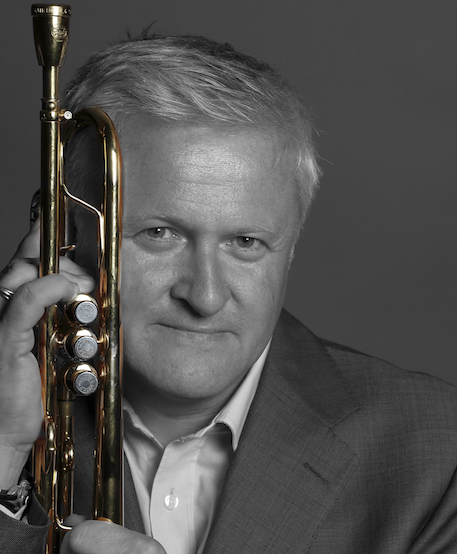
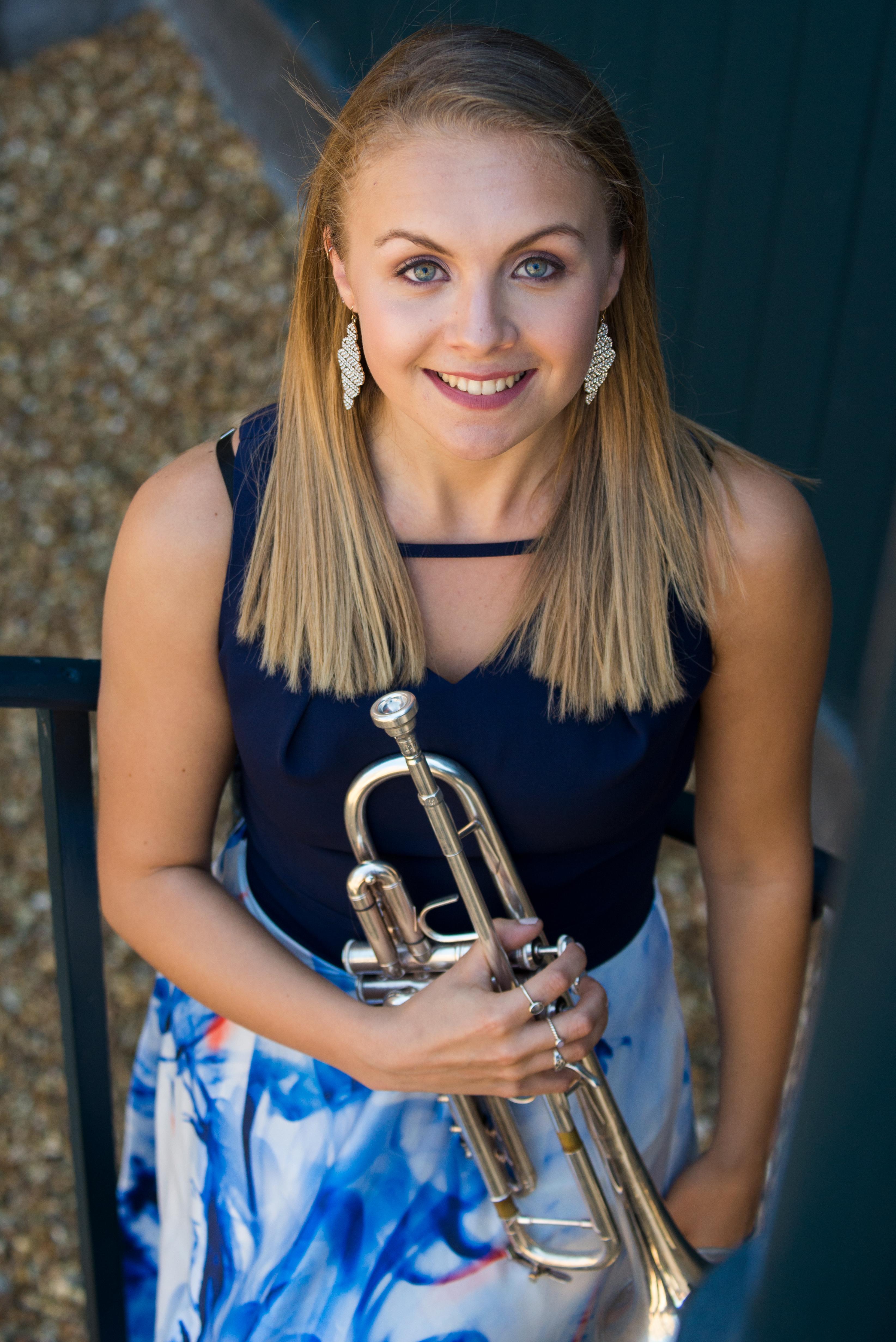
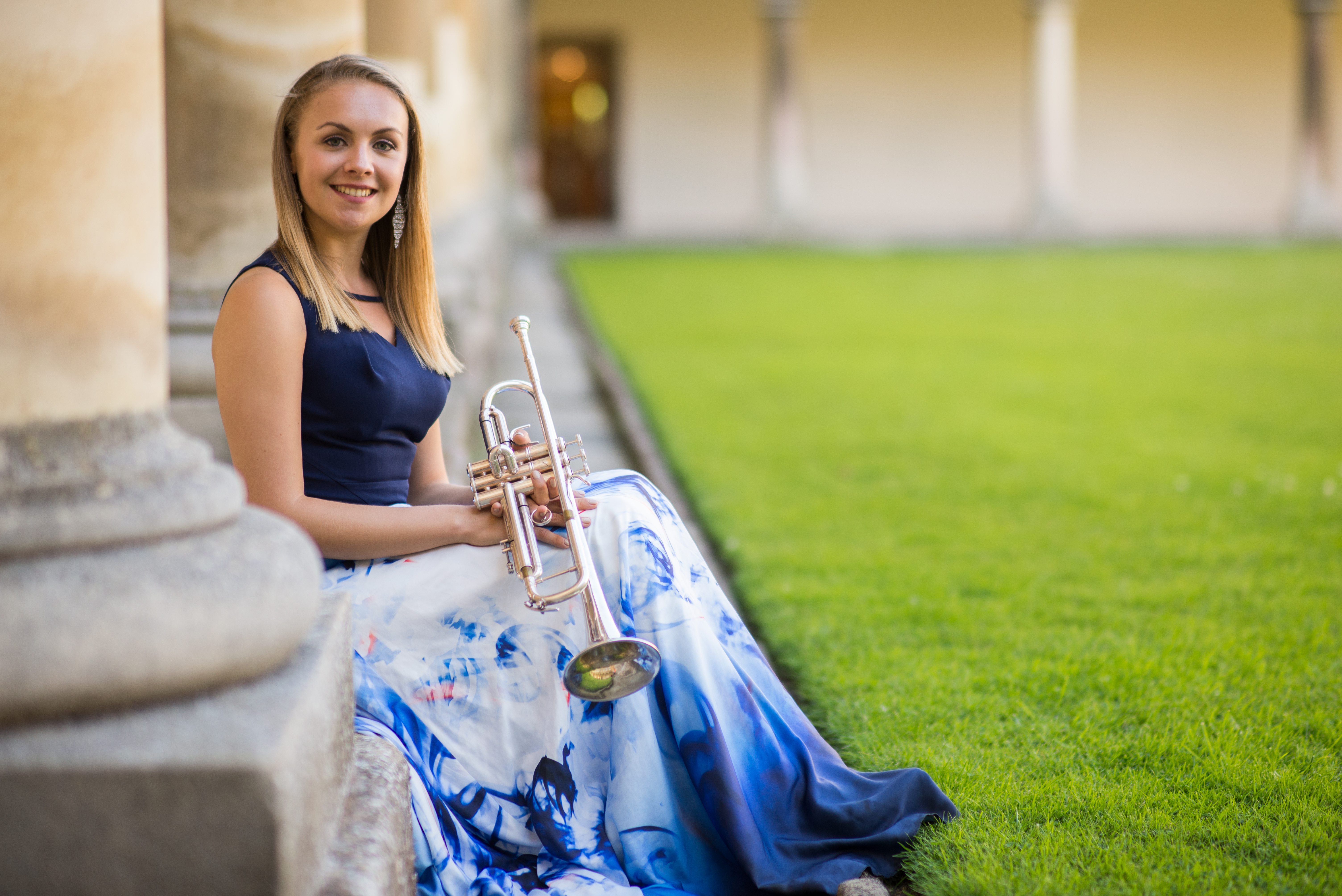
John Foster is a leading exponent of performance on historical trumpets and cornetto as well as being a former member of the Sydney Symphony Orchestra. John is a former classmate of mine from the Royal College of Music, and talks to me here about trumpets, trumpeting and his recent collaborations with Pickett Brass.
What first drew you to the trumpet? Any early musical influences?
My earliest musical recollections came from listening to my grandmother singing and playing the organ in far North Queensland, and after that my next encounter with music really came through the primary school system. At school I played piano, violin, recorder, percussion, and then eventually by age 10, I was given a trumpet. Probably the first time I was acutely aware of music for the trumpet was when I was 12 years old and heard my first recording of Maurice Andre.
Can you talk a little about your trumpet education and how that has influenced what you are doing now?
All of my early music education on the Trumpet came through I would say an American style of Trumpet teaching. My teacher at age 12 was Yoram Levy (Israel Philharmonic) a former student of Vincent Cichowitz and Adolf Herseth, and all the usual Trumpet methods that went along with the ‘Chicago school’ including the Arban Method, Cichowitz studies, Rochut, Schlossberg, Louis Davidson, Vassily Brandt and several other methods. After receiving a thorough grounding in orchestra on solo studies on the modern Trumpet I moved to the United Kingdom, to the Royal College of music in London where I studied baroque trumpet with the wonderful Professor Michael Laird (Academy of St Martin’s in the Field) and Mark Bennett, and further formal, modern trumpet studies with Paul Beniston (London Philharmonic). I also benefitted greatly at this time by taking private studies with Ian Balmain (Covent Garden) and Rod Franks (London Symphony). During these formative years I was also very privileged to spend quite a bit of time with Swedish trumpet soloist Håkan Hardenberger.
What trumpeters do you most admire and enjoy listening to?
What a great inspiration is always been French trumpet virtuoso Maurice Andre, his magnificent sound and sensitive approach to music making always seem to transcend the fact he was even playing the trumpet. These days Reinhold Friedrich is also one of my favorite players to listen to. In a similar way to Maurice Andre he manages to always ensure that the audience feels the emotions he conveys in his playing. In the 21st-century we are truly spoiled with choice from so many wonderful artists and so many fine recordings being made in the last 50 years. Some other artists (past and present) that spring to mind are Adolf Herseth, Maurice Murphy, Håkan Hardenberger, Thomas Stevens, Vincent DiMartino, Doc Severinsen, Serge Nakariakov, Giuliano Sommerhalder, David Gurrier, Niklas Eklund, Matthias Hoffs, Yigal Melzer, Marc Ulrich, Gabrieli Cassone, Michael Laird, Mark Bennett, Crispian Steele-Perkins, David Blackadder, Neil Brough, Edward H. Tarr, Friedemann Immer, Geoffrey Payne, Gordon Webb, Omar Tomasoni, Michael Sach, and so many more…..
At what point did you make the decision to move away from an orchestral career to focus on early music?
By the time I reached my mid 30s I had already spent the better part of 20 years playing in professional orchestras (the last 12 years of those with the Sydney Symphony). Whilst I adore the orchestral repertoire and performing orchestrally (and will probably never fully divest from playing in orchestras) my true passion has always been with the trumpet/cornetto repertoire from the 16th – 19th centuries. I’m also very involved in directing and conducting now as well.
I hear that you have quite the instrument collection! Can you tell me about a few highlights?
I have over 100 historical instruments pertaining to the trumpet family. Some highlights would include:
•   Original English Slide Trumpet by F.Besson c.1860
•   Hand-Stopped Natural Trumpet in D by Georg Öttensteiner c.1850
•   MacFarlane’s ‘Clapper Key’ Cornopean by Charles Pace c.1850
•   B flat Keyed Bugle by Charles Pace c.1840
•   E flat Keyed Bugle by George Smith c.1835
•   Coach Horn (House of the Duke of Glouster) by Kohler of London c.1796
How does the future look for period instrument performance?
I think the future for period Instrument performance is incredibly bright. Here in Australia (as like never before) universities and Conservatories are embracing early music and historically informed performance practices by adding resources to the departments in order to properly train young musicians.
Any advice for aspiring players who are interested in getting into early brass?
The classical music industry is both a very challenging and rewarding one. Firstly I would advise any aspiring Brass players to definitely become involved in early brass playing. Fundamentally (particularly in the case of the trumpet and horn) the Natural Trumpet/Baroque Trumpet gives the best possible foundation to any serious brass player’s fundamentals, being that everything you perform is based on the natural harmonic series, sounds must be extremely well-connected, with great support and air-flow, as well as there being an absence of ‘force’ in the blowing. Musically, the playing of historical instruments also gives a wonderful foundation into developing ‘ensemble listening skills’. In particular listening to the other instruments and vocalist (not just the immediate Brass colleagues). The softer dynamic range of early brass instruments allows for much more sensitive listening and acute awareness to other ensemble members, and indeed in many cases it also allows more readily to the imitation of style. From a practical point of view; with the size of the classical music industry seemily shrinking, and with more and more players graduating from leading universities, being able to except work on historical Instruments only allows for one more avenue of work for players. Anything today I see historical instrument playing seeping more and more into the regular working life of symphonic players as well.
How about ATA? Any plans for future course?
Indeed the Australasian Trumpet Academy hopes to have many more courses in the future, once international travel is readily available again (post the current pandemic).
Can you talk a little about your relationship with Pickett Brass and the process of designing your mouthpieces?
Certainly. I have worked with several instrument makers and mouthpiece designers over the past 20 years but upon meeting Peter Pickett (from Pickett Brass) I was immediately impressed. Peter has a wonderful mind for engineering and matches that with all the skill and precision you would expect from a 21st century mouthpiece maker,however what sets him apart is that Peter Pickett is also a real trumpet player. I found it such a great advantage when describing to Peter what I wanted in my signature John Foster Baroque Trumpet Mouthpiece, that not only did he understand what I wanted from the technical specifications, he also knows forensically from the players point of view what will work. The results speak for themselves I love the mouthpieces Peter makes for me and I’d recommend them to anyone. https://www.pickettblackburn.com/signature-series-trumpet-models-c-107_115_200/john-foster-p-1647.html
What does 2021 hold for you?
Lots of Golf and Trumpet Practice at the moment awaiting the end of COVID 19 lockdowns.
What instruments do you use?
Trumpet in C/D (A = 415hz/430hz/ 440hz) – ‘Foster Model’ (2016), based on an instrument by Johann Kodisch (Nürnberg ca.1700) Baroque Mouthpiece – ‘John Foster’ Signature Model by Pickett Brass Tromba di tirasi in C/D (A = 415hz) made by my own construction (reproduction bell after J.W. Haas c.1720) Cornetto (Soprano A = 440hz) – Phillip McCann (2005) Cornettino – Christopher Monk (c.1970) Mute Cornetto – maker anonymous (UK) Keyed Trumpet in E flat (A = 430hz, 440hz) My own construction (2006). Demilune Trumpet in F/E/Eb/D/C/Bb by Stephen Giordano, based on original instrument by Anon (Strasbourg ca. 1805) Keyed Bugle in B flat ‘New Improved’ by Charles Pace (ca.1840) Keyed Bugle in E flat by George Smith (ca.1830) English Slide Trumpet in F/E/Eb/ D/C by F. Besson (c.1880) Posthorn in A by Kohler and Sons (c.1880) Cornet in G/Ab/A/Bb ‘Levy Model’ by Courtois (c.1875) Cornet in Ab/A/Bb by Thiboulville- Lamy (in high pitch, 1890)
Modern Trumpets • B flat Trumpet by Vincent Bach Model #37 • C Trumpet by Vincent Bach, 25H leadpipe 229 bell. • Eb/D Trumpet by Schilke • Piccolo Trumpet by Schilke P5-4
Books:
•   ‘The Baroque Trumpet Revival’ by John Foster (Publisher David Hickman, Hickman Music)

•   ‘The Natural Trumpet’ and other related instruments. by John Foster (published by Kookaburra Music).
SIGN UP HERE FOR NEW BLOG ARTICLES EMAILED DIRECT TO YOUR INBOX:
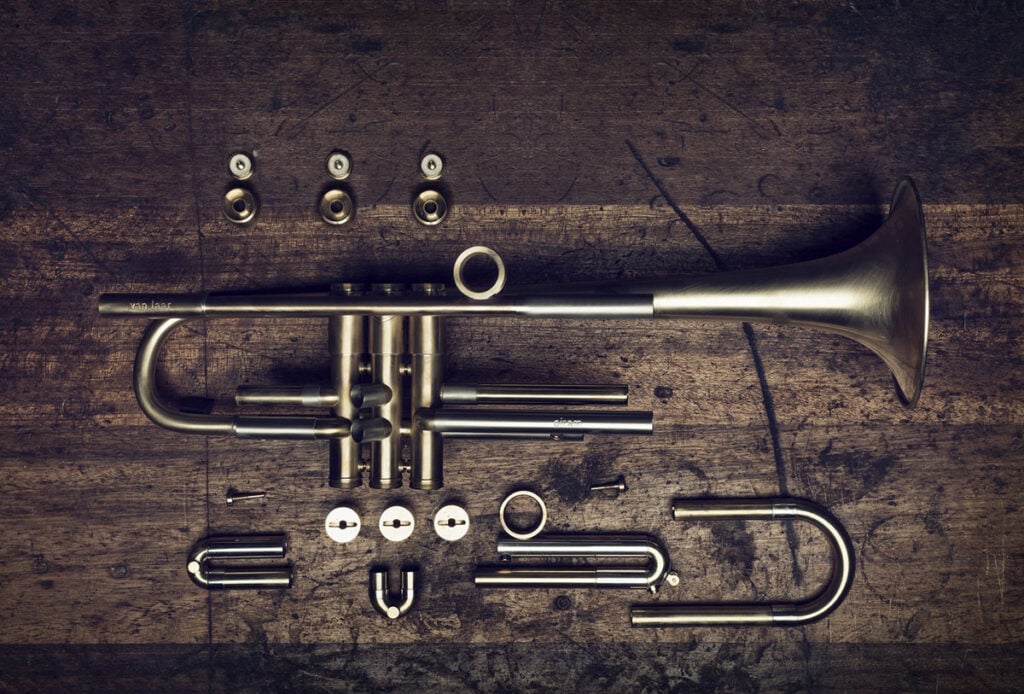
Interview with Hub Van Laar (June 2018 @ ITG Conference, San Antonio)
What made you want to play brass in the first place?
As a child you had 2 options in my village. I began by playing football, and in my first game I scored 3 goals… in the wrong direction! It was then decided that I should go to the ‘Fanfare’ and play an instrument! I mainly played trombone and got to a very high level. I stopped playing however because of stage-fright. The nerves affected me so badly, and after trying hard to overcome this, I pursued the repairing.
What made you want to get started with designing instruments?
It was funny – when I was 8, I said I wanted to be a trumpet-maker. I always had that goal. I don’t know why! I wanted to be a trumpet-maker and a farmer. I played in the local brass band, and I was thinking, “Somebody has to make these instruments”. The military band were looking for someone to repair. After that I went to work for a large Dutch manufacturer, and then had the opportunity to work for a small manufacturer in Stuttgart as part of a team of just 4 people. There you had to do everything, it was a great experience.
I have always loved my work and have never been a person that likes to have a day off. I am always happiest when I am busy. The workshop is just 46 seconds from my house!
What were the first models that you designed and built from scratch?
You start working out of necessity and repairing to earn money. I then started to adjust and adapt instruments and would get lots of players to play them to hear what they thought. I started with the flugelhorn because in Holland and Belgium we have ‘Fanfare’ groups with 10 or 15 flugelhorns. This was my market! The trumpets came after that, then the cornet, and now this year the piccolo trumpet is ready.
You have to be very careful bringing a new model onto the market, as if it is not quite ready, before you know it you have a bad reputation. I have to be 100% sure that it is perfect.
You have a number of very well-established models in your range now. Where they all designed with a particular sound or style in mind, or developed more for particular players?
In the beginning I worked with a number of players. The difficulty is that everybody tells you something different! The one unstable factor in an instrument setup is the player him or herself. With lots of players around me, I found that the quality got worse because you are constantly having to change things.
I now do most of the testing myself, and then take it to various players once I am completely happy with the design and setup. Listening to the customers is really important. I start a design by listening to what players need, I then go away and work on the technical stuff to create it. You learn this by doing it, it is not a case of reading a book and then knowing what to do. I believe this is a great strength.
Would you say that all of your trumpets across your entire range have particular characteristics that set them apart from many other makers?
They play in tune! It is also important to me that they look good. People’s first contact with my instruments is with their eyes so I need this to be good. The second thing people are interested in is the valves – if they are not perfectly smooth and responsive, they will put the instrument back down again. The third thing is when they start playing!
So, what’s next?!
Life is like sitting on the bullet train in Japan. Everything goes by so quick! At 40, I never worried about that, but after I hit 50, I think about that a lot. I intend to enjoy life more and work slightly less. I have a plan in place for 10 years’ time, for the company to go to a trusted friend who works with me, so that the good work can continue, and the name does not get lost!
Are there any new models that you are keen to explore?
The most important thing for me is that every new model and design is better than the last one. I am not able to spend a lot of money on marketing, so I have to make sure that the quality of my instruments speaks for itself. We just concentrate on one model at a time to ensure that everything is as good as it can be.
We have been working hard on the piccolo, and we have another C trumpet model, that I worked on with a player at the Concertgebouw. Our next investment is going to be in a CNC machine which will help a lot with our design processes. The most important thing for the future is maintaining the high quality that we have now.
Is there anything else that you would like to add?
It is not possible to make these instruments alone. Without Heidrun who deals with the business side, none of this would be possible. I cannot deal with that side of things, I just want to make great instruments.
Instrument Overview with Jesse McBee of Thompson Music:
“At Thompson Music, we are proud to be a dealer for Van Laar trumpets. Particularly, we’ve been impressed by the versatility of their product line, as well as the Van Laar team’s attention to detail, quality, and customer service. From their line of Bb trumpets, the most popular horns we sell and usually stock are the B1, B2, B4, B5 and B7, as well as the Oiram II and Oiram III. From the flugelhorn line, we see much interest in the B2, B3, and Oiram Fresu.
As aforementioned, the Van Laar line is diverse enough to have an offering for every player’s performance demands. From lead trumpet, to chamber music, to solo playing, to small group jazz, there is a horn to fit that player’s needs. Additionally, several models serve as great all-around instruments should the player need an instrument for various playing demands. Van Laar’s attention to detail is impeccable, combining the benefits of a handmade product with modern quality control tolerances. Our customers are consistently impressed with the quality and presentation of the product, as we have been when our orders arrive in the store.”
Marc Geujon is Principal Trumpet of the Orchestre de l’Opéra National de Paris. As well being a Professor at the Conservatoire de Saint Maur des Fossés, he is growing in reputation as a soloist and educator. September 2018 will also see Marc take up a teaching position at the Conservatoire National Supérieur de Musique de Paris. I was delighted to be able to catch up with him and also to find out about his latest collaboration with Schilke.
What drew you to the trumpet as a child?
When I was 11, I asked my parents if I could learn music. After one year of learning theory and reading notes, I asked the music school if I could try trombone. The music school director answered, “There are no more trombones available, you will learn the trumpet…!”. I began with a non-professional teacher in my village. One year later, I passed an audition to enter the regional conservatory. The trumpet teacher didn’t want to take me in his class, because my sound and level were so terrible, and he told me to learn the tuba. I refused… He said, “Ok… stop playing during the summer and we will start at the beginning in September. Four years later, I graduated from the conservatory and joined Eric Aubier’s class for 1 and a half years. After, I entered the Paris Conservatoire.
Were there any particular early musical influences, or any musicians now that you particularly admire?
As with a lot of players, my first recordings were of Maurice André. And the CD which persuaded me to become a trumpeter was “Great French Trumpet Concertos” from Eric Aubier.
It was the reason why I asked to study with Aubier. He taught me a lot, especially on stage. When I was around 20, he asked me many times to play some baroque pieces for 2 trumpets or more with him (Vivaldi, Molter…) and also played the second part in Bach Masterpieces with him. It was an incredible experience for me.
Now, I’m a big fan of Reinhold Friedrich, Matthias Höfs, Pacho Flores… As orchestral players, I love Gábor Tarkövi, Peter Masseurs, Frits Damrow, David Bilger, Michael Sachs…
https://youtu.be/Tvua70Ctjfc
Do you have a set practise routine that works for everything, or do you have to change it drastically depending on what gigs you have in your diary? Does your practice change drastically from doing an operatic run, or a recital tour for example?
I have a practice routine that works for most of my days. Basics from Michael Sachs Daily Routine, Plog Program, Stamp, Arban, Clarke… It depends on the time I have to practice. I try to think the trumpet to be as natural and easy as possible… I work every day in that way. The only thing very important is that I need to practice in the morning, every day. I drive my kids to school every morning and begin my warm-up at 8:30am.
How does this change when you are travelling?
The problem is to play in the hotel room, with a practice mute. And also the jet lag… but I try to keep my routine and to do my best despite the hours, places and climate.
When you are teaching, have you found that your emphasis has changed over the years as your own experiences and playing develops and changes? Are there particular ‘schools of thought’ or strict ‘methods’ that you like to use with your students?
Yes, I have evolved a lot in my playing and teaching year after year. I try to be a student in my mind every day. I listen to a lot of music, I practice a lot of new things, I buy a lot of new books… so I try to share all my experiences with my students.
The most important thing I try to teach is “Trumpet playing must be easy”. I have the chance to see most of world’s best singers on stage every evening. The better they are, the easier they sing! It takes a lot of time and practice to play with easiness, but it’s so important and useful…
What are the key things that young aspiring players should concentrate on?
Sound, rhythm, music…and practice!
What has the process been like working on new Trumpets and Mouthpieces with Schilke? Can you tell us a little about how that relationship came about and what the design process was like?
Around 12 years ago, I was in a music shop in Paris to try a Schilke P5-4 piccolo for a colleague. Andrew Naumann, Schilke owner and president, and Phil Baughman, sales manager, were in the upper floors of the shop. They heard me playing the piccolo and offered me a Bb trumpet t try, a B1 anniversary model. I wasn’t a fan of that model, but I tested also a C trumpet (a C3) and it was so much easier to play compare to my Bach C. I bought it, and an X3 Bb one month later.
I met Andrew Naumann and his wife Julie several times after that, and I’m lucky to say that we are good friends now. I have played Schilke for 12 years now (C3, X3, E3L, G1L, P7-4, C5-4, XA-1…). When Schilke created their HD models, Andrew asked me to test them. They were good horns, but too stiff for me. We developed the C3HD, which was a little bit more flexible and brighter. It was better, but I was not completely satisfied for my playing style. Andrew and I discussed a completely new project. A new line which keep the standard qualities of the Schilke trumpets, but with a more orchestral instrument, with a beautiful rich sound, a lot of core, brilliance, and extremely flexible.
After 18 months of design and research, the Soloiste series was born. A new C and a new Bb trumpet, completely new… Not an assembly of existing parts, or small modifications on existing horns… And I can say that these trumpets are the best trumpets I have ever played.
In February, I was at the Schilke factory to finalize the Bb Soloiste with Andrew, and I asked Chris Jones, the Schilke mouthpiece production manager for a mouthpiece which fits perfectly with my Soloiste new trumpets. He made an incredible mouthpiece for me, and the Schilke Soloiste MG mouthpiece was born…
Most enjoyable project or gig?
I can say that it’s Christmas every day for me. I’m a lucky guy! I play in a wonderful orchestra, the Opera National de Paris orchestra, with a very nice and talented brass section. I play chamber music with the Opera brass quintet. I play regularly with piano or organ for recitals, and more and more with orchestra for solo concerts.
Every time I play, it is a good moment for me. And I love to meet other musicians from all over the world to play, discuss and share…
Proudest professional moment?
Perhaps ‘Pictures at an Exhibition’ in Vienna Musikverein with the Paris opera orchestra… a wonderful moment with my colleagues. It was a change from our usual work in the pit.
https://youtu.be/W0-lJVmsDXg
What have you got coming up that you are most looking forward to?
I would love to record CDs now. It would be a good time in my life to do that… and I would love to travel more to play and teach French trumpet repertoire.
Thanks for your time Marc, is there anything else that you would like to add?
I would just like to thank very much my family for all the love they give me, Andrew and Julie Naumann with all the Schilke team for all their support and kindness, all the musicians I have met who have taught me something extra, and also, thank you, John for asking me these questions! 😉
Please visit Thompson Music to find out more about the new Schilke Soloiste Trumpets on the links below:
Acclaimed trumpet soloist and respected educator Rex Richardson has been described as “one of the world’s most engaging and astonishingly versatile trumpeters” (Style Weekly), and “among the very best trumpet soloists in the world today” (ITG). I was delighted to be able to catch up with him and to find out more.
What drew you to the trumpet as a child?
I think it’s funny in retrospect, that I began playing the trumpet, only because I’m asthmatic. My family, into which I was adopted as 9-month old, was not the slightest bit musical, but my mother tells me that I was drawn to music from the very beginning. Early on, I joined church and school choirs, and quite surprisingly (to anyone who has heard my raspy speaking voice) I was often given solo parts, so I must have had a bit of an affinity for it. Then at the age of ten, the family doctor suggested joining the school band on a wind instrument to assist with my asthma. Because my best friend at the time played the trumpet, I thought I’d give it a go!
Were there any particular early musical influences, or any musicians now that you particularly admire?
One of my very first influences, before I even really “took” to the trumpet at age 14, was Maurice Murphy. I had the Star Wars soundtrack on vinyl, because as an eight-year old (when the film was released in 1977) I thought the film – and the music – were the best things ever! The London Symphony personnel were listed in the credits, which is how I discovered Maurice and the rest of that phenomenal brass section. Years later I’d be thrilled to play with him and to develop a wonderful friendship with him and his lovely wife Shirley.
I think it was seeing Doc Severinsen on the Tonight Show, as well as seeing the Boston Pops on TV – when the trumpet section included Tim Morrison – that nudged me in the direction of wanting to pursue the trumpet more seriously. From that point, I was spending my allowance on records: Maurice André, Rafael Mendez, Wynton Marsalis (whose first records were just being released), Miles Davis, Freddie Hubbard, Woody Shaw, Louis Armstrong, saxophonist Mike Brecker – these were the earliest influences, but the list started to expand rapidly.
To this day, the list of musicians that I admire continues to grow…to list all of them might be beyond the scope of this interview, ha-ha! I find inspiration in wildly varying sources, from trumpet artists of every stripe to jazz saxophonists, and from classical singers to rock bands. I’ve been blessed to share the stage with a number of my recent heroes (Trumpeters Pacho Flores, Sergei Nakariakov, Til Brönner, Wayne Bergeron; saxophonists Steve Wilson and Chris Potter); some I would love to play with are vocalists Jan DeGaetani, Dawn Upshaw and Inari George, as well as Beck and Radiohead.
I have spoken with a number of players for this blog, and one thing that keeps coming up is how players often get categorised or pigeonholed into one particular genre. This could be a tough one, but if you were pushed to have to categorise yourself into one particular musical genre, where would it be?
Interesting question. I think that everyone finds it convenient to label things & people, but I don’t think it’s so easy to do that for most players anymore. Someone might “live” in a particular genre but make strong statements in another…take Pacho Flores, who is renowned as a classical soloist but whose latest amazing recording features folk arrangements for trumpet and guitar. Or take Mark Inouye, one of the U.S.’s very best orchestral players, who is also a dynamite jazz improviser. In my case, it’s tough because I pretty much split my time and energy as a classical soloist and a jazz musician. I suppose I’d categorise myself as living in “new music,” if that can be considered a genre, because I specialize in post-bop as a jazzer and often premiere solo works on the classical side. However, my last recording featured “old” music – our famous concertos by Haydn, Hummel, Telemann, Albinoni and Tartini (albeit, played on modern rather than period instruments), and I often play tributes to Louis Armstrong or other “older” jazz trumpet legends.
So, I don’t really know! I used to be more concerned with musicians trying to “limit” me with a label, but I don’t really care anymore; I just play music that I enjoy.
You are renowned for your skill as an all-round musician playing a wide variety of settings and styles. Mentally, is there a big shift from going from say a concerto with orchestra to the next night, playing a jazz set?
In a word: YES! The bigger challenge for me is that I often need to shift in the middle of performances; that is, I might do a pops show with orchestra that features concertos in the first half and jazz in the second. But truly, the challenge for me is less about making the shift itself, than it is about being physically and mentally conditioned to play whatever I have to…I find that, if I get out of shape, it tends to be my physical conditioning on the classical side (mostly with regards to delicate attacks, pristine articulation, details like those) and my mentalconditioning on the jazz side (losing my sense of “flow” when improvising, getting rusty in certain keys, etc.).
How do you keep that level of versatility in your playing? Do you have a set routine that works for everything or do you have to change it drastically depending on what gigs you have in your diary?
I’ve found that a balance of disciplined routine and flexible adaptability works best for me. I have certain fundamentals that I love and tend to hit every day: Stamp bending exercises, Clarke Technical Studies with every form of articulation (including jazz), and flexibility. I have a quite elaborate routine with the Clarke book in particular; too complicated to detail here! But working jazz articulation into the mix with along my single, K-, double- and triple-tonguing helps me to feel that it’s natural to switch styles, like switching accents if you’re bilingual.
I also tend to do an elaborate workout on certain harmonically “dense” tunes, playing modes, arpeggios and bass lines, as well as improvising at different tempos, to keep my improvisation skills in shape. I still listen and transcribe too (mostly stealing licks from Chris Potter or other saxophonists I admire!).
Beyond this though, my practicing tends to be based on what I need: What’s the repertoire for the next concert? Am I rusty in some area; e.g., is my single tonguing getting clumsy, fingers stiff, flexibility need a touch up? I have ways of dealing with any area of my playing that may be slipping.
I guess your teaching is pretty important to you? You have been at VCU since 2002 and also a visiting professor at the RNCM – have you found that your teaching methods and emphases have changed a lot over the years?
Yes, while I feel most comfortable and confident in my work as a performer/composer, I really enjoy teaching and feel that I have drawn tremendous personal and musical benefit from working with students, as well as from my long tenure at VCU and my association with other schools. I was International Tutor in Trumpet at the RNCM from 2012-2015 and have been back several times since, to teach and to perform. I really love that place! It’s bristling with musical energy.
For sure, things have changed over the years. When I started teaching, I understood almost nothing about the mechanics of playing; I have always simply found exercises that allowed me to develop skills without considering what I was doing with my lips, tongue, breathing etc. To this day, I feel that this is still a bit of a blind spot for me; I don’t entirely understand “how” I play but I can tell you which I exercises I practiced to get there! So, virtually everything I know about the mechanics of playing the trumpet is through teaching, not through my own playing. On the other hand, I feel I’m pretty good at teaching people how to structure a practice routine.
I still find that I can’t always diagnose student embouchure issues with perfect confidence, so I turn to some of my colleagues, in particular Taylor Barnett and Kevin Maloney at VCU, to help with that. I don’t pretend to be a “master” teacher and don’t tout my students’ accomplishments, which I feel are wholly their own; I simply want to help every musician that I can, and am very happy to enlist the assistance of wiser pedagogues whenever I feel that will benefit a particular student.
What are the key things that young aspiring players should concentrate on?
Get your fundamentals together and be a good musician.
That is, spend the time to acquire the skills required of every trumpeter (healthy/efficient sound production, flexibility in every register, articulation, fingers, etc.), then commit wholly to becoming the best interpreter of music that you can, whether you want to play in an orchestra, improvise, play with rock/pop/folk groups, or any combination of any genres. Remember that people should feelsomething in response to our performances, so as you learn to play expressively – and to master the nuances of what that means in any particular context – you have to stay tuned in to your own emotional connection with music as a listener. I don’t care about my own feelings while I perform; indeed, I always play best when my heart and mind are quiet. However, I want to play in such a fashion that the listenercan have a special experience, will feel moved, or uplifted from hearing the music. If that doesn’t happen, then all my practicing is for naught.
I learned this by simply observing my own emotions when I listen. Being overwhelmed while listening to Mahler’s Das Lied von der Erde,or just by the sound of Coltrane’s saxophone or Inari George’s voice…this is a powerful thing, and I want to my make my own small contributions to music lovers’ experiences.
Most enjoyable project?
Actually, this is a Manchester story! I’ve had a myriad of enjoyable projects of course but playing at Band on the Wall in 2012 with the jazz bands from Chetham’s School of Music really stands out for me. It was the perfect night…the kids were astonishing, as they always seem to be at Chet’s, and we were all – performers and audience alike – completely swept up in the excitement, indeed the magic, of sharing that music. Yes, performing with young students turned out to be one of the most musically satisfying experiences of my career!
Proudest professional moment?
I’d have to say that’s quite recent: I played with Doc Severinsen and the Indiana Wind Symphony in mid-March. Doc heard me play a new concerto by Allen Vizzutti the night before on a different concert, then another new concerto (by the RNCM’s own Andy Scott) on the concert we shared…and we played together too. Doc had incredibly kind words about my playing; I was stunned and humbled by his reaction. It was deeply validating!
What have you got coming up that you are most looking forward to?
These are busy times! Tomorrow morning, I fly to Minnesota to play as soloist with the Adam Meckler Jazz Orchestra, and then on to Wisconsin for a residency at Lawrence Conservatoire. This will be followed by a concert with the Motor City Brass Band in Detroit, then a residency in Austria, doing several jazz concerts (including a trumpet summit with Austrian virtuosos Thomas Gansch and Daniel Nösig); then back to Michigan to work with the Brass Band of Battle Creek, and then off to perform a couple of concertos at the ITG Conference in San Antonio. So….that gets me to the end of May!
My big news is that I’ve got a new CD coming out in mid-May: Freedom of Movement: 21stCentury Trumpet Concertos, featuring the aforementioned works by Vizzutti and Andy Scott, as well as Tony Plog’s Concerto for Trumpet and Brass Band and Jim Stephenson’s “Rextreme” Concerto. That was a lot of work for a multitude of people (recorded in four cites on three continents), and I’m very excited about it!
Thanks for this Rex, and I am looking forward to seeing you at the ITG Conference next month! Is there anything else that you would like to add?
Just wanted to thank you wholeheartedly for thinking about me, John!
For further information about Rex including upcoming concerts and projects, please visit rexrichardson.net
Sign up here for new blog articles emailed direct to your inbox:
I met up with Markus Stockhausen on a (typically) rainy day at the Royal Northern College of Music in Manchester, UK on 23rd March 2018. He is a trumpeter at the cutting edge of modern performance, and as I was to find out during the course of this interview, a fascinating one at that!
JH: Thank you for meeting me here in Manchester Markus! You are in the middle of a tour at the moment I believe?
MS: Yes, last week I was touring with Florian Weber, we had 4 concerts in the UK. And here in Manchester I have a guest professorship at the RNCM, so I come here once or twice a year to either teach or do concerts. This time around I am doing a concert of my compositions with Big Band and String Orchestra. There are some smaller scale pieces in the first half with different instrumentation and lots of different elements including free improvisation. The second half is a piece called “Tanzendes Licht” [Dancing Light], a work that I wrote around 10 years ago for the Swiss Jazz Orchestra together with the Camerata Bern. That was a commission to bring those two ensembles together. I also later adapted it slightly to perform with the Metropole Orkest under Jules Buckley. This is the version that we are performing now in Manchester. I am very happy to come here, and the students, particularly the rhythm section, are excellent. I was so astonished to find such good players here, and all so young too!
Festival Time in Jazz, August 2017 in Ozieri, Sardegna, Italy. Photo: Gerhard Richter
JH: Can I take you back to the beginning of your trumpet experience and ask you what made you choose the trumpet?
MS: My father [Composer, Karlheinz Stockhausen] brought me a small post horn back from England when I was about 8 or 9. I had a blow on that one a few times and somehow, I felt drawn to the trumpet players of the brass section whenever I would go along to hear my father’s works in rehearsals and concerts. I don’t know why, I just found this fascinating! I started on piano when I was age 6, but when I was 12 we had to choose a second instrument at school. I tried the trumpet, and although I don’t think that I was especially gifted at that stage, I loved the sound and also the possibilities of being able to play with other players in small ensembles, wind bands, big bands, dance music, on weddings, funerals! … everything that you can think of! We had a band at school, we started to improvise, I had a small motorbike and with the trumpet on my back I was travelling all over the place going from one rehearsal to another. School wasn’t really that important to me, it was more about making music.
When I was around 15 or 16 we had a lot of good teachers. Jiggs Whigham lived near my home and leant me some important LPs. He also came down to teach our school big band sometimes which was great.
There were 3 main strands to my music making in those early days: The 1st was my classical teacher who took me through the major repertoire – Haydn, Hummel, Telemann, Hindemith etc, and orchestral excerpts and studies. The 2nd was the jazz and improvising that I enjoyed doing. The 3rd was from when I was 17 when I started to work with my father who would take me into orchestras to sit in the trumpet section to play his pieces. And when I was around 18 or 19 I began to take solo roles in some of his projects. He wrote “Sirius” for me which was an incredibly musical and demanding piece, 96 minutes of music we had to perform from memory. I was just 19 at this point! Shortly after, in 1978 he wrote “Michaels Reise um die Erde” as a trumpet concerto for me, which – being part of the Opera cycle “Licht” – in 1981 had its opera premiere at La Scala di Milano.
The kind of training that I received through my father really exceeds anything that any other student could possibly have! It was so broad.
JH: With this incredibly broad training that you had, with so many different styles, did you identify mostly with and enjoy one particular kind of playing?
MS: At that age, no, I enjoyed everything. I was ambitious and wanted to develop everything. I entered solo competitions which opened the door for me to perform with orchestras. I was taken on by an agent who helped to develop this side with me. I lost count of the number of times that I performed the Haydn concerto… with my father’s cadenzas of course! I had requests from other composers to perform their works, which I did sometimes, but I favoured working and collaborating with my father.
People told me that I had to decide which direction to take. I also considered conducting which I enjoyed, but ultimately decided not to pursue that as my trumpet playing would suffer. That was a big decision. I made the decision NOT to choose between playing different styles, but to continue pushing myself with classical, jazz etc. It became hard sometimes when a concerto one night would be followed by a jazz club gig the next, followed by a project with my father! I tried to space things out but it was not always possible – it sometimes was difficult and stressful.
JH: And what about now? Do you find that it is difficult to prepare for so many different kinds of projects?
MS: Yes, but in 2001 I took the decision to stop the collaboration with my father and to concentrate more on my own projects. This gives me more space to contemplate and organise. I also no longer take on classical concertos, I think my last Haydn concerto was 2008. There are lots of people that can do that – I think that it is important that I concentrate on what I can do that is unique. I wanted to explore my creative side deeper, and since then I have started various projects, duos, trio, quartet, larger ensembles… I recently started 2 new ensembles with 7 musicians, one is called Wild Life, the other is called Eternal Voyage. Sometimes I composefor them, but Wild Life is completely improvised.
I do not write so much now for larger ensemble. My son is now 25, and when he started to get older I was writing a lot. But when my daughter arrived in 2009, I felt that my energy and time to compose reduced drastically. Part of that creative energy goes into a person rather than into compositions! And it has to be that way.
JH: And are you able now to manage your work schedule pretty much how you want it, around your family life? It is that age-old dilemma for working musicians isn’t it?!
MS: I get complaints from my family that I am not at home enough, but they get used to it of course. It is difficult, but we manage. But if you want to keep the trumpet up at a good level, you have to be performing constantly. So, it is an essential choice for me to be on the road a lot, and away from the family sometimes. You certainly get used to airports and train stations! I try to do mostof my organisational work while I am travelling so that when I am at home, I can be more present. The projects that I do now are all incredibly enjoyable and rewarding, and I am at least able to stay in control of my schedule from this point of view. Sometimes I go on tour with my wife Tara Bouman, our duo MOVING SOUNDS. Then the whole family travels, which is very nice too.
My duo with Florian Weber is particularly busy at the moment, I think as funding gets tighter, a duo is suddenly much more appealing to a promoter than a quartet! And we constantly change our performances and the pieces depending on how we feel. It is incredibly liberating to be able to follow your emotions and state of mind instantlyin a performance.
As an interpreter,preparing a concerto is completely different as you have to train yourself to replicate a state of mind that is particularly suitable to that repertoire. The mental preparation is often the biggest challenge with that. With improvised music, I can just follow my own intuition, emotion and energy levels. “Go with the flow” as you say in English, and ride on the wave of your energy. It is more natural in a way.
Markus Stockhausen in Starnberg, 2016. Photo: Thomas J. Krebs
JH: You talk and teach on the subjects of the emotional, mental and spiritualpreparations towards performance and music making. Do you think that this is an aspect that can be ignored with a lot of ‘traditional’ trumpet teaching?
MS: No, they are as important for traditional performance also. Yet, I would say that it is very personal. From a young age, I was interested in finding better ways for controlling my body, controlling my breathing, and found that yoga was very helpful. I still do it on a daily basis. When I am travelling I will go for a short run every day and also do some meditation which helps me to stay calm, centre myself, and also to connect to something that is much bigger than we are, I call it ‘The Source’. Everything that we are is a manifestation of something vaster than we can possibly comprehend. And yet every one of us is a representation of that, and if we can make that conscious link to that ‘source’, by reducing our mental activity to an open state, we can have access to a much greater wisdom and energy that we can use in our lives. It brings us forward, it inspires us, it gives us ideas, and also good health. It is nothing strange or foreign, it is our deeper nature. Just open up to it.
JH: Would you say that this outlook changes the way that you approach playing and practicing the trumpet?
MS: I just try to listen to my body when I practice, to see what it needs. There is still some ambition there to cover the full range and to play strongly. I usually do some flapping of the lips and a short mouthpiece warm-up to promote blood circulation. I then activate my breathing as I learnt under Carmine Caruso. I have a pdf available to download on my website of my version of some of these exercises, that I find really helpful, I call them “The Basic Caruso”. Then I proceed with gently soft low register exercises for a few minutes before I start to play whatever I want to.
Coming back to Caruso, I studied twice with him having been recommended to him by Marvin Stamm. I was initially irritated that he was not a trumpeter, and there was a sterile system of how to practice… but then I understood, and it opened up something in me and made me understand that activating your breathing is the MOST important thing. I added a little bit myself, where you exhale completely before inhaling. You are then full of breath which gives you much more energy, even to approach simple things. Teaching your body to work in this way takes a lot of the problems away from the lip.
Another thing is that when you play a difficult passage, of course there is tension in the body. The important thing is that once you no longer need the tension, you should release it and move past it. I learnt this from yoga. The balance between contraction and relaxation is key. We have this in trumpet playing all of the time.
Another piece of advice that I would like to offer is not to overdo the practice. Stop as you are beginning to feel tired, do not push on through. I made this mistake too many times in my youth, it is much better to play in smaller units and then take a break. I tend to do 2 or 3 sessions each day, around 40-45 minutes each time. I try to make sure that I really challenge myself in that time, but then take the time to relax afterwards. A lot of my practice involves improvisation, so I like to sometimes use a metronome to train my timing, as well as varying the spaces in which I play – sometimes a dry room, sometimes a big resonant space. It can feel physically very different playing in different rooms as you need to breathe much more deeply in a bigger space in order to fill it. The whole body vibrates differently, as well as your instrument of course. Sometimes I will also change my equipment depending on the space too.
JH: Do you tend to stick to a fairly set routine when practicing, or does it change a lot depending on what projects you are working on?
MS: It is pretty fluid really. The warm up is only 10 to 15 minutes and then I practice whatever I need to be working on, whether it be improvisation, pieces with my small groups, or something else. Usually there is a lot of organisational work to do along with lots of travelling so my practice time is limited. I have to really focus on what is coming up next and make the best possible use of my available practice time. My equipment changes depending on whether or not I will be miked up or not, so that also affects my practice.
Festival Time in Jazz, August 2017 in Ozieri, Sardegna, Italy. Photo: Gerhard Richter
JH: And what equipment are you using mostly?
MS: I mostly play Bb trumpet, Flugelhorns and Piccolo. These are the instruments that I generally travel with. I have a tuning bell, large bore Bach with a lightweight 72 bell. This is my oldest instrument and is the one that I fill has ‘my sound’. I also recently bought a Bach 43B (Mariachi) with a bronze bell. I love the sound of it and I am gradually getting used to having a bit more resistance. I also have an Olds Recording that has been customised, a Callichio with a Bach bell, a Schilke X3 with a beryllium bell and several others! Sometimes I don’t really feel like playing a particular trumpet on one day, so I will change things around and pick something else. On longer tours of course, I have to decide on an instrument to take with me. When I am going to a concert by car, sometimes I may take several instruments with me including perhaps 2 different flugelhorns – I have a very nice Van Laar flugelhorn which is quite heavy – great sound, great projection, but can get tiring playing for long performances. I also have a much lighter instrument, an Adams with a very light copper bell that was made for me by a local maker, Gaertner und Thul. It allows me to play very evenly and in tune in the whole register and does not tire me. I took off all excess weight including the triggers and the regular water-keysto make it as light as possible. At least with the flugelhorn, you can still get the water out quickly and easily by twisting and tipping the instrument. I am quite extreme in the way that I adjust and customise my instruments! My research on flugelhorns lasts about 4 years now …
I also am particular with mouthpieces. I have a wide variety of different styles, cup depths, apertures… but all with the same rim from JBS. These rims were unfortunately discontinued so I made sure that I bought a lot of them! I combine the rims and cups with different Warburton backbores. The difference a small adjustment to throat or backbore can make to the whole response and intonation of your instrument is phenomenal, and I like to experiment until it is as good as it can be.
I must say that in the last 20 years or so, the quality of mouthpiece manufacture around the world has drastically improved and there are so many makers that can produce consistent products. Even the Bach mouthpieces tend to be very consistent now! Thanks to the new digital technology.
Young players now have such an advantage having access to fantastic craftsmanship with instruments and mouthpieces. The only question is making sure that you have opportunities to try them.
JH: Would you say that things have changed in the past 20 or 30 years to make it even more important for students to be developing versatility in their playing and being open to trying lots of musical styles?
MS: The possibilities are there more than before, and maybe also the necessity to be a versatile player. I you go down the route of being a freelance player, I think that versatility is an absolute ‘must’. From early on I would encourage students to be good readers, to have orchestral experience, to have big band experience, and also some small group experience including improvisation.
But this is one answer only… The alternative answer to this question is, in the end you must realise yourself. Find out whatyou love, who you really are, and try to find situations which match your satisfaction and musical desires and instincts. Or else, you might be unhappy. In the end, we live our lives for ourselves, not for the money, not for anyone else. Through music we have incredible opportunities to express ourselves. It is worth saying that not many of us know at a young age exactly what we want to do, so perhaps a combination of both of these answers is the correct approach, try out many things and distillate your taste, style, abilities and thus find yourself.
JH: What are your plans looking ahead?
MS: Right now, I want to concentrate on the projects that I currently have going on, including my duo with Florian Weber called ‘Inside Out’, our CD ‘Alba’ on ECM has been doing really well. I have a new recording coming out in July with an ensemble that I have got going again called ‘Eternal Voyage’, on Sony Records. There are a lot more ‘world music’ elements in this and it is a bringing together of East and West. I like the name and concept of ‘one world music’ as a way of describing this group, but it is sometimes difficult to get engagements for this ensemble, because we are many players. I also have a new improvising group that includes my brother Simon again – we hadn’t worked together for about 15 years. The project is called Wild Life and we have just had a beautiful festival appearance, which has been filmed for the prestigious arte tv.
The ‘Moving Sounds’ duo with my wife Tara Bouman on clarinets also has some concerts coming up later in the year. We perform together since 2002 and have steadily developed our playing. It is maybe the most spiritual music of all my projects. My quartet ‘Quadrivium’ had a CD release with Sony last August that has been successful. Because of this recording I am nominated for the German ‘Echo Jazz Prize’. We will promote this group still further. We have to put a lot of energy into developing these projects, but I am pleased that we are getting a lot back now as a result of the hard work.
I am also continuing my seminars which give me occasional moments of rest from the touring and concerts. This is almost a second life in parallel with everything else, where everyone can come and participate. We do introspection, singing, voice improvisation and silence – this has the purpose of relaxing and finding your own centre in a more spiritual environment. I find that music is such a perfect means to dive into silence and meditation and expand yourself and relax. I found some beautiful places where I can run these seminars throughout the year and for me it is a really good mix.
MS: We are in a world with more possibilities than ever before, of course also with more competition. Have trust in yourself, don’t compare yourself in a judging way, follow your inner vocation, and if you pursue you ambitions, they willmaterialise. Follow your inner conviction and your desires, and in the long run you will succeed. And above all: enjoy your life. It is the only thing you have, and you will only ever live NOW.
JH: Thank you for your time Markus, and I am looking forward to hearing you perform at the ITG Conference in San Antonio, TX in May!
Jerry Hey is one of the most prolifically recorded trumpet players around. His style, sound and musicality made him the go-to guy on the LA scene, and as a horn arranger he is second to none. His collaborative projects with the great Quincy Jones are now legendary, and even now, after 40 years at the very top of the business, Jerry is still the man to go to for scintillating horns.
From a personal perspective, Jerry Hey is the reason that I picked up a trumpet as a child after hearing those early Michael Jackson albums, so I was delighted that he could spare me some time to answer a few questions:
My reason for first picking up a trumpet was hearing you on those Michael Jackson tracks! What was yours?
My father was a trombone player and my 10-year older brother had a bugle he played in the Boy Scouts that I picked up as a child.
Who would you say was your biggest musical influence in those early days?
Clifford Brown – my father heard him live in Chicago and bought his first record.
Can you tell us a little about your time studying with Bill Adam?
He was simply the greatest person I have ever met, and that has nothing to do with the trumpet but a lot about life, which I try to emulate.
Your time in Hawaii in the early days sounded huge in terms of your development as a player and arranger. How did that move to LA come about and how was that transition?
Hawaii was pivotal in my development with forming Seawind and meeting Gary Grant. Seawind moved to LA to record and Gary had moved from Hawaii a year earlier. Seawind played at the Baked Potato in North Hollywood at least once a week for a couple of years. A lot of musicians came to hear us so that helped get my start in the studio scene, but Gary Grant was instrumental in getting me on many sessions. Also, having met Chuck Findlay and Dalton Smith in Hawaii, they also recommended me for sessions.
Did you have any regular practise routines to keep you in shape during busy periods?
I did the daily routine that evolved under Mr. Adam’s teaching and that Larry Hall and I adapted.
What are the priorities for young and aspiring players hoping to have a long and successful career?
What trumpets and mouthpieces have you used over the years?
Bach 37 and Bach 3C were my standards throughout, but I played a Calicchio for a while and a had a Bob Reeves mouthpiece which was a copy of a NYC Bach 3C rim.
This is a guest question from Johnny Thirkell, who I interviewed a few weeks ago! [you can read it here] “In the lesson that you gave me, you had me blowing super loud through everything. Much louder than I would ordinarily practise. Is there a specific reason for that or is it just that I am a wimp?!”
It is mainly to get the sound concept that Mr. Adam was trying to impress upon us all. And also to keep the air moving at all times. But once that is established it doesn’t have to be at full volume all the time, like when playing Arban or Charlier for example.
Your horn sections have always had a trademark sound and style that have set the benchmark that producers and engineers now aspire to. Where did that rich, bright and intense sound come from?
It all starts with the players and everyone having a concept of how to make the section sound the best. Then the writing and engineering also play a big part in the sound. Fortunately, I started with Bruce Swedien and Quincy, who both knew exactly how the horn section should be recorded and what the section should sound like. It was a big learning experience for me with both of them.
What are your favourite microphones for recording trumpet?
Bruce Swedien has an incredible array of mikes he used on us, and any mike he used was amazing. My general favourites are Neumann U47, Neumann KM54, Neumann FET47, Neumann U67, and most recently the Royer 121 and 122.
What are the horn sections that you like to listen to that you have not been involved with?!
Tower of Power, Brecker Brothers, Edgar Winter White Trash, Stevie Wonder, Snooky Young with Count Basie and Thad Jones.
Is there a particular project that you can say has been your most enjoyable?
Too many to single out just one! Any Quincy projects, Al Jarreau, Earth Wind and Fire, David Foster Projects, and George Duke.
Do you have proudest professional moment?
There are so many recordings that I am very proud of, but maybe the proudest moment was the first time I worked with my son, Andrew, when he recorded the horn section. We were doing our usual recording when I said, “Let’s double that!” Andrew talked back through the phones and said, “maybe we should do one more”. “Play that back for me Andrew. Wow, OK, you’re right. Let’s do one more take!” And from that very point on, I knew he had some really amazing ears and I go with his suggestion every time. I’m a proud father!”
Above: Gary Grant, Wayne Bergeron, Andrew Hey, Jerry Hey, Bill Reichenbach, Dan Higgins
If you are interested to read more from Jerry, please give Michael Davis’ Hip-BoneMusic a visit. There is a great interview covering all sorts, from ‘Arranging Techniques’ to ‘Wine Recommendations’!
Winston Byrd has made a career out of drawing on many different styles including classical, blues, pop, jazz and improvisation. One of Winston’s big breaks at a young age was to become a member of the Dizzy Gillespie All-Star Big Band, and he has gone on to have a career working with a ‘who’s who’ of the music business.
Derek Saidak at Legends Brass has very kindly put me in touch with Winston so that we can learn more!…
What drew you to the trumpet as a child?
Well… It was a combination of things. I first saw Dizzy Gillespie on The Tonight Show, then I saw Chuck Mangione on Don Kirshner’s Midnight Special, and the one that sealed the deal was seeing and hearing Alan Rubin, in The Blues Brothers. It was seeing all these great men, doing what they do, that lit the fire under me, so by the time I got to the point in elementary school, where they ask you, “What do YOU want to play?”, it was a done deal.
Did you have any particular early musical influences or heroes?
PLENTY!!! Of course, John Birks ‘Dizzy’ Gillespie, that’s where we’ll start, because be it, The Tonight Show, Sesame Street, etc… because when I was a kid, he was everywhere and to a child, his trumpet just had your attention… It was the coolest thing to me. It didn’t look like everyone else’s trumpet, and that’s what made Dizzy so cool to me… He was an individual and unique, no on equaled him!
As I went on, I would check people out, and I would say, going forth, Jon Faddis, who not only is a hero to me, but also a friend and mentor. I never got to meet Dizzy, because right when I was about to get on the scene, he had passed by then, but being around Jon is being around Dizzy’s spirit and I’d like to say that I did meet Dizzy through Jon.
Clark Terry… who really helped EVERYBODY and took a liking to me when I was a teenager.
He too was basically family! He and my Dad would have a drink together, when ever I had a gig with him. He was so good to me and my family. I spoke with him, two days before his passing and he asked about my Mom, Dad and Brother… Brings tears to my eyes thinking about it… He was my friend, my musical grandpa and my hero…
Randy Brecker, who’s style is like no one else and his approach to improvisation, has always stuck with me. I just love the way Randy thinks! Don Ellis, who made me learn different time signatures (which made it easier because I’m a drummer as well!), Lew Soloff, cause he could play just about anything. I particularly like to go back in history and check out the elders, A LOT, like Roy Eldridge, Charlie Shavers, Joe Newman, Joe Wilder… Those gentlemen were beyond incredible and really did pave the way for us generations to come.
Can you pick out a few career highlights to date?
Oh… let’s see… There’s the 27 years of traveling the world, the TV stuff, here, there and abroad, the movies I’ve played on, played for Her Majesty, The Queen, last summer… John, I can hardly keep up with myself and to be honest, when I conquer one mountain, I’m usually sprinting down the downgrade of it to take on the next one that I’m about to climb. I never rest on my laurels and I’m ALWAYS up for the next challenge/adventure, whatever it is, but to list them all here… We’d need a MUCH bigger interview!
What projects have you got coming up?
Well, I’m in the middle of my fourth album and this is a special one, because as I said above, I’m always looking for the next challenge. I wish I could say more about it, but around the camp, “Mums” the word, but I can assure you, it’s going to surprise EVERYBODY!!!
As a top performer, are there any particular routines that you follow to keep yourself in good shape for performance? How do keep on top of your trumpet playing, particularly while you are travelling?
For one thing, it was vigorously exciting to be hitting the road at 17, now I’m 45 and you HAVE to take care of yourself, if you want to continue the longevity of your craft.
1.) REST!!!!! You gotta get rest on the road! It never hurts to hang out, here and there, but you have to remember, this instrument is just as physical as a sport, so proper rest is a must!
2.) Warm-Up… I don’t care how old or young you are, again, this is a physical instrument that combines cardio and muscular activities. If you don’t warm up, one day IT WILL catch up with you! Doc Severinsen is in his 90’s and he’s does a long warm up! Whether you take an hour (I do an hour to ninety minutes) or 4 or whatever, you gotta warm up!!!!!
3.) Listen… Listen to music at every chance. Doesn’t matter what genre, keep music in your ear. When I’m on the road, I got volumes to choose from. If I can’t get too much practice done in travels, I’m listening and within that listening, my brain is inhaling all those licks, patterns and nuances that are definitely gonna come out in my playing. My mind is a steel trap, John!
4.) Relax… When I’m on the road for long periods of time, I try to work in a golf game or two. Now, I’ll be the first to say, I ain’t that great at the game, but I enjoy for the scenery, the peacefulness and it takes my mind off the music, so that when I go back to it, it’s all fresh and new to me… (I’m not admitting any past golf scores, either…)
5.) Have fun… John, I have MAJOR fun out on the road. Life is too short to deal with mess. There’s a whole world that’s beautiful and exciting out here to see, and I’m thankful to God that He’s given me the opportunity to see all the sides of His Wonderful Creation, Our Planet. The different people, creeds, colors, religions, foods, cultures, etc… I really enjoy going to other places and partaking into THEIR culture, rather staying within mine, in a foreign country…
I tell young musicians ALL the time… I was 17 when I had my chance, and if you get yours…
SEE THE WORLD!!!!
Can you tell us a little about the current relationships that you have with manufacturers? What was the process like, working with Legends Brass on new mouthpieces?
My relationships are just like family…
The longest relationship out of all my endorsements, is Cannonball Musical Instruments. Tevis and Sheryl Laukat are my ‘second in command’ parents, when my own parents can’t make it to an event or something, that’s how close we are and I love them dearly, and Derek Saidak is like my big brother, who takes very special care of me!
Working with Derek… He’s a smart guy! He knows his stuff on mouthpieces and he’s a very fine player himself! I don’t get to Tennessee as much as I’d like to, but I’m gonna get there more now, as my schedule is taking me there, in the near future, but I say that to say this…
Derek is so knowledgeable and on top of his game, that, when I want to make a change or alter anything within my own line of mouthpieces, he can do it with just my explaining it to him over the phone! That’s how genius this guy is, and I am mighty, mighty proud to be playing his mouthpieces, because they are that great AND MORE!!!!!
Have I forgotten anything?! Is there anything else?!
I’d just like to say Thank You and that it was an honor and a pleasure to talk with you, John! I hope we get to do it again sometime soon!
To find out more about Winston Byrd including current projects and recordings, visit www.winstonbyrd.com
The Legends Brass mouthpieces that Winston plays on can be viewed here
Sign up here for new blog articles emailed direct to your inbox:
Vince DiMartino is sought after as both a trumpet performer and educator. His vast wealth of performance experience includes lead and solo work with the Lionel Hampton Band, Chuck Mangione Band and Clark Terry Band. Vince has appeared as soloist with top orchestras and bands throughout the USA and also has numerous solo recording projects. He has played an important part for the International Trumpet Guild over the years, and is a regular teacher, clinician and artist at specialist seminars and courses around the world.
Through Vince’s relationship with Pickett Brass, I was delighted to be able to put a few questions to him:
What drew you to the trumpet as a child?
I really was interested in drums but they said they had enough so I tried trumpet! I liked it and stuck with it.
Did you have any particular early musical influences or heroes?
Yes! I met Louis Armstrong in my first year of playing. He talked to me and was so nice to me. I also met Maynard Ferguson the same night! My neighbor was a bass player and told me to get a few records-Miles Davis, Maynard, Rafael Mendez and Billy Butterfield. Lucky me!
Career highlights to date?
So many…but I try to love every day, concert, rehearsal or practicing. I must say there is nothing like playing with my son Gabriel. I love Greece and my friends, Australia and my friends there, Asia….etc. Every place in the world especially home is great!
As a leading educator and clinician, have you found that your approach to playing and teaching the trumpet has changed over the years? How and why?!
Of course! My attention to the basics of producing a consistent sound are always in my mind. My teaching has become more simple. Every school of trumpet thought eventually reaches that same conclusion.
As a top performer, are there any particular routines that you follow to keep yourself in good shape for performance?
I try to keep my fundamentals higher than what is required to play most works.
How do keep on top of your trumpet playing while you are travelling?
Keep doing what you do every day the same as best you can. Try to play three times a day. I usually do that at home too.
Can you tell us a little about the current relationships that you have with manufacturers? What was the process like, working with Pickett Brass on new mouthpieces?
We are lucky to have so many wonderful industry people! I know most of them by name, product and reputation. I have been fortunate to have worked pretty closely with many of them.
As far as working with Peter Pickett and Eric Murine, it is wonderful! They have helped me develop a set of mouthpieces for all my trumpets, cornets and flugelhorn. I am lucky to live close to Lexington and can visit frequently. Peter is always willing to listen to me about my “ideas”. He lets me try some things and then we go on, working together hand in hand. I always feel like I am part of the process. As a result, I have felt that many of the things we have to do with a trumpet are more confident and feel good. Eric is a fine player too and usually comes very close to picking what I need to start with. Great team work from all sides.
Pickett Brass offer a huge range of trumpet mouthpieces – their experience in trumpet playing and manufacturing gives a broad range that is immaculately designed and produced. As well as Vince, they have an incredible roster of artists including Allen Vizzutti, Rex Richardson, Doc Severinsen and Jens Lindemann. Visit their website to find out more.
Thompson Music stock a great range of Pickett Brass mouthpieces – you can click here to view the full range.
The Vince DiMartino Signature mouthpieces are all available here
Vince is also a Shires Performing Artist: You can view these trumpets here
Sign up here for new blog articles emailed direct to your inbox:
D.H. Lawrence writes: “Never set a child afloat on the flat sea of life with only one sail to catch the wind.” The same could easily be said about trumpet students and the importance of developing versatility in not only their playing but also their outlook on life.
To discuss how we achieve this, I have been fortunate to have the thoughts and experience of 2 fantastic trumpet players who have both made careers out of crossing musical boundaries, genres and pigeon holes.
Mike Lovatt is primarily a commercial player (John Wilson Orchestra, BBC Big Band and session and show extraordinaire) although classically trained, who is often asked to guest on principal trumpet with the major orchestras. www.mikelovatt.co.uk
Shaun Hooke is a classically trained player, now Principal Trumpet with the RTE Concert Orchestra in Dublin and regularly also plays lead trumpet with the RTE Big Band. www.dublintrumpetacademy.com
They both have some fascinating insights into approaching very similar problems and challenges, but from different perspectives.
Can you tell us a little about your background as a player, and what you got you into the trumpet in the first place?
Mike: I was born into a musical family. My Dad was head of music at a secondary school and my Mum was a fine amateur singer with the local choral society. Early in his career my Dad began to collect instruments and taught himself to play them. There were no peripatetic teachers in those days and he wanted to be able to teach well enough to form a youth orchestra within the school. By the time he retired he was conducting an orchestra of about 70 children! The trumpet was one of the many instruments lying around the house. I really wanted to play the trombone but at the age of eight my arms weren’t long enough.
Around that age on a shopping trip to the local supermarket, I was drawn to the record carousel and saw a record with a picture of a trumpet player on the front. It was Eddie Calvert ‘The Man with the Golden Trumpet’ I immediately asked if I could have it and after listening to the album I tried to play along with it using an old Selmer. I was hooked! Trumpet playing was all I wanted to do.
I began to play in my Dad’s youth orchestra and eventually the Staffordshire youth orchestra. I really wanted to be a professional and every day I would rush from school to try to play along to all sorts of records. I would pretend I was doing a concert with the Syd Lawrence Orchestra or that I was Maurice Murphy with the London Symphony Orchestra or a member of the PJBE, or the great Kenny Baker. This developed my ear not only for pitch but also for sound, style, articulation, placement of time and phrasing.
Disaster struck when aged 14; I was involved in a serious cycling accident. I lacerated my top lip and lost several front teeth. I thought my playing days were over. Thanks to the skills of the plastic surgeons of the North Staffs hospital I healed and began to try to play again. At first it was terrible, I could not produce a sound. Eventually I got it working again enough to do my grade 8 and I then auditioned for the music colleges. The range I previously had didn’t come back however and it wasn’t until I discovered the Maggio system some 10 years later that finally my chops came together.
I was fortunate to study at Trinity College of Music in the 80’s. My teacher was Norman Burgess, formally principal trumpet of the BBC concert orchestra, and later co-principal in the BBC Symphony. He taught me to be as versatile as possible with a view to being employable in the future. He also encouraged me to attend the extra-curricular college big band rehearsals run by the great Bobby Lamb. There were no Jazz courses available at music colleges back then, so I was lucky to be able to learn from these two great musicians who between them had a wealth of experience from all sides of the profession. I quickly realized that whatever style you play, a good solid technique on the instrument is essential. With a strong technical foundation and embouchure, it is possible to cope with the demands of all styles of playing.
Shaun: I grew up in Leicestershire in England. I was enormously lucky to be able to avail of free trumpet lessons provided by our County Music Service. Particularly Don Blakeson, who was taught by David Mason who in turn apparently could trace back teacher to teacher all the way back to Handel’s time! I’m doing the Messiah next week so hopefully something has worn off on me. I was also heavily involved with Enderby Silver Band. I started with them as they reformed in ’77 when I was a nipper and enjoyed many happy years growing up with so many wonderful people to mentor me.
I decided to do Chemistry at Oxford University rather than going on to music college, but I had the trumpet bug and after completing a doctorate I knew I wanted to at least give pro trumpet playing a go. Jon Holland and Wes Warren at the CBSO taught me orchestral skills and still now I put myself back in their presence the moment before I play something. What did Jon say to do here? What was Wes’s trick for this?…
Quite quickly I was appointed to Principal Trumpet in the RTE Concert Orchestra but to this day I’m still thinking about how these guys coached me and I’m passing it on to my own students.
Your job involves you constantly switching styles – do you have a regular practise routine that encompasses everything, and what are the most important things to concentrate on?
Mike: I believe production is key across all types of trumpet playing. In commercial music, big bands and some Jazz playing the style requires a more defined articulation and sometimes brightness and sizzle in the sound. I always maintain that under that brightness there should be a full broad tone across the entire register. High notes are expected in lead trumpet playing and some areas of commercial music and so should be developed. However, they must never be the be all and end all at the expense of a good sound and considered playing. Super C is almost normal range these days but it’s important to have a full rich centered sound. You should always use your ears and listen to all types of music… try playing along with the music you listen to and copy it. You could also record yourself playing different styles and listen back and compare. For a particular style to come across to the listener, it needs to be exaggerated.
Shaun: I don’t really have a set practice routine. As a full time performer, I think it’s important to have some time away from the trumpet. I try to have one day a week where I’m neither playing or studying repertoire to help clear the head and relax the muscles. My emphasis on preparation is looking after the basics. Generally, I always have plenty of strength, stamina and range because I’m working pretty constantly. There are skills however that might not be required week in week out, and these are the ones that I’m careful to maintain at home. Flexibilities and double and triple tonguing can get rusty pretty quickly if you don’t end up being asked to produce them, particularly valve/tongue coordination so these are the things I always make sure stay sharp. The other golden rule is “practice what you’re NOT doing currently.” If I’ve been doing lead big band charts at work I try to make sure I play something at home on my regular orchestral mouthpiece and something on the piccolo trumpet – choose something for my own pleasure rather than something coming up in the schedule. Vice versa, I always try to do 15-20 minutes on my lead mouthpiece, 2-3 days before I start a project that is going to need that. Other than that, I try to listen to recordings of stuff I have coming up. Not really to familiarise or learn repertoire but more to guard from getting “stuck in your ways”.
It’s nice to be inspired by others and try to do repertoire differently the next time it comes around. I listen to lots of players from the 20s,30s and 40s and try to emulate their styles. There are lots of transcriptions of their solos and I like to collect the original recordings.
Do you have a basic instrument and mouthpiece setup that covers most things, or is it very different depending on what the schedule brings?
Mike: My basic trumpet and mouthpiece set up is the same for most of the works I perform. I play my own signature model Mike Lovatt Smith-Watkins Bb Trumpet exclusively. It is a 460 bore. The bell is similar in size to a Bach 37 except that is a heavy weight. I have two gold plated instruments and one that is silver-plated. I use my own range of signature mouthpieces of which there are three models: Studio, Lead and Classical.
The majority of my playing is done on the Studio mouthpiece. On this set up I play first Trumpet in the John Wilson Orchestra, perform lead on the West End show 42nd Street and the BBC big band, and when on first trumpet in Studio sessions. Mouthpieces are very personal and what works for me may not work for someone else. Lip formation and lip thickness determine what might work and feel comfortable to the individual. My mouthpieces are perfect for the various styles required of me. It seems other players like their ability to be used in different settings. When playing in the high register, I find the Lead with its large back bore, medium shallow cup and the comfy 5ish Bach diameter rim enables me to produce a bright sound I need, and stamina is helped by the resistance being transferred to the trumpet through the large back bore. I use my classical piece (more or less a Bach 3C) for studio sessions sitting down the line, my practice and occasionally on first trumpet if I require a broader darker sound.
My instruments have different qualities because of the plating. The silver ML Smith Watkins trumpet enables me to produce a cutting bright sound not only useful in Lead but also certain styles of orchestral music too. I don’t change lead pipes for different styles of playing. I could if I wanted, as the trumpet features an interchangeable leadpipe system. However, I like to keep the feel (resistance) of the instrument the same regardless of the genre of the music I am playing to help me with my production and familiarity in supporting the notes and sound. I use the ML designed pipe that comes with the trumpet as it balances perfectly with the 37-size bell and the bore size of the instrument. The most important thing here is sound quality whether it is classical, jazz, lead in a big band, pop horn section or solo.
Shaun: To be honest, kit is everything in my job. We try of course to perform in the correct style, but the range of sounds and timbres required is so varied that it really means you need some different equipment to achieve that. At the beginning of my career I did that mostly by playing on my beloved Bach (then later Yamaha) B-flat and using quite a variety of mouthpieces. It had a degree of success, but it is hard work on the embouchure, chopping and changing rims, cup depths, throats, backbores etc… and I certainly felt that my tuning and accuracy suffered.
For the past number of years I have had a different approach. My responsibilities at RTE were putting more emphasis on my role as lead trumpet in the RTE Big Band and I felt I needed a dedicated lead instrument. I tried great gear from Shires, Smith-Watkins and Schilke but I fell in love with B&S’s JBX trumpet. When I’d decided to buy this, the store asked if I’d like to try the B&S Challenger II trumpet (their standard classical model). Well I loved it. So now I have two B flat trumpets, one for classical work and one for light repertoire. The huge advantage for me is that the reverse leadpipe is almost the same on both, the bore is the same, the bell profile is the same, so the tuning slots and the way it “blows” feels entirely similar, making it so easy to switch back and forth.
But the JBX bell is lightweight and has a French bead giving it a really exciting live fizzing sound. Whilst the Challenger II bell (a 43) is much more solid and rounded sound much like the Bachs I’d been playing for the previous 30 years. Since then I have B&S C and E-flat trumpets both light and heavyweight bells. As to mouthpieces I use a Bach 1 1/4c on both of my B-flats for orchestral (Challenger II) and “Show” work (JBX). For lead work I use a Marcinkiewitz 3/3C. I turned up at work once without my old lead mouthpiece and was loaned this by my excellent co-principal Eoin Daly – I liked it so much I bought 2 so I could keep one at home and one at work and therefore wouldn’t be caught out again. I have a Schilke piccolo that I use for recording work but have recently just bought a Scherzer rotary valve piccolo for baroque and orchestral repertoire. Again, it’s all about making the right sound. I use a Marcinkievitz 7s mouthpiece on the piccolo. I found one in 1989 in an “odds and sods” box at a band competition thinking it would be a good “screamer” mouthpiece but it didn’t work for that. It got me through a tour of Brandenburg 2 though so I’ve stuck with it.
How has the versatility that you require affected the way that you approach teaching? Do you recommend that advancing students work on a wide variety of playing styles or concentrate on fundamentals?
Mike: The versatility that I have developed over the years is something I try to pass on to my students. I encourage listening to all types of music. This is essential for stylistic development. Occasionally this is done in lessons but I encourage listening to be done on a regular basis to keep ones ear in tune with different styles. A couple of years ago I gave a trumpet class at a major conservatoire in London and when I asked if anyone had listened to any music recordings or attended concerts recently, not one of the 12 classical trumpet students had. One of them admitted to listening to Bruno Mars three days previously!
I teach fundamental trumpet techniques. First and foremost, I make sure the student has a solid embouchure formation and can make a good basic sound. I’m a stickler for note production and articulation so there are exercises based around those techniques using Arban and Schlossberg. I use Caruso, Stamp, Maggio and my own ideas to develop the embouchure. I try to instill playing with reverence for the music. Long notes are important to develop resonance and to find the ‘soul’ of the note and the core of ones playing. When you have control of the sound, this can be adapted and applied to whatever style you are playing. I teach different vibrato techniques and ways to help note projection whether at the back of an orchestra, in a west end pit or in a studio microphone technique to record well.
Shaun: The music business is hard and getting harder. I always encourage my students to be flexible even if you’re pretty sure that you will be going in one particular direction. Make sure you have the skills to be able to say ‘yes’ to the next call and go in and do a good job. It is a wonderful way to earn a living but at the outset, you need to be out there making contacts and proving your professional credentials. One of my colleagues in the RTE CO was a regular in a German Beer band to put money on the table while he was trying to break into the orchestral scene. Work hard but don’t be over focused is my advice.
What is easier, a classically trained player playing light music or a commercial player playing in a classical orchestra section?
Mike: As someone who has dipped my toe into both sides of the profession, I am inclined to say that both styles are as difficult as the other to play convincingly. You need to apply yourself honestly to the style and exaggerate it enough to come across to the listener. I have always had the view that trumpet playing is trumpet playing and that the most important quality to have is solid musicianship built from listening. Always listen carefully to your sound and the music going on around you. If you’re playing third trumpet in a classical section on a film soundtrack recording, you then respect that and whoever is on first trumpet. Try to blend with them and above all support the sound style they are playing. The same goes for an orchestral player playing big band repertoire on a symphonic pops date. I have played with orchestras from San Francisco Symphony, the Concertgebouw Amsterdam, CBSO, BBC Symphony, LSO, LPO, Philharmonia, BBC Scottish, BBC Philharmonic, RTE Concert, Gothenburg Symphony, BBC Concert and many more. On many of these occasions my role is to help shape and lead classical players into becoming commercial big band section players in a three-hour rehearsal followed by a concert. Some seem more capable of giving up to the music and using their ears more than others. If they have a solid technique and command of their instrument, then they are more able to adapt successfully.
To quote John Wilson “anyone who can play good lead trumpet in a dance band can play first trumpet in a symphony orchestra”.
I think it can be difficult for ‘classical’ players to get used to playing swing quavers, combined with the way in which articulation changes in commercial playing. I always try to help by singing the phrasing to them and making them feel confident they can do it. It’s also important to tell the players to articulate and play the shorts and longs accurately.
Shaun: I think that it is not always right to pigeon hole people like that, but there are people who specialise of course. I remember taking the chance to have Tony Fisher come over to cover a James Bond concert for me when my wife was about to pop with our first child. Of course, I waxed lyrical to our management – he was interviewed for RTE radio about the very first Bond sessions including of course the original theme track – it was a brilliant week. Then the baby was born, and I was gone for a few weeks and they asked him to come and do a week of Mendelsohn… he gracefully declined – although it would have been interesting I expect!
I come from a classical background, trained over the years and “on the job” to do light repertoire, and I have local guys here that slot in well in the RTECO and RTE Big Band, but similarly we have guys who mostly do commercial work who are fine sitting down the line on orchestral repertoire. We have lots of mixed programmes where this is required. All the “classical” guys have plenty of “light” experience and the commercial guys are for the most part classical trained so have orchestral skills and can TRANSPOSE. That is the key!
What challenges and projects have you got coming up?
Mike: I’m so happy I’ve managed to carry on doing many varied projects, gigs and recordings with orchestras, bands, groups and big bands all over the world. My future projects include my first solo album with the amazing Fodens Brass Band, directing the Stockholm Radio Symphony Brass in a concert of Billy May’s Big Fat Brass music, big band lead trumpet sessions for Gary Barlow, UK jazz festivals this summer with the Skelton Skinner all-stars, concerts with the John Wilson Orchestra, concerts and broadcasts on lead trumpet with the BBC Big Band, continuing on lead trumpet for 42nd street and as guest first trumpet for the Symphony in Antwerp. I am fortunate to be looking forward to such a stylistically varied schedule.
Shaun: A few highlights of upcoming stuff are: The Classical Series at the National Concert Hall featuring Mozart, Mendelssohn and Beethoven; studio work with Irish singer/songwriters for rock station RTE2FM; Giselle with visiting English National Ballet, Bartok’s Bluebeard’s Castle with the Irish National Opera. Up to our summer holidays we are also doing 4 sell-out shows at the Donnybrook Dublin Rugby Stadium and The Marquee in Cork with RTE2FM of 90s dance anthems! Hopefully we will tour this show in Australia in the autumn.
There are not many 22-year-olds that made it onto my list of fabulous trumpet players that I wanted to try to interview. Matilda Lloyd’s biography however, is glitteringly impressive and it does not seem possible to have achieved so much in music at such a young age!
Matilda came to prominence in the UK in 2014 by winning both the Brass Final of BBC Young Musician of the Year, as well as the BBC Radio 2 Young Brass Award. A BBC Proms solo debut followed in 2016, and in October last year, Matilda won the inaugural Eric Aubier International Trumpet Competition in France, beating off competition from 53 other top players along the way.
Graduating from Trinity College, Cambridge last year, she is now studying for a Masters at the Royal Academy of Music in London. I am grateful that Matilda could find the time in amongst her studies and trumpet engagements to share some thoughts with us:
What made you choose the trumpet as an instrument? Were there any particular early musical influences?
My Dad played the trumpet while he was at school. As a very curious 8 year old, I was rummaging around in our cupboards one afternoon and stumbled across his very old trumpet. Naturally, I wanted to have a go! As I could make a decent sound on the instrument, which isn’t easy to do, I decided that I wanted to start having lessons and that’s where the story began. My Mum is a piano teacher and accompanist, and she started teaching me the basics on the piano a few years earlier, so my ability to read music and rhythms really helped when I first started to play the trumpet.
What are some of your performing highlights to date?
I think my absolute performing highlight has to be playing as a soloist at the BBC Proms in July 2016. Walking onstage at the Royal Albert Hall to an audience of 6,000 and many thousands more watching when the Prom was broadcast on television, was one of the most memorable experiences of my life. It was absolutely exhilarating, and an experience like no other. Performing with the BBC Philharmonic, led by Alpesh Chauhan, was just incredible as I really felt the support of the orchestra and that they were following me – it felt more like chamber music than a concerto. And I was lucky enough to be able to do it twice! Aside from the Proms, another performing highlight was playing First Trumpet in Bruckner’s Seventh Symphony with Bernard Haitink conducting in his home, the Royal Concertgebouw in Amsterdam. To work with such an incredible conductor in a place that means so much to him with an audience that were so mesmerised by the performance was absolutely unforgettable.
What are your long term goals after leaving the Royal Academy of Music?
My ambition is to be an international trumpet soloist. I would love to be able to expand the trumpet repertoire, both through the commissioning of new works and also the revival of forgotten works. Too often, works are performed at their premiere and then rarely played again – and I am trying to re-introduce lost works into the repertoire by recording them and playing them in my recital programmes. I would also like to do more educational and outreach work as a soloist to try and encourage more young people (especially girls!) to take up a brass instrument.
What instruments and mouthpieces do you play on?
I’ve had my Bach Stradivarius LR43 Bb Trumpet for about 10 years now! I originally wanted the more standard 37, but at the time of my purchase the UK warehouse had just burnt down and the shop didn’t have any in stock to sell! Luckily, I decided in the shop that I preferred the 43 anyway and haven’t ever wavered from that decision. I have recently purchased the new Yamaha C trumpet that I absolutely adore – it feels very easy to play. I also have a Yamaha Eb/D trumpet, and a Schilke piccolo. I play on a Warburton mouthpiece – 10* backbore with a 3M top.
You have had success in a number of high profile competitions now, while still very young. How do you manage preparing so many programmes for a gruelling competition week while also continuing with your studies and other engagements?
This is a difficult question as different methods work for different people! What’s best for me is to learn pieces well in advance. If I know I have a quiet period say five months before a competition, I will learn a few of the pieces in the repertoire during that time. This enables me to leave them alone during busier patches when I have more urgent things to prioritise. I also find that this ends up improving how I play those pieces as I always find them easier at the second time of practising them! I also always try to perform the pieces for a competition beforehand, whether in a recital or a masterclass, just so that the competition is never the first time performing the repertoire.
Do you have any particular advice on keeping your chops in good physical shape during these preparations?
I recommend not doing much more than 3½ to 4 hours of practice a day. And ideally this would be split up into smaller chunks spread throughout the day for the best stamina. It is very tempting in the run up to a concert or competition to panic and do last-minute over practice, where you suddenly increase the amount of practice or the length of practice sessions. This is very bad for the lip so try to avoid this as much as possible! I would recommend tapering down the amount of practice over the few days before the performance to rest the lips and give them a chance to recover and be on top form for the day.
Congratulations on winning the inaugural Eric Aubier Trumpet Competition last October! Can you share with us any insights into what it was like going through that process in particular?
Thank you very much! The competition was a great experience for me, particularly as I was able to share a flat with a fellow student from the Royal Academy of Music. This was an absolutely fantastic idea and I think my experience of the competition would have been completely different if I had stayed alone. It was great to have company throughout the week as it was a complete rollercoaster. With the quick-fire rounds often on consecutive days, emotions ranged from being nervous before performing, the adrenaline and high after performing, the worry about whether the performance was good enough or not, the anticipation of the results, the elation at finding out I had got through a round, the stress of having to then rehearse with the pianist for the next round on that same day, and then the nerves for that performance in the next round the next day! Having someone to share all of this with made it a whole lot easier, so an enormous thank you to Aaron Akugbo for his company and support. The competition in Rouen was an incredibly enjoyable week for me. All the other competitors were very friendly, and many of them stayed the whole week to support us in the semi-final and final, which was really lovely.
Do you have any general advice for any young players?
I just want to say something that I think will resonate with every brass player in the world! Every single musician in the world has periods or moments of self-doubt, wondering whether they are good enough or not for something, or comparing themselves to other players. So often, people are afraid to enter a competition or put themselves forward for a concert or opportunity because they are afraid that they won’t play as well as they know they can or fear that someone else will play better. All I have to say about this is that you are not alone! The only outcome of not applying for something is that it won’t happen. If you don’t apply for a competition, you can never win it. So the one thing I would encourage all brass players is to put themselves forward for opportunities and embrace them!
Please visit www.matildalloyd.com for further information and for upcoming concerts
Used by Google Analytics to determine which links on a page are being clicked
30 seconds
_ga_
ID used to identify users
2 years
_gid
ID used to identify users for 24 hours after last activity
24 hours
_gat
Used to monitor number of Google Analytics server requests when using Google Tag Manager
1 minute
_gac_
Contains information related to marketing campaigns of the user. These are shared with Google AdWords / Google Ads when the Google Ads and Google Analytics accounts are linked together.
90 days
__utma
ID used to identify users and sessions
2 years after last activity
__utmt
Used to monitor number of Google Analytics server requests
10 minutes
__utmb
Used to distinguish new sessions and visits. This cookie is set when the GA.js javascript library is loaded and there is no existing __utmb cookie. The cookie is updated every time data is sent to the Google Analytics server.
30 minutes after last activity
__utmc
Used only with old Urchin versions of Google Analytics and not with GA.js. Was used to distinguish between new sessions and visits at the end of a session.
End of session (browser)
__utmz
Contains information about the traffic source or campaign that directed user to the website. The cookie is set when the GA.js javascript is loaded and updated when data is sent to the Google Anaytics server
6 months after last activity
__utmv
Contains custom information set by the web developer via the _setCustomVar method in Google Analytics. This cookie is updated every time new data is sent to the Google Analytics server.
2 years after last activity
__utmx
Used to determine whether a user is included in an A / B or Multivariate test.