Originally posted June 23, 2020 by John Hutchinson; Updated July 29, 2026 by Leslie Saidak. In 2020, Mouthpiece Online interviewed Peter Pickett, founder of Pickett Brass and now also steward of Blackburn Trumpets. Six years after our original conversation, Peter Pickett reflects on what has changed—and what has not. (Jump to 2026 update.)

At Pickett Brass and Blackburn Trumpets, every mouthpiece and instrument begins with a deep respect for the art of music and the craft of precision.
2020 INTERVIEW
Can you talk a little about the background to getting started on this trumpet craftsmanship journey with Pickett Brass and Blackburn Trumpets?
This entire journey of Pickett Brass and Blackburn Trumpets, in hindsight, appears elegant and neat when laid out on paper, but it has actually been quite challenging. I’ll look back one day and say that all the pieces were laid out and it was such a natural progression, but the truth is that opportunities came and went. With some luck, I was able to latch onto key ones along the way. For example, when Cliff Blackburn approached me in 2009 about working with him to carry Blackburn Trumpets forward, I happened to be in the right place at the right time.
Most of the company’s significant steps forward have hinged on being in the right place at the right time, paying attention, and taking advantage of fortuitous timing. You must always be aware of what’s going on around you and have the imagination to envision the possibilities, even when they sound impossible in the moment.
My internal, irrational, and unconscious drive to bring this all to life came from combining the joy of playing trumpet with my background in engineering and manufacturing. What could be a better combination of those interests? So much of the company’s progress has been driven by brute force and pure work ethic: powering through inefficiencies and uncertainty, accelerating our learning, and not settling for what was easy or merely sufficient. Out of the gate, you simply have to execute and do the work required to get it done.
When Pickett Brass officially started in 2003, I did not have all the skills necessary to do what we do today. But that didn’t stop me from stepping forward to see if all of this could work. Stumbling through numerous issues that had nothing to do with the actual parts really woke me up to the sheer number of obstacles we would need to overcome.

Who or what were your inspirations?
Most of my inspiration comes from wanting to make something meaningful and bring something to life. Being able to create something from raw materials—from almost nothing—is what fuels me most. Coupling that with music, and creating something that contributes to the creation of music, only reinforces the inspiration.
The incredible variety of artists I get to meet and work with is humbling. Ultimately, it’s a privilege to be part of this music-making community, and that is not something to take lightly. When we are actively part of something larger than ourselves and can contribute to the greater good, it isn’t an opportunity to boast or brag, but rather to quietly contribute to the growth of the community and build strength together.

Did you set out with ideas of how manufacturing could be improved?
Absolutely. When any process becomes elegant and efficient, it’s more fun and enjoyable. This applies to any endeavor. We don’t play trumpet because it’s hard, no fun, and produces unpleasant sounds. Instead, when we become adept and efficient at playing the instrument, it becomes more enjoyable—and the end product is that much better. Wanting the business, design, and production processes to be elegant and efficient has always been a significant driving force.
How and why did you branch out from valve trim-sets to the excellent custom mouthpieces that you now produce?
When all of this started in 2001, I was aiming to make only one set of trumpet buttons for myself. They were made by hand—nothing special, but made by me, for me. Stems, top caps, and bottom caps followed, and as far as I could tell at the time, that was all it was going to be.
Mouthpieces followed as a natural progression around 2007. I had the machines to make them and, as every trumpet player knows, no single mouthpiece is going to be “it” for every player. The unlimited possible variations in brass-instrument mouthpieces allow many designers and manufacturers around the world to participate in this industry. That was exciting. Despite the idea that “everything has been invented already,” I could still produce unique mouthpieces that worked differently for players and had never been made before.
Are there any unexpected challenges that you have met along the way?
Absolutely – seemingly endless and absolutely overwhelming at times. Most people don’t realize what goes into creating and running a complete business. Making actual mouthpieces is only one small aspect and can be challenging in itself, but ultimately it takes so many other steps to get that freshly made mouthpiece out the door to a player. So overcoming the challenges of running a business from the financial processes, to ecommerce development and management, taxes, payment processing, facilities, and numerous others, have all been challenges.
Running a successful manufacturing business takes a lot of time and commitment. How do you balance this with having a life outside of the workshop?!
Running a small business is all-encompassing and a lifestyle choice. Some call it a curse and others a privilege, but there is almost no time in any day when the business isn’t being worked on or thought about. So balance in the traditional sense is fleeting and fairly nonexistent.
The variety of activities the business offers is one outlet. From manufacturing to meeting with customers, there is a wide range of involvement and autonomy. Trade shows, for example, give me a fantastic opportunity to meet new people, hear new music, and see new places outside the shop.
Can you talk a little about your work with Cliff and taking on the Blackburn Trumpets brand?
Cliff and I have been friends for a long time, beginning when I met him at the 2004 International Trumpet Guild conference in Denver. He probably doesn’t remember that initial introduction, but it was my first opportunity to talk briefly with him and his wife.
Over the years we saw each other often and talked at conferences, eventually working together on manufacturing Blackburn trumpet mouthpieces and other components. At the 2009 ITG Conference in Harrisburg, Pennsylvania, Cliff asked if I would be interested in helping carry Blackburn Trumpets forward after his retirement. Of course the answer was yes, but little did I know it would take another seven years to work through the details.
During that period we trained, learned, and explored what made Blackburn Trumpets so well known. Even after we acquired the company in 2016, an incredible amount of learning and work remained. It has been an overwhelming exercise, but it has ultimately proved worth the work and challenges.
What were your plans and ambitions for the future?
As it turns out, making trumpets from scratch is hard. The process is mind-boggling when you consider all the details along the way—and details matter. We were working toward complete documentation and process improvements so the Blackburn brand could continue well into the future, with strength and a solid succession plan.
I wanted the Blackburn team to expand as our space expanded. With a solid group of craftspeople who understood the quality and technical expectations, we could produce like no other. On the mouthpiece side, we continued to expand capabilities and improve processes. It may not sound significant, but reducing the number of steps needed to produce a mouthpiece—or any product—makes the entire process better, easier, and more enjoyable. We strive to study how we work and try new approaches so we remain relevant and avoid destructive complacency.
At the moment, the world is in the midst of the Covid-19 pandemic. How has this affected you?
The Covid-19 pandemic and uncertainty has all but fully consumed everyone. Our business, like many others, has been shut down for a while to stem the spread of the virus, bringing to a halt the production of mouthpieces and trumpets like never before. In addition, the economic fallout from the significant job disruptions and losses worldwide is incredibly disheartening. Despite the day to day challenges facing us, I am optimistic that we will get through this together. This period of time offers an unprecedented opportunity for self reflection and a pause – a universal “time-out” per se. The challenge has been that this has all progressed so quickly and it’s hard to appreciate the sudden change in routines and ‘normal’ and do the self-reflection and evaluation. Herein lies the present challenge – and the chance for the once in a lifetime opportunity.
2026 UPDATE
What are the most significant changes at Pickett Brass and Blackburn Trumpets since the original interview in 2020?
The biggest change is that the plans we were discussing in 2020 have become a much broader, more mature operation. We have continued to document processes, strengthen the team, improve the way work moves through the shop, and expand both the Pickett mouthpiece side and the Blackburn instrument side of the business. Of course, we have Covid in there as well – a disruptive event that lasted years. I think its effects are still being felt, both in how people interact and also in the economy. Covid has become part of how we relate and navigate.
What has not changed is the foundation: we are still in Lexington, still combining musicianship with engineering, and still making products with extraordinary attention to consistency and sound. The scale and range are larger, but the goal remains the same—to make tools that help musicians do their best work.
How has your product line expanded or changed?
The product line now reaches well beyond the trumpet trim sets and early mouthpieces that started the business. On the mouthpiece side, we offer one-piece and modular two-piece designs across trumpet, cornet, flugelhorn, trombone, and other brass applications, along with artist models, educator and young-artist options, multiple materials and finishes, scanning, replating, and related services.
Blackburn has also grown into a wide family of complete instruments and components: B-flat and C trumpets, cornets, piccolo and specialty instruments, bugles and herald trumpets, plus bells, leadpipes, and accessories. That breadth lets us serve a developing student, a teacher building a studio, and a professional looking for a very specific response or sound.
What was your very first shop like? What tools and equipment did you use, and how did that change along the way? When did you move into CNC technology?
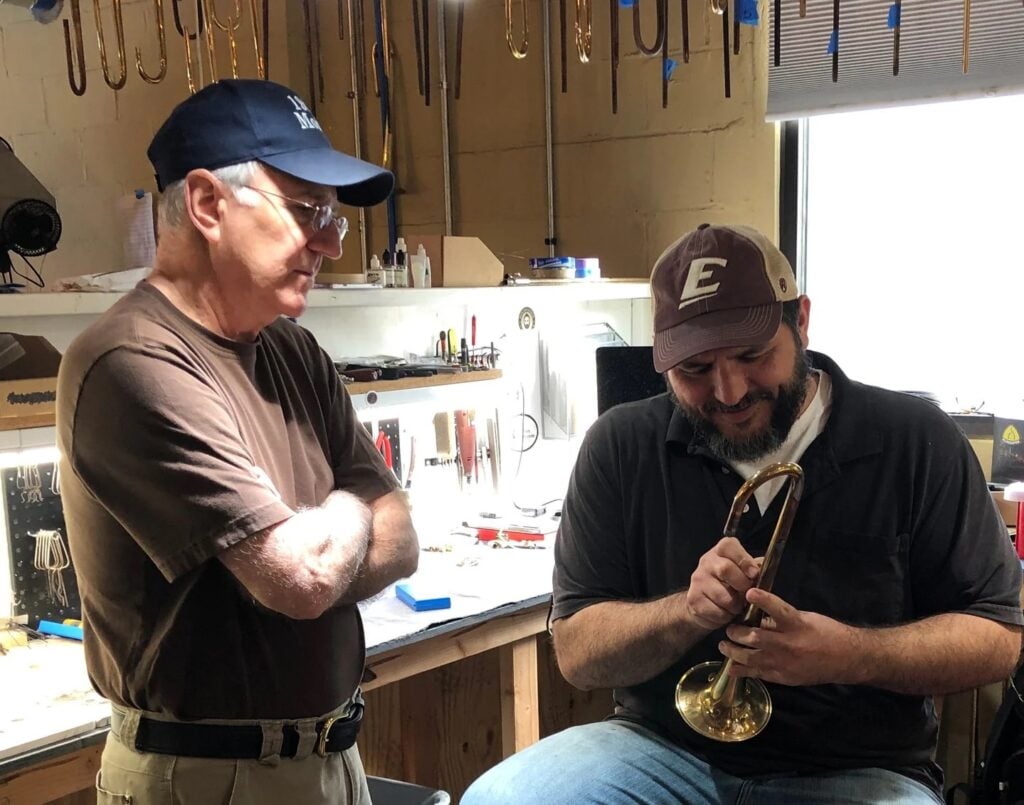
The first “shop” was very modest – the 300 square foot garage behind my house. The original goal in 2001 was simply to make one set of trumpet buttons for myself, and those first pieces were made by hand. From there I added the tools and skills needed for stems, caps, and other small parts. By about 2007 I had the machining capability to begin making mouthpieces, and each new product exposed the next limitation in our tooling, measuring, documentation, or workflow.
The move toward CNC was not a single switch so much as an evolution. Manual work taught me how the material behaved and what the musical result needed to be; CNC machining, CAD/CAM, better inspection tools, and more disciplined process control then gave us repeatability and the ability to explore designs much more efficiently. Today our mouthpieces are designed and manufactured in-house using proprietary CAD/CAM software and precision machining, followed by careful measuring, hand finishing, plating, and individual inspection.
How has the Blackburn Trumpets part of the shop evolved? Are high-tech tools used there, or is it all done by hand?
Blackburn has become more deeply integrated into the Lexington shop, while preserving the instrument-making knowledge passed down from Cliff. It is not a choice between technology and handwork; the process depends on using each where it contributes most.
Precision equipment supports design, tooling, repeatable components, pistons and valve blocks, bells, tubing, and inspection. But a Blackburn instrument is still assembled, fitted, finished, tested, and adjusted by skilled craftsman. Bell making, soldering, alignment, final finishing, and play-testing all require judgment that cannot be reduced to pushing a button. Modern engineering helps us hold the details consistently; hand craftsmanship is what turns those details into an instrument.

What is the best way to get Pickett Brass mouthpieces and Blackburn Trumpets?
The easiest starting point is the Pickett Blackburn website, where players can see the broad product range and learn how the different options fit together. We ship worldwide and also work with a number of dealers.
For a specific mouthpiece or instrument, however, the best route is often a conversation. Players can schedule a phone consultation or a visit to our Lexington shop, and trade shows remain a great place to meet us and try equipment. A dealer can also be the right choice when a player wants local guidance. The important thing is not the channel—it is getting enough information about the player, instrument, and musical goal to make a useful recommendation.
You built the bugle used for the Kentucky Derby. How did you make that connection? What kind of instrument is it, and what mouthpiece is used?
That project grew out of a long relationship with Steve Buttleman, the official bugler at Churchill Downs. As the 150th Kentucky Derby approached in 2024, we reached out because it felt like the right moment to create a new instrument for him and bring the Blackburn name back to Churchill Downs.

We built Steve a custom Blackburn bugle and a B-flat herald trumpet for the Derby and for performances at Churchill Downs and Keeneland. The herald trumpet is based on the Blackburn 313A20S bell and #52 leadpipe, a combination designed to project with power and clarity while remaining easy to play in the fanfare setting. The instrument was a gift from our team, and hearing it carry the “Call to the Post” was both a proud Kentucky moment and a meaningful example of what a close relationship between maker and musician can produce.

What other ways have you connected with and contributed to your local community?
Community has always been part of the reason for doing this work. We contribute first by keeping specialized design and manufacturing in Lexington, employing and training local craftspeople, and making instruments that carry Kentucky workmanship to musicians around the world. We also welcome players and educators into the shop, meet students and professionals at events, support music education through educator and young-artist offerings, and collaborate with local partners when a project needs expertise beyond our walls.
The Derby instruments made that connection visible on a very large stage, but the quieter work matters just as much: helping a student find equipment that makes playing more rewarding, sharing knowledge with an educator, supporting a local ensemble or organization, and creating skilled work here at home.

We hold an unwavering belief that our knowledge, passion and commitment to you, the musician, will increase confidence on your musical path. We are musicians helping musicians through precise machining, exceptional service, and integrity. We honor and protect the legacy and traditions by guaranteeing the highest product quality and consistency at all times.
-Pickett Brass and Blackburn Trumpets
Original post updated by Leslie Saidak July 29, 2026.