
Advice · Education · Interview

The Carmine Caruso Legacy

I think that the concept of a saxophonist and former violinist becoming one of the most well-respected and well-known trumpet (and brass) teachers is a fascinating one. His callisthenic approach will be well-known to many readers through his publications, but in addition to this concentration on the physical synchronisation of different muscle groups, he also built a reputation on positivity and for really nurturing his students.

So many top players over the years attribute a huge portion of their success to Carmine Caruso – I was fortunate enough to be able to gather the thoughts of four of these fabulous players, in order to get to the bottom of how their experiences with Carmine influenced them and their careers: Marvin Stamm, John Thirkell, Randy Brecker and Markus Stockhausen.

VISIT THE ‘EDUCATIONAL RESOURCES’ PAGE FOR FREE WORKSHEETS AND LINKS TO PUBLICATIONS

Why did you go to study with Carmine Caruso?

MARVIN STAMM:  I had just settled in New York City in late 1966 and was beginning to be a part of the jazz and studio scene. I mentioned to friend and fellow trumpet player Burt Collins that I wanted to continue to study and work on certain aspects of my playing. Coming off the road, I was bothered by a few things that I felt needed to be addressed. Burt told me about his study with Carmine, that he was a trouble-shooter and problem-solver. He also mentioned a number of players who had been helped through studying with Carmine, among them the great lead player Al Porcino and others, and he felt Carmine would be the teacher to see.

JOHN THIRKELL:  I was at Leeds College of Music when I first came across the Caruso Method. I had studied several other method books – Claude Gordon, Louis Maggio etc. – but something about the concise and prescriptive nature of the Caruso appealed to my sensibilities. Do A and B will happen, then do C and D will result, and so on. That kind of regime somehow clicked with me and I quickly became a devotee. My then trumpet teacher was, I’m afraid, very much against such perceived radical methods but I think that only made me more determined. I’ve always been (and still am) one for swimming against the tide.

RANDY BRECKER:  I was playing in the Duke Pearson big band in ’66 and the other 3 trumpet players, (Marvin Stamm, Burt Collins and Joe Shepley) had studied with him and swore by him and said I should see him to improve my range.

MARKUS STOCKHAUSEN:  In January 1978 I came to New York. It was a winter with heavy snow. New York was peaceful and quiet. I contacted Marvin Stamm, whom I admired from his recordings with the Pat Williams Orchestra. I told him that I would like to have lessons with him. He denied and said that instead I should go to his teacher, Carmine Caruso, which then I did. Nevertheless, I had a good time with Marvin, he took me several times to studio sessions and gave me the opportunity to feel the scene, to meet other players like Alan Rubin, Lew Soloff, and also, I witnessed a rehearsal with the Maynard Ferguson Band in some hotel, a great experience at the time.

What were your impressions of the first lesson?

MARVIN:  Carmine was one of the most positive thinkers I have ever met, and he strived to infuse this positive attitude into all his students. Any progress, any improvement, no matter how small, was recognized as progress and needed to be appreciated in that light. My impression after my first lesson was that I had really found the teacher who could help me over whatever obstacles I felt were a problem.

JOHN:  My overriding memory of the first lesson was how energizing it was. He had the uncanny ability to make you feel like you could achieve absolutely anything, and he removed much of the worry I had associated with playing and practicing. He always said that, if you are following his instructions implicitly and not making progress, then the fault was in his teaching rather than in you. That idea was incredibly liberating and allowed me to focus on the process rather than worry about any innate ability. Just do it! I felt that sense of positive energy every single time I came out of a lesson.

Also, I couldn’t believe how little I actually played. I would say in the 90 minutes I was with him, I played probably no more than 15 minutes maximum, the rest of the time being taken up with the explanation of his theories and the idea of allowing your body to adapt and find the solutions rather than you consciously trying to find them. That was a common thread in all of the lessons and I would go as far as to say that he was as much a psychologist as he was a trumpet teacher. He talked you into playing well. There is a common idea that, as a trumpet player if you think you are going to miss it, you’ll miss it. Caruso, as with so many other things, turned that into a positive by inculcating the idea that, by knowing that you will hit it, you’ll hit it. And the more you know it, the more you’ll hit it.

RANDY:  Well he had those airline noise-reducing huge headphones on the whole time and talked a lot… and said a bunch of surprising things about how to approach his exercises (don’t worry about your sound, don’t worry if you miss a note etc.

MARKUS:  With Carmine I had seven lessons. Each time he would write me the next exercise on a little sheet of paper. So, in the beginning I just had the six notes I think, and at the end of the month the full system. His book was in preparation and had not yet been released, and he did not care so much about it, I had the expression. His teaching, though he had a system, seemed very individual.

His room was dusty, with old book shelves full of music, and a fan. The heating was hot, he just wore an undershirt, and often put on his headphones while I played, the kind they use in airports. Now I can understand him very well, because also for me the trumpet often is loud to my ears, and I use some plugs or phones when I play or teach a lot. He was very kind with me, like a father. His eyes were loving and distant at the same time. He was very patient, but clear, to the point.

What were the big changes that you found from the way that you had previously approached the trumpet?

MARVIN:  I’m not sure there were big changes in my approach to the trumpet. What I was looking to find were solutions to a problem, and I believe any big changes were more in my thinking—that is, in discovering how and what to practice to overcome these issues.

Problem-solving, of course, is most always a slow process. The time during which I studied with Carmine took place before cell phones, tablets and laptops, even the Internet, so everything moved at a slower pace than it would today. Musicians’ expectations of progress were based on the “long view” rather than how much could be learned in the short term. Carmine had a unique ability to recognize and analyse individual problems, so the exercises he gave were designed for each student to assimilate corrections into their playing slowly, without disrupting their ability to continue working while at the same time finding answers to their musical problems. The exercises were also meant to become permanent solutions that would serve the players throughout their performance career. So, the big changes happened over time and in small increments.

I approached Carmine to help overcome the “break” I had at the top of the staff—to close the space in that area so as to provide a smooth path from top to bottom. Meantime, Carmine also saw problem areas that he could fix while helping me with what I perceived to be my only impediment. I was using movement or manipulation with my hands for one thing; another was playing a note before properly setting for it, kind of like “jumping on a running horse.” Carmine also knew that I wanted to build stamina and broaden my sound, thereby making my lead-playing stronger and more effective. All this we achieved over time. Patience was the key to the results I desired.

JOHN:  The idea that, whilst practicing the Caruso method, you should not worry at all about musicality or the sound. This was purely calisthenics. Building muscle. Pushing the body a tiny bit further every time and allowing it to find a way to cope. Rather than make arbitrary changes in order to achieve an objective, by pushing the body it will find its own way to cope with the added demands. Again, this is incredibly liberating and allows you to stop worrying and just focus on the process.

Tapping the foot is also a big part of the method – that and the breath attack on the first note of an exercise – the idea being to train all of the disparate muscles required to play a note to come together at the exact same time. Again, subliminally training the body to automatically synchronise everything.

RANDY:  Better high register and more flexibility.

MARKUS:  His exercises focused my embouchure and gave me strength and endurance and developed my high register.

Could you feel a big difference in your playing immediately after starting studying with Carmine, or was it a slower process to see results?

MARVIN:  Some things were immediate, but the bulk of what I wanted to achieve was a slower process.

JOHN:  I think I pretty much felt a difference straight away, but this was probably more a result of the incredible sense of self belief which he gave you. You came away from a lesson feeling that nothing was impossible and that certainly manifested in the way I played thereafter. That confidence removes much of the doubt that holds back progress and I found myself playing with much more abandon. On a more physiological level though, pretty soon I found my range, not necessarily expanding that much but certainly becoming much more solid and dependable and I think that was as a result of the muscular development.

RANDY:  Pretty fast I must say.

Were there any aspects of the teaching that contradicted what you had been working on previously?

MARVIN:  Yes and no. His approach was quite different. Carmine was very “up front” that he was not working on students’ musical values, but on their physical attributes, striving to solidify a structural approach to playing the instrument. He told his students NOT to put aside playing etudes, solo pieces, practicing Arban’s, Schlossberg, Colin or other methods. He always stressed to me the importance of mixing in his studies with all the others that I had been working on, especially the musical ones.

If there were any contradictory elements to Carmine’s approach, they might be the use of nose-breathing, the long-settings, and the tapping of one’s foot to create the rhythmic movement of moving from tone to tone.

Nose-breathing allows one to have no movement of the corners of the mouth when taking a breath, thereby making possible a long setting, a consistent or constant placement of the horn to the lips. Tapping of the foot to set up the “time” meant that when moving from one tone to another, the only thing one had to be aware of was to consciously move “to the beat,” thus eliminating having to think of the many other elements of playing the instrument—the tongue, air, and muscles. Only moving to “time.”

Carmine’s exercises might be considered by some to be contrary to the usual structural exercises as those utilized by Schlossberg, Arban, St. Jacome, and Charles Colin. The approach was certainly different. And though I did some work out of the Baermann Clarinet Method, this was not really for any technical aspect, but rather to work over the break that I hoped to minimize to the fullest. All the exercises other than the Baermann were Carmine’s. There was also a strong focus on using dynamics in his exercises, both in a typical and atypical manner. These were used to work the embouchure in a more arduous way, making actual performance of demanding music much easier.

JOHN:  The idea of not being concerned with musicality or sound was very different but you soon learn to separate out the Caruso part of your practice from the other, more music focused stuff. He would use the analogy of a footballer (American football, not proper football) working out in the gym with weights. Where were the weights during the football game? But the weight training was of fundamental importance to his performance on the field.

RANDY:  Well I always worked on my sound and sound didn’t matter when doing his callisthenic exercises.

MARKUS:  He knew all the struggles that I was going through at the time. My embouchure had to be dry while playing, at least the top lip, which had been a problem for me during concerts when I sweated a lot, especially with spot lights on me. His pedal tone exercises followed by the chord pedals gave me a wet embouchure, resulting in much better playing possibilities.
Did you continue with his methods exactly as prescribed, or did you need to adapt them to fit in better with your work schedule, etc.?

MARVIN:  No, I didn’t find a need to adapt anything to fit my work schedule. Carmine always stressed to practice his exercises as he prescribed in the lessons, but when performing in my work, approach things as I usually did. He said the effects of his exercises working their way into my playing would happen by osmosis—that it should happen seamlessly. In my experience, I found this to be true.

I tried to use his methods exactly as prescribed. As is the case with any fine teacher, however, if he felt at some juncture that a change in approach might be more beneficial, he would make the necessary change. I studied with Carmine six and one-half years and continue to include a number of his exercises in my daily practice, along with a number from Laurie Frink, Dennis Najoom, and the classic methods mentioned earlier.

JOHN:  For several years I followed his methods to the letter but in time, as I got busier and busier as a pro player, I slowly watered down the routine as it can be physically quite demanding, and it becomes more important that your chops are in shape for your session rather than completing the whole routine. The Caruso done thoroughly means you are pushing your body more and more and, by overdoing it you can leave your chops a little shredded. I remember explaining the lessons as taught by Caruso to Guy Barker and, being Guy, he went mad and practiced it for hours. Well, of course it did more harm than good, and he pretty soon gave it up. The idea is to go through the day’s routine, take a break then move on to your regular practice. These days I tend to stick to the 6 notes exercise as part of my warm up and maybe once a week do the full routine.

RANDY:  Tried just to do what he said to do, fit them into what I was already doing, but I applied his ideas about timing to other things I did like the Adam Routine warm up.

MARKUS:  At times I would overdo the exercises. Especially the soft-loud-soft, as well as the loud-soft-loud exercises were very strenuous to me when I did them on a daily basis. Nevertheless, I continued the exercises for quite some years, not always very regularly, but still. Within time I found my own way, a little more moderate, and surely not applying the full system, I am aware of that. I do the exercises only from time to time now, when I feel I need to focus my embouchure or prepare for a very hard trumpet concerto. Often just by doing the “Six notes”, the body remembers the whole thing immediately and I can play up and down without any further warm ups. The body actually is magic, how it can reproduce results that have been properly programmed. In fact that is the basis for Carmine’s system, as well as of others of course, that the cells have memory.

I would like to thank Marvin, John, Randy and Markus for their contributions here! Please visit their websites to find out more:

Marvin Stammmarvinstamm.com

John Thirkelljohnnythirkell.com

Randy Breckerrandybrecker.com

Markus Stockhausenmarkusstockhausen.de

Click here to purchase a copy of Carmine Caruso’s ‘Musical Calisthenics for Brass’ at Thompson Music

Markus Stockhausen’s “The Basic Caruso”, from which his quotes are taken above, is available here

Photo Credits: Bev Nathan (John Thirkell), Judy Kirtley ( Marvin Stamm), Gerhard Richter (Markus Stockhausen)

Sign up here for new blog articles emailed direct to your inbox:


Advice · Education · Interview

Professional Development : Kate Amrine

When I left music college (nearly) 20 years ago, the approach to building a healthy portfolio of freelance work as a trumpeter was rather different to now:  Face-to-face networking; Being in “the right place at the right time” with the right people; Backing up any opportunities by being a “good guy to have around” and a good player.  This was the limit to one’s self-marketing.

It struck me at the time that even when things were busy, and the diary was booked up a couple of months ahead, there was never a feeling of being in control and having ‘ownership’ (this seems to be the buzz word) of your career.  This is what led me to start to explore other things that I could do alongside the trumpet-playing that could bring me more of a sense of control over my own career.

Speaking to younger professionals now, I see quite a different picture.  The opportunities that the internet has brought are vast, and musicians are quickly learning how to maximise what it has to offer. Players now have limitless control over their own image and career.  This series looks at this in more detail:

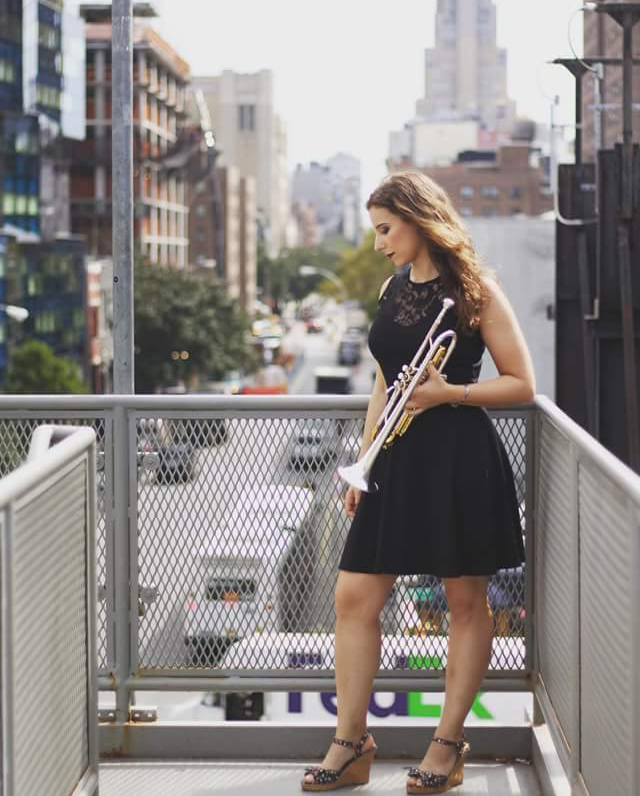
Next up in ‘Part 2’ to help me look at this in more depth is Kate Amrine.  Kate is a trumpet player and educator based in New York City.  She currently freelances in many different genres from Orchestra to Broadway, and also is an active soloist, currently working on her second album.  Music entrepreneurship has always been an interest and she recently presented her “Designing your Career in Music” masterclass at New York University where Kate has been an Adjunct Professor since 2013.

How did you find the transition from college to working as a trumpet player?

When I first moved to NYC 8 years ago to start my undergraduate degree at New York University, I remember being so enamoured by being able to play so many different styles and seeing so many opportunities to play everywhere I looked.  The sense of wonder and amazement hasn’t diminished but now it is accompanied with the knowledge of knowing how much work everything requires and knowing that sometimes things just don’t work out, no matter how much work goes into it.  Since I moved here, I have recorded a solo album, started recording my second album, became a composer, performed 2 concertos as a soloist with orchestra, given countless recitals, played on Broadway, and many more things.  It is an exciting time to be a musician, yet I know that it is very different than it was even as little as ten years ago.  I currently teach all ages from elementary school to college students at NYU and I really enjoy helping musicians find their path and purpose.  I have written many posts about how I started freelancing in New York and other various aspects of being a musician on my blog.  Check them out here: http://kateamrine.com/blog

I knew pretty early on when I moved here that my reputation started immediately – both as a person and as a musician.  Even when I was a student and still learning, I knew that every time someone worked with me and heard me play that it was an opportunity that could further my career – no matter how small the gig, how much it paid, or what kind of music it was.  I still have that mindset that anyone and everyone is always listening, and I think it is one of the most valuable things to keep in mind when building a career as a musician.

What did you expect working life to be like when you were at college?  Were you given any career development guidance?  Was the reality of working life different to how you imagined it?

I had huge preconceptions of what music school was like – most of which were tied to what I thought I needed to know upon graduation.  For example, I assumed that I was supposed to learn all of the brass quintet repertoire in college and I didn’t want to be unprepared when I graduated if I was called for something, so I put together a group and ended up learning a good majority of the brass quintet rep by performing it in the subway.  I was so concerned about being behind and unprepared when I graduated that I over prepared and tried to do as much as possible to get ready for life after graduation.  I took some music business classes at school but quickly realized that a lot of what I was expecting to learn about “the real world” I was going to have to learn myself.  I constantly met with other musicians to learn from them over coffee.  I listened to many music entrepreneurship podcasts.  I read many of the books designed to help students figure out what’s next.  I was always fascinated with how musicians build their careers from their own personal interests, what pays the bills, navigating admin and teaching jobs and more.  I had some admin experience during school: working for trumpeter Jeremy Pelt as his assistant, working for the Festival of New Trumpet Music, and assisting John Rojak the head of the Brass Dept at NYU.  I was incredibly grateful for these experiences because I learned so much about life, being a musician, how to put projects together, and more – all of which prepared me so much for everything I do today.

Despite everything I did to be in the best possible situation when I graduated, in my third year at NYU I found out I was going to be graduating a year early so I had to accelerate my plans and get my career plans in order.  Even here in NYC, I felt like being in school can be such an uncomfortable bubble where your whole world is determined by the people around you and it can be hard to break out of that.  Some of my colleagues didn’t always have the best attitudes and weren’t inspiring positive influences to be around, and that was sometimes difficult to try to ignore.  Fortunately, the majority of my colleagues were great, and I was excited to be in ensembles outside of required orchestra – playing new music, recording for films, and more.  I knew that things would be different after I graduated but there were so many things that I couldn’t have realized or prepared for when I was still stuck in the “bubble” of school.  I subsequently learned so much more in that year out of school than I had in my last year of undergrad because I figured out how good I really needed to be to be a working musician, how to master time management and be the most productive, and so many more things that weren’t quite possible to really grasp when I was in school.

The biggest difference I felt after I graduated was that I wasn’t being seen as much as I had been while in school at NYU.  I would see other musicians in the practice rooms, in class, in rehearsal, and around campus and then they would think of me as someone to work with for upcoming projects.  However, when I graduated and spent more time practicing at home and playing occasional gigs, I didn’t see as many people who I could potentially work with as I had been at school, and I remember feeling a sudden shift and dip in my gig income where I soon realised I needed to figure out a new plan.  I figured out that I needed to make more of a conscious attempt to be seen – both online and in person at gigs.  I had to talk with people, get to know them and what they were involved in and be more personally engaged in being a more direct part of other people’s projects and the community.  Only after this mindset shift and a drastic improvement in my playing did I start to see some big changes in the year after I finished my undergraduate degree.

Do you think that educational institutions need to look again at how they prepare students for a career in music?

I do think that educational institutions need to revisit the way they prepare students for a career in music, but I think it will be a long time before the change is made.  For example, I knew that my income after school would be combining what I earned from any admin or teaching jobs with what I earned performing.  However, I never took any classes on teaching in my undergraduate degree because they never fit with my schedule as a performance major.  There are also so many “area specific” things that I think are harder to teach on a national level, particularly how to get started freelancing in a scene like New York where there are already so many accomplished and talented people everywhere.  I also remember hearing stories about the old days where someone graduates, and they are immediately handed a Broadway show, or they take their first ever orchestra audition and get the job. These kinds of things don’t happen too often anymore, and I think schools should prepare their students more for building a diverse income of multiple streams not from one position or even particular style of music.

Another thing that I think is important to mention is that we don’t have to do this alone.  When we are looking to get better at a certain type of music or area of our practice, we take a lesson.  If you are looking to get more in shape, then you hire a personal trainer.  Last year I was looking to get more organized in my career and I started working with a coach.  Having someone who isn’t a friend, or your parents listen to your dreams, goals, and help push you in the right direction is such an invaluable experience and I definitely recommend it.  I think someone graduating college and thinking “what do I do now??” is probably the clearest example of someone who would benefit from working with a career coach but that isn’t the only type of person who would benefit from being focused and introspective.  I consider myself to be very organized and self-aware yet the process of talking to someone who isn’t personally invested in my own projects has been extremely helpful in figuring out exactly what I want to be doing and how to get there.

image2

You have a number of varied and interesting projects that you have put together.  Can you tell us a little about them?

Currently I am working on a bunch of different projects and I feel so lucky and inspired to be a part of them.  My newest one is eGALitarian – a brass ensemble comprised of women playing music by women composers.  Our goal is to inspire women in the community and make a difference for the women around us.  In addition to our standard concerts, we are collaborating with different organizations in the community to make an impact.  With my colleague Becca Epstein-Boley, I run the Brass Chicks Blog where we publish interviews with prominent female brass players and feature a weekly Five Things Friday post written by a member of the community.  We curate the content and plan the social media as well.  I also recently joined Wavefield, a new music ensemble where we will be doing some teaching and performing a few concerts at Carnegie Hall.  My friend Kate Barmotina and I have been collaborating as a duo (Kate squared) and putting together concerts featuring women performers and women composers.  Outside of these projects, I have been doing a bit more composing and am getting pieces and recordings together for my second album featuring new music inspired by politics and social concepts.  I recently put together a solo show of this music and it was reviewed here:
https://nationalsawdust.org/thelog/2018/08/24/in-review-kate-amrine/

I notice that you are involved in a number of all-female groups and music blogs etc.  Would you say that things are better now for female brass players?  There are certainly a larger number of high-profile female brass soloists now.  Would you say that this reflected on the freelance scene in NYC?

There are certainly a higher number of female brass soloists than there were, and it is very exciting.  I always try to show my students examples of both men and women performing. Growing up I didn’t really see too many examples of prominent female brass players, although my first two trumpet teachers were women in the military bands in DC.  In terms of the general treatment of female musicians, it is hard to say if things are necessarily “better now” than they were 20 – 30 years ago… especially since I was very young then.  With the rise of social media, there is certainly a greater access to education about the wide variety of brass players out there, but it hasn’t necessarily made its way into pop culture as much.  I still occasionally get comments from audience members and non-musicians asking about my lung capacity as a woman and commenting on how my gender is pretty rare as a brass player.  As awful as it is, I think that the ‘Me Too’ era has been a great thing for interactions with people of all genders and sexualities.  There is a serious reckoning in the arts world (from classical organizations like NY Phil, the Met, NY City Ballet to movies and more) and people are realizing that certain behaviour should no longer be tolerated and passed over.  This will create more respectful environments for all musicians and it is very exciting.

I do think the New York City freelance scene is much more diverse now than several years ago.  Usually I am not the only female musician in the brass section, but there are some subsets of NYC freelancing, like Broadway for example, that could certainly be a bit more diverse.  On the other hand, a vast majority of my performances this month in September have been with all female ensembles so there are many women around who are collaborating to create new and interesting musical experiences.

How differently do you approach “just promoting yourself”, to promoting a particular project?  I like your “Trumpet Tips Tuesday”!

Thank you!  I’ve been having a great time with the Trumpet Tips Tuesday videos and it has been a fun thing to work on.  If you haven’t checked out any of the Trumpet Tips videos, please check out my Instagram @katetrumpet or search for #TrumpetTipsTuesday .  I think of promoting myself as highlighting everything about me, from sharing a selfie, what I like to eat (donuts), the commute to a recent rehearsal, and more.  Promoting ME is basically a complete package of this is the kind of person I am;  this is what it would be like to study with me, work with me, and/or interact with me.  Promoting a project is a lot more calculated and planned out based on the release date, who else is involved, and more.  The most successful project that I promoted (other than Brass Chicks, which is continuous and ongoing) was my album As I Am.  The funds for my debut album were raised through crowdfunding on Indiegogo’s Generosity platform and all of the posting and contacting people about it in the months before the recording sessions was a very involved process.  I ended up raising about 80% of what was needed, which equated to $6500, and was unbelievably helpful to the completion of the album.

How do you keep track of your promotional activities?  Do you draw up a plan/strategy for each project, or is it more instinctive?

I keep track of marketing and promotion by making a calendar with a note for what I’m posting on each day.  Since I mostly post the same things on each platform like Facebook and Instagram, it is generally pretty easy to keep track.  Having a whole week or month planned out is perfect for seeing the trajectory of what I’m posting. I can plan to highlight different upcoming gigs, time out promotion for a show just right, and make sure I don’t share too many of one kind of post too often.  I don’t usually post different things on each account, but some things are better on Instagram than Facebook.  For example, if I am advertising a new blog post then I’ll either screenshot it (for Instagram) or post the link and a description on Facebook.  Similarly, sharing relevant NY stories or political things is definitely better for Facebook and I use the Instagram story feature to show little highlights throughout my day.  I also always try to keep track of my audience.  Personally, my audience on my Facebook personal page and even my artist page is mostly comprised of fellow freelancers and people I know in New York City while my Instagram is more connected internationally to trumpet players and artists everywhere.

With your crystal ball, how do you think things will change further for musicians looking to promote themselves, and find & engage new audiences?

I honestly think it is a very exciting time for musicians looking to promote themselves and expand their audiences because anything can happen.  There are some seriously creative chamber ensembles out there, like the Melodica Men, Too Many Zooz, Two Cellos, and more where musicians have found their own artistic voice and are able to make money performing.  In a way this puts a different kind of pressure on young musicians because it is almost not enough anymore to graduate with a good take on orchestral excerpts and standard solo repertoire – expecting to be employed.  The most successful musicians today are the ones who can book their own performances, network with other musicians, and have a strong musical vision for the kind of music they want to perform.

Website: kateamrine.com

Instagram: @katetrumpet

Facebook: @kateamrine

Blog: kateamrine.com/blog

You may also be interested to read ‘Professional Development’ Part 1, which gets the thoughts of UK-based trumpeter and marketer, Becca Toft.


Sign up here for new blog articles emailed direct to your inbox:

[jetpack_subscription_form show_subscribers_total=”false” button_on_newline=”false” submit_button_text=”Sign up” custom_font_size=”16″ custom_border_radius=”0″ custom_border_weight=”1″ custom_padding=”15″ custom_spacing=”10″ submit_button_classes=”” email_field_classes=”” show_only_email_and_button=”true”]

Advice · Education · Interview

Professional Development : Becca Toft

When I left music college (nearly) 20 years ago, the approach to building a healthy portfolio of freelance work as a trumpeter was rather different to now:  Face-to-face networking; Being in “the right place at the right time” with the right people; Backing up any opportunities by being a “good guy to have around” and a good player.  This was pretty much the limit to one’s self-marketing.

It struck me at the time that even when things were busy, and the diary was booked up a couple of months ahead, there was never a feeling of being in control and having ‘ownership’ (this seems to be the buzz word) of your career.  This is what led me to start to explore other things that I could do alongside the trumpet-playing that could bring me more of a sense of control over my own career.

Speaking to younger professionals now, I see quite a different picture.  The opportunities that the internet has brought are vast, and musicians are quickly learning how to maximise what it has to offer.  Players now have limitless control over their own image and career.  This series looks at this in more detail:

First up in ‘Part 1’ to help me look at this in more depth is Becca Toft.  Becca is a London based freelance trumpet player and founder of the musician’s online marketing website DIY Musician.  She is currently lead trumpet of the Jazz Jamaica All Stars Big Band and the Prince tribute band, New Purple Celebration.  Becca is a part for the trumpet quartet Bella Tromba where she also acts as their in-house arranger. Becca’s career has developed with the help of social media, leading to a strong following on both her freelance trumpeter page and her ensembles pages.  She has developed DIY Musician to help others understand the benefits of social media and personal websites.

What led you to take up the trumpet?

I learned how to read music before I could read words and growing up I played a number of instruments, but when I was 10 I joined a marching band, and they needed trumpets, so I was given a trumpet and was told to learn it.  So, I did and it soon took over my life!  

What did you expect working life to be like when you were at college?  Were you given any specific career development guidance?

I had a lot of friends who were leaving college when I was starting, so I got a first-hand look at what was to come.  I saw people doing amazing things, and I saw people struggling to pay the bills.

College focused on two things: auditioning to get into an orchestra, and teaching skills.  I knew that I wanted to do projects and learn skills that weren’t on my degree course syllabus, so I looked elsewhere to pick up the skills I wanted.

How was reality different to the theory?  Do you think that educational institutions need to look again at how they prepare students for a career in music?

Having a career in music is extremely broad and it is hard for institutions to cater for every pathway of a music career, but I do think they should be teaching core self-employed skills, self-promotion and marketing.

You have a number of varied and interesting projects that you are involved with, can you tell us a little about them?

As you might expect, as a freelance trumpeter I am in a number of different ensembles and bands of different genres.  My trumpet quartet, Bella Tromba, focuses on classical recitals, concert society and festival dates.  I am in a jazz collective called the Nu Civilisation Orchestra which is an arts council funded group that perform nationwide projects.  I play for a thrash brass band (Brass Funkeys), a Prince tribute band (New Purple Celebration) and a local function band (Soul Calibre).

When I get involved with a project, I find it hard not to get involved with the marketing/promotional side.  I love taking photos anyway and I am always happy to share footage with the others involved.

Do you find that there are particular marketing outlets that work better for different kinds of projects, whether it be an album release, or live solo performances etc? For instance, would you hit YouTube, FaceBook, Twitter, Instagram, Blogs, your email-outs in a similar way, or do certain platforms work better for different projects?

You have to work with what you are comfortable with and on a platform that you know you can maintain.  Each platform has its positives and negatives, yes, but there is no point using twitter if you hate writing or using Instagram if you only have grainy photos. If you can do 4 things (website, email-outs + 2 social media platforms) then that is enough.  If you spread yourself too thin then you can miss out on the benefits of each platform.

How differently do you approach “just promoting yourself”, to promoting a particular project? 

I have a clear objective for each account I have.  My trumpet Instagram @horn_identity is almost like my own online CV.  It shows an overview of what I do as a trumpet player, adds a bit of personality and it connects me with other musicians doing similar things.  Each ensemble has its own Instagram with its own character, theme and audience objectives. For these, I am attracting fans of the music and engaging with people who are potential audience members.

What would you say have been your most successful and also least-successful ways that you have tried to promote particular projects?

For 2 years in a row now my trumpet quartet has received packed out audiences in our London concert.  This audience is different to our usual audience when we tour more rural areas of the country and can be communicated with through a mixture of Facebook, Instagram and our mail out.  These gigs are much easier to have control over as you can see the response there and then.  When we go to concert societies, they always comment on how bright and appealing our pictures are and have a big impact on the awareness of the concert.

Sticking an event or page up on Facebook and hoping people will flock towards it is probably the thing I have found least useful.  It is good for awareness and so people can see that you are working, but normally people do not attend on that basis alone.

How do you keep track of your promotional activities?  Do you draw up a plan/strategy for each project, or is it more instinctive?

I love a plan, and I believe for any project a plan is a good starting place.  I have an initial plan outlining post and engagement qualities and then review it every month or so to see what is working and what is not.  It is very important to have a goal in mind.  For example; increase engagement by 20% in the next month or increase audience by 100 in the next week.  Although these goals are small, they all help you get to the end result with greater ease.  I believe using many smaller goals instead of a single end goal allows for an element of flexibility.

With your crystal ball, how do you think things will change further for musicians looking to promote themselves, and find & engage new audiences?

The people I see with the most success treat their ensembles like a business. They look at how they can sell their product and how best to market themselves.  This is hard as musicians often think this will restrict their musical freedom and allow less creativity and fun. But this should not be the case!  It is just letting the world know what you are about and finding those people in the world that love what you do!

Do you have any further advice for fellow musicians?

I would always advise keeping your personal life separate from your professional life online, create a separate artist page for gig and promo pics and leave your friends and family with all the pictures of you and your pet!

Also, think about the time of day you are posting.  You might be up and online at 2am, but no one is going to see your post, so wait, put it in your drafts and save it for a more appropriate time!

For musician marketing tips, guides and causes, find my Instagram (@diy.musicians), Facebook or website (diymusicians.co.uk)


Sign up here for new blog articles emailed direct to your inbox:

[jetpack_subscription_form show_subscribers_total=”false” button_on_newline=”false” submit_button_text=”Sign up” custom_font_size=”16″ custom_border_radius=”0″ custom_border_weight=”1″ custom_padding=”15″ custom_spacing=”10″ submit_button_classes=”” email_field_classes=”” show_only_email_and_button=”true”]