
Trumpet Artist Profile : Alexandre Herichon

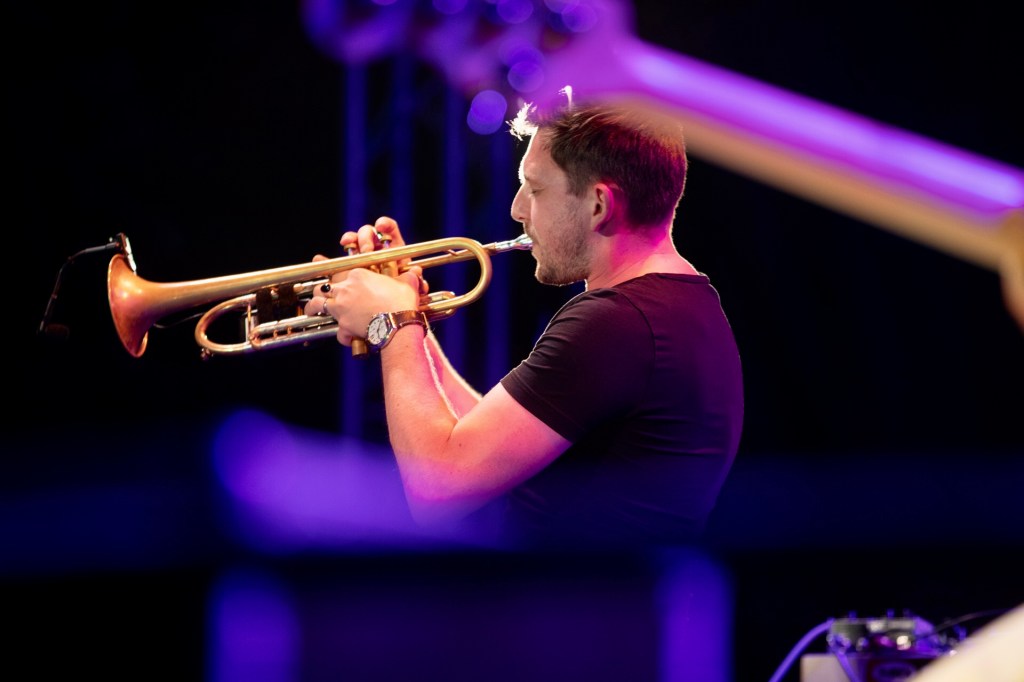
Alexandre Herichon is an eclectic musician, at home playing lead trumpet, improvising, and as a composer/arranger. He shares some trumpeting thoughts as well his experience with his new Agami trumpet.

What first drew you to the trumpeting the early days?

My parents listened to jazz music when I was a kid, and we saw, sometimes, some jazz bands with horn players, so I think it impacted me, but I can’t say why the trumpet, specifically. One thing is shure, I never quit, even in the hard times, since I began, when I was 10. 
Who or what were your early musical influences?

My teachers of course, who gave me the passion of music, the older musician in the music school orchestras and at the early beginning, the fact to play at church with my family. After came the big names and the jazz records. 

Do you have any particular practice regimes? Does this change a lot depending on whether you are doing more lead playing, or jazz, or funk for instance?

Yes, it changes sometimes, and especially depending on what I have to play. The most important for me is my flexibility. So, I always do tongue flexibility exercices to be shure I’m easy with it. Notice that I say, “tongue”, not lips! I do like a kind of whistle and my lips respond to it naturally. Then, if I’m more on a jazz/improvisation gig, I’ll work the most fingering and harmonic exercises on all the range. If I’m on a lead gig, I’ll work some muscles exercises, like Caruso, and be shure to hit the high notes perfectly. 

What do you think are the most important elements of music and trumpet playing that young players should focus on?

Regarding the trumpet playing, the two most important basics are, the air and the tongue position in the mouth. For the music, you can do the kind of music you like and want, but, in all case, do it seriously, spending a lot of time on details and trying to reach perfection. Play all time at 100% trying to make the band or the orchestra sounds greater as possible. Always be invested in the music and it will gives back to you.

Can you talk a little about your Agami trumpet, why you play it, and the process of selecting it?

Agami trumpet are great horns, really! Love it!I first saw pictures on Instagram (go follow him-> agami_music_france 😉) and said to myself “wow, those horns are beautiful!” So Thierry Sohier (from Agami) contacted me to organize a meeting and invited me to try the trumpets. I directly felt good playing it. Easy, great sound, warm on the low range and bright on the upper register, polyvalent. Anyway, all a trumpet should have as qualities. I tested it some months, on many different gigs and adopted it. I feel I can do what I want on this trumpet!

What are some career highlights to date?

I had and still have the chance to play with many great bands and artists around the world, Electro Deluxe in Japan, No Jazz in India, Etienne M’Bappé in South Corea, Panam Panic in Marocco, Big Funk Brass, Ben l’Oncle Soul and more!

Like many artists, I guess that your work has been badly affected by the pandemic? How have you found keeping up the playing to a high level, and getting back to (hopefully) being much busier now?

Yes it was a strange periode… But I have the chance to be a teacher in jazz music conservatory and private lessons so it kept me in touch with people and music, so it helped me a lot. I began to work on music producing too, and it takes a lot of time so it was on point. Some home recordings and tv sessions happened too in the second part of the pandemic and the work began to come again. Now it’s ok and we hope the worst is behind us now. 

And what projects do you have coming up?

My personal projects, Big Funk Brass and Panam Panic have released their albums not long ago (go check it too 😉) so this year will be a booking and touring year, between the other projects and lessons. I’m beginning to think about my new personal project too, kind of new jazz 5tet. I’ll let you know about that when it’ll be more clear. 


SIGN UP HERE FOR NEW BLOG ARTICLES EMAILED DIRECT TO YOUR INBOX:
[jetpack_subscription_form show_subscribers_total=”false” button_on_newline=”false” custom_font_size=”16px” custom_border_radius=”0″ custom_border_weight=”1″ custom_padding=”15″ custom_spacing=”10″ submit_button_classes=”” email_field_classes=”” show_only_email_and_button=”true”]

Adams Trumpets in the UK

The past few years has seen some tough times for the Musical Instruments industry in general, with many established manufacturers, distributors and retailers feeling the pinch – this has however left opportunities for a number of smaller companies to diversify and expand, and we have also seen a number of new niche companies spring up.

One of these is Fultone Brass. Set up by Neil Fulton, a well-respected UK trumpet player, Fultone Brass imports Adams trumpets to the UK as well as developing a number of new products. Earlier this year I caught up with Neil at the RNCM Festival of Brass to find out more about his new venture:

What brought you to develop a relationship with Adams?

After working for nearly 20 years in the music profession I have probably tried most of the widely recognised professional model trumpets on the market. Always striving to find the best compatible sound, highest build quality and the most efficient instruments available. That search led me in 2016 to work with the Dutch instrument maker Adams. As a result I decided to take up the opportunity of being their UK dealer and alongside my playing career I set up Fultone Brass.

How did you find the experience of trying Adams trumpets different to other instruments that you have tried or adapted?

Miel Adams is in charge of the build and development of the brass range. Every model is individually designed and built in house from start to finish. As a result the quality is outstanding. Across the range I found all the models very free blowing with great slotting and fantastic tuning. Each instrument is custom built so the choice of bell material, metal gauge and finish is up to the customer. Adams also have a Selected option in every model  which is based on the most popular combinations so this helps save any confusion.

Can you give us a run-down on the range?

There really is something for everyone. The ‘commercial ‘ range is fantastic. The A1, A4, A4LT, A5, A8 and A9  would all be classed as commercial. The A4LT is proving popular for jazz and big band performers. Played in the lower dynamics it’s got great body and warmth but it lights up when you give it some for the lead stuff. Russell Bennett ( West End, John Wilson Big Band and Julian Joseph All Star Big band ) is playing on one and he loves it.

The A2, A3, A7 and A10 B-flats are more classical. The A10 with a 0.55 bell is my favourite for the orchestral repertoire, very efficient with great projection.
I’m not really a C trumpet player so the Adams C1 has been doing the rounds in the Royal Opera House Covent Garden, Halle and BBC Scottish Symphony Orchestras and everyone seems to really like it.   The piccolo is great too, sound-wise it sits in between the Scherzer and Schilke and  it comes as standard with the 3rd slide trigger and both sets of cornet and trumpet shanks.

The Adams cornet has the modern main slide tuning option and traditional 1st & 3rd triggers as well.  With the help of Mark Wilkinson (principal cornet of Fodens Brass Band) we tweaked the feel of it to help fit into the traditional British Brass Band sound and Paul Hughes (principal cornet at Faireys) has been testing it out as well.  I think it will prove to be very popular.

There are several Flugelhorn models as well which are great plus Euphoniums and Tubas. The E3 Euph is very popular and there is a brand new Adams trombone being launched at the Frankfurt Musik Messe in April.

Please tell us a little about the other projects that you are working on.

There are some exciting projects in the pipeline for Fultone Brass.  We are on twitter now and I will be working on some short video clips of the Adams range with some of the guys, so that it is easier to see and hear them all. We are currently building an A10 for Gareth Small ( Principal Trumpet with the Halle Orchestra, London Brass) and Gareth is helping with the testing of a new Adams E-flat trumpet which is being developed at the moment.

I’ve got a new range of Fultone Brass trumpet  cases as well, all made in the UK. The first batch of triple cases have all sold out so far which is great.  The full range of doubles, triples and quads will be available on the site soon and we are looking at developing a new Flugelhorn/Trumpet plus mutes for commercial players.
I’ve also got a new range of intermediate instruments called Manchester Brass, exclusively available to Fultone Brass in the UK. The  build quality and the valve blocks are great and they will be added to the website soon.

As well as this, the first batch of prototype Ft series trumpet mouthpieces are being tested now and the second batch with a few tweaks will be ready soon all being well, again all made in the UK.

How do you combine running this alongside your career as a freelance trumpet player?

Fultone Brass has been up and running just over a year now so it’s relatively new. It’s been great so far, being a freelance musician I get to travel all over the country so that really helps and I get to meet some great people and fantastic players from all genres of music.

You can see the range of instruments at fultonebrass.co.uk

Resources for Group Trumpet Tuition

Music education has changed drastically over the past few years, and is a topic upon which instrumental teachers have often lamented.  In the UK in particular we had a sudden shift to whole-class and group instrumental tuition 12 years ago, which has taken a long time to establish itself as anything more than a musical experience for children.  Now that teachers are getting more accustomed to this setting and scenario, approaches to teaching beginner students are having to change with the focus particularly in the early weeks and months on having fun, rather than a technical grounding.

From my experience, I felt ill-equipped with suitable resources moving into group teaching (2005-2010), so found that I was primarily relying on writing and creating my own.  I know that this is a similar story that I have heard from many other trumpet teachers too.  In many respects this is a good thing as you do not become bound to a ‘method’ and any materials that you do use are purely as a resource rather than a learning guide.  In this setting particularly, improvisation (both from students and teachers!), singing, general musicianship and listening become even more important tools.

As we have all adjusted to these changes, many of the available teaching materials and ‘tutor books’ have now changed as well.  Here I have given a run-down of many of the methods and resources that can be useful for teaching beginning students in a group situation.

Trumpet Basics – John Miller (pub. Faber) 

This is a great step-by-step method, with a nice mix of different styles too.  The ensemble pieces included here are well-arranged and work really well.  The layout is clear and is engaging for learners of all ages.  The only negative aspect is that there are not many pieces that are suitable for a mixed ability group, and it does rely on everyone progressing at a pretty similar rate.

Standard of Excellence – Bruce Pearson (pub. Kjos) 

The variety of exercises and tunes here is great, and the ensemble stuff, particularly mixing with the other brass instruments is well thought out and fun.  The layout though could probably do with being updated as younger children particularly seem much more engaged by an open layout with pictures and diagrams as well as the notation.  Some of the repertoire could also do with a facelift.

Team Brass – Richard Duckett (pub. Faber) 

I really like the step-by-step nature of this method as each page introduces new elements while also consolidating the previous page.  This alongside the nice ensemble arrangements makes this a good resource particularly for mixed instruments.  The repertoire and the layout though are a little outdated now and perhaps is not as engaging for younger children as some of the other options available.

Essential Elements (pub. Hal Leonard) 

This has good varied content and works well with combinations of all brass and woodwind.  The ensembles work nicely, although involves some adaptation to work with mixed abilities.  The online resources are also really well integrated, with apps available for phone and tablet.

The Boosey Brass Method (pub. Boosey & Hawkes) 

This has a lovely, clear and engaging layout.  It is full of great games and activities that are good for at home as well as in the lesson.  A particular feature that I really like is visualising of notes as ‘building blocks’ to help encourage controlled air flow.  This tutor book is however aimed more at individual or small group tuition with lots of nice mixed ability duets, but no arrangements ‘ready to go’ for larger ensembles.

ABRSM Music Medals (pub. ABRSM) 

The Music Medals offer good targets and in-class assessment for children learning in a group, and there are a number of good resources too.  The ensemble book has a nice selection, but it is very narrow in style.  The ‘musicianship’ side of the syllabus seems a little dry and is also quite hard to teach to groups of younger children in an engaging manner.

Trinity College London – Small Group Tests, & First Access Tests for whole classes (pub. Trinity) 

As with the Music Medals, this is a way of setting targets and offering individual assessment (and certificates) to children learning in groups.  There is a nice variety of repertoire with many different styles represented.  There is also a real emphasis on ear work and improvisation, and all of the tunes have lyrics to encourage aural development.

There are obviously a lot of other resources both in print, as audio, video and online that I have not covered here, and I am very interested to hear of teachers’ experiences with the materials above, or indeed any others that have been useful to readers.

Bagpipe Lung

A New Year brings with it a fresh start, and a resolution to keep instruments clean and hygienic.  If you need any further confirmation of the importance of keeping your instrument clean, please read on!…

Back in August 2016, the BBC and numerous other news agencies were reporting on a journal article written by doctors at Manchester’s Wythenshawe Hospital.  They described a rare but fatal case of what they described as “bagpipe lung” in a 61-year-old patient.  The deceased man is thought to have developed a bad reaction to mould and fungi lurking inside the moist interior of his bagpipes.

The patient had been struggling with respiratory problems over a number of years, during which time doctors had ruled out all possible environmental causes that they could think of.  On a hunch, the doctors sent away the pipes for testing only to reveal that the instrument was riddled with damp-loving mould and fungi – the types that the doctors know can cause serious lung problems.

Sadly, the damage that had already occurred to the man’s lungs was irreversible.  His condition deteriorated and he tragically died some weeks later.

There have also been a number of other documented cases of this in the UK with Saxophone, Trombone and Trumpet players.  Fortunately in these cases, the cause was identified early enough for the patients to recover.

So what steps do we need to take to prevent the build of yeast and other harmful pathogens in our trumpets?

Fortunately the answer to this is nowhere near as complicated as the problems faced by this patient or his doctors.  Regular cleaning.  Whether an instrument is being used regularly or not, the damp environment is a perfect breeding ground for all sorts of nasties.

Woodwind instruments where the instrument can be easily swabbed after every playing to remove moisture are pretty straightforward to keep in a hygienic state.  Brass on the other hand is not so easily attended on a daily basis, so it is important that we flush them out and clean them thoroughly when we do make the time.  I generally suggest to student that this is done monthly.

Taking the instrument apart and soaking it in a hot bath with a mild detergent is generally the best starting point to help to loosen dirt and grime.  I would then suggest both a brush pull-though and then a sponge pull-through to drag out the offending matter!  Finally a rinse through with hot (but not boiling) water should leave your trumpet clean.

I have found some really good quality pull-throughs etc for this purpose, links to a few are listed below this article.

You may also be interested in a few of these simple products that I have found that can be useful for keeping your instrument free of grime on a daily/weekly basis, meaning that you can perhaps do the “full flush” slightly less frequently.

Spitballs from Herco have been around for years, seemed to fall out of favour, and have now made a big comeback.  These are specially treated pieces of moist foam that are blown right through the instrument.  On their own, they will not take the place of a thorough flush, but used regularly reduce the need for frequent full cleans.  These are really popular with trumpet players, although not so popular with anyone who is on the receiving end of one exiting a trumpet bell at speed!  The link to the manufacturer’s webstore is here, although it is also available from most good music stores.  http://store.jimdunlop.com/p/he185si-sm-spitballs-18-jar

There has been a huge drive towards using natural and/or non-toxic ingredients in oils and cleaning materials recently.  One interesting company that I have come across are B Sharp Brass.  Their Virtuoso Cleaning Kit includes a really good instrument soak that you dilute to clean your instrument – the residue from this also helps to prevent build up in the instrument too.  http://www.bsharpbrass.com/products

There are loads of good brush pull-throughs around, too many to list here, but I generally favour ones without too much bare wire to scratch the inside of the instrument.  In addition to these, I like the following kit from Reka which has perfectly sized spheres on the end of the cleaning cord and bars, perfect for dragging out any last bits of dirt.  http://www.reka-web.com/228/