
Trumpet Artist Profile: Matilda Lloyd

There are not many 22-year-olds that made it onto my list of fabulous trumpet players that I wanted to try to interview. Matilda Lloyd’s biography however, is glitteringly impressive and it does not seem possible to have achieved so much in music at such a young age!

Matilda came to prominence in the UK in 2014 by winning both the Brass Final of BBC Young Musician of the Year, as well as the BBC Radio 2 Young Brass Award. A BBC Proms solo debut followed in 2016, and in October last year, Matilda won the inaugural Eric Aubier International Trumpet Competition in France, beating off competition from 53 other top players along the way.

Graduating from Trinity College, Cambridge last year, she is now studying for a Masters at the Royal Academy of Music in London. I am grateful that Matilda could find the time in amongst her studies and trumpet engagements to share some thoughts with us:

What made you choose the trumpet as an instrument? Were there any particular early musical influences?

My Dad played the trumpet while he was at school. As a very curious 8 year old, I was rummaging around in our cupboards one afternoon and stumbled across his very old trumpet. Naturally, I wanted to have a go! As I could make a decent sound on the instrument, which isn’t easy to do, I decided that I wanted to start having lessons and that’s where the story began. My Mum is a piano teacher and accompanist, and she started teaching me the basics on the piano a few years earlier, so my ability to read music and rhythms really helped when I first started to play the trumpet.

What are some of your performing highlights to date?

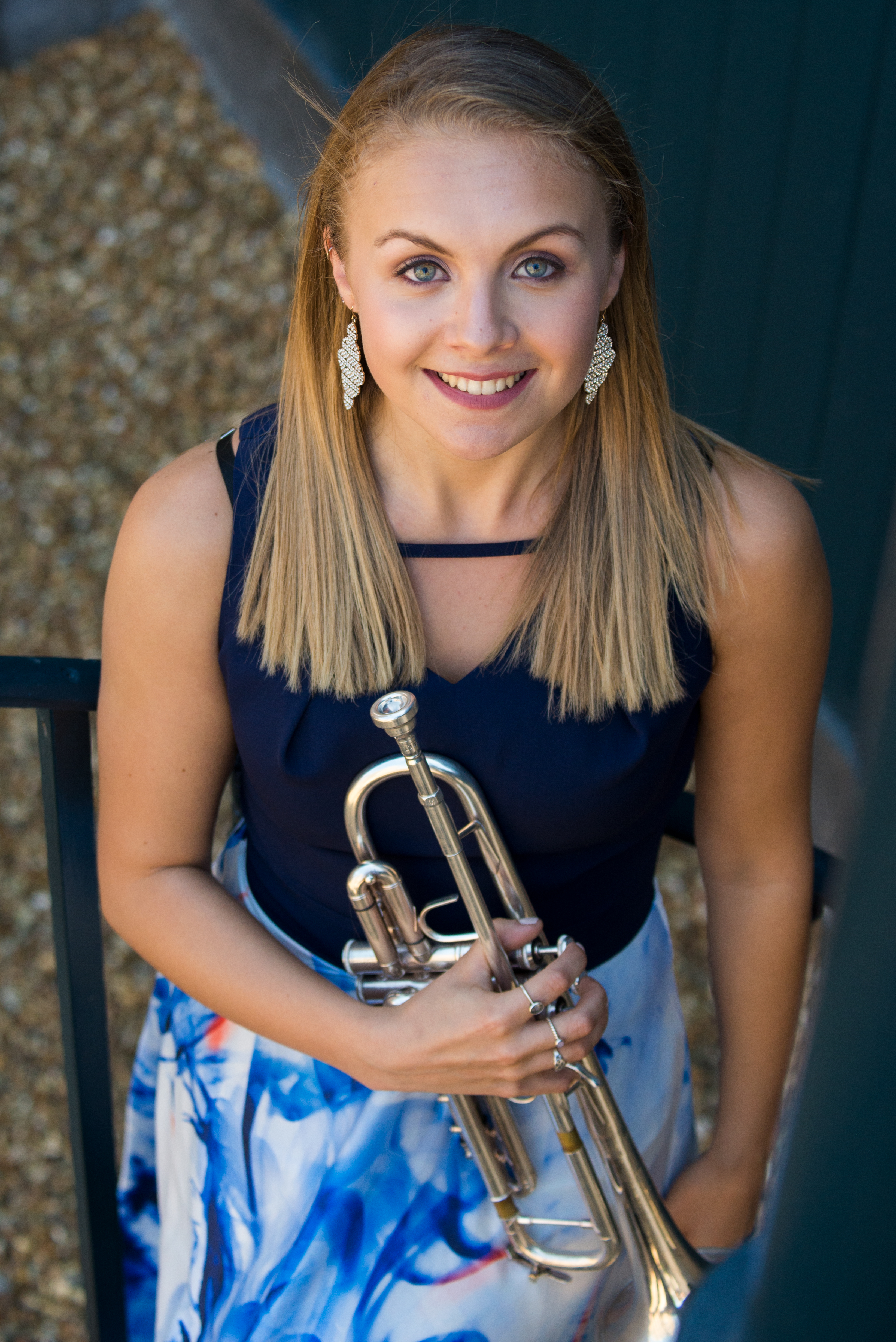
I think my absolute performing highlight has to be playing as a soloist at the BBC Proms in July 2016. Walking onstage at the Royal Albert Hall to an audience of 6,000 and many thousands more watching when the Prom was broadcast on television, was one of the most memorable experiences of my life. It was absolutely exhilarating, and an experience like no other. Performing with the BBC Philharmonic, led by Alpesh Chauhan, was just incredible as I really felt the support of the orchestra and that they were following me – it felt more like chamber music than a concerto. And I was lucky enough to be able to do it twice! Aside from the Proms, another performing highlight was playing First Trumpet in Bruckner’s Seventh Symphony with Bernard Haitink conducting in his home, the Royal Concertgebouw in Amsterdam. To work with such an incredible conductor in a place that means so much to him with an audience that were so mesmerised by the performance was absolutely unforgettable.
AJM_6050.jpg

What are your long term goals after leaving the Royal Academy of Music?

My ambition is to be an international trumpet soloist. I would love to be able to expand the trumpet repertoire, both through the commissioning of new works and also the revival of forgotten works. Too often, works are performed at their premiere and then rarely played again – and I am trying to re-introduce lost works into the repertoire by recording them and playing them in my recital programmes. I would also like to do more educational and outreach work as a soloist to try and encourage more young people (especially girls!) to take up a brass instrument.

What instruments and mouthpieces do you play on?

I’ve had my Bach Stradivarius LR43 Bb Trumpet for about 10 years now! I originally wanted the more standard 37, but at the time of my purchase the UK warehouse had just burnt down and the shop didn’t have any in stock to sell! Luckily, I decided in the shop that I preferred the 43 anyway and haven’t ever wavered from that decision. I have recently purchased the new Yamaha C trumpet that I absolutely adore – it feels very easy to play. I also have a Yamaha Eb/D trumpet, and a Schilke piccolo. I play on a Warburton mouthpiece – 10* backbore with a 3M top.

You have had success in a number of high profile competitions now, while still very young. How do you manage preparing so many programmes for a gruelling competition week while also continuing with your studies and other engagements?

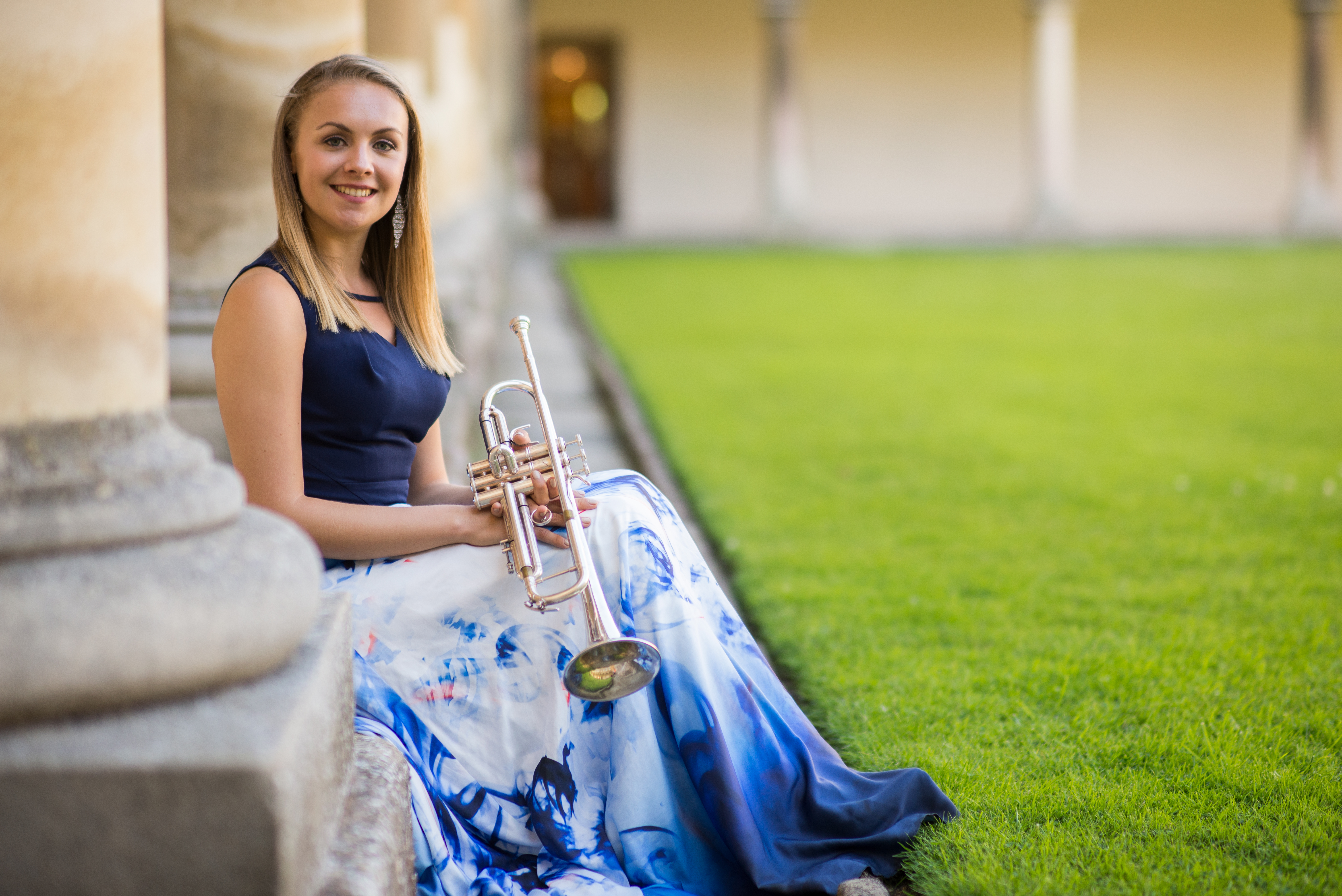
This is a difficult question as different methods work for different people! What’s best for me is to learn pieces well in advance. If I know I have a quiet period say five months before a competition, I will learn a few of the pieces in the repertoire during that time. This enables me to leave them alone during busier patches when I have more urgent things to prioritise. I also find that this ends up improving how I play those pieces as I always find them easier at the second time of practising them! I also always try to perform the pieces for a competition beforehand, whether in a recital or a masterclass, just so that the competition is never the first time performing the repertoire.
AJM_6435

Do you have any particular advice on keeping your chops in good physical shape during these preparations?

I recommend not doing much more than 3½ to 4 hours of practice a day. And ideally this would be split up into smaller chunks spread throughout the day for the best stamina. It is very tempting in the run up to a concert or competition to panic and do last-minute over practice, where you suddenly increase the amount of practice or the length of practice sessions. This is very bad for the lip so try to avoid this as much as possible! I would recommend tapering down the amount of practice over the few days before the performance to rest the lips and give them a chance to recover and be on top form for the day.

Congratulations on winning the inaugural Eric Aubier Trumpet Competition last October! Can you share with us any insights into what it was like going through that process in particular? 

Thank you very much! The competition was a great experience for me, particularly as I was able to share a flat with a fellow student from the Royal Academy of Music. This was an absolutely fantastic idea and I think my experience of the competition would have been completely different if I had stayed alone. It was great to have company throughout the week as it was a complete rollercoaster. With the quick-fire rounds often on consecutive days, emotions ranged from being nervous before performing, the adrenaline and high after performing, the worry about whether the performance was good enough or not, the anticipation of the results, the elation at finding out I had got through a round, the stress of having to then rehearse with the pianist for the next round on that same day, and then the nerves for that performance in the next round the next day! Having someone to share all of this with made it a whole lot easier, so an enormous thank you to Aaron Akugbo for his company and support. The competition in Rouen was an incredibly enjoyable week for me. All the other competitors were very friendly, and many of them stayed the whole week to support us in the semi-final and final, which was really lovely.

Do you have any general advice for any young players?

I just want to say something that I think will resonate with every brass player in the world! Every single musician in the world has periods or moments of self-doubt, wondering whether they are good enough or not for something, or comparing themselves to other players. So often, people are afraid to enter a competition or put themselves forward for a concert or opportunity because they are afraid that they won’t play as well as they know they can or fear that someone else will play better. All I have to say about this is that you are not alone! The only outcome of not applying for something is that it won’t happen. If you don’t apply for a competition, you can never win it. So the one thing I would encourage all brass players is to put themselves forward for opportunities and embrace them!

Please visit www.matildalloyd.com for further information and for upcoming concerts

You can also follow Matilda on Twitter at @lloyd_matilda and on Instagram as @matildalloydtrumpet 


Sign up here for new blog articles emailed direct to your inbox:

[jetpack_subscription_form show_subscribers_total=”false” button_on_newline=”false” submit_button_text=”Sign up” custom_font_size=”16″ custom_border_radius=”0″ custom_border_weight=”1″ custom_padding=”15″ custom_spacing=”10″ submit_button_classes=”” email_field_classes=”” show_only_email_and_button=”true”]

Trumpet Artist Profile: Eric Miyashiro

With a trumpet in his hands, Eric Miyashiro is a force of nature. The powerful sound, blistering range and flamboyant lyrical playing suggest a very different personality to the one that I met! Eric is one of the gentlest, nicest people that I have come across so I was thrilled when he agreed to spend some time doing this interview for Mouthpiece Online…

What drew you to the trumpet as a child?

My dad was a well-known trumpet player in Honolulu, Hawaii, so music and trumpet came naturally.  It was like a “toy” for me, I really don’t remember when I started to play!

Who are/were your main musical and trumpeting influences?

Well, there are sooooo many… my dad, Maynard, Bobby Shew, Snooky, Doc, Herseth, Vizzutti, Jerry Hey, Chuck Findley, Freddie, Stahl, Chase, Audino, Clark Terry, Faddis, Wynton… too many to list. I like everybody! I always try to find something in a player that I like, and then learn from them.

As a young pro, one of your first big touring band gigs was with Buddy Rich – What was it like as a young player going into that environment on lead trumpet?

To tell you the truth, I was too green to take that chair, I was not ready… but I think that Buddy saw something in me and he let me grow in to that chair. It was brutally a tough, difficult book to play. Buddy’s energy was so strong that you can’t help but to get caught up in that typhoon of power – it was real tough to try to keep up with him. But it was also the best, and the most fun I had on the road… I would not trade those years for anything!

You have worked with a few manufacturers over the years on custom mouthpiece and horn designs. Can you give us any insights on the design process from a players’ perspective, particularly in relation to your GR mouthpiece and Yamaha trumpet?

Over the years, I was able to meet and work with most of the famous makers. Each company has their own philosophy and systems in designing their products, some of them contradicted the others, but overall the science is the same. Yamaha and GR are at the highest level of product tolerance control in my opinion. To me, the horn and mouthpiece are just tools, it really doesn’t make you sound any different or better then you are capable… depending on how long the “honeymoon” period lasts!

But having a horn that is easy to work with is the key to letting your personal voice come through your playing. I have had about 600 mouthpieces, 47 Bb trumpets, 2 MF Firebirds, 5 flugels, 4 piccolos, 3 melophoniums and a superbone. I have tried all the gadgets known to mankind, and my conclusion is in the end, it’s you and your “voice” in your head that matters. You can change the way you sound by finding a sound that you want and need, that comes from listening, and trying to get a strong image etched in your head. Your priority should be finding equipment that is easy to handle. Only then can you concentrate on the music at hand, rather than fighting the horn, and blaming the horn and mouthpiece for your performances.

Mouthpieces are like your shoe size, bigger is not better! And resistance, from your horn or mouthpiece, is your friend. Learn how to use resistance. Lean against it, and let the resistance help to keep your buzz from opening up too much.

In some recent ‘clinics’ of yours that I attended, you discussed some really interesting approaches to playing high notes! You demonstrated with a leadpipe and some tissue paper that it is not necessarily about airspeed. Can you share some of your thoughts, theories on this? How did you come to start using these techniques?

I always knew from early on that it wasn’t all about the “Air”, “Tongue Arch”, “Pedal Tones” etc. Everything is important, and it’s about balance. We often base our playing on physics with fluid dynamic and acoustic theories. What we do is completely unique. There are very few detailed, and scientifically proven studies done on the physics of brass playing. Any studies are not accurate and reliable because of the player’s physical and personality differences.

The amount and the speed/pressure of the air is a factor that will come into play with the lip tension, tongue position, mouthpiece design, the horn, acoustical condition and the size of the room etc… and on and on… So many factors are involved, but one thing that is certain, is that we “overblow” when things are not working with the chops.

I know this because I am guilty of having done this for most of my life. So, I have been doing my share of studies and experimentation to figure what does and does not work. The bore size, bell size, venturi size, or the gap and drill size on mouthpieces does not necessarily determine the resistance. It is the balance between all of this, plus the most unstable factor, you and your preference.

For you, what are the key factors in keeping on top of your playing when you are travelling?

Sleep, (which is hard to do….) Lots of water, avoiding alcohol, (which is really hard to do)… and keeping your chops in shape by carefully maintaining the buzz centre and the mouthpiece position.

If you could give any advice to a teenage Eric, or suggest that he does things differently, what would you say?

Take lessons!!!! I have never taken a lesson in my life, I am self-taught so I have many bad habits!

Please visit www.ericmiyashiro.com to find out more.

To see the range of GR Mouthpieces, please visit Thompson Music and purchase with an additional 11% off over Thanksgiving weekend.


Sign up here for new blog articles emailed direct to your inbox:

[jetpack_subscription_form show_subscribers_total=”false” button_on_newline=”false” submit_button_text=”Sign up” custom_font_size=”16″ custom_border_radius=”0″ custom_border_weight=”1″ custom_padding=”15″ custom_spacing=”10″ submit_button_classes=”” email_field_classes=”” show_only_email_and_button=”true”]

Trumpet Artist Profile: Allen Vizzutti

Regular readers will most likely need no introduction to Allen Vizzutti – an artist of the highest calibre: soloist, recording artist, composer, educator and master clinician!

On a visit to the UK earlier this year I caught up with him and wanted to discuss two main topics with him – a fascinating topic on which Allen often talks in clinics and also in his method books that have become standard literature for students around the world: whether there is an over-emphasis on the word “buzz” in a trumpeter’s vocabulary; and also the design process behind the impending launch of the new Yamaha Vizzutti Model Trumpet.

I had a (brief!) opportunity to have a blow on a new prototype 9335V when Allen was touring Europe recently, and my first impression was that it felt very similar in response and tonal character to the 9335NY New York model. There was perhaps a slightly richer tonal core across the range though. I very much look forward to having a proper test-drive when the instrument is launched later this year – watch this space!

Below, Allen tells us a little about the thoughts and processes behind this new model:

“ The new Yamaha 9335V Bb trumpet will be launched in it’s second iteration in November. The Vizzutti model idea was born in a conference room in Japan several years ago and I was given the go ahead to help design a personal model from the ground up. It was an exciting opportunity and one for which I am very grateful. I worked on the project with Yamaha genius designers Bob Malone and Wayne Tanabe in New York at the Yamaha Atelier on 5th Ave.

Even though we had permission to start from scratch I had been enjoying using a gold plated but otherwise stock New York Xeno for some time. Logically we chose to start with that trumpet as the basis for the new model. If that didn’t prove successful we could always begin again from scratch. I would like to make clear that I am not a trumpet designer. My input was based on evaluations of the physical feel, the sound, timbre and the trumpet’s characteristics in different registers. Again, I was pretty happy with my stock Yamaha New York Xeno. I should note that I brought along a Bach Strad that belonged to one of my students because there were characteristics of that horn that I liked and wanted to reference.

The short story is after a few hours of experimenting with different small part changes we were getting amazing results. We blew the Bach away early on. Changes consisted of using different small parts made of varying materials and having different weights. We moved bracing and tested myriad slides, water keys and valve parts. I would ask for something and Bob and Wayne would head into the workshop and return to the testing room with changes. The final result came relatively quickly. The new 9335V had a better harmonic structure and was slightly more open and free blowing without being a large bore. It was much easier to play above high C regarding both response and resistance. The sound was a little darker than the New York Xeno. In reality, the improved characteristics of this trumpet are most noticeable by professional or near professional level players. When played with maximums of flexibility, power, control and beauty it is the best horn I have had.

Later when production was in full swing I tried 40 examples of the trumpet. Asked to pick 2 for my personal use I couldn’t really tell the difference between them. In the end I randomly pointed at a couple and those were the horns I ended up using. Unfortunately the first run of the 9335V was limited to a small number of units. The good news is the newer version will be unlimited!

Yamaha 9335V 2.0. What’s been changed? Over a couple of years Bob Malone worked on small tweaks to the 9335V. After he was happy with it I tried out several examples. We ended up with a minimal version of changes through evaluation most of which you cannot see. The water key structure is probably the most observable difference to the newest 9335V. It plays great. I like it a little better. I can honestly say I would be happy performing on either version.

Like a great automobile company, Yamaha is committed to constant development and improvement. The evolution never stops. The Yamaha 9335V should be available in November 2017. “

Regarding the question, “To buzz or not to buzz?”, Allen has kindly pointed me towards the relevant page in his method which I have reproduced below this. From my perspective, buzzing has always been a fundamental part of my teaching and important concept for beginners to grasp early on. The main priority for me is that the buzzing is used to show students how relaxed the chops should be and to put the emphasis on the air and support.

Aged 16, I was put through quite an aggressive embouchure change that set the mouthpiece onto a “buzzing embouchure”. This meant that my embouchure barely moved across the range of the instrument, but unfortunately my sound went to crap! It was only when I started at the RCM at 18 that James Watson told me to ignore the past 2 years, and I suddenly had my sound and flexibility back! Therefore Allen Vizzutti’s theories below strike a chord with me…

“ The use of the word buzz in trumpet study is pervasive. When creating sound with the lips alone or playing the mouthpiece alone it is easy to understand why this is true. The sounds created are sounds of buzzing. However, buzzing one’s lips into a trumpet mouthpiece will create an unwanted “beginner’s” sound. Even actual beginners can avoid ever having a beginner’s sound when taught to blow and not to buzz.

Using the embouchure [described on page 153], one can learn to send a steady and firm airflow through the aperture – made by the lips, into the trumpet, creating a wonderful tone without ever thinking of buzzing. The tense, tight sound of buzzing and the accompanying weeks of frustration associated with “unlearning” this habit can be completely avoided. Unfortunately, for most of modern history, the conventional wisdom of trumpet pedagogy has been to instruct beginners to buzz their lips. Aggressively sending air through the trumpet without buzzing causes the air column to cycle in waves against the tubing of the horn. The vibrating air column is a result of the air meeting the resistance set up by the lips, mouthpiece and leadpipe. The trumpet bell amplifies the vibration. The smoother one blows through the horn, the smoother the sound. Buzzing does not create the sound.

ls there any purpose in buzzing? Actually, yes. Buzzing is just a different entity than trumpet tone production. Buzzing the lips without the mouthpiece and trumpet, including flapping them (loose and low-pitched), is a very useful relaxation technique. I do it to loosen my lips, warm down and as an emergency substitute when warming up may be impossible. Lip buzzing exact pitches to then match on the trumpet, as suggested in some educational material, is of little value (other than ear training), in my opinion. My range on the lips alone is very limited. My range on the trumpet is much more extensive.

Playing the mouthpiece alone is often referred to as mouthpiece buzzing. lt can be very useful as part of an organized warm-up. The concept of playing the mouthpiece should be the same as playing the trumpet. lmproving one’s mouthpiece sound can really help improve one’s trumpet sound as well. Eliminating the trumpet and its sometimes-confusing technical concerns can encourage successful breathing and relaxed blowing. Playing melodies on the mouthpiece is very helpful for ear training and embouchure pitch control. Ultimately, the smoothness of playing the mouthpiece alone will translate to a smooth and steady trumpet sound. “

To find out more about Allen, his projects, recordings and publications please visit www.vizzutti.com


Sign up here for new blog articles emailed direct to your inbox:

[jetpack_subscription_form show_subscribers_total=”false” button_on_newline=”false” submit_button_text=”Sign up” custom_font_size=”16″ custom_border_radius=”0″ custom_border_weight=”1″ custom_padding=”15″ custom_spacing=”10″ submit_button_classes=”” email_field_classes=”” show_only_email_and_button=”true”]

What difference does mouthpiece material make?

This is too a broad question and also very difficult to judge!  I ask it because I came across a now-discontinued Sterling Silver Yamaha 14B4 trumpet mouthpiece a short while ago and was very interested to find out…

1. What difference the silver makes…and

2. Why they were discontinued.

Question 2 is probably pretty straightforward to answer. Where they are still showing as available in the UK, the retail cost of them is around £300, which is most certainly not a price bracket that we are accustomed to with Yamaha.

What difference the silver makes requires some playing and listening, so I have lined up 3 mouthpieces that are all advertised as having the same rim and cup profiles from Yamaha and will test them on a Xeno 8335RGS and a Bach 180ML37:

Standard 14B4 Trumpet Mouthpiece

Custom GP (heavyweight) 14B4 Trumpet Mouthpiece

Custom 925 Sterling Silver 14B4 Trumpet Mouthpiece

I played each mouthpiece on both trumpets at a range of dynamics and registers using a variety of attacks and articulations. I took notes based on how they ‘felt’, and also recorded them closely-miked to get an idea of how they would perform for me in the studio. I also asked a trumpeter friend (although they may not be for much longer after the racket that I subjected them to!) to listen from the other side of the room and take their own notes.

The whole lot makes for a long (and not particularly interesting) read, so I have done a summary below and would very much welcome thoughts from other players (and indeed designers and manufacturers) on these and any other mouthpieces made from non-brass.

The Standard mouthpiece gives a nice even sound across the range, although it gets overly bright for me in the upper register and doesn’t really open out enough for my taste in the lower registers.  This is probably partly to do with the fact that although I generally have always played on 14 style (Bach 3) rims, I have also always opened out the throats to give less resistance.  The brightness and ‘edge’ that I was experiencing was also picked up on by my audient and to a lesser degree by my close-miked recording.

The Custom GP mouthpiece is also brass and has more mass around the outside of the cup.  Immediately I felt a huge tonal difference.  The sound was much more centred and had a richer and more solid tonal core across the registers.  I could not however get a brightness of sound (even on the 8335RGS) at louder dynamics that I would want.  Interestingly, my listener at the other side said that there was not much difference at louder dynamics to the standard model.  This was also the case listening back to the recording, suggesting that the biggest difference with the GP model is in feel and comfort from a playing perspective rather than necessarily in sound.

The Sterling Silver model has a similar volume to the standard (a bach-ish style blank) but is certainly a few grams heavier than the standard due to the material.  It felt instantly different – more tonal core (quite similar to the heavier GP), but surprisingly also a massively quicker response.  Unlike the GP model, what I was feeling as a richer sound did actually come across to the audience and the difference could clearly be heard on the recording.  Generally you would expect this from a tighter or shallower-cupped mouthpiece, but not necessarily from something like the 14B4.  The rim and cup profiles, the throat and backbore should all be the same as the standard model, however this mouthpiece responded completely differently.

I mentioned earlier that I generally open out my mouthpieces to a 25 or 26 throat. This silver model has a standard narrower 27 throat, yet has a strange combination of the open sound that you associate with a larger mouthpiece with the quick response and overtones that you can get from a smaller more resistant piece.

What do my fellow trumpeters think? I would be really interested to hear what you have thought about non-brass mouthpieces.  There are obviously a lot of options now available made out of synthetic materials and plastics. Has anyone experimented with metals other than brass, and is there scope and/or a financial viability for designers and manufacturers to explore this further?

Numerous mouthpiece options are available along with specialist advice from Thompson Music.


Sign up here for new blog articles emailed direct to your inbox:

[jetpack_subscription_form show_subscribers_total=”false” button_on_newline=”false” submit_button_text=”Sign up” custom_font_size=”16″ custom_border_radius=”0″ custom_border_weight=”1″ custom_padding=”15″ custom_spacing=”10″ submit_button_classes=”” email_field_classes=”” show_only_email_and_button=”true”]

The ‘All Rounder’

There is a multitude of great pro trumpets currently on the market, and some wonderful manufacturers working alongside players and teachers to develop instruments for every style of music, approach and player. In a previous post I have discussed finding the right balance of resonance/resistance for you. Here I am going to be less specific!…

At some point in every player’s development, there comes a point where you are looking for that first pro-level instrument. In most cases we are advised to get something as flexible as possible and suitable for a variety of styles and settings. It is this ‘all-rounder’ that I am talking about here.

I have lined up Bb trumpets to try from Bach, Yamaha, B&S, Conn & P.Mauriat. I have played on a number of other good all-round Bb trumpets over the years from Stomvi, Getzen, Schilke, Jupiter XO and Kanstul among others, and would welcome your thoughts and opinions on these and any other instruments that fit into this category that I have not been able to line up here. Schilke I know in particular is really loved by a lot of my US colleagues. Unfortunately the full range of Bbs is not easily available in the UK so I may have to arrange a visit to Chicago in the future to finish this article properly!!!

Bach Stradivarius 180 Series

This has been the reference instrument for players across the globe for many years now. It is characterised by lots of overtones around a warm rounded-core. The bells are designed to be individual – the positive of this is that there is likely to be a trumpet available somewhere to suit most players. The negative of course is that it is advisable to try a large number of these to get one that feels right for you.

The 2 most popular are the 180ML37 and the LR180ML43. The 180ML37 has been considered the go-to 1st pro trumpet for generations. The late taper #37 bell is the one that manufacturers such as Yamaha and B&S have tried to emulate in their models over the years. The LR180ML43 is a lighter instrument with reverse leadpipe and an early taper #43 bell. This has been popular particularly in Europe with players who cover a wide variety of musical styles and genres.

Intonation is generally pretty good on Bachs, however some instruments can be very flat at the 5th Partial (top space E, Eb and D) and quite sharp at the 6th (G, F# and F) meaning that it can take some adjustment for a student to get used to it. They also for this reason generally work best when combined with a larger fuller-cupped mouthpiece so that the pitch can be adjusted easier.

Current prices in the UK are around £2,500-£2,900 (including tax) and in the US around $2,600-$3,100.

Yamaha Xeno YTR8335RGS

I have picked this instrument from the range, as although it is not the ‘basic’ model, I believe that it is the most versatile. Bach loyalists over the years have criticised Yamaha instruments for their lack of character. The RGS has a more open and less resistant leadpipe configuration paired with a gold brass bell. This gives a lovely combination of a warm even sound across lower and medium dynamics, but has a great bright ‘sizzle’ when you give it some welly!

For years, the Yamahas have been considered the cheaper and lesser alternative to the Bachs, however the improvements to this model in particular make it a good and viable option. Intonation is pretty even across the range with a much livelier response than other models in the Xeno range.

Prices however have risen a lot recently so they are no longer the ‘cheap’ alternative. £2,000-£2,300 in the UK and $2,400-$2,700 in the US.

B&S Challenger II 3137

A number of pro orchestral players have moved onto this trumpet or versions of it in recent years, most notably Philip Cobb at the London Symphony Orchestra. The Challenger II is considered to be a good Bach-copy at an excellent price. It also has elements of the Yamaha in its smooth transition across the registers, even sound and decent intonation. There is a little something missing with regard to overall resonance for my personal taste, but you cannot deny that this model proves exceptional value for money (in Europe at least!) and is a very good trumpet for someone who is just starting to take their playing and progress really seriously.

UK prices are around £1,300-£1,700. Prices in the US are $2,000-$3,300. By this from the UK people!

P.Mauriat PMT-71

Now this is an interesting one. P.Mauriat trumpets are not widely available in the UK, but are well represented across mainland Europe and the USA. I worked with P.Mauriat a few years ago so fortunately had the opportunity to try a wide variety of their models.

Their first moves into the trumpet market included some interesting designs of primarily jazz models – both heavy 600 series and lightweight 700 series instruments.

Their recently launched 71 (and 72 with a gold brass bell) have a lot of the lively and responsive characteristics of the original PMT-700, but with much more depth of sound making this a really versatile instrument. I am yet to see one ‘on the market’ in the UK or Europe yet, but I believe that some of my American colleagues are starting to be able to see them over there. Worth checking out if you get the opportunity – time I suppose will tell whether P.Mauriat make a significant impact in an area that already has some steep competition!

I imagine that prices will be around £2,000 and $2,300 respectively.

Conn Vintage One 1BS

I have selected the sterling silver bell model from this range – the resonance and brightness is astonishing. It is not necessarily your typical ‘all-rounder’, however I have selected it here because I have come across probably an even split of classical players on this as I have jazz/commercial.

I was knocked out by the ease of making a full and rounded sound on this horn, and also at how it really takes off in the louder passages with relatively little effort. The downside for me however was the intonation: Low C sits a fraction sharp for my setup and 3rd-space C is slightly flat. Not having a clean octave here takes some getting used to.

UK prices are around £2,200-£2,400. US is around $2,800-$3,200.

As I have been talking to players while putting this together, people keep raving to me about their perfect Bb trumpet from X, Y and Z manufacturer. There is wonderful research, design and craftsmanship around the globe going into trumpet manufacture at the moment, including a number of smaller specialist trumpet-builders that I will be featuring in coming weeks. Again, my emphasis here is on that FIRST PRO TRUMPET PURCHASE that generally needs to be a good all-rounder and blend easily with friends and colleagues.

I very much welcome your thoughts and comments on any of the instruments featured here, and indeed any of the multitude that are not!


Sign up here for new blog articles emailed direct to your inbox:

[jetpack_subscription_form show_subscribers_total=”false” button_on_newline=”false” submit_button_text=”Sign up” custom_font_size=”16″ custom_border_radius=”0″ custom_border_weight=”1″ custom_padding=”15″ custom_spacing=”10″ submit_button_classes=”” email_field_classes=”” show_only_email_and_button=”true”]