
Trumpet Artist Profile: Marvin Stamm

Marvin Stamm is a colossus of the music world, having performed and recorded with many jazz legends throughout his illustrious career. At 79-years-young, he is still going strong and has many interesting thoughts here on adapting to change, both musically and physiologically over the years. There is sound and compelling advice here for musicians of all instruments and of all ages!

What first drew you to the trumpet?

Upon reaching the seventh grade in the school I attended in Memphis, Tennessee, every student was required to participate in a form of the arts—either become part of the band or sing in the chorus and take art. I had no talent for art nor any interest in singing in a chorus, so I chose instrumental music, which at my school was the standard concert band instrumentation. Part of my decision also rested upon the fact that I was rather shy at that age, and thought I could hide within a larger organization and not be noticed. The reason I chose the trumpet was because my older brother, an avid record collector, had a recording by Clyde McCoy entitled “The Sugar Blues” with which he employed the Harmon mute with the stem to produce wa-wa effects, growling, and flutter-tongue. This was quite impressive to me, and this is why I chose the trumpet.

Were there any particular early influences or musicians that you admired?

There were many early influences upon me, and they would have great consequence on the path I chose. Among the important people who first influenced me were my two wonderful band directors during my school years in Memphis; they gave me great training in the basics of music, playing in their concert bands. Another was my afore-mentioned brother, Gordon. My interest in jazz came about very early in my musical experience because hegave me access to his complete jazz collection, allowing me to play along with his records pretty much from the genesis of my musical endeavors. This gave me early exposure to this music  and hadgreat impact on me. I was so enthralled with playing music that I decided after only two years—at age fourteen—this would be my path in life.

Another person exerting great influence during my high school years in Memphis was my trumpet teacher, Perry Wilson. Perry helped me build my musical foundation. He took me through Arban’s, St. Jacome, Schossberg, and Klose, also spending a great deal of time playing duets with me in order to teach me how to work, phrase and blend with other players. At the end of each lesson, he took me into one of the piano rooms and played tunes with me to help me broaden my improvisational skills, learn new material—and, so very important—develop my ear. He also was instrumental in my working in Memphis dance bands from age sixteen. I was very fortunate to have fine and dedicated teachers from the very beginning who prepared me well for my chosen career.

Through every phase of my musical and personal life there have been people willing to offer encouragement and help. There were several very fine musicians form my growing up in Memphis, many of the professional players the Dallas/Ft. Worth area and at the university during my years at North Texas State (now the University of North Texas). The years with Stan Kenton and Woody Herman were of immense value to my growing and developing as a player as well as the two years doing show work in Reno, Nevada. And then throughout all my years working in New York and beyond.

It would be impossible to list all the musicians with whom I have worked and who personally influenced me, but among the trumpet players whom most of our colleagues would recognize would be Mannie Klein, Bernie Glow, Ernie Royal, Snooky Young, Thad Jones, Ray Crisara, Burt Collins,  and Kenny Wheeler. And this lists just a few of the many who were of enormous significance to my music and my life. Someone once said to me that I had achieved a marvelous career and I had done all on my own efforts. I laughed and told him he could not be more mistaken. I had help every step of the way and experience this still to this day—from friends and musical colleagues alike.

As a young player, what was it like joining Stan Kenton?

I joined the Stan Kenton Orchestra as his jazz trumpet soloist immediately upon graduation from the University of North Texas in 1961. However, my relationship with Stan pre-dated that occasion because the North Texas band was kind of a house band at the 1960 Indiana University Kenton Clinics, serving as his band for that week. He conducted us in nightly concerts and became quite familiar with my playing, In November of that year Stan asked me to complete the last three and a half weeks of the 1960 tour because Sam Noto had been offered a steady gig at the Latin Quarter in New York City and needed to leave the band. This was really my baptism of fire with the band.

I joined fully after graduating from North Texas and toured with him for two years, recording five albums with the band. The orchestra, during my tenure, toured only in the U.S. and Canada, mostly playing one-nighters. I gained a good bit of national recognition and exposure touring with the band and especially through my being featured extensively on the recordings.

Working for Stan Kenton was great—he was very much a father figure, quite a special person, and very dedicated and inspiring to one such as myself. He was also very patient with me during my time with the band. I underwent a bit of an embouchure change because I was playing low onto the top lip, that is, onto the red tissue of the lip. Because the band played so hard, and most times quite loud, this caused me to cut my lip. With the help of John Haynie, my trumpet teacher from the University of North Texas, I moved the mouthpiece up on the top lip a good bit, providing more vibrating surface for playing and more muscle tissue, more “meat”, for the mouthpiece to rest upon. This was quite a drastic move for me and took a long time for me to adjust to, causing me a great deal of stress. During this whole period of adjustment, Stan was very patient and encouraging to me, showing how much concern and care he had for the people who played in his band.

My time on the Kenton band provided great experience in that it gave me a clear view of “life on the road.” I received a lot of solo exposure and met many people who contributed much to my growth and life experience. Some became friends for life. This playing experience was especially invaluable because you had to be at the top of your form every night in spite of being weary or sometimes ill; or many times playing where acoustics were less than perfect with tired or hurt “chops” and always being on the move. This instilled the concept that when it was time to perform, it didn’t matter how you felt—you were expected to be at your best at all times, under all sorts of conditions. And the one who expected the most from you was you yourself!

During your period as a busy studio player, what were the main things that you concentrated on in practice sessions to keep yourself in good shape and ready for anything?

Fundamentals, fundamentals, fundamentals! I wanted to keep my embouchure strong, but flexible and my technique accurate. We almost never knew what we would be playing from session to session until our arrival at the date. And some days we would be  playing three or four different sessions, all of a different musical style. I might be playing lead trumpet on one session, flugelhorn on another, and piccolo trumpet on a third. Our musicality depended upon our exposure to many styles of music and the interpretation thereof. But the ability to go into number of different musical environments, having the flexibility and stamina to perform to the highest standards day in and day out was the foundation of such a career. I found that keepingmy“instrumental”side in it’s best working order was the best way to be prepared for this kind of functionality. That meant stressing fundamentals.

What prompted your move away from the studio work to concentrate on your own jazz projects?

In the late ‘80s I realized I was feeling musically unfulfilled by the work I was doing. For the first 17 years or so of my studio period, while doing a lot of commercials and such, I still was also involved with a lot of musical recording projects, many of which were in the jazz genre. In the early ‘80s, the shift in work was more to commercials, and the recordings were mostly R&R recordings. There was little creative input being asked of the players, and I was feeling like just a journeyman musician, like “cog in the wheel” of most projects.

In addition, the technology aspect of the music was growing and many of the keyboardists and synthesizer players involved in projects were also being asked to write the arrangements for these projects—few with any knowledge of or skills in orchestration. We became the sources for informing them of what possibilities there were for various instruments, sometimes teaching them the most rudimentary things such as what was the lowest note on a trombone and the highest note playable by a typical saxophonist. It was very frustrating to most of us who had worked for years to become educated, masterful musicians.

In 1987, Lew Soloff introduced me to Swiss composer and and band leader George Gruntz, who was looking for someone to replace Lew for an upcoming tour, as Lew was already booked at that period of time. George invited me to join his group of U.S. and European musicians and I accepted, beginning what was to be a twenty-three year association with his Concert Jazz Band.

The musicians for this tour included Americans Lee Konitz, Claudio Roditi, Larry Schneider, Mike Richmond. Adam Nussbaum, Ray Anderson, Art Barron, David Taylor, Joe Henderson and others. Among the Europeans were trumpeters Palle Mikkelbourg, Manfred Schoof, and alto saxophonist Luten Petrovsky. There were straight-ahead players, BeBop players, and avant-garde players, all coming from across the musical spectrum. Moming from a more traditional big band background, I was initially taken aback by it all, but by the end of the tour, I was inspired. I felt that it might just be possible to move away from being a studio musician to become a jazz musician.

The thought was, at first, frightening. I remember one night discussing what I intended with drummer Ed Soph, wondering aloud how I was going to make this happen. Ed told me not to worry, it would definitely happen. Of course, I also talked all this over with my wife, who felt I should go for it. From this, my decision was made. For the next three years, i put myself out there, and if there was a choice between a recording session or a jazz gig or a tour, I took the jazz gig and turned down the session. Eventually, it became obvious to those in the business and they started calling others for studio dates. As well, my work as a jazz player was growing, so over time, one replaced the other. This began the most creative period of my musical life, and I never looked back.

As the years have gone by, would you say that your approach towards practice, preparation and performance has changed? If so, is it something that has had to change?

I certainly feel my approach has changed over time. It is true physically as well as musically. People tend to change physically as they age, even from their 30’s into their 40’s. and again from their 40’s into their 50’s and so on. This is just a physiological fact. Understanding when one’s practice and approach to the instrument needs to be altered—even if only slightly—from time to time to meet these circumstances is a great challenge. No one wants to change from what has worked successfully for a long time. But sometimes change is necessary, particularly when the problem may be physiological. I have seen many examples of players who don’t understand when their physiology changes and are so stymied by this that they don’t recover. They keep trying to approach everything the same way they have done for years, and yet, it doesn’t work anymore. Having a teacher or outside coach can help when one feels frustrated. A coach or teacher one trusts may see things looking from outside our faces than we don’t perceive on the inside. I sought help several times from the late Laurie Frink, a most wonderful teacher and player, who helped me to understand and work through my own problems.

Musical circumstances can also require a player take a different approach to practice. It all depends upon the kind of music and performance one is being asked to play, especially if one is working as a free-lance player. One example would be someone playing a show night after night that requires a hard blow, but then being asked to play a week in a small chamber orchestra where the  music is softer and requires a different sound. The practice necessary to prepare for this kind of change would be quite different than the preparation for a difficult show. Practicing fundamentals to keep one’s embouchure flexible to play in any circumstance is necessary and certainly helps one to overcome many of the changes one must go through.

Every player experiencing physical or musical changes in their playing must be mindful of finding his own solutions to whatever challenges might arise. This will involve being flexible in his thinking and approach to these challenges going through the various stages of their careers. There has never been one answer for everyone; each of us must find our own. This is a challenge we all face.

What equipment do you use?

My trumpet is a Bach Model 72 Lightweight that the great lead player Bernie Glow picked out for me in 1969. My mouthpiece is a Najoom 7M (for medium). I play two flugelhorns, an old Cousnon I bought used in 1964, probably made in the 1950’s, and a French Besson, made under the auspices of Boosey and Hawkes by Zig Kanstul, at the urging of me and Guido Basso,the great Canadian trumpeter. I use either a GR custom mouthpiece (close to a 62M) or a very old Bach 10 1/2 C flugelhorn mouthpiece.

What do you think the priorities are for young aspiring players to keep in mind to give themselves the best shot at a long and successful career as a trumpeter?

There are a number of priorities to developing a long and successful career, each being a key basis of the other. Mastery of one’s instrument is certainly the foundation of any successful career, and practice of the fundamentals is the basis of that foundation. Part of this is also understanding the importance of developing a good sound because one’s sound is his voice, who he is musically. And while mastering etudes, solos, and excerpts are important, listening to and performing in many areas of music is the key to becoming a versatile player—and versatility is central to being a busy, working musician. There are those who are able to develop a career as a specialist in a given field, but they are rare birds in the equation. Being able to answer any work call and performing whatever that call requires is the key to having a successful career as a working musician. And that means having a working knowledge of many kinds of music.

What are your proudest career moments?

Over many years of playing music, I believe the thing I am most proud of is all the years of playing in the company of so many great musicians and being accepted as one of them. I had the great privilege of playing with my heroes, and to this day, I still feel that I am trying to play up to the level of musicianship that they set. But I don’t feel this as an element ofpride; I actually feel great humility at this acceptance and being a part of so many wonderful musical moments. I had the privilege of living my dream, fulfilling my musical fantasies.

What are your most enjoyable career moments?

There have been so many that it is difficult to pick one or two special experiences because there have been so many. Sitting a the trumpet section with people like Bernie Glow, Ernie Royal, Snooky Young, Ray Crisara, Randy Brecker, and so many others was always special. Reaching to achieve the highest level of performance in the company of many great musicians was constantly thrilling. Words can’t really express the feelings this generated, day after day, performance after performance. I guess the most important thing to take away from what I am trying to express is that music is never about “me,” but about “we.” Community, everyone striving to bring the best to each musical moment, is the most fulfilling element of great musicians playing together. And I was most fortunate to be some part of so many of those experiences.

What projects have you got coming up?

I am going to be doing a project in the UK next summer with Matt Gough and Andy Bush, both excellent trumpeters and composers. Andy and I met in the mid-1980’sand have been dear friends ever since. Matt is a new friend and the composer of a magnificent multi-medium suite, “The Forgotten Fairground.” I’m sure you’ll be hearing a lot about this project soon.

I’ve also been privileged to be a part of several projects by pianist and composer Michael Holober. We’ve become very close friends dating back to when he conducted the Westchester Jazz Orchestra of which I was a member. I have been a part of four of his projects in the past four or five years, and he has mentioned two or three future projects that he is working on. Michael is also a musical partner in my quartet along with drummer Dennis Mackrel and  bassist Mike McGuirk.

And I continue to perform as a guest soloist in various settings. I appeared at the Guildhall this past July, performing two of the Miles Davis/Gil Evans suites, “Miles Ahead” and “Sketches of Spain,” with Scott Stroman conducting. Working under Scott’s baton is always exhilarating!  I shared the solo chores with UK trumpeter Robbie Robson, and if any of your readers are unfamiliar with Robbie’s music, please do become familiar with it. Robbie is extraordinarily creative and gifted musician. I enjoyed so much sharing this program with him.

In closing, let me say that in light of all I have been so fortunate to do in music, I am happy any time I can be in the company of extraordinary and like-minded musicians, people I can enjoy playing with, listening to, and  learning from. To me, that’s what it’s all about!

Please click here to read about Marvin’s time studying with Carmine Caruso

You can see and hear lots of great clips of Marvin playing on his website


Sign up here for new blog articles emailed direct to your inbox:

[jetpack_subscription_form show_subscribers_total=”false” button_on_newline=”false” submit_button_text=”Sign up” custom_font_size=”16″ custom_border_radius=”0″ custom_border_weight=”1″ custom_padding=”15″ custom_spacing=”10″ submit_button_classes=”” email_field_classes=”” show_only_email_and_button=”true”]

Professional Development : Kate Amrine

When I left music college (nearly) 20 years ago, the approach to building a healthy portfolio of freelance work as a trumpeter was rather different to now:  Face-to-face networking; Being in “the right place at the right time” with the right people; Backing up any opportunities by being a “good guy to have around” and a good player.  This was the limit to one’s self-marketing.

It struck me at the time that even when things were busy, and the diary was booked up a couple of months ahead, there was never a feeling of being in control and having ‘ownership’ (this seems to be the buzz word) of your career.  This is what led me to start to explore other things that I could do alongside the trumpet-playing that could bring me more of a sense of control over my own career.

Speaking to younger professionals now, I see quite a different picture.  The opportunities that the internet has brought are vast, and musicians are quickly learning how to maximise what it has to offer. Players now have limitless control over their own image and career.  This series looks at this in more detail:

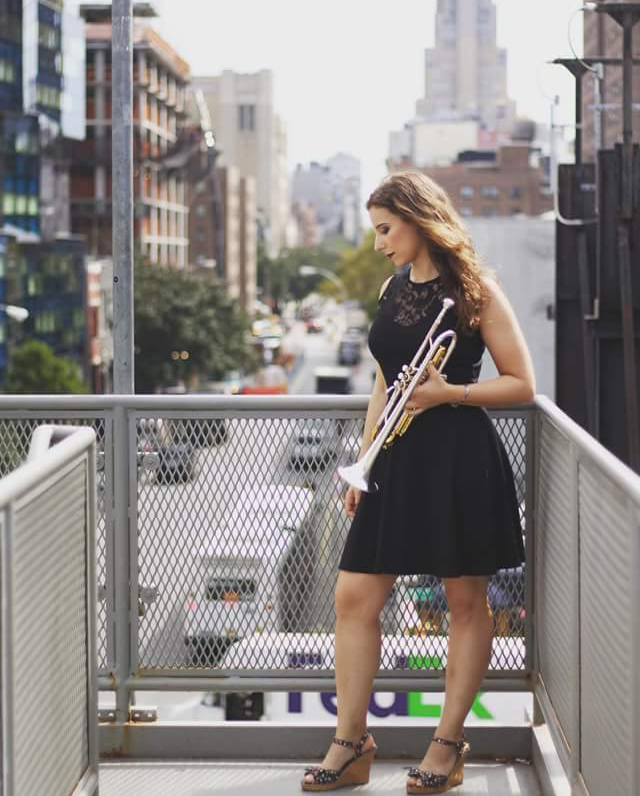
Next up in ‘Part 2’ to help me look at this in more depth is Kate Amrine.  Kate is a trumpet player and educator based in New York City.  She currently freelances in many different genres from Orchestra to Broadway, and also is an active soloist, currently working on her second album.  Music entrepreneurship has always been an interest and she recently presented her “Designing your Career in Music” masterclass at New York University where Kate has been an Adjunct Professor since 2013.

How did you find the transition from college to working as a trumpet player?

When I first moved to NYC 8 years ago to start my undergraduate degree at New York University, I remember being so enamoured by being able to play so many different styles and seeing so many opportunities to play everywhere I looked.  The sense of wonder and amazement hasn’t diminished but now it is accompanied with the knowledge of knowing how much work everything requires and knowing that sometimes things just don’t work out, no matter how much work goes into it.  Since I moved here, I have recorded a solo album, started recording my second album, became a composer, performed 2 concertos as a soloist with orchestra, given countless recitals, played on Broadway, and many more things.  It is an exciting time to be a musician, yet I know that it is very different than it was even as little as ten years ago.  I currently teach all ages from elementary school to college students at NYU and I really enjoy helping musicians find their path and purpose.  I have written many posts about how I started freelancing in New York and other various aspects of being a musician on my blog.  Check them out here: http://kateamrine.com/blog

I knew pretty early on when I moved here that my reputation started immediately – both as a person and as a musician.  Even when I was a student and still learning, I knew that every time someone worked with me and heard me play that it was an opportunity that could further my career – no matter how small the gig, how much it paid, or what kind of music it was.  I still have that mindset that anyone and everyone is always listening, and I think it is one of the most valuable things to keep in mind when building a career as a musician.

What did you expect working life to be like when you were at college?  Were you given any career development guidance?  Was the reality of working life different to how you imagined it?

I had huge preconceptions of what music school was like – most of which were tied to what I thought I needed to know upon graduation.  For example, I assumed that I was supposed to learn all of the brass quintet repertoire in college and I didn’t want to be unprepared when I graduated if I was called for something, so I put together a group and ended up learning a good majority of the brass quintet rep by performing it in the subway.  I was so concerned about being behind and unprepared when I graduated that I over prepared and tried to do as much as possible to get ready for life after graduation.  I took some music business classes at school but quickly realized that a lot of what I was expecting to learn about “the real world” I was going to have to learn myself.  I constantly met with other musicians to learn from them over coffee.  I listened to many music entrepreneurship podcasts.  I read many of the books designed to help students figure out what’s next.  I was always fascinated with how musicians build their careers from their own personal interests, what pays the bills, navigating admin and teaching jobs and more.  I had some admin experience during school: working for trumpeter Jeremy Pelt as his assistant, working for the Festival of New Trumpet Music, and assisting John Rojak the head of the Brass Dept at NYU.  I was incredibly grateful for these experiences because I learned so much about life, being a musician, how to put projects together, and more – all of which prepared me so much for everything I do today.

Despite everything I did to be in the best possible situation when I graduated, in my third year at NYU I found out I was going to be graduating a year early so I had to accelerate my plans and get my career plans in order.  Even here in NYC, I felt like being in school can be such an uncomfortable bubble where your whole world is determined by the people around you and it can be hard to break out of that.  Some of my colleagues didn’t always have the best attitudes and weren’t inspiring positive influences to be around, and that was sometimes difficult to try to ignore.  Fortunately, the majority of my colleagues were great, and I was excited to be in ensembles outside of required orchestra – playing new music, recording for films, and more.  I knew that things would be different after I graduated but there were so many things that I couldn’t have realized or prepared for when I was still stuck in the “bubble” of school.  I subsequently learned so much more in that year out of school than I had in my last year of undergrad because I figured out how good I really needed to be to be a working musician, how to master time management and be the most productive, and so many more things that weren’t quite possible to really grasp when I was in school.

The biggest difference I felt after I graduated was that I wasn’t being seen as much as I had been while in school at NYU.  I would see other musicians in the practice rooms, in class, in rehearsal, and around campus and then they would think of me as someone to work with for upcoming projects.  However, when I graduated and spent more time practicing at home and playing occasional gigs, I didn’t see as many people who I could potentially work with as I had been at school, and I remember feeling a sudden shift and dip in my gig income where I soon realised I needed to figure out a new plan.  I figured out that I needed to make more of a conscious attempt to be seen – both online and in person at gigs.  I had to talk with people, get to know them and what they were involved in and be more personally engaged in being a more direct part of other people’s projects and the community.  Only after this mindset shift and a drastic improvement in my playing did I start to see some big changes in the year after I finished my undergraduate degree.

Do you think that educational institutions need to look again at how they prepare students for a career in music?

I do think that educational institutions need to revisit the way they prepare students for a career in music, but I think it will be a long time before the change is made.  For example, I knew that my income after school would be combining what I earned from any admin or teaching jobs with what I earned performing.  However, I never took any classes on teaching in my undergraduate degree because they never fit with my schedule as a performance major.  There are also so many “area specific” things that I think are harder to teach on a national level, particularly how to get started freelancing in a scene like New York where there are already so many accomplished and talented people everywhere.  I also remember hearing stories about the old days where someone graduates, and they are immediately handed a Broadway show, or they take their first ever orchestra audition and get the job. These kinds of things don’t happen too often anymore, and I think schools should prepare their students more for building a diverse income of multiple streams not from one position or even particular style of music.

Another thing that I think is important to mention is that we don’t have to do this alone.  When we are looking to get better at a certain type of music or area of our practice, we take a lesson.  If you are looking to get more in shape, then you hire a personal trainer.  Last year I was looking to get more organized in my career and I started working with a coach.  Having someone who isn’t a friend, or your parents listen to your dreams, goals, and help push you in the right direction is such an invaluable experience and I definitely recommend it.  I think someone graduating college and thinking “what do I do now??” is probably the clearest example of someone who would benefit from working with a career coach but that isn’t the only type of person who would benefit from being focused and introspective.  I consider myself to be very organized and self-aware yet the process of talking to someone who isn’t personally invested in my own projects has been extremely helpful in figuring out exactly what I want to be doing and how to get there.

image2

You have a number of varied and interesting projects that you have put together.  Can you tell us a little about them?

Currently I am working on a bunch of different projects and I feel so lucky and inspired to be a part of them.  My newest one is eGALitarian – a brass ensemble comprised of women playing music by women composers.  Our goal is to inspire women in the community and make a difference for the women around us.  In addition to our standard concerts, we are collaborating with different organizations in the community to make an impact.  With my colleague Becca Epstein-Boley, I run the Brass Chicks Blog where we publish interviews with prominent female brass players and feature a weekly Five Things Friday post written by a member of the community.  We curate the content and plan the social media as well.  I also recently joined Wavefield, a new music ensemble where we will be doing some teaching and performing a few concerts at Carnegie Hall.  My friend Kate Barmotina and I have been collaborating as a duo (Kate squared) and putting together concerts featuring women performers and women composers.  Outside of these projects, I have been doing a bit more composing and am getting pieces and recordings together for my second album featuring new music inspired by politics and social concepts.  I recently put together a solo show of this music and it was reviewed here:
https://nationalsawdust.org/thelog/2018/08/24/in-review-kate-amrine/

I notice that you are involved in a number of all-female groups and music blogs etc.  Would you say that things are better now for female brass players?  There are certainly a larger number of high-profile female brass soloists now.  Would you say that this reflected on the freelance scene in NYC?

There are certainly a higher number of female brass soloists than there were, and it is very exciting.  I always try to show my students examples of both men and women performing. Growing up I didn’t really see too many examples of prominent female brass players, although my first two trumpet teachers were women in the military bands in DC.  In terms of the general treatment of female musicians, it is hard to say if things are necessarily “better now” than they were 20 – 30 years ago… especially since I was very young then.  With the rise of social media, there is certainly a greater access to education about the wide variety of brass players out there, but it hasn’t necessarily made its way into pop culture as much.  I still occasionally get comments from audience members and non-musicians asking about my lung capacity as a woman and commenting on how my gender is pretty rare as a brass player.  As awful as it is, I think that the ‘Me Too’ era has been a great thing for interactions with people of all genders and sexualities.  There is a serious reckoning in the arts world (from classical organizations like NY Phil, the Met, NY City Ballet to movies and more) and people are realizing that certain behaviour should no longer be tolerated and passed over.  This will create more respectful environments for all musicians and it is very exciting.

I do think the New York City freelance scene is much more diverse now than several years ago.  Usually I am not the only female musician in the brass section, but there are some subsets of NYC freelancing, like Broadway for example, that could certainly be a bit more diverse.  On the other hand, a vast majority of my performances this month in September have been with all female ensembles so there are many women around who are collaborating to create new and interesting musical experiences.

How differently do you approach “just promoting yourself”, to promoting a particular project?  I like your “Trumpet Tips Tuesday”!

Thank you!  I’ve been having a great time with the Trumpet Tips Tuesday videos and it has been a fun thing to work on.  If you haven’t checked out any of the Trumpet Tips videos, please check out my Instagram @katetrumpet or search for #TrumpetTipsTuesday .  I think of promoting myself as highlighting everything about me, from sharing a selfie, what I like to eat (donuts), the commute to a recent rehearsal, and more.  Promoting ME is basically a complete package of this is the kind of person I am;  this is what it would be like to study with me, work with me, and/or interact with me.  Promoting a project is a lot more calculated and planned out based on the release date, who else is involved, and more.  The most successful project that I promoted (other than Brass Chicks, which is continuous and ongoing) was my album As I Am.  The funds for my debut album were raised through crowdfunding on Indiegogo’s Generosity platform and all of the posting and contacting people about it in the months before the recording sessions was a very involved process.  I ended up raising about 80% of what was needed, which equated to $6500, and was unbelievably helpful to the completion of the album.

How do you keep track of your promotional activities?  Do you draw up a plan/strategy for each project, or is it more instinctive?

I keep track of marketing and promotion by making a calendar with a note for what I’m posting on each day.  Since I mostly post the same things on each platform like Facebook and Instagram, it is generally pretty easy to keep track.  Having a whole week or month planned out is perfect for seeing the trajectory of what I’m posting. I can plan to highlight different upcoming gigs, time out promotion for a show just right, and make sure I don’t share too many of one kind of post too often.  I don’t usually post different things on each account, but some things are better on Instagram than Facebook.  For example, if I am advertising a new blog post then I’ll either screenshot it (for Instagram) or post the link and a description on Facebook.  Similarly, sharing relevant NY stories or political things is definitely better for Facebook and I use the Instagram story feature to show little highlights throughout my day.  I also always try to keep track of my audience.  Personally, my audience on my Facebook personal page and even my artist page is mostly comprised of fellow freelancers and people I know in New York City while my Instagram is more connected internationally to trumpet players and artists everywhere.

With your crystal ball, how do you think things will change further for musicians looking to promote themselves, and find & engage new audiences?

I honestly think it is a very exciting time for musicians looking to promote themselves and expand their audiences because anything can happen.  There are some seriously creative chamber ensembles out there, like the Melodica Men, Too Many Zooz, Two Cellos, and more where musicians have found their own artistic voice and are able to make money performing.  In a way this puts a different kind of pressure on young musicians because it is almost not enough anymore to graduate with a good take on orchestral excerpts and standard solo repertoire – expecting to be employed.  The most successful musicians today are the ones who can book their own performances, network with other musicians, and have a strong musical vision for the kind of music they want to perform.

Website: kateamrine.com

Instagram: @katetrumpet

Facebook: @kateamrine

Blog: kateamrine.com/blog

You may also be interested to read ‘Professional Development’ Part 1, which gets the thoughts of UK-based trumpeter and marketer, Becca Toft.


Sign up here for new blog articles emailed direct to your inbox:

[jetpack_subscription_form show_subscribers_total=”false” button_on_newline=”false” submit_button_text=”Sign up” custom_font_size=”16″ custom_border_radius=”0″ custom_border_weight=”1″ custom_padding=”15″ custom_spacing=”10″ submit_button_classes=”” email_field_classes=”” show_only_email_and_button=”true”]

Trumpet Artist Profile: Massimo Longhi

After visiting the Arena in the beautiful city of Verona some 20 years ago, I have been fascinated by not only its history but its use today as one of the most spectacular opera venues that you will ever visit.  Built nearly 2,000 years ago, this outdoor amphitheatre could accommodate over 30,000 spectators, attracting audiences from across the Roman Empire.

What would it be like to work here as Principal Trumpet with its resident orchestra?  Well Massimo Longhi knows!  He has held this position for 25 years now and has kindly shared his thoughts with us.

What got you started on trumpet?

The trumpet came into my life at 10, my grandfather and my uncle played in my family in the village band.

Who and what were your biggest early musical influences?

Certainly, Maurice Andre was decisive, and then the opera, which still fascinates me and stimulates me, and has opened me up to an incredible world and has influenced my way of playing.

Which trumpeters today do you enjoy listening to?

The one and only… Wynton Marsalis

How did joining the ‘Arena di Verona Orchestra’ come about?

The Verona Arena Orchestra is a full-time orchestra that carries out the summer festival in the Arena from May to September and the rest of the year is produced in the beautiful Teatro Filarmonico of the city (18th century theatre) with operas, concerts and ballets.

In 1993 I won the competition for the position of the first trumpet, and have been there ever since.

The Arena in Verona is one of my favourite places to visit! Was it difficult to adjust to playing outdoors instead of a traditional concert hall environment?  Are there any things that you do different technically on the trumpet when playing outdoors?

Every year when we start work in the Arena we need a little bit of acoustic adjustment, the ear has to get used to it. Technically we think we are playing better, rather than stronger, the best thing is to imitate the voice of the singers and to think of projecting the sound.  The less force use, the more the sound projects and sings.  I do not need use any different equipment for playing in this environment.

Are there any favourite memories or highlights from your time so far in the orchestra, that you would like to share?

Today, just as 24 years ago, when I started working in the Arena, the most incredible thing is the moment of silence that precedes the director’s gesture that starts the show and I can assure you that the silence of 15,000 people is magical!

What projects have you got going on at the moment?

In addition to the orchestra, I have been a conductor for some time.  Here is an association that organises my master class concerts and competitions – www.associazionemusicalepozzoli.com

What are the most important things for young aspiring trumpet players to remember?

That the study and the continuous work on the instrument will give the best results, playing an instrument on a professional level means dedicating oneself to it every day.  It’s a bit like trying to fill a bucket with a hole in it!

What gear are you playing on?

I am a Yamaha artist and I use their trumpets but the mouthpiece for the trumpet player is incredibly important!  I play Frate Precision mouthpieces.

What are the benefits that you have found after changing to your Frate Precision mouthpieces?

The first time I tried them I was struck by how they responded to my ideal sound.  It may seem strange but since I use it I have not had any problems with my lips.  I also liked having the opportunity to develop some ideas with Dario and I must say that today I am extremely pleased!

Can you tell us a little about the process involved with selecting your mouthpiece?

Choosing a mouthpiece is not simple but if we base the choice mainly on the sound we want, it is easier to achieve.  Personally, I have to be satisfied with the sound first, and then later I looked for variations on the edge of the rim and the throat that help me to smooth out any imperfections.

Massimo plays on the following model of mouthpiece: Classic Model 2-M-3-106.

For sales enquires and for advice on which mouthpiece to select, please visit our Online Store.

You can find out more about Dario Frate in this interview.

You can read about fellow Frate Precision artist, Fabrizio Bosso in this interview.


Sign up here for new blog articles emailed direct to your inbox:

[jetpack_subscription_form show_subscribers_total=”false” button_on_newline=”false” submit_button_text=”Sign up” custom_font_size=”16″ custom_border_radius=”0″ custom_border_weight=”1″ custom_padding=”15″ custom_spacing=”10″ submit_button_classes=”” email_field_classes=”” show_only_email_and_button=”true”]

Professional Development : Becca Toft

When I left music college (nearly) 20 years ago, the approach to building a healthy portfolio of freelance work as a trumpeter was rather different to now:  Face-to-face networking; Being in “the right place at the right time” with the right people; Backing up any opportunities by being a “good guy to have around” and a good player.  This was pretty much the limit to one’s self-marketing.

It struck me at the time that even when things were busy, and the diary was booked up a couple of months ahead, there was never a feeling of being in control and having ‘ownership’ (this seems to be the buzz word) of your career.  This is what led me to start to explore other things that I could do alongside the trumpet-playing that could bring me more of a sense of control over my own career.

Speaking to younger professionals now, I see quite a different picture.  The opportunities that the internet has brought are vast, and musicians are quickly learning how to maximise what it has to offer.  Players now have limitless control over their own image and career.  This series looks at this in more detail:

First up in ‘Part 1’ to help me look at this in more depth is Becca Toft.  Becca is a London based freelance trumpet player and founder of the musician’s online marketing website DIY Musician.  She is currently lead trumpet of the Jazz Jamaica All Stars Big Band and the Prince tribute band, New Purple Celebration.  Becca is a part for the trumpet quartet Bella Tromba where she also acts as their in-house arranger. Becca’s career has developed with the help of social media, leading to a strong following on both her freelance trumpeter page and her ensembles pages.  She has developed DIY Musician to help others understand the benefits of social media and personal websites.

What led you to take up the trumpet?

I learned how to read music before I could read words and growing up I played a number of instruments, but when I was 10 I joined a marching band, and they needed trumpets, so I was given a trumpet and was told to learn it.  So, I did and it soon took over my life!  

What did you expect working life to be like when you were at college?  Were you given any specific career development guidance?

I had a lot of friends who were leaving college when I was starting, so I got a first-hand look at what was to come.  I saw people doing amazing things, and I saw people struggling to pay the bills.

College focused on two things: auditioning to get into an orchestra, and teaching skills.  I knew that I wanted to do projects and learn skills that weren’t on my degree course syllabus, so I looked elsewhere to pick up the skills I wanted.

How was reality different to the theory?  Do you think that educational institutions need to look again at how they prepare students for a career in music?

Having a career in music is extremely broad and it is hard for institutions to cater for every pathway of a music career, but I do think they should be teaching core self-employed skills, self-promotion and marketing.

You have a number of varied and interesting projects that you are involved with, can you tell us a little about them?

As you might expect, as a freelance trumpeter I am in a number of different ensembles and bands of different genres.  My trumpet quartet, Bella Tromba, focuses on classical recitals, concert society and festival dates.  I am in a jazz collective called the Nu Civilisation Orchestra which is an arts council funded group that perform nationwide projects.  I play for a thrash brass band (Brass Funkeys), a Prince tribute band (New Purple Celebration) and a local function band (Soul Calibre).

When I get involved with a project, I find it hard not to get involved with the marketing/promotional side.  I love taking photos anyway and I am always happy to share footage with the others involved.

Do you find that there are particular marketing outlets that work better for different kinds of projects, whether it be an album release, or live solo performances etc? For instance, would you hit YouTube, FaceBook, Twitter, Instagram, Blogs, your email-outs in a similar way, or do certain platforms work better for different projects?

You have to work with what you are comfortable with and on a platform that you know you can maintain.  Each platform has its positives and negatives, yes, but there is no point using twitter if you hate writing or using Instagram if you only have grainy photos. If you can do 4 things (website, email-outs + 2 social media platforms) then that is enough.  If you spread yourself too thin then you can miss out on the benefits of each platform.

How differently do you approach “just promoting yourself”, to promoting a particular project? 

I have a clear objective for each account I have.  My trumpet Instagram @horn_identity is almost like my own online CV.  It shows an overview of what I do as a trumpet player, adds a bit of personality and it connects me with other musicians doing similar things.  Each ensemble has its own Instagram with its own character, theme and audience objectives. For these, I am attracting fans of the music and engaging with people who are potential audience members.

What would you say have been your most successful and also least-successful ways that you have tried to promote particular projects?

For 2 years in a row now my trumpet quartet has received packed out audiences in our London concert.  This audience is different to our usual audience when we tour more rural areas of the country and can be communicated with through a mixture of Facebook, Instagram and our mail out.  These gigs are much easier to have control over as you can see the response there and then.  When we go to concert societies, they always comment on how bright and appealing our pictures are and have a big impact on the awareness of the concert.

Sticking an event or page up on Facebook and hoping people will flock towards it is probably the thing I have found least useful.  It is good for awareness and so people can see that you are working, but normally people do not attend on that basis alone.

How do you keep track of your promotional activities?  Do you draw up a plan/strategy for each project, or is it more instinctive?

I love a plan, and I believe for any project a plan is a good starting place.  I have an initial plan outlining post and engagement qualities and then review it every month or so to see what is working and what is not.  It is very important to have a goal in mind.  For example; increase engagement by 20% in the next month or increase audience by 100 in the next week.  Although these goals are small, they all help you get to the end result with greater ease.  I believe using many smaller goals instead of a single end goal allows for an element of flexibility.

With your crystal ball, how do you think things will change further for musicians looking to promote themselves, and find & engage new audiences?

The people I see with the most success treat their ensembles like a business. They look at how they can sell their product and how best to market themselves.  This is hard as musicians often think this will restrict their musical freedom and allow less creativity and fun. But this should not be the case!  It is just letting the world know what you are about and finding those people in the world that love what you do!

Do you have any further advice for fellow musicians?

I would always advise keeping your personal life separate from your professional life online, create a separate artist page for gig and promo pics and leave your friends and family with all the pictures of you and your pet!

Also, think about the time of day you are posting.  You might be up and online at 2am, but no one is going to see your post, so wait, put it in your drafts and save it for a more appropriate time!

For musician marketing tips, guides and causes, find my Instagram (@diy.musicians), Facebook or website (diymusicians.co.uk)


Sign up here for new blog articles emailed direct to your inbox:

[jetpack_subscription_form show_subscribers_total=”false” button_on_newline=”false” submit_button_text=”Sign up” custom_font_size=”16″ custom_border_radius=”0″ custom_border_weight=”1″ custom_padding=”15″ custom_spacing=”10″ submit_button_classes=”” email_field_classes=”” show_only_email_and_button=”true”]