The challenge of adding resistance to the mouthpiece buzz is one that a number of people have tackled, but always with big compromises to be made. German trumpet player, educator and designer, Markus Arnold talks to me here about his journey in designing the acclaimed ‘Buzz-R’.
Can you give us a little background to starting this design process?
My father taught me how to play trumpet at an early age. Since then I’m playing professionally in very different styles of music (classical music, bigband/jazz, german/austrian folk music, etc.).I also do workshops, band/orchestra coaching, clinics and private teaching.
The Buzz-R is handmade out of high quality wood and was developed in cooperation with a woodwind instrument manufacturer. We tested quite a few different sorts of wood and after a while we found the perfect one in terms of vibrance, resistance and longevity. The form of the product is designed ergonomically so the Buzz-R is easy and comfortable to hold.
What are the primary purposes of the Buzz-R?
First of all, the main concept of this training device is added resistance. The mouthpiece alone makes it quite hard to produce a relaxed buzz. There’s much more embouchure and lip tension needed than if you would play your actual instrument. Especially Kids and Beginners are having a hard time with this lack of resistance. I think that buzzing the mouthpiece should feel like playing the instrument. And that’s why the Buzz-R works so well. You can adjust the degree of resistance, depending on your individual taste, with closing one hole or one-and-a-half or letting both holes open for a freer feel of blow.
One other great feature is that you can practice almost everywhere. Because of its quiet sound and small size you can use it in the car, on a trip, on holidays and at home. Especially whenever it is unable for you to bring your instrument with you. The Buzz-R is also excellent for warming up.
What challenges did you face along the way with this design process?
Of course it can be very difficult for a family company to grow and compete with the big brands. But our strong spirit and love of detail helped us to make brass players from over the world become better players. We’re receiving messages everyday from happy customers, telling us about their progress. That’s a very satisfying feeling!
How long was the process from initial conception to the product reaching the market?
The process was quite long. I thought about the idea for over 20 years. And this idea wasn’t commercial at all in the beginning. I built the first example for myself after experiencing positive effects from buzzing the mouthpiece with added resistance, especially with wood. And so the “Buzz-R” was born. More and more colleagues got interested in the concept so I decided to produce more.
What were your main ways of launching and marketing the Buzz-R?
In the beginning I was mainly advertising my products through social media like facebook and instagram. It took not very long and big shops like Thomann and Amazon got interested. Meanwhile there are dealers all over the world who are selling my products. And even famous players like Wayne Bergeron or Eric Miyashiro are talking about using the Buzz-R in their workshops and clinics. This is also not too bad 😉
Is there anything that you would differently?
Nothing!
What new developments are you currently working on?
We have a new product available in our online shop, called the “Lipmaster”. It’s a unique training device, which is also handmade out of high quality wood. With the Lipmaster you can train your embouchure and lip muscles easily and isolated, away from your instrument. You can find it on our website www.buzz-r.de.
We’ve also planned to publish a new brass method book in the near future where the concept of the Buzz-R is explained in detail. It will be an innovative compilation of common topics like embouchure, breathing, efficient practice, etc. This book also includes some instructional videos, exercises with funky play-alongs and practice routines.
Randy Dunn is a trumpeter from Houston, TX with incredibly broad experience across diverse musical styles as a performer and educator. He was originally interviewed by John Hutchinson in 2020, focusing on topics including his approach to playing and teaching as well as working on mouthpiece designs with Legends Brass.
As the new author of Mouthpiece Online’s blog, I recently caught up with Randy Dunn for an update. He’s recently published a new book of trumpet exercises, and he’s added a new mouthpiece to his line-up from Legends Brass. (See the full original interview below.)
-I hear you have recently published a new trumpet method book. And is it available online free of charge?
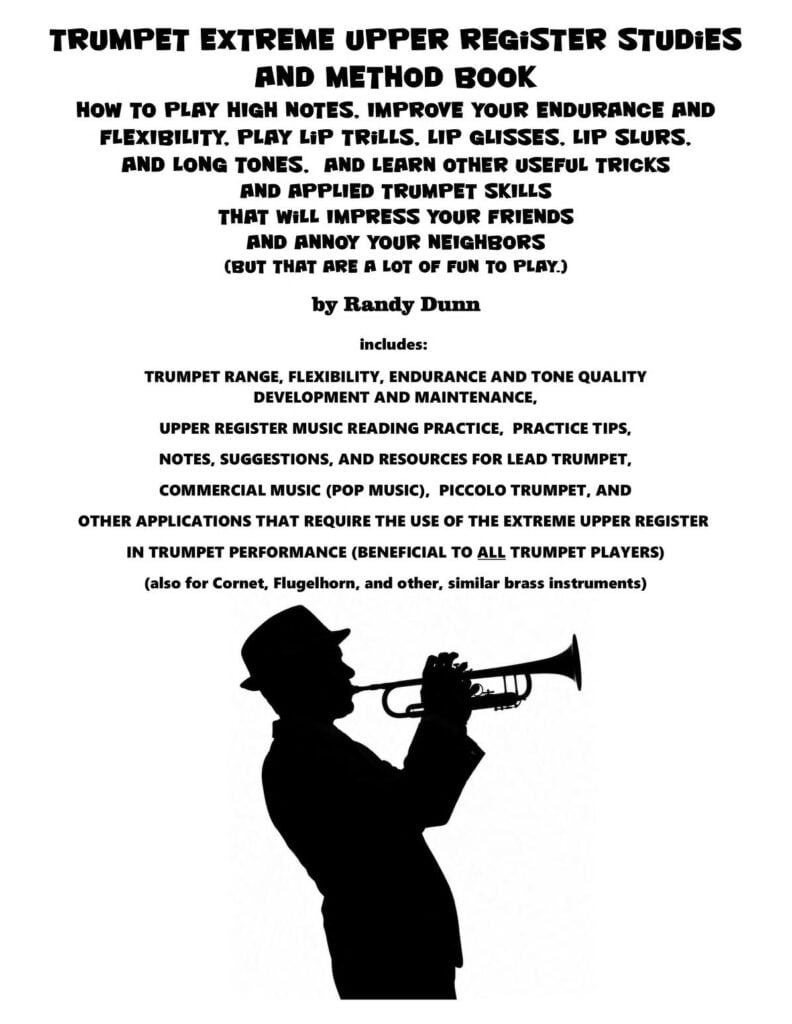
Yes, the “Trumpet Extreme Upper Register Studies Method Book“, by Randy Dunn, is now available! The exercises found in the first part of my book include exercises that I had written out (by hand) and used with my trumpet students for many years, ever since the early 1980s. The exercises found later on in the book (in Part 2 of the book) are mostly ones that I had written out primarily to use myself in developing and maintaining my extreme upper register (and, those exercises worked very well, since I now have a range that goes up to at least double-high C (always reliably), and sometimes (depending on the day) a little higher than that. I believe that my new book will be very helpful to trumpet players (both students and professional trumpet players) who are working on improving and expanding their upper register, or who (like me) simply want to maintain their upper register skills.
I decided to make my new book available for FREE (my gift to the trumpet world, since I love all of the citizens of that world), and have published it at The Internet Archive (archive.org). There, the book can be downloaded in PDF form and can either be used on tablet computers (like iPads, etc.) or it can be printed out in paper form by the down-loader.
-Since the original interview in 2020, you’ve added a new mouthpiece to your kit, haven’t you?
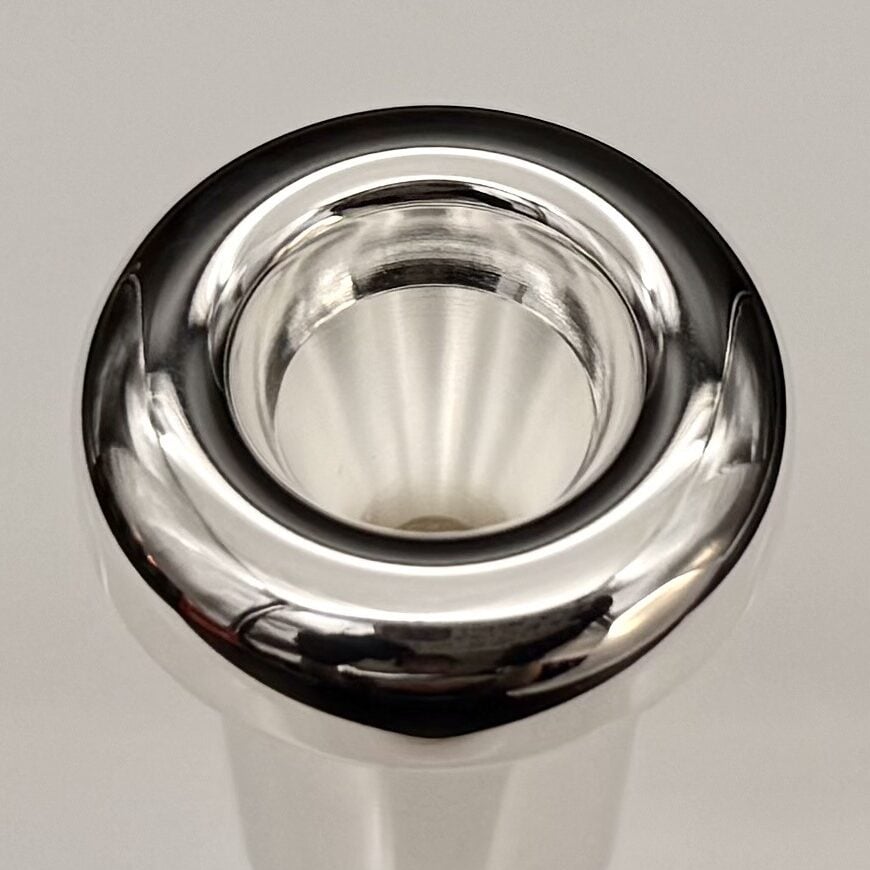
Yes, last year, in 2025, I added the Legends Git R Dunn flugel mouthpiece, designed by Derek Saidak at Legends Brass. Here is my review of the new piece:
“My search for the best flugelhorn mouthpiece that allows me to easily switch back and forth between my smaller inner diameter rim lead trumpet and classical trumpet mouthpieces (and piccolo trumpet mouthpiece) is now finally over! Legends Brass has once again exceeded my mouthpiece design expectations with their new .600” Git R Dunn Flugelhorn Mouthpiece. This mouthpiece has significantly increased my flugelhorn upper register range and endurance, and it has also improved my flexibility, all while still getting that beautiful, characteristic flugelhorn sound that I demand. The unique design of this mouthpiece makes it a mouthpiece that every trumpet/flugelhorn player needs to try.
Legendary mouthpiece designer Derek Saidak worked with me in creating the design for this outstanding flugelhorn mouthpiece. The design of this mouthpiece was inspired mostly by the designs of three other mouthpieces.
The comfortable, cushion rim of the mouthpiece is an exact copy of the rim of the .600” GIT R DUNN Trumpet Mouthpiece that Legends Brass designed for me to use for my classical-type trumpet music and all-around general trumpet playing. And the rim of the GIT R DUNN Trumpet Mouthpiece is exactly the same as the rim of the mouthpiece that I use for lead trumpet playing and on piccolo trumpet, the Legends Brass .600” JT CS Trumpet Mouthpiece (with a rim that is based on a vintage Jet Tone Charlie Shavers model trumpet mouthpiece.)
Many professional trumpet players and advanced student players have described this rim (on the Legends Brass JT CS Trumpet Mouthpiece and the GIT R DUNN Trumpet Mouthpiece) as the most comfortable trumpet mouthpiece rim ever made, and I agree with that. In fact, this rim is so popular that Legends Brass makes the JT CS Trumpet Mouthpiece in several different inner rim diameter sizes, ranging from .590” to .650”. If you are looking for a great lead trumpet or piccolo trumpet mouthpiece with an inner rim size within this size range, I highly recommend that you check this trumpet mouthpiece out in your preferred inner rim size. By the way—the tone quality of this mouthpiece is so beautiful, that you can also get away with using it for all of your trumpet playing needs, not just for lead trumpet playing. But, if you also want a trumpet mouthpiece that is a bit darker and richer, with a bit more of a robust, orchestral trumpet-type sound, then you will also want to try the .600 GIT R DUNN trumpet mouthpiece (which has a slightly deeper cup, and also has the more open, Legends Chicago backbore that is often preferred by orchestral trumpet players.)
Looking down below the rim, the lower part of the .600 Git R Dunn Flugelhorn Mouthpiece is based on a vintage Parduba 4 & ½ flugelhorn mouthpiece that was designed by Dick Akright especially for me, many years ago. But the new Git R Dunn flugelhorn mouthpiece has a smaller inner rim diameter than the old, Akright-Parduba flugel mouthpiece, and it also has a few other improvements and enhancements that were made to it (Thank you, Derek!) It has a typical, Parduba-style double-cup, with the first cup being shallow and bowl-shaped, which makes the upper register much easier, and also add just a hint of sparkle to the sound. The second, deeper cup of the mouthpiece is a typical, funnel-shaped cup that is found on virtually all flugelhorn mouthpieces (and French horn mouthpieces), producing that standard, dark, fluffy sound that you expect to hear from a flugelhorn, and also greatly aiding the notes in the lower register. The heavy blank with added mass that is used on this mouthpiece also helps to darken the sound, and it also stabilizes the notes in the upper register, making them easier to play.
Although the flugelhorn is really an alto instrument, several well known later period flugelhorn players sometimes play this instrument in the soprano register, and sometimes even going up to the more extreme piccolo-trumpet register. The famous flugelhorn soloist and band leader Chuck Mangione is perhaps the most well-know example of this. The saxophone-playing leader of a jazz quintet that I often work with loves Mangione tunes (which usually soar up pretty high above the staff), and in that band, we often play a half a dozen of Mangione’s tunes on our gigs. The Legends Git R Dunn flugel mouthpiece enables me to play those Mangione tunes easily, even at the end of a 3-hour gig.
I have also used the Git R Dunn flugel mouthpiece while playing in big bands, both for flugelhorn solo work, and with the entire section playing flugels, and the results are always excellent. I have had many people comment on how beautiful my tone quality on flugelhorn is with this mouthpiece, with several (including trumpet/flugelhorn players) saying that it is the most beautiful flugelhorn sound that they have ever heard. What’s really amazing is that on an improvised flugelhorn solo with a big band, I can soar up into the extended upper register (like around F, E, or G above high C) and it still sounds beautiful and flugelhorn-like. I love watching the faces of audience members and my fellow band members when I do this. Their jaws drop open and then eyes open wide with surprise and delight when they hear me play in the upper register on the flugelhorn, which is something that nobody expects.
The Git R Dunn flugelhorn mouthpiece makes it so much easier for me to play the flugelhorn, and I enjoy playing that instrument so much more now that I have switched to that mouthpiece.I’ve had to play a couple of gigs with it when I was kind of sick (You know, “The show must go on”), and yet it was still easy for me to play, even though I was a bit ill. With the other, older flugelhorn mouthpieces that I had used in the past, playing under those kind of conditions would have been a real struggle for me. Thank you, Legends Brass!
The .600” Git R Dunn flugel mouthpiece is readily available in the three most common flugelhorn shank tapers: (1) Large (Standard/Yamaha); (2) Small (Bach); and (3) French. I personally have this mouthpiece in the Large taper, since the two flugelhorns that I use most often have this taper. But Legend Brass also made another copy of this mouthpiece for me that has a cornet mouthpiece taper on it. I use the cornet mouthpiece taper version of the Git R Dunn flugel mouthpiece when I’m playing on my vintage 1961 Martin Magna flugelhorn, which I use when I want to feel like Miles or Wallace Roney. Some of the older vinage flugelhorns from the late 1950s and early 1960s had receivers that required flugelhorn mouthpieces with the same shank taper as a cornet mouthpiece. (An interesting fact about flugelhorn history!)
The .600” Git R Dunn flugelhorn mouthpiece is extremely versatile, and I have used it on all kinds of gigs that require flugelhorn (or that I have chosen to play flugelhorn on), including gigs with big bands, jazz combos, horn bands (Rock/R&B/Funk/etc.), church gigs, and more. And, I would even use it in orchestras for post horn solos, or for orchestral pops concerts, when the need arises. So be sure to check out this mouthpiece and give it a try: You’ll be glad that you did!”
Original interview with Randy Dunn from 2020, by john hutchinson:
What drew you to the trumpet as a child?
For some reason, I was always highly interested in music as a child, in spite of the fact that neither of my parents were musicians. There were a couple of things from my early childhood that I suspect were responsible for my great general interest in music. In the early 1960s, when I was very young, our family had bought a tiny, wind-driven (by a small electric motor) portable, table-top reed organ that had medium-small-sized black and white keyboard keys (they were probably just the right key size for my little 5-year-old fingers) and it also had two rows of accordion-like chord buttons and bass buttons that played a limited selection of chords that were arranged in an order that made sense regarding key relationships.
Even though this little organ was bought for the amusement of the entire family (to be used sort of like a toy), I was the member of the family who was playing with it most of the time, and I spent hours and hours entertaining myself with it. This tiny organ was made for use by non-musician amateurs, and it came with some little songbooks that had some easy, familiar songs in them (folk songs and old pop songs, mostly) and I sort of taught myself to read music by playing the songs in those books, and I also enjoyed just freely improvising on those keys. My improvising probably wasn’t that great, I’m sure, since I knew nothing about music theory at the time. But it was at least good enough to please and entertain the child version of myself. It just occurred to me for the first time in my adult life that I might be able to find some pictures and other information about that little organ online, and I did! It was a Sears Silvertone Model 603 Organ (no doubt ordered out of the Sears catalog.) Here is a link to a YouTube video of that organ in action: https://www.youtube.com/watch?v=cORy05zY_gU
I also had a small record player when I was very young (my parents must have bought it for me when I was around 5 years old), and I also had a lot of vinyl records (singles and full albums) to play on it, and I really loved listening to those records over and over, and spent a lot of time doing that. I had vinyl records with all kinds of music recorded on them, including music genres such as “kiddie music” recorded specifically for children, pop music, movie soundtrack albums, classical music albums, easy listening music (“elevator music”), and also some jazz and jazz pop music. This was the early to mid 1960s, so there was still a good bit of new jazz-influenced popular music being recorded at the time. I didn’t spend very much time listening to the children’s records that I owned, instead choosing to play all of the other records over and over again and really enjoying them all, especially the ones that featured orchestras and big bands.
So, I think having both that little Sears organ (which was almost like a toy) and that little record player when I was a young child really taught me how to listen to music and also encouraged me to mentally analyze music that I was listening to, even though it was in a musically uneducated way.
Later, when I was about to turn age 11 and was also about enter the 6th grade in public school, I knew that I wanted to play an instrument in the school band, but I had a really tough time deciding on which instrument I wanted to play, since I liked all of the instruments. I remember really liking the clarinet a lot back then, and I had thought that was the instrument that I wanted to play. But my parents talked me into playing the cornet instead, for some reason. They had a couple of friends who had been in the school band who had played the cornet, and I think they also might have just really liked the cornet and trumpet better themselves. So, I became a cornet player (and later, a trumpet player) more or less by random accident.
Did you have any particular early musical influences or heroes?
Growing up as a young child in the 1960s, I heard a lot of great trumpet music on the radio that I really enjoyed (much of which I heard well before I ever even played the cornet or trumpet), since there were a lot of hit singles that featured the trumpet back then, such as the hit single recordings by Al Hirt and by Herb Alpert and the Tijuana Brass. And, I also remember really liking the trumpet and brass section on those early Blood Sweat & Tears hits (Lew Soloff in particular later became a huge influence on my trumpet playing.) Those artists continued to record big hits into my early days of playing the cornet (trumpet) when I was in junior high school, and I sometimes tried to play their music myself by ear, or at least what little of it their music that I could play back then. Herb Alpert’s hits were heard everywhere at that time, and so everyone knew them and recognized them all, and the same was true with some of Al Hirt’s recordings. Once I began playing the cornet myself, I checked out a couple of Al Hirt’s albums from our local public library (on the recommendation of my middle school band director), and I listened to those recordings over and over again, and I really loved every Al Hirt track that I ever heard, even though I was a very weak young cornet/trumpet player at the time, and wasn’t yet serious about playing the trumpet myself.
Entering into high school was a big musical game-changer for me. That’s when I started buying and listening to lots of albums recorded by Doc Severinsen. My high school band director and Doc had met one year at the Texas Music Educators Association convention one year before I had ever entered high school and they had become good friends. As a result of that friendship, Doc played concerts as a featured soloist with my high school band every year that I was there, in addition to also playing those concerts several years before and after I was in the high school band.
When I was still in middle school (or “junior high school”), I had heard Doc play a live concert with the high school band and I was totally mesmerized with how beautifully and musically Doc played the trumpet, and that’s when I became Doc’s fan for life. So Doc is definitely a big personal mentor and inspiration of mine, and I have had the pleasure of getting to visit with Doc and reminisce about those times on several occasions over the years when Doc had come to Houston to perform with various different professional musical ensembles that he has led.
While I was still in high school, I also starting listening to a lot of Marice André albums, and as a result of that listening, he was a great influence on my piccolo trumpet playing once I added that instrument to my collection when I was in college. I also first began listening to a lot of great recordings of many of the standard trumpet concertos (recorded by many different soloists) when I was in high school, such as concerti by Hummel, Haydn, Torelli, Telemann, Franz Richter, and others. Also around that same time, some of the other, older high school band students had introduced me to the music of Bill Chase (and his trumpet-heavy jazz-rock band, Chase), as well as to the big band music of Maynard Ferguson, which resulted in my loving and idolizing those great trumpet players as well. And, of course, I was also also staying up late and watching and listening to Doc Severinsen play with (and lead) the orchestra for the Tonight Show with Johnny Carson on TV most week nights.
Rafael Mendez was another great trumpet soloist whose recordings I had also listened to a lot beginning when I was in high school. Also in my high school days, I became a big fan of the group, Chicago (beginning my freshman year in high school), and later, Tower of Power, and both of those bands had great horn sections that featured some fine trumpet playing. And, I also began to really like and appreciate the music of Henry Mancini back then, which included Mancini’s great trumpet sections and soloists, such as Bud Brisbois and Conte Candoli, and Mancini’s music was heard in many movies and television shows of that time period. Mancini even had his own weekly musical TV show called The Mancini Generation during that time period.
I definitely need to mention that Bob Odneal has been a huge influence on my lead trumpet playing. I have known Bob and have been listening to him play for many years, ever since I was in high school (Bob and I attended the same high school in our hometown of Baytown, Texas, although he is older than me, and therefore attended that school—and played concerts with Doc there—before I did.) I have really learned a whole lot from Bob throughout my entire lifetime, and I still continue to learn things from him. In addition to Bob being an extraordinary trumpet player, he is also a really great teacher and band leader.
Going from late high school into college, I added even more trumpet heroes to my list of major influences, including Clifford Brown, Jon Faddis, Marvin Stamm, and Arturo Sandoval (during his days in Cuba when he played with the band, Irakere.)
While I was in college, I also began to gravitate much more toward classical music (which became my primary performance genre throughout most of my life), and in that genre, I was most greatly influenced by my college trumpet professor and former Houston Symphony principal trumpet, James Austin, who is to this day, my idea of what the perfect symphonic trumpet player should sound like. But Bud Herseth, Vincent Chicowicz, and Gerard Schwarz and several other trumpeter players who were playing with the major symphony orchestras at that time also greatly influenced me as a classical trumpet and orchestral trumpet music performer, along with Maurice Andre, of course, who is the gold standard of piccolo trumpet performance.
There are so many other great trumpet players whose music has touched and influenced me greatly, and I think that, as trumpet players, we are each a product of everything and everyone we have ever listened to. But the trumpet players I mentioned above are the ones who have had the biggest influence on me, especially in my earlier years, from childhood up through early college in particular.
What have been some of your career highlights to date?
Probably the most enjoyable moments of my career have been getting to perform often with some of Houston’s finest classical and orchestral musicians, including many who perform with the major local professional orchestras, such as the Houston Symphony, Houston Ballet, and Houston Grand Opera orchestras, and also with musicians who are members of the great local professional theater orchestras. But, it has been equally rewarding for me to be able to perform with some of the Houston area’s greatest jazz and pop musicians. Houston has some of the finest musicians you will ever find, in all genres.
I have also really enjoyed getting to perform in orchestras and bands with some well-known singers and instrumental soloists, including Johnny Mathis, Casey Abrams, Doc Severinsen, Dennis Dotson, Kirk Whalum, and many others. Since I got to play concerts with Doc Seveinsen back when I was in high school, that experience has been hard to top!
I have also done some interesting film and television music recording work, including playing the fanfares in the 2015 BBC-TV movie, The Dresser, staring Anthony Hopkins and Ian McKellan, and also writing and performing a trumpet fanfare duet for a Zappos Shoes television commercial. I have also worked as a composer and music producer for several up-and-coming film directors both Houston and Austin, Texas, writing and producing music for some short films (made for film festivals) and some television programming. I even played trumpet and flugelhorn (among other instruments) in some of that film and television music that I produced.
I really enjoy playing a lot of different types of music (which keeps me from getting bored), including classical chamber music, orchestral music, big band jazz, small jazz combo, pop/R&B/funk/rock, and latin music. And speaking of latin music, I’ve even played in bands in which all of the other band members were fluent in Spanish (since it was their first language) except for me, and the rehearsals and performances of those bands were conducted completely in Spanish. Fortunately, music is the universal language, which makes communication among musicians easy, in spite of any language differences.
As an experienced educator and player, have you found that your approach to playing and teaching the trumpet has changed over the years?
I am a retired music educator, having taught band and music for many years in the public schools in Texas. Before I retired from teaching, I was also working part-time as a free lance professional trumpet player all those years that I was a teacher (the trumpet gigs were mostly in the evenings and on weekends.) Before becoming a life-long career classroom teacher, I also spent four years working as a full-time private trumpet teacher in the Houston area. During that time period, I was teaching between 90 to 110 trumpet students each week, while also simultaneously working as a free lance trumpet player. (I had also taught trumpet lessons part-time my last couple of years in college.)Even though I am retired from teaching, I still enjoy continuing to work some with band and music students from local high schools, middle schools, and colleges, in addition to continuing to work as a free lance professional trumpet player.
The biggest change to my playing and teaching the trumpet over the years is that I now personally spend a lot less time on practicing warm-ups, etudes, and technical exercises (you know, all of that “trumpet stuff”), and I instead spend a lot more time practicing repertoire for upcoming concerts and other performances. It is important to practice all of those trumpet techniques basics, but you encounter a lot of those in the repertoire you play anyway (especially if you are playing professionally.)
I do continue to play certain exercises on a regular basis (see next question for more details), but I often divide and spread those routine exercises out over 2 different days rather than practicing all of those different routine and technical exercises all on the same day (which, if I did practice them all on the same day, might leave little time for me to practice my performance repertoire, which is much more important, since that’s what I’m getting paid to play.) Splitting up my routine practice exercises and warm-ups and spreading them out over a couple of days also makes my practice days more interesting, since every day’s practice is a little bit different, with more variety. (Again, see the next question for more details about how I do all of this.)
As a performer, are there any particular routines that you follow to keep yourself in good shape for performance? How do you keep on top of your trumpet playing while you are traveling or really busy?
There are two very important things that I do to keep myself in good shape for trumpet performances:
(1) I make sure that at least 50% of my daily trumpet practice and playing is done in the middle to low register and/or playing very softly. This is an important technique for developing and maintaining good endurance (and also important for a strong upper register, which seems to be closely associated with good endurance.) This type of daily practice (when at all possible) has been recommended to me by many great trumpet players from all music genres, from classical and orchestral to jazz and beyond.
I keep a written practice journal that keeps running totals of how much time I have spent so far each day practicing soft/middle-low register stuff: I draw a smooth circle around the numbers of minutes (or hours and minutes) that I have written down for this type of practice that I have done. And, I draw a jagged, spiky circle around the minutes of loud and/or high register practice that I have done in each of my practice sessions. If I do a combination of the two types of playing during the same practice, then I circle the practice time for that session by making part of the circle smooth, and part of the circle spiky-jagged, approximately indicating the ratio amounts of the two types of practice done. After my last practice session of the day, I add up all of those minutes (from my two running totals of those two different types of practice) in order to get a grand total of hours and minutes that I practiced that entire day, and I write that total practice time amount in the left margin, next to the day’s date in my journal, and then I draw a rectangular box around the grand total of hours and minutes that I practiced that day.
(2) The other thing that is important is that, instead of practicing just once a day for a long time period, I like to practice in several relatively-short practice sessions throughout the day (always beginning my first practice session of the day fairly early in the morning), and then I rest and don’t play the trumpet for at least as long as I just practiced in the previous session before I begin the next practice session of the day. And, the moment when my lips are starting to feel either a little tired and fatigued, or “wobbly,” or maybe even feeling a little bit painful sometimes, then I stop playing immediately and take another long rest (or, I’ll stop practicing for the rest of the day, if my lips are too tired, or if I feel like I have practiced enough that day.)
As for what I practice, I probably spend about 90% of my time practicing music for upcoming performances, since that’s what I’m getting paid to play. It’s very easy to get distracted with practicing too many warm-ups, technical studies, etudes, lip-slurs, and long-tones, and other “trumpet player stuff.” Nobody will ever pay you to play any of those things! Not that those things don’t have value, because they do—I admit that I do think that they are important, and so I still spend a little time practicing and playing them—but no more than about 10% of my daily practice time on them, usually. Younger and developing trumpet students may need to spend a little larger percentage of their practice time each day playing these types of exercises though, in order to learn those techniques that are still new to them and therefore haven’t mastered yet. (That’s called “paying dues” and developing the basic skills of fine trumpet playing.)
I always warm up carefully each day, starting on second-line G (with at least a fairly long note, getting the best, most centered tone quality possible), and then I gradually expand my way down lower and then up higher throughout the total commonly-used range of the trumpet (or maybe even higher, if I am about to play some lead trumpet music or something that goes extremely high.) I do these expanding-throughout-my-entire range warm-ups with either some slow scales and/or arpeggios, or sometimes with expanding lipslurs and/or lip glisses (octave glisses), very carefully moving into the extremes of the lower and higher registers, and concentrating on relaxing and using as little mouthpiece pressure as possible, while getting the most beautiful, well-centered sound I possibly can.
I have a list of several things in my practice routine that I like to do regularly. When I was a student (especially in college), I would practice and play each of those things every day, if at all possible. But, after many years of playing all of those basic trumpet techniques, I now usually split them up and spread them out over 2 days (occasionally even having to spread them out over more than two days) so that I don’t spend more than 10% of my daily practice time on warm-ups and technical studies (“trumpet stuff.”)
I do have a set of “trumpet technique basics” that I like to start my practice day with, not only as a warm-up, but also to focus my practice, and to maintain all of the basic skills that I need to play the trumpet the way that I want to be able to. Each day, I practice each of those trumpet technique basics on only one pitch (or “key”) in all possible octaves (or, I might instead stick with that same pitch/key for two days, if I split this routine up and spread it out over two days.) After I have played through all of these exercises on that particular pitch or key, then I will move on to a new pitch to focus on for the next new day’s warm-up and routine practice. (I do this with all twelve possible pitches/keys, going through them in the order of the circle of fifths.)
Here is that list of daily (or semi-daily) essential exercises and skills for trumpet playing that I practice every day (or, sometimes over the span of 2 days, if I split this routine approximately in half and do only half of it a day over the span of 2 days), and I practice these regularly in order to keep my basic trumpet skills and techniques in good condition:
1. Longtones and Tonguing Exercises—I play long notes very softly on the “pitch of the day” in all octaves possible, holding each of these notes for as long I can in one breath (I count the number of seconds I hold each note), until I can no longer hold the note out without still being relaxed (and then stopping before I would have to squeeze the last of the air out in order to go any longer.) I do this a couple of times with each note (in each octave), and then I also play a long, single tongue exercise on that same note, starting with a whole note, and then going to shorter and shorter note values (whole note, 2 half notes, 4 quarter notes, 8 eighth-notes, 16 16th-notes, and then ending with a whole note with a fermata over it.) I then play various common double-tonguing and triple-tonguing rhythmic exercises on that same note. I repeat this process with the same pitch in every octave that I can comfortably play it in.
2. 4ths and 5ths—I slur between the “note of the day”, up a perfect 5th, then up a perfect 4th from there, etc., playing these 2 different pitches in all registers (also taking them down into the lowest register possible.) These 2 pitches function like tonic and dominant, or the 1st and 5th pitches of a scale, and therefore, these intervals are often found in music. Then, I start with the “note of the day” and this time, I slur up a perfect 4th first, then up a perfect 5th from there, etc., playing these 2 different pitches in all registers possible. In this case, these 2 pitches function like dominant and tonic, or the 5thand 1st pitches of a scale. [In other words, my “pitch of the day” serves as both tonic and dominant in these 4ths and 5ths interval exercises that I practice.]
3. Octaves—I play octave jumps, up and down, using the “pitch of the day,” playing these cleanly in all possible octaves, slurred, tongued, and also glissed. For even more of a challenge, I’ll jump up and down between all possible octaves that I can play of that “pitch of the day.”
4. Scales & Arpeggios—On the “pitch of the day,” I play a scale and an arpeggio, playing each in as many octaves as possible, first by memory, then I either play some arpeggio (chord) studies from the Arban book, or a I simply make up my own, similar arpeggio/chord studies. The “scale and arpeggio of the day” that I play as part of my practice routine is always selected from one of the following pairs:
(Notice that the first five pairs listed below are scales and arpeggios that are often used with the same harmonies or chord symbols.)
●Major Scale and Major (Triad) Arpeggios (maybe with a little bit of Major 7th chord arpeggio also);
●Mixolydian Scale (Dominant 7th Scale) and Dominant 7th Arpeggios;
●Minor Scale—I like to mostly practice the Dorian Minor scale, because that’s the minor scale that I use most often in jazz improvisation (but I also sometimes play the other minor scale forms a bit: Melodic, Harmonic, and Natural Minor scales) and Minor (Triad) Arpeggio, and also the Minor 7th Arpeggio;
●Diminished Scale (also known as Octatonic Scale or Whole-Step—Half-Step Scale) and Diminished 7th Arpeggios
●Whole Tone Scale and Augmented (Triad) Arpeggios;
●Blues Scale, and Pentatonic Scale, and also Stacks of Perfect 4ths (the stacks of 4ths, which represent extended tertian harmonies, such as 13th chords—are practiced here instead of the usual arpeggios)
●3rds Studies (scales with broken 3rds), plus Clarke’s Technical Studies (my choice), plus favorite “licks” or I’ll review some of the most technically challenging scales and arpeggios of my choice.
I eventually work my way through all of the “scales and arpeggios” pairings listed above, playing each set in all 12 keys/pitch centers. Since there are 7 of these pairings, and 12 different pitch centers (or keys) for each one, it takes me at least 84 days to work my way through all of them, if I do a new one every day (7 x 12 = 84.) So, in other words, it takes me almost 3 months—minimum–to complete this cycle. If I spit the daily routine in half, it will take me twice as long to work my way through all of these routines. I have a deck of color-coded index cards with each of these scale+arpeggio sets in each key/pitch center written on them that I use to help me keep track of which one I’m currently on, along with notes about which ones I have practiced on each day that I keep in my practice journal.
5. Interval Studies—from the Arban book, etc. (These are extremely important in developing and maintaining accuracy in playing.) I do these starting on the “pitch of the day” only, using the “scale of the day” from my practice routine.
6. Clarke’s Technical Studies by Herbert L. Clarke (the study of my choice from this book—I often rotate these), played in the “key of the day” only, but in all of its possible octaves.
7. Chromatic Scale, starting on the “pitch of the day,” going up as many octaves as possible. (It’s important to be able to play chromatic runs starting on every note, and the First Study from Clarke’s Technical Studies is also a great study for achieving great chromatic scale technique.
8. Range Practice—For playing in the extreme upper register, I will play some exercises (such as octave jumps—slurred and tongued—or arpeggios or scales or favorite licks) starting with one that goes up to high C above the staff, then going up from there by half-steps until I go as high as I can possibly play. For me, that’s usually about a double-high C, but sometimes a little higher than that, and on some days it’s a little lower (if I’m having a particularly bad chops day.) I rest frequently, as necessary in order to avoid tiring my lips out and injuring myself. I usually do these range exercises going up to double-C every day, but on the rare day that I might be having a “bad chops day,” I might skip these that day. I know some very fine trumpet players who also have great endurance and a great upper register who only practice these types of range exercises every other day. So you have to do it the way that works best for you personally.
9. Lip Glisses (Glissandi)—These sort of go along with the Range Exercises listed above. I start on C in the staff and gliss up to high C, glissing up and down several times, usually a total of eight times without stopping in between each one at these different dynamic levels: mf, mf, pp, pp, ff, ff, mf, mf. I then continue going up chromatically by half-steps, doing the same thing, but moving up gradually to higher and higher notes, until I am playing octave glisses up to double-high C (or as high as I can go on that particular day, at least.) NOTE: When I was younger, I spent a lot of time practicing lower lip glisses, going through all 7 lip-slur fingerings and starting on the lowest note that I could play with each fingering, and gradually adding more and more notes to these lipslurs/glisses, working my way up to playing 7-note glisses with each fingering, then later even 8-note and 9-note glisses. Those are really great exercises for learning all of the notes in the harmonic series for each of the seven fingering combinations of the trumpet.
ADDITIONAL NOTE: When I was a student (in high school and college), I spent a lot more time practicing the “trumpet basics” that make up my daily routine, but that’s because those skills were new to me then (or at least newer), so I was still learning these skills then and developing those basic techniques and establishing the muscle memory needed to perform each of them well and accurately. In my student days, I spent a lot more time practicing long-tones, lip-slurs, and scales (and later, also arpeggios.) Every great professional trumpet player I have every known, no matter what age and generation (trumpet players from all music genres, from classical/orchestral to jazz and beyond) has stressed the importance of practicing these things, and I have personally heard many of them warming-up with them and practicing them.
As I got older and had learned my lip-slurs extremely well (along with their accompanying harmonic series notes) and was therefore very skilled at playing them, to the point where they were almost boring, and required little concentration or effort from me when playing them, I then stopped practicing so many lip slurs, relying instead mostly on arpeggio studies to help me to maintain my lip flexibility in much the same manner, only I also get arpeggio fingering technique practice in with those exercises.
Throughout high school and college I also spent a lot of time practicing lip trill exercises in all registers (starting out with the lip trills in the middle and low registers only at first, in my early high school years.) But, again, after I had gotten really good at those and they had become extremely easy for me to play (even the lip trills in the upper register), I no longer spent much time practicing lip trills, with the exception of the ones that I would encounter in concert and gig literature that I would be playing (lip trills are especially common in big band music, of course.)
Also, as a student, I spent a lot of time gradually learning all of the different common scale and arpeggio forms listed above in my practice routine. Beginning a little bit in middle school and continuing into high school, I had learned all 12 major scales and major triad arpeggios, spending a couple of weeks on mastering each one of these 12 scales (along with the corresponding arpeggio) when I was in my first year in high school so that I could learn them really well and in order to play them really fast if I needed to (or wanted to.) Then, after learning all 12 of them (in all keys), I would quickly play through all of my major scales and arpeggios every day, starting with the lowest one (F# or Gb) and going up chromatically by ½ steps to as high as I could go playing these scales and octaves two octaves each, and then I would play the remaining scales/arpeggios that were then above my two octave range only one octave each (or, one octave “plus”–with a partial extra octave, as my young high school range would permit.)
Late in high school, I started to learn some minor scales and arpeggios a little bit, but I didn’t really woodshed those and learn them really well (along with the other scales and arpeggios I mentioned above) until I began my college years of study and realized that I still had a whole lot more to learn in order to achieve really good, comprehensive, basic trumpet technique.
Technology has produced the biggest changes in the way that I practice now compared to when I was younger. Metronome and tuner apps, instead of actual metronomes and tuning machines that I used in the pre-computer days when I was younger, as well as music audio and video files that can be instantly downloaded or streamed from the internet have all been major game-changers in the way that I practice now. Also, some other music-related computer programs, such as Digital Audio Workstation (DAW) programs have also changed the way that I sometimes practice and make music now.
As far as what I do to keep my chops and my trumpet playing in good shape when I’m traveling or really busy: I always travel with at least one instrument (Bb), even if it’s only my cheap little Bb pocket trumpet. No matter where I travel to, I always manage to find a some place there where I can get some practicing done without disturbing others. Over the years, I’ve practiced in many empty hotel ballrooms and meeting rooms, in empty classrooms of schools and universities, in empty Sunday school rooms and sanctuaries in churches, in parking garages, in empty stairwells, in empty office buildings—after office hours, in empty wooded areas, etc. When traveling, I find myself constantly analyzing every place that I see and evaluating it for its use as a temporary practice room or practice space.
If I’m staying in a hotel when I travel, I sometimes might do a little bit of my warming up and such in my hotel room, but if I do, I’ll point my trumpet bell toward something that will either absorb or dissipate the sound somewhat (pointing my bell toward pillows, or chair cushions, or heavy clothing, etc.) If I’m staying with relatives or friends who live out of town, I’ll usually wait to let my really loud and really high practicing rip lose when everyone else leaves the house for some reason or another.
Before I retired from teaching, I always kept my pocket trumpet in my car, where I often played warm-ups and chop-builders on it (long-tones, lipslurs, etc.), as well as tonguing exercises and other things on it, sometimes even playing these one-handed while I was driving to and from work (which was usually about a 30-minute trip each way for me, depending on the Houston traffic.) Every time that I had to stop at a traffic light, or got caught in a stop-and-go traffic jam, or got stuck behind a train that was either very long or that was stopped on the track, I got some really good practicing in. (There was a train track very close to the school that I taught at.) When I traveled to conventions, I would often carry my pocket trumpet in a small gig bag and then put it in a backpack that I carried around with me.
Other than practicing, I sometimes “set my chops” to embouchure position (but sort of relaxed—not too tense) during times when I’m sitting idle, but am unable to play the trumpet (in meetings, in waiting rooms, watching a TV show, etc.) I have always made the most of every minute that I have had to practice, even while I was still working a day job. Any time that I had before school, or during my lunch time (after I had finished eating) I would use these opportunities to get in a little bit of practicing (every little bit of practice that you can do helps.) Always getting my first practice session of the day done as early in the day as possible really helps with keeping my chops in shape also.
Can you tell us a little about the current relationships that you have with manufacturers? What was the process like, working with Legends Brass on new mouthpieces? How have these new mouthpieces helped your trumpet playing?
Working with Legends Brass on my signature custom mouthpiece, the GIT R DUNN trumpet mouthpiece, was a wonderful experience for me. Derek Saidak and his wife, Leslie (who own and operate Legends Brass) are both mouthpiece-making geniuses, and I am extremely impressed with the way they run their business, their great selection of unique mouthpiece designs that can meet the needs and preferences of just about any trumpet player, and their amazing attention to detail and creativity.
Derek designed the GIT R DUNN mouthpiece for me to use primarily for me to use for classical and orchestral trumpet playing on my larger trumpets, such as my trumpets in the keys of Bb, C, D and Eb (not for piccolo trumpet use.) Before Derek began designing that mouthpiece (at my request), I had recently switched to using two different Legends mouthpieces for my lead trumpet playing (and similar playing) and also for my piccolo trumpet playing. Both of these Legends mouthpieces have different advantages and different qualities in the way they sound and play and are therefore each best suited for different situations. (See below for more information about this.)
I loved the comfort and the feel of my Legends JT CS .600” lead trumpet mouthpiece so much (which is my primary lead trumpet mouthpiece) that I wanted to play on it all the time! And, even though the sound is great on it, it doesn’t quite get that characteristically orchestral trumpet sound that virtually all professional orchestra and classical trumpet players typically get. Also, it was always difficult for me to quickly switch back and forth between my lead trumpet/piccolo mouthpiece and my old “classical” mouthpiece, because the feel and the blow of the two mouthpieces were so different. This had really become an issue with my playing in recent years as I began to play a lot more different kinds of gigs requiring me to play a lot of different styles of music (classical chamber music, orchestral music, big band, jazz, pop, etc.) Similarly challenging was the fact that more churches (and therefore more church gigs) were moving toward blended services that required me to quickly switch back and forth between playing more contemporary lead trumpet-type jazz and rock style music to playing traditional classical, baroque, and romantic style music, all within the same church service, and often switching back and forth between the two different styles.
To solve this problem, I wanted a special custom mouthpiece that had the same rim, throat, and venturi cylinder design as the Legends JT CS .600” “lead trumpet” mouthpiece that I had been using for lead trumpet and piccolo trumpet playing, but I wanted the new custom mouthpiece to have a more open, broader, darker-sounding backbore (like the Legends Chicago backbore), and I also wanted this new custom mouthpiece to have a little bit deeper cup (but not too deep.) Derek and I both believed that these changes in the design would fatten up and darken the sound a bit more, yet would still provide good support in the upper register as well as enable good endurance, all while still being able to produce a rich, fat sound that still produces some “classical” brilliance and richness to its tone. The result was the new Legends GIT R DUNN .600” trumpet mouthpiece, which I am very pleased with, and I now use that mouthpiece exclusively for my general trumpet playing and practice, as well as for performing “classical” style chamber music and orchestra music. (I use the GIT R DUNN mouthpiece for everything except for piccolo trumpet playing, lead trumpet playing, and for some jazz solo playing.) By the way: I know many other older professional classical trumpet players who, like me, played on typical large inner diameter rim trumpet mouthpieces when they were young college students and young professional players, but who now play on much smaller inner diameter rim mouthpieces.
Not long before working with Derek on designing the GIT R DUNN mouthpiece, I had begun using two other Legends mouthpieces that were from the standard Legends mouthpiece catalog. I was using those two mouthpieces for lead trumpet-type playing and for playing piccolo trumpet, and those are the mouthpieces that I still use exclusively for those purposes. And now I can’t imagine having to use any other mouthpieces for those types of playing.
For most of my lead trumpet playing (probably about 80% of the time), and for all of my piccolo trumpet playing, I use the Legends JT CS .600” mouthpiece, which is inspired by the classic Jet Tone Charlie Shavers model mouthpiece, but with some significant improvements that Derek made to the original design. This mouthpiece has the most comfortable rim of any trumpet mouthpiece I have ever played on in my many years of trying hundreds of different trumpet mouthpieces. And, it is so easy to play on, giving me great results with less effort, and also encouraging me to relax more when I’m playing. It gets that big, fat sound that I want on piccolo trumpet without requiring me to work too hard, greatly improving my endurance on the piccolo trumpet as well as making the upper register much easier.
And that same Legends JT CS .600” mouthpiece has a similar effect when I use it for lead trumpet playing on the standard Bb trumpet. On that instrument, it also gives me a big, fat, beautiful sound that requires less effort than any of the lead trumpet mouthpieces that I had ever used or tried before. Likewise, this mouthpiece also greatly improved my lead trumpet endurance, and it also really stabilized my extreme upper register (from normal lead trumpet range up to double-high C and a little beyond), making my extreme upper register playing so much easier and much stronger-sounding and more beautiful-sounding than every before. The tone quality of this mouthpiece is so great in all registers that I also usually use it for playing jazz trumpet solos, in addition to using it as a lead trumpet mouthpiece.
Sometimes when I’m playing lead trumpet, I will instead use the Legends RM 16S .595” mouthpiece (which I use for playing lead trumpet about 20% of the time), which is a mouthpiece inspired by the classic Rudy Muck mouthpiece, but with some very important improvements that Derek made to the original, classic design. Like the Legends JT CS, the Legends RM 16S is also very comfortable, with a wide, cushion rim. And, the rim of the RM 16S feels like it is the same size as the JT CS, even though its inner-rim diameter is actually slightly smaller (but the outer rim is even wider, providing even more cushion.) I use the RM 16S for lead trumpet work that requires me to play gigs that last for an extra-long time, or that require almost continuous playing, or that involve an unusual amount of extreme upper register lead trumpet playing. The RM 16S requires me to back off and relax when I play even more so than the JT CS does, because of the way that it blows, which is extremely efficiently. And that, in addition to the extra-wide extreme cushion rim, makes it feel almost like I don’t even have a mouthpiece touching my lips when I play on it.
The RM 16S also has a bit more edge and brightness to it than the JT CS does. But on the other hand, the JT CS is a little fatter-sounding, yet still has plenty of brightness to allow it to cut through a big band also. Flexibility is also just a little bit easier on the JT CS than on the RM 16S. But, my choice of which one of these two mouthpieces I use when playing lead depends both on the style of the piece of music that I’m playing, the type of sound that I want for that particular piece, and also sometimes the type of performance that I’m using it in. (I’ll often switch back and forth between these two lead trumpet mouthpieces during a big band gig.)These three trumpet mouthpieces of mine that are made by Legends Brass (GIT R DUNN, JT CS, and RM 16S) are the only trumpet mouthpieces that I ever use now. I don’t have any formal relationships with any instrument manufacturers, and I use a variety of great instruments made by various manufacturers.
2020 so far has been a ‘challenging’ year to say the least? What has this meant so far for your work? How have you been adapting to online work
Well, like everyone else, I’ve had a lot of gigs and performances canceled as a result of the COVID-19 pandemic quarantine. For many of us living in the United States, the quarantine began in full shortly before Palm Sunday and Easter, so many of us musicians had our Easter gigs canceled. Several bands that I often perform with usually play a lot of festivals and party gigs beginning about early to mid-spring and going on into the summer, and those gigs will also all be lost this year, as well as the many weddings and wedding reception gigs that we do. Also, the jazz quintet that I sometimes play with abruptly had all of its restaurant, club, and wine bar gigs canceled after all of those venues were ordered to close down in order to slow down the spread of the COVID-19 virus.
During the quarantine, I have been able to keep my trumpet practicing going strong, in spite of the fact that I have no performances scheduled for the foreseeable future. I begin my first practice session of each day, as always, early each the morning, shortly after waking up and having some coffee. It’s been difficult to be as productive as normal for most of us, I think, because most people haven’t been sleeping very well during this quarantine, for various reasons. That’s one of the main reasons why I make sure to get my trumpet practice out of the way early, while my somewhat sleep-deprived mind is still in its freshest and most productive state.
I originally thought I would be making a number of new trumpet videos to post online while under quarantine, but—so far, at least—I’ve been busy with other things. In between keeping up with the pandemic news and standing in long lines for groceries and other essentials from time-to-time when I need to get them, I’ve also been hard at work finishing up my income tax returns (which, in the U.S., can be rather complicated and time-consuming, unfortunately.)
Also, during the earliest days of this quarantine, I was bored enough and had enough time and energy on my hands that I started to work on designing some new trumpet mutes that I had been thinking about making for a while. I spent a lot of time experimenting with various prototypes for these new mutes and, as a result, I came up with a really great set of unique mutes (or, more accurately, a mute system) which is extremely versatile and can be used for several different types of common mute indications found in trumpet sheet music, or for discretionary trumpet solo use, or even as excellent trumpet practice mutes.
The result of this effort is that I have now created the best trumpet mutes of the following types that I have ever played: bucket mute, hat mute, “in stand” mute, practice mute, and whisper mute (soft mute.) I am so thrilled with the results that I am planning on manufacturing these mutes of mine commercially once we all start recovering from the current economic crisis that has resulted from the COVID-19 pandemic shutdown. I’m hoping to be able to launch these new mute products beginning in early 2021, and I think that I’ll be able to sell them at a very reasonable price so that they are afforable not only for professional trumpet players, but for students as well. I really believe in these mutes, and I think that they will become revolutionary new accessories that every trumpet player will want to have.
It’s interesting that it took a pandemic and a quarantine for me to be inspired to invent and perfect those new mutes. I read an article recently that said that, when Sir Isaac Newton was quarantined during another famous pandemic that you might have heard of, known as the Plague, he continued his studies and work at home. It was during this time of quarantine that Newton did some of his best and most famous work, including inventing calculus, studying optics and light, and studying gravity, which led him to the creation of his famous laws of motion. https://www.biography.com/news/isaac-newton-quarantine-plague-discoveriesI’m not saying that my newly-invented trumpet mutes are as significant or as important as all of those things that Newton invented, of course. But, I do think that my new mutes will be significant to trumpet players and that they will also be greatly admired and appreciated by trumpet players and their audiences. This is just another example of how we can all use this time of quarantine and isolation to accomplish some great things, or at least to continue to get some work done so that we are ready to resume our business as usual once the quarantine is lifted. Once the quarantine ends and live music performances are finally allowed to resume, those of us who kept our chops in shape by practicing throughout the quarantine period will be ready to work, and we’ll be the ones getting all of the gigs and keeping our performing reputations going. (And each student who continues to practice hard throughout this quarantine will likely wind up being first chair in their school band when school finally starts back up again.)
What advice do you have for young aspiring trumpet players out there?
I recommend practicing daily in multiple practice sessions, and always practicing with daily goals as well as long-term goals. (It helps to write everything down.) Also, you should find the best teachers you can to study with, and don’t be shy about asking questions of pro players who you see perform, or who maybe that you yourself get to perform with. (You can learn a lot from older players, especially.)
Also, make sure that other people hear you play, and that you are always prepared to sound as good as you possibly can, even if you are just playing in rehearsals or in semi-public practice areas. (Such as university music school practice rooms.) A university jazz band director happened to walk by my practice room in the school’s music building once when I was in the middle of playing a Maynard Ferguson solo (from his latest album at that time), and that jazz band director (who hadn’t met me before) introduced himself to me and invited me to audition to play lead trumpet in his jazz band, since his hot-shot lead trumpet player that was in his band had just graduated and left the university. I wound up winning the audition for that spot in the band, which means that there must have been a bunch of trumpet players with weak upper registers at that school that particular year, because I didn’t even think that my range and upper register were that great at that time! But that was a really great experience for me, as it was my first opportunity to play lead trumpet in a big band.
I also recommend that you make friends with other fine professional trumpet players and other serious trumpet students, and that you also develop strong friendships with other fine musicians who play other instruments besides the trumpet. Not only can you learn a lot from these types of connections, but these relationships could also help you to get some future gigs and other jobs of various types (such as music teaching jobs.)
If you ever get bored with your practicing and playing, then do something to shake things up a bit. Start playing some styles of music that are outside of your typical comfort area. For example, classical and orchestral specialist trumpet players could start practicing some jazz also. And, jazz or big band specialist trumpet players could practice and play some classical trumpet music. Not only will this give you more musical diversity, but it will also make you a better musician, and will present you with the opportunity to learn and develop some new skills.
Listen to a lot of recordings (over and over again) and also listen to live performances of the trumpet players who you want to sound like, and then make an effort to copy their sound and style when you practice.
Thank you, John. This interview and discussion was a real pleasure.
Mario Guarneri will be known to many readers as a performer and educator of the highest calibre. A former member of the Los Angeles Philharmonic, Mario is also in demand as educator and lecturer on the pedagogical concepts involved with his groundbreaking designs (www.berp.com) and the trumpet in general. Here he shares with me some thoughts on approaching different stylistic challenges both as a player and a teacher.
Can you please give a little background to your playing styles?
Interesting question that I don’t ever recall answering before. First of all, I believe from the beginning I was taught to play in the style of the music you were performing. Using my ears and understanding the context was critical to what sound and style I heard in my head and should be reflected in the music I was playing. The point of being a professional musician when reproducing music composed by someone else is to first understand the “style” of the written notes (context). You then create the style in how you take notes on a page and end up making appropriate sounds to come out of the bell.
The style I select is totally dependent on the context of the music when I’m playing something composed. If I’m recreating someone else’s style by ear then I also need to understand and listen to the context. In either case the ear connected to your musical brain is your most important teacher. That by the way is also true for basic sound production on a trumpet.
In my opinion I was not paid to place my “style” into orchestral solos required to perform as an orchestral trumpet player. However, I must admit that I tried sometimes to the dismay of the conductor. The skill of being able to perform in different styles served me well during the 12 years of my life when I was working in the LA studios. It was not unusual to go from “Looney Toons” in the morning to a John Williams score that afternoon and maybe an LA Chamber Orchestra concert that night. How fortunate I was to have those opportunities.
When I improvise and/or perform music I have written, then I create my own style which I hope to make interesting, compelling to the listener, lyrical, “musical” and above all honest.
What kind of groups did you play in as a kid?
I played in the school band starting when I was eight… (yes we had a band in elementary school.) When I was eleven, I played in what was called a “Dixieland” band with high school kids, and I joined the Berkeley Youth Symphony when I was 14. I joined the union at 13 and played summer gigs with a dance band of adult professionals.
Who were your biggest trumpeting influences?
I was listening to Louis Armstrong, Bunny Berigan, Harry James, Rafael Mendez, Muggsy Spaniard, Roy Eldridge, Chet Baker, a recording of the Haydn by Wobisch and my teacher Eddie Smith
What was the focus of your practice time as a young player and student?
The Arban’s book and Mendez solos, plus transcribing some jazz solos and improvising on basic blues changes. I had a 78 record with blues in Bb on one side and in F on the other side.
We seem to live in an age where people need to be defined by one thing. Pigeon-holed. Does this ring true to you?
I have done my best to defy being thought of as being a particular type, (i.e. classical, commercial, jazz, avant-garde, studio.. etc.) of trumpet player.
What is your experience (both positive and negative) of being defined in this way?
I personally see nothing positive about being defined as one kind of player. However, there are people that hire musicians who want to make sure they are hiring the right person for the job “style-wise” who want to know “what kind of a player are you”? I think a better question would be and one that I have asked players when I have contracted orchestras for film dates, “are you comfortable playing…?” Professionals know what they are capable of doing and rarely put themselves in the wrong musical situation. If they do it once it probably won’t happen again.
What steps have you taken to overcome any difficulties caused by this?
One of the best pieces of advice I got on this subject was from Manny Klein, a legendary trumpet player in Los Angeles.
“Kid, it’s not what you play, it’s what you pass”. It happened more than once that a contractor put me in the wrong seat…faced with a lead trumpet big band part with Chuck Findley in the section I would immediately pass the part along with the extra money I was to receive as the principle player.
What are the biggest technical changes that you make when completely switching styles?
First, I would decide if it will help to make a physical change by playing a different instrument and/or a different mouthpiece. Those changes will often support the way I hear a different style. Hearing the style in your head is the most important aspect of switching styles in my opinion. Any technical changes happen “automatically” if I hear the style/sound before I put it into the instrument. For instance, articulations are very different between the orchestral world and bebop style. I could break it down to “where the tongue goes and how the air is released” for a student, but eventually you need to get to the point of hearing it and playing what you hear.
Do you need to take a different approach to technical trumpet practice as you prepare for a patch of symphony work compared to say a jazz combo?
Yes, but not entirely. I believe that the basic function and use of the breath is the same, and that the embouchure set up also stays consistent. All of the things I do for sound production, strength, flexibility, endurance, range are the same. Suspending the breath and playing on top of an engaged air capacity works for everything. Free buzzing, playing on the berp, playing pedals, working the Stamp exercises and working out of the Flexus book with lots of bending is what I do for starters every day. (See my videos, Berp & Bat Tools Part I and II at www.berp.com). The bigger difference in approach is between written music and improvised in my mind.
For recreating notes on a page, the skill set is all about accuracy, evenness of sound, intonation and musical style. That would also be true for playing lead in a big band, principle in an orchestra, brass quintet, etc.
Improvising requires playing what you hear/compose instantaneously! At the very least a different skill set which to my mind requires different practice routines. The first part stays the same. Working towards the most efficient sound production habits should be the foundation for all styles and musical challenges.
The essential difference comes down to being able to instantaneously hear and play a sound that is not predetermined. Because you are composing in the moment when improvising your technique has to be such that you can produce whatever interval your creative mind comes up with. When I played in the orchestra when I knew the schedule for the year, I could prepare to play every note I needed to play for the next year (except for the contemporary pieces we performed or obscure literature which I had not seen before).
It is easy to get very static in your approach when playing in an orchestra because of the requirements I just mentioned. The practice routine will also start to become too “routine” and your playing can suffer from staying too inside the box…doing only that which allows you to “do your job”. Of course that in itself is a big challenge, but I believe the musical benefits of doing more than that are extremely rewarding and worthwhile.
Your basic set up should allow you to do whatever you hear and your daily routine should include exercises you make up on the spot so that you can test to see that your set-up allows intervals and dynamic shifts that you may never have thought of before! The critical part of the set-up is fully explained in the previous mentioned Berp and Bat Tools video, but how you set up and suspend your air and “creating a face” with your embouchure are the most important elements.
How do you keep your ears and brain fully prepared for switching and playing in different styles, from a musical perspective?
This may sound obvious, but I believe the most efficient practice tool is to listen very intently and imitate on your instrument and with your voice. It is also very helpful to record and compare your version with the style you are trying to recreate. Playbacks can be painful but “the proof is in the pudding”. Finally, here is an exercise I created to help me with this process. Take an orchestral excerpt like the opening to “Pictures at an exhibition” and play the pitches out of time and transpose up and down an octave from the original for each note. Connect the line in an improvisational style. Does your set up make it easy to do this? Starting from the other side of the spectrum take a bebop line like “Freedom Jazz Dance” and perform it as though it was the opening to “Pictures….”
How do you approach all of these practice elements with your current students? Is there a technical ‘middle ground’ to be found to give students a good overall grounding, or do they need to be prepared to switch?
If you prepare consistently with each breath engaged and “making your face” at the end of the breath you will have the potential to perform whatever you are hearing in your head. Challenge yourself every day and enjoy the process. Music is such a wonderful gift to share ….do it with gratitude and appreciate the opportunity.
Sign up here for new blog articles emailed direct to your inbox:
When you talk about getting your trumpets adjusted so that they respond perfectly to you or matching and adjusting a mouthpiece so that it works perfectly with your horn, you are probably already thinking about Bob Reeves!
I was able to meet up with Bob at ITG 2018 for a coffee and a chat about his career. In 2018, Bob was celebrating a staggering 50 years in the industry. I am sure that he has some pretty special stories to tell, but in this interview, we mainly stuck to the technical stuff and the fascinating challenges that he faces in helping us all to be better players.
One of the topics that readers would like to hear about is matching the right equipment to players. What can you tell us?!
When I started in Hollywood it was the capital of music. There was so much recording going on there. There were great players already in Los Angeles but also lots of touring orchestras from the US and around the world would visit. I used to work with whatever they brought in for me to look at. My philosophy is to service. I am not a salesman; I don’t sell things. I listened to players to work out what will make their life easier.
Take one great Hollywood trumpet player, Tony Terran. I saw him 3 times a week looking at adjusting mouthpieces. I had pretty well perfected the process for valve alignment – I call that the foundation. If that is not right, you can forget the rest of it. So, one day I took his trumpet, took it in the back, cleaned it and did a valve alignment on it, and brought it back. He then came back 3 days later with all of his trumpets and his son’s, had them aligned, and never needed to have another mouthpiece adjusted in all his career.
I stayed in touch with his son who now still uses those same trumpets in Las Vegas and says that he doesn’t ever need anything else from a horn. I like to hear that. Like I said, I am not a salesman, I don’t care what people come in for. I hear them play, and that gives me most of the answers to where their problems lie. If I can fix that by looking at the player and their equipment, that is great. I don’t have to sell them something.
So, if you are listening to a player, can you confidently diagnose their technical deficiencies just from the sound?
Yes. I won’t mention any names, but there is a particular trumpet soloist who makes me crazy. I can hear on recordings that they are a very fine musician, but there are some technical problems that I would be able to fix given a chance. I can hear that the instrument is very badly out of alignment, so every note sounds different. And you can see looking at their face while playing that it is a battle and is having to overcompensate. Maybe one day I will reach out to them!
I built trumpets at Benge back in the 60s. I was the worst guy in the place because I always wanted to try to improve things. After 3 years, I didn’t have a friend in the place! I am not sorry about that at all. It started me on the process of making trumpets to be as good as they can be. And I still keep working on it today.
Trumpets built today by a number of manufacturers are very poorly made and adjustment is essential. Many instruments are designed alongside great players, but the problem is that at the mouthpiece end of the instrument, you can’t really hear yourself clearly while playing. I will always listen to the sound coming from the bell. That is what matters. You have to be able to tell where the note actually starts. I can tell you whether the note is starting inside the bell, at the edge or even outside of the bell. You cannot tell this when you are playing.
All the time that I am working with a player, I am listening carefully to their sound and how they describe what they are not satisfied with, but I am also slowly teaching them to listen too, as they have often never thought about it before. You are busy in your head when you are playing so you tend to ignore things. Maybe you are just glad to get the note!
So, doing the valve alignment is the foundation to figuring out any other problems. Higher register is where I see the biggest problems occurring, often with very fine and strong players. People reach a point where they change from what they can do instinctively with their good technique and change to try to ’muscle’ the next note out. This is an area that I often work on both in trumpet and mouthpiece adjustment but also in that player’s own technique.
I have a good friend and talented trumpet player. He could play solos with double C and triple C, just like songs. He had that upper register so figured out that he could just ‘play’ the thing without thought. He never looked like he was working hard. And he did that on a standard mouthpiece. There are very few people who have figured that out!
So how do you approach it with a customer when you know that there are things as much about their own trumpet technique that need to be fixed, as well as the trumpet and mouthpiece? That must be tricky!
Everybody who comes in has their own opinion. If it is correct, I say nothing. For most players, it takes more time to adjust their thinking than it does to adjust the horn. The mouthpiece is David and their own mind is Goliath! Through our conversation I need to slowly get them to give up a little – as my suggestions gradually become more successful, they become easier and easier to work with. The next time they come back it is much easier.
What are the most common adjustments to mouthpieces that you make?
The rim is the most important to most players. Most people come in with a rim that they like, so I just cut the rim off and work with that if it is already comfortable for the player. Then we work on finding something that matches the sound that he wants and also with the kind of resistance that he wants to match that horn. I don’t tell anybody what to do, I don’t make choices for people. I advise, but you’ve got to make the choice that is right for you. You’ve got to be happy. That’s the only way that I am going to be happy.
Is there ever a battle where perhaps people don’t like to hear what you have to say?
Absolutely. A few people have packed up their stuff on me. You know what, sometimes they don’t come back for years. And then all of a sudden, they come back because someone else has eventually convinced them.
Which of your customers over the years have given you the most pride in the changes that you have been able to help with?
There are so many and don’t want to leave anyone out! One example would be the 8 hours that I spent with Hakan Hardenberger and changed everything that he came in with! He did a concert the next night and sounded great. Doc Severinsen has been a great guy to work with. Sometimes it is difficult as he always has his own opinions and you have to work with that. He is a great trumpet player and a terrific person. There really are too many great players that it has been a pleasure to work with!
Are there common preconceptions that players come to you with?
We talk about the gap between the end of the mouthpiece and start of the leadpipe. People have opinions about that, professors have opinions about that. The player tells you that they must have a gap of precisely X. Nobody can tell you that, it is very personal. For you, that gap might be 2 hairs’ width too big or small, but some people will remain adamant until you have proved it to them. 6 thousands of an inch gap completely changes the way that the horn feels and sounds. Getting the gap right is matching the mouthpiece to the trumpet. That gap cannot be taken to the next trumpet. You have to discover it all over again. That is what got me started thinking about building sleeves, because the player wants to have one mouthpiece in a number of different horns. I think of mouthpieces as tools – I probably have 25,000 different ‘tools’ in my shop, all with different purposes.
If you are playing the horn in a small room, you may want a different gap than you may want in a larger room. The reflected sound coming off a wall in a smaller room is going to be very different to what a listener will hear when you are playing in a concert hall. This is one important thing that I have to teach players when they come in. If I convert a player’s mouthpiece to the sleeves system, I suggest 3 sleeves. At first, the player wants the one that works there and then. It may not be perfect in the next venue. So, small variations may sit easier for different performance settings.
The important thing for me is not to have a plan for a particular player until I have heard them properly. Then, I will have a number of options in mind for us to experiment with. I have been doing this a lot of years now, but I will never presume to know exactly what will be perfect for each player that I hear. It is really important to try the things that your instincts tell you may not be right too!
‘Service’ always needs to come first, certainly before ‘sales’. I hope that this is something that continues in our industry, but it is hard to predict what is to come for different companies in the future. The thing that I think about at the end of each day is the person that I have helped and whether or not their life is a little easier. Not, whether I have made money or not.
Are there any new developments or tools that you are looking at for the future?
We are always looking to see what we can improve both in the products and services we offer, and in our manufacturing processes. For trumpet, our latest thing is a project of mine that I had wanted to do for several years. I took good examples of popular rims and cups — 3C, 1-1/2C, and some others – and designed a backbore to go with them that keeps their classical sound but improves their intonation and efficiency.
Our biggest developments have been for trombone. I’ve done custom work for trombone players since the beginning, but for the first time we released a line of stock mouthpieces in collaboration with Noah Gladstone of the Brass Ark. We have models for small and large bore tenor and bass trombone. It’s been great to see players like Jay Friedman and Charlie Vernon of the Chicago Symphony and David Rejano Cantero of the L.A. Philharmonic using our pieces. Besides the stock and custom mouthpieces we make, we now also offer our Reeves Sleeve system for large bore tenor and bass trombone.
I have a hard time sleeping at night because I’m always thinking of new things. The next project will likely be a new trumpet backbore I’ve been working on. We’ll see!
Do you still have any ambitions to fulfil or are you there yet?!
One thing I would love to do is to spend more time travelling to different countries, listening to and working with lots more players. Although the fundamentals are the same for great trumpet players around the world, there are so many subtleties and small differences of tone and style that I want to explore more.
Johnny Thirkell is one of the great unsung heroes of the music industry. With a truly prolific recording output, his trumpet features on thousands of hits over the past thirty odd years. To find out more about Johnny, please follow this link to read this great interview (even if I do say so myself!) that I did with him last year.
I caught up with Johnny recently to find out about his creatively-named ‘Horn Camp’, a residential course in the beautiful surroundings of the Sierra Nevada mountains…
Tell me about Horn Camp.
Horn Camp is about a group of Trumpet and Sax players getting together for a week to play, learn, talk and hang together in a friendly and relaxed atmosphere.
I’m very fortunate to have a house in the beautiful Sierra Nevada mountains, about 20 minutes out of Granada and it’s where I go whenever I need to get away from all the distractions of life and focus on something that needs to be done – whether it’s practice, writing, business or just thinking, I find the relaxed and peaceful environment helps me to really get down to work and I always achieve much more there than I could ever do at home. So it seemed to me that it would be the perfect place to take a bunch of students if we wanted to focus on the fundamentals of playing as well as look at the peripheral things which can really make all the difference. Things which aren’t easily taught within the confines of the regular teaching schedule.
I’ve always found the traditional 1 hour a week teaching model to be quite limiting insofar as there is only so much you can convey in an hour and often, by the time the student has gone home and gets around to practicing, he/she may well have forgotten some of the teachings and you, the teacher, are not there to answer any questions. Also, in a one hour lesson it’s very difficult to fit in some of the peripheral disciplines which can be hugely beneficial to wind players – things like breathing exercises, posture, stress management and mental well-being. So, by running the camp we allow students to put a week aside to focus on all of these things while we, the teachers are available all day long to answer any questions and provide help and guidance. Plus, it will be fun too!!
What can students expect?
Aside from a great environment where we all work together, we will look at a more rounded approach to playing your instrument. Not just technique on the instrument but also the things you can do without the instrument to improve your playing and musicianship. There’ll be modules on Pilates for Wind players, Cognitive learning techniques, Breathing exercises, stress management and lots more. Plus, after dinner there will be the opportunity to talk about a broader range of things – like how publishing works, copyright protection or brass arranging – or simply to answer any questions the students might have.
We aim to create a relaxed environment where we all help and encourage each other, irrespective of individual ability, and no-one needs to worry about traffic or the daily chores of life. We’ll break up the day relaxing by the pool or walking the famous hanging bridges of the Los Cahorras, which are close by. We might even have the odd drink!
Why Trumpet & Sax?
Being wind instruments, there is so much crossover in technique between the two – particularly in the fundamentals such as breath control – and I think there is much that we can learn from each other. The Sax tutor is my old friend Snake Davis. He and I have been best buddies for 40 years and in that time we’ve worked together on more sessions and tours than I care to remember. However, as well as being an amazing sax player he is one of the best communicators and educators that I know and he will be leading a lot of the ‘off-instrument’ subjects like Pilates, Yoga breathing etc. Things which are highly relevant to both instruments, irrespective of ability level. Ideally we will have 3-4 trumpeters and 3-4 sax players so there’s also plenty of scope for knocking up some ensembles too.
What standard do you need to be?
Because there is a lot of focus on fundamentals such as breath control, expression and musicality as well as the ‘off-instrument’ disciplines, the camp will be relevant to players of a wide range of abilities. In fact I see it as a plus to have a range of abilities as it usually winds up with everyone helping each other. We always ask students to leave their competitiveness at the gate and enter into an atmosphere of mutual trust and support. That way we will all take away the maximum from the week and no-one need feel awkward or out of their depth. Having said that, you will need to be able to play – but I would say that so long as you play to a reasonable level, you will fit in and benefit greatly from the course.
What’s included?
The camp runs from the 4thto the 10thMay 2019 and the fee includes all tuition plus resources – worksheets and music – breakfast, lunch and evening meal every day and all beer, wine and soft drinks for the duration. We will collect students from Malaga Airport and drop them back at the end of the week. There are double and twin rooms available and non-playing partners are welcome.
Interview with Hub Van Laar (June 2018 @ ITG Conference, San Antonio)
What made you want to play brass in the first place?
As a child you had 2 options in my village. I began by playing football, and in my first game I scored 3 goals… in the wrong direction! It was then decided that I should go to the ‘Fanfare’ and play an instrument! I mainly played trombone and got to a very high level. I stopped playing however because of stage-fright. The nerves affected me so badly, and after trying hard to overcome this, I pursued the repairing.
What made you want to get started with designing instruments?
It was funny – when I was 8, I said I wanted to be a trumpet-maker. I always had that goal. I don’t know why! I wanted to be a trumpet-maker and a farmer. I played in the local brass band, and I was thinking, “Somebody has to make these instruments”. The military band were looking for someone to repair. After that I went to work for a large Dutch manufacturer, and then had the opportunity to work for a small manufacturer in Stuttgart as part of a team of just 4 people. There you had to do everything, it was a great experience.
I have always loved my work and have never been a person that likes to have a day off. I am always happiest when I am busy. The workshop is just 46 seconds from my house!
What were the first models that you designed and built from scratch?
You start working out of necessity and repairing to earn money. I then started to adjust and adapt instruments and would get lots of players to play them to hear what they thought. I started with the flugelhorn because in Holland and Belgium we have ‘Fanfare’ groups with 10 or 15 flugelhorns. This was my market! The trumpets came after that, then the cornet, and now this year the piccolo trumpet is ready.
You have to be very careful bringing a new model onto the market, as if it is not quite ready, before you know it you have a bad reputation. I have to be 100% sure that it is perfect.
You have a number of very well-established models in your range now. Where they all designed with a particular sound or style in mind, or developed more for particular players?
In the beginning I worked with a number of players. The difficulty is that everybody tells you something different! The one unstable factor in an instrument setup is the player him or herself. With lots of players around me, I found that the quality got worse because you are constantly having to change things.
I now do most of the testing myself, and then take it to various players once I am completely happy with the design and setup. Listening to the customers is really important. I start a design by listening to what players need, I then go away and work on the technical stuff to create it. You learn this by doing it, it is not a case of reading a book and then knowing what to do. I believe this is a great strength.
Would you say that all of your trumpets across your entire range have particular characteristics that set them apart from many other makers?
They play in tune! It is also important to me that they look good. People’s first contact with my instruments is with their eyes so I need this to be good. The second thing people are interested in is the valves – if they are not perfectly smooth and responsive, they will put the instrument back down again. The third thing is when they start playing!
So, what’s next?!
Life is like sitting on the bullet train in Japan. Everything goes by so quick! At 40, I never worried about that, but after I hit 50, I think about that a lot. I intend to enjoy life more and work slightly less. I have a plan in place for 10 years’ time, for the company to go to a trusted friend who works with me, so that the good work can continue, and the name does not get lost!
Are there any new models that you are keen to explore?
The most important thing for me is that every new model and design is better than the last one. I am not able to spend a lot of money on marketing, so I have to make sure that the quality of my instruments speaks for itself. We just concentrate on one model at a time to ensure that everything is as good as it can be.
We have been working hard on the piccolo, and we have another C trumpet model, that I worked on with a player at the Concertgebouw. Our next investment is going to be in a CNC machine which will help a lot with our design processes. The most important thing for the future is maintaining the high quality that we have now.
Is there anything else that you would like to add?
It is not possible to make these instruments alone. Without Heidrun who deals with the business side, none of this would be possible. I cannot deal with that side of things, I just want to make great instruments.
Instrument Overview with Jesse McBee of Thompson Music:
“At Thompson Music, we are proud to be a dealer for Van Laar trumpets. Particularly, we’ve been impressed by the versatility of their product line, as well as the Van Laar team’s attention to detail, quality, and customer service. From their line of Bb trumpets, the most popular horns we sell and usually stock are the B1, B2, B4, B5 and B7, as well as the Oiram II and Oiram III. From the flugelhorn line, we see much interest in the B2, B3, and Oiram Fresu.
As aforementioned, the Van Laar line is diverse enough to have an offering for every player’s performance demands. From lead trumpet, to chamber music, to solo playing, to small group jazz, there is a horn to fit that player’s needs. Additionally, several models serve as great all-around instruments should the player need an instrument for various playing demands. Van Laar’s attention to detail is impeccable, combining the benefits of a handmade product with modern quality control tolerances. Our customers are consistently impressed with the quality and presentation of the product, as we have been when our orders arrive in the store.”
Marvin Stamm is a colossus of the music world, having performed and recorded with many jazz legends throughout his illustrious career. At 79-years-young, he is still going strong and has many interesting thoughts here on adapting to change, both musically and physiologically over the years. There is sound and compelling advice here for musicians of all instruments and of all ages!
What first drew you to the trumpet?
Upon reaching the seventh grade in the school I attended in Memphis, Tennessee, every student was required to participate in a form of the arts—either become part of the band or sing in the chorus and take art. I had no talent for art nor any interest in singing in a chorus, so I chose instrumental music, which at my school was the standard concert band instrumentation. Part of my decision also rested upon the fact that I was rather shy at that age, and thought I could hide within a larger organization and not be noticed. The reason I chose the trumpet was because my older brother, an avid record collector, had a recording by Clyde McCoy entitled “The Sugar Blues” with which he employed the Harmon mute with the stem to produce wa-wa effects, growling, and flutter-tongue. This was quite impressive to me, and this is why I chose the trumpet.
Were there any particular early influences or musicians that you admired?
There were many early influences upon me, and they would have great consequence on the path I chose. Among the important people who first influenced me were my two wonderful band directors during my school years in Memphis; they gave me great training in the basics of music, playing in their concert bands. Another was my afore-mentioned brother, Gordon. My interest in jazz came about very early in my musical experience because hegave me access to his complete jazz collection, allowing me to play along with his records pretty much from the genesis of my musical endeavors. This gave me early exposure to this music and hadgreat impact on me. I was so enthralled with playing music that I decided after only two years—at age fourteen—this would be my path in life.
Another person exerting great influence during my high school years in Memphis was my trumpet teacher, Perry Wilson. Perry helped me build my musical foundation. He took me through Arban’s, St. Jacome, Schossberg, and Klose, also spending a great deal of time playing duets with me in order to teach me how to work, phrase and blend with other players. At the end of each lesson, he took me into one of the piano rooms and played tunes with me to help me broaden my improvisational skills, learn new material—and, so very important—develop my ear. He also was instrumental in my working in Memphis dance bands from age sixteen. I was very fortunate to have fine and dedicated teachers from the very beginning who prepared me well for my chosen career.
Through every phase of my musical and personal life there have been people willing to offer encouragement and help. There were several very fine musicians form my growing up in Memphis, many of the professional players the Dallas/Ft. Worth area and at the university during my years at North Texas State (now the University of North Texas). The years with Stan Kenton and Woody Herman were of immense value to my growing and developing as a player as well as the two years doing show work in Reno, Nevada. And then throughout all my years working in New York and beyond.
It would be impossible to list all the musicians with whom I have worked and who personally influenced me, but among the trumpet players whom most of our colleagues would recognize would be Mannie Klein, Bernie Glow, Ernie Royal, Snooky Young, Thad Jones, Ray Crisara, Burt Collins, and Kenny Wheeler. And this lists just a few of the many who were of enormous significance to my music and my life. Someone once said to me that I had achieved a marvelous career and I had done all on my own efforts. I laughed and told him he could not be more mistaken. I had help every step of the way and experience this still to this day—from friends and musical colleagues alike.
As a young player, what was it like joining Stan Kenton?
I joined the Stan Kenton Orchestra as his jazz trumpet soloist immediately upon graduation from the University of North Texas in 1961. However, my relationship with Stan pre-dated that occasion because the North Texas band was kind of a house band at the 1960 Indiana University Kenton Clinics, serving as his band for that week. He conducted us in nightly concerts and became quite familiar with my playing, In November of that year Stan asked me to complete the last three and a half weeks of the 1960 tour because Sam Noto had been offered a steady gig at the Latin Quarter in New York City and needed to leave the band. This was really my baptism of fire with the band.
I joined fully after graduating from North Texas and toured with him for two years, recording five albums with the band. The orchestra, during my tenure, toured only in the U.S. and Canada, mostly playing one-nighters. I gained a good bit of national recognition and exposure touring with the band and especially through my being featured extensively on the recordings.
Working for Stan Kenton was great—he was very much a father figure, quite a special person, and very dedicated and inspiring to one such as myself. He was also very patient with me during my time with the band. I underwent a bit of an embouchure change because I was playing low onto the top lip, that is, onto the red tissue of the lip. Because the band played so hard, and most times quite loud, this caused me to cut my lip. With the help of John Haynie, my trumpet teacher from the University of North Texas, I moved the mouthpiece up on the top lip a good bit, providing more vibrating surface for playing and more muscle tissue, more “meat”, for the mouthpiece to rest upon. This was quite a drastic move for me and took a long time for me to adjust to, causing me a great deal of stress. During this whole period of adjustment, Stan was very patient and encouraging to me, showing how much concern and care he had for the people who played in his band.
My time on the Kenton band provided great experience in that it gave me a clear view of “life on the road.” I received a lot of solo exposure and met many people who contributed much to my growth and life experience. Some became friends for life. This playing experience was especially invaluable because you had to be at the top of your form every night in spite of being weary or sometimes ill; or many times playing where acoustics were less than perfect with tired or hurt “chops” and always being on the move. This instilled the concept that when it was time to perform, it didn’t matter how you felt—you were expected to be at your best at all times, under all sorts of conditions. And the one who expected the most from you was you yourself!
During your period as a busy studio player, what were the main things that you concentrated on in practice sessions to keep yourself in good shape and ready for anything?
Fundamentals, fundamentals, fundamentals! I wanted to keep my embouchure strong, but flexible and my technique accurate. We almost never knew what we would be playing from session to session until our arrival at the date. And some days we would be playing three or four different sessions, all of a different musical style. I might be playing lead trumpet on one session, flugelhorn on another, and piccolo trumpet on a third. Our musicality depended upon our exposure to many styles of music and the interpretation thereof. But the ability to go into number of different musical environments, having the flexibility and stamina to perform to the highest standards day in and day out was the foundation of such a career. I found that keepingmy“instrumental”side in it’s best working order was the best way to be prepared for this kind of functionality. That meant stressing fundamentals.
What prompted your move away from the studio work to concentrate on your own jazz projects?
In the late ‘80s I realized I was feeling musically unfulfilled by the work I was doing. For the first 17 years or so of my studio period, while doing a lot of commercials and such, I still was also involved with a lot of musical recording projects, many of which were in the jazz genre. In the early ‘80s, the shift in work was more to commercials, and the recordings were mostly R&R recordings. There was little creative input being asked of the players, and I was feeling like just a journeyman musician, like “cog in the wheel” of most projects.
In addition, the technology aspect of the music was growing and many of the keyboardists and synthesizer players involved in projects were also being asked to write the arrangements for these projects—few with any knowledge of or skills in orchestration. We became the sources for informing them of what possibilities there were for various instruments, sometimes teaching them the most rudimentary things such as what was the lowest note on a trombone and the highest note playable by a typical saxophonist. It was very frustrating to most of us who had worked for years to become educated, masterful musicians.
In 1987, Lew Soloff introduced me to Swiss composer and and band leader George Gruntz, who was looking for someone to replace Lew for an upcoming tour, as Lew was already booked at that period of time. George invited me to join his group of U.S. and European musicians and I accepted, beginning what was to be a twenty-three year association with his Concert Jazz Band.
The musicians for this tour included Americans Lee Konitz, Claudio Roditi, Larry Schneider, Mike Richmond. Adam Nussbaum, Ray Anderson, Art Barron, David Taylor, Joe Henderson and others. Among the Europeans were trumpeters Palle Mikkelbourg, Manfred Schoof, and alto saxophonist Luten Petrovsky. There were straight-ahead players, BeBop players, and avant-garde players, all coming from across the musical spectrum. Moming from a more traditional big band background, I was initially taken aback by it all, but by the end of the tour, I was inspired. I felt that it might just be possible to move away from being a studio musician to become a jazz musician.
The thought was, at first, frightening. I remember one night discussing what I intended with drummer Ed Soph, wondering aloud how I was going to make this happen. Ed told me not to worry, it would definitely happen. Of course, I also talked all this over with my wife, who felt I should go for it. From this, my decision was made. For the next three years, i put myself out there, and if there was a choice between a recording session or a jazz gig or a tour, I took the jazz gig and turned down the session. Eventually, it became obvious to those in the business and they started calling others for studio dates. As well, my work as a jazz player was growing, so over time, one replaced the other. This began the most creative period of my musical life, and I never looked back.
As the years have gone by, would you say that your approach towards practice, preparation and performance has changed? If so, is it something that has had to change?
I certainly feel my approach has changed over time. It is true physically as well as musically. People tend to change physically as they age, even from their 30’s into their 40’s. and again from their 40’s into their 50’s and so on. This is just a physiological fact. Understanding when one’s practice and approach to the instrument needs to be altered—even if only slightly—from time to time to meet these circumstances is a great challenge. No one wants to change from what has worked successfully for a long time. But sometimes change is necessary, particularly when the problem may be physiological. I have seen many examples of players who don’t understand when their physiology changes and are so stymied by this that they don’t recover. They keep trying to approach everything the same way they have done for years, and yet, it doesn’t work anymore. Having a teacher or outside coach can help when one feels frustrated. A coach or teacher one trusts may see things looking from outside our faces than we don’t perceive on the inside. I sought help several times from the late Laurie Frink, a most wonderful teacher and player, who helped me to understand and work through my own problems.
Musical circumstances can also require a player take a different approach to practice. It all depends upon the kind of music and performance one is being asked to play, especially if one is working as a free-lance player. One example would be someone playing a show night after night that requires a hard blow, but then being asked to play a week in a small chamber orchestra where the music is softer and requires a different sound. The practice necessary to prepare for this kind of change would be quite different than the preparation for a difficult show. Practicing fundamentals to keep one’s embouchure flexible to play in any circumstance is necessary and certainly helps one to overcome many of the changes one must go through.
Every player experiencing physical or musical changes in their playing must be mindful of finding his own solutions to whatever challenges might arise. This will involve being flexible in his thinking and approach to these challenges going through the various stages of their careers. There has never been one answer for everyone; each of us must find our own. This is a challenge we all face.
What equipment do you use?
My trumpet is a Bach Model 72 Lightweight that the great lead player Bernie Glow picked out for me in 1969. My mouthpiece is a Najoom 7M (for medium). I play two flugelhorns, an old Cousnon I bought used in 1964, probably made in the 1950’s, and a French Besson, made under the auspices of Boosey and Hawkes by Zig Kanstul, at the urging of me and Guido Basso,the great Canadian trumpeter. I use either a GR custom mouthpiece (close to a 62M) or a very old Bach 10 1/2 C flugelhorn mouthpiece.
What do you think the priorities are for young aspiring players to keep in mind to give themselves the best shot at a long and successful career as a trumpeter?
There are a number of priorities to developing a long and successful career, each being a key basis of the other. Mastery of one’s instrument is certainly the foundation of any successful career, and practice of the fundamentals is the basis of that foundation. Part of this is also understanding the importance of developing a good sound because one’s sound is his voice, who he is musically. And while mastering etudes, solos, and excerpts are important, listening to and performing in many areas of music is the key to becoming a versatile player—and versatility is central to being a busy, working musician. There are those who are able to develop a career as a specialist in a given field, but they are rare birds in the equation. Being able to answer any work call and performing whatever that call requires is the key to having a successful career as a working musician. And that means having a working knowledge of many kinds of music.
What are your proudest career moments?
Over many years of playing music, I believe the thing I am most proud of is all the years of playing in the company of so many great musicians and being accepted as one of them. I had the great privilege of playing with my heroes, and to this day, I still feel that I am trying to play up to the level of musicianship that they set. But I don’t feel this as an element ofpride; I actually feel great humility at this acceptance and being a part of so many wonderful musical moments. I had the privilege of living my dream, fulfilling my musical fantasies.
What are your most enjoyable career moments?
There have been so many that it is difficult to pick one or two special experiences because there have been so many. Sitting a the trumpet section with people like Bernie Glow, Ernie Royal, Snooky Young, Ray Crisara, Randy Brecker, and so many others was always special. Reaching to achieve the highest level of performance in the company of many great musicians was constantly thrilling. Words can’t really express the feelings this generated, day after day, performance after performance. I guess the most important thing to take away from what I am trying to express is that music is never about “me,” but about “we.” Community, everyone striving to bring the best to each musical moment, is the most fulfilling element of great musicians playing together. And I was most fortunate to be some part of so many of those experiences.
What projects have you got coming up?
I am going to be doing a project in the UK next summer with Matt Gough and Andy Bush, both excellent trumpeters and composers. Andy and I met in the mid-1980’sand have been dear friends ever since. Matt is a new friend and the composer of a magnificent multi-medium suite, “The Forgotten Fairground.” I’m sure you’ll be hearing a lot about this project soon.
I’ve also been privileged to be a part of several projects by pianist and composer Michael Holober. We’ve become very close friends dating back to when he conducted the Westchester Jazz Orchestra of which I was a member. I have been a part of four of his projects in the past four or five years, and he has mentioned two or three future projects that he is working on. Michael is also a musical partner in my quartet along with drummer Dennis Mackrel and bassist Mike McGuirk.
And I continue to perform as a guest soloist in various settings. I appeared at the Guildhall this past July, performing two of the Miles Davis/Gil Evans suites, “Miles Ahead” and “Sketches of Spain,” with Scott Stroman conducting. Working under Scott’s baton is always exhilarating! I shared the solo chores with UK trumpeter Robbie Robson, and if any of your readers are unfamiliar with Robbie’s music, please do become familiar with it. Robbie is extraordinarily creative and gifted musician. I enjoyed so much sharing this program with him.
In closing, let me say that in light of all I have been so fortunate to do in music, I am happy any time I can be in the company of extraordinary and like-minded musicians, people I can enjoy playing with, listening to, and learning from. To me, that’s what it’s all about!
Please click here to read about Marvin’s time studying with Carmine Caruso
You can see and hear lots of great clips of Marvin playing on his website
Sign up here for new blog articles emailed direct to your inbox:
When I left music college (nearly) 20 years ago, the approach to building a healthy portfolio of freelance work as a trumpeter was rather different to now: Face-to-face networking; Being in “the right place at the right time” with the right people; Backing up any opportunities by being a “good guy to have around” and a good player. This was the limit to one’s self-marketing.
It struck me at the time that even when things were busy, and the diary was booked up a couple of months ahead, there was never a feeling of being in control and having ‘ownership’ (this seems to be the buzz word) of your career. This is what led me to start to explore other things that I could do alongside the trumpet-playing that could bring me more of a sense of control over my own career.
Speaking to younger professionals now, I see quite a different picture. The opportunities that the internet has brought are vast, and musicians are quickly learning how to maximise what it has to offer. Players now have limitless control over their own image and career. This series looks at this in more detail:
Next up in ‘Part 2’ to help me look at this in more depth is Kate Amrine. Kate is a trumpet player and educator based in New York City. She currently freelances in many different genres from Orchestra to Broadway, and also is an active soloist, currently working on her second album. Music entrepreneurship has always been an interest and she recently presented her “Designing your Career in Music” masterclass at New York University where Kate has been an Adjunct Professor since 2013.
How did you find the transition from college to working as a trumpet player?
When I first moved to NYC 8 years ago to start my undergraduate degree at New York University, I remember being so enamoured by being able to play so many different styles and seeing so many opportunities to play everywhere I looked. The sense of wonder and amazement hasn’t diminished but now it is accompanied with the knowledge of knowing how much work everything requires and knowing that sometimes things just don’t work out, no matter how much work goes into it. Since I moved here, I have recorded a solo album, started recording my second album, became a composer, performed 2 concertos as a soloist with orchestra, given countless recitals, played on Broadway, and many more things. It is an exciting time to be a musician, yet I know that it is very different than it was even as little as ten years ago. I currently teach all ages from elementary school to college students at NYU and I really enjoy helping musicians find their path and purpose. I have written many posts about how I started freelancing in New York and other various aspects of being a musician on my blog. Check them out here: http://kateamrine.com/blog
I knew pretty early on when I moved here that my reputation started immediately – both as a person and as a musician. Even when I was a student and still learning, I knew that every time someone worked with me and heard me play that it was an opportunity that could further my career – no matter how small the gig, how much it paid, or what kind of music it was. I still have that mindset that anyone and everyone is always listening, and I think it is one of the most valuable things to keep in mind when building a career as a musician.
What did you expect working life to be like when you were at college? Were you given any career development guidance? Was the reality of working life different to how you imagined it?
I had huge preconceptions of what music school was like – most of which were tied to what I thought I needed to know upon graduation. For example, I assumed that I was supposed to learn all of the brass quintet repertoire in college and I didn’t want to be unprepared when I graduated if I was called for something, so I put together a group and ended up learning a good majority of the brass quintet rep by performing it in the subway. I was so concerned about being behind and unprepared when I graduated that I over prepared and tried to do as much as possible to get ready for life after graduation. I took some music business classes at school but quickly realized that a lot of what I was expecting to learn about “the real world” I was going to have to learn myself. I constantly met with other musicians to learn from them over coffee. I listened to many music entrepreneurship podcasts. I read many of the books designed to help students figure out what’s next. I was always fascinated with how musicians build their careers from their own personal interests, what pays the bills, navigating admin and teaching jobs and more. I had some admin experience during school: working for trumpeter Jeremy Pelt as his assistant, working for the Festival of New Trumpet Music, and assisting John Rojak the head of the Brass Dept at NYU. I was incredibly grateful for these experiences because I learned so much about life, being a musician, how to put projects together, and more – all of which prepared me so much for everything I do today.
Despite everything I did to be in the best possible situation when I graduated, in my third year at NYU I found out I was going to be graduating a year early so I had to accelerate my plans and get my career plans in order. Even here in NYC, I felt like being in school can be such an uncomfortable bubble where your whole world is determined by the people around you and it can be hard to break out of that. Some of my colleagues didn’t always have the best attitudes and weren’t inspiring positive influences to be around, and that was sometimes difficult to try to ignore. Fortunately, the majority of my colleagues were great, and I was excited to be in ensembles outside of required orchestra – playing new music, recording for films, and more. I knew that things would be different after I graduated but there were so many things that I couldn’t have realized or prepared for when I was still stuck in the “bubble” of school. I subsequently learned so much more in that year out of school than I had in my last year of undergrad because I figured out how good I really needed to be to be a working musician, how to master time management and be the most productive, and so many more things that weren’t quite possible to really grasp when I was in school.
The biggest difference I felt after I graduated was that I wasn’t being seen as much as I had been while in school at NYU. I would see other musicians in the practice rooms, in class, in rehearsal, and around campus and then they would think of me as someone to work with for upcoming projects. However, when I graduated and spent more time practicing at home and playing occasional gigs, I didn’t see as many people who I could potentially work with as I had been at school, and I remember feeling a sudden shift and dip in my gig income where I soon realised I needed to figure out a new plan. I figured out that I needed to make more of a conscious attempt to be seen – both online and in person at gigs. I had to talk with people, get to know them and what they were involved in and be more personally engaged in being a more direct part of other people’s projects and the community. Only after this mindset shift and a drastic improvement in my playing did I start to see some big changes in the year after I finished my undergraduate degree.
Do you think that educational institutions need to look again at how they prepare students for a career in music?
I do think that educational institutions need to revisit the way they prepare students for a career in music, but I think it will be a long time before the change is made. For example, I knew that my income after school would be combining what I earned from any admin or teaching jobs with what I earned performing. However, I never took any classes on teaching in my undergraduate degree because they never fit with my schedule as a performance major. There are also so many “area specific” things that I think are harder to teach on a national level, particularly how to get started freelancing in a scene like New York where there are already so many accomplished and talented people everywhere. I also remember hearing stories about the old days where someone graduates, and they are immediately handed a Broadway show, or they take their first ever orchestra audition and get the job. These kinds of things don’t happen too often anymore, and I think schools should prepare their students more for building a diverse income of multiple streams not from one position or even particular style of music.
Another thing that I think is important to mention is that we don’t have to do this alone. When we are looking to get better at a certain type of music or area of our practice, we take a lesson. If you are looking to get more in shape, then you hire a personal trainer. Last year I was looking to get more organized in my career and I started working with a coach. Having someone who isn’t a friend, or your parents listen to your dreams, goals, and help push you in the right direction is such an invaluable experience and I definitely recommend it. I think someone graduating college and thinking “what do I do now??” is probably the clearest example of someone who would benefit from working with a career coach but that isn’t the only type of person who would benefit from being focused and introspective. I consider myself to be very organized and self-aware yet the process of talking to someone who isn’t personally invested in my own projects has been extremely helpful in figuring out exactly what I want to be doing and how to get there.
You have a number of varied and interesting projects that you have put together. Can you tell us a little about them?
Currently I am working on a bunch of different projects and I feel so lucky and inspired to be a part of them. My newest one is eGALitarian – a brass ensemble comprised of women playing music by women composers. Our goal is to inspire women in the community and make a difference for the women around us. In addition to our standard concerts, we are collaborating with different organizations in the community to make an impact. With my colleague Becca Epstein-Boley, I run the Brass Chicks Blog where we publish interviews with prominent female brass players and feature a weekly Five Things Friday post written by a member of the community. We curate the content and plan the social media as well. I also recently joined Wavefield, a new music ensemble where we will be doing some teaching and performing a few concerts at Carnegie Hall. My friend Kate Barmotina and I have been collaborating as a duo (Kate squared) and putting together concerts featuring women performers and women composers. Outside of these projects, I have been doing a bit more composing and am getting pieces and recordings together for my second album featuring new music inspired by politics and social concepts. I recently put together a solo show of this music and it was reviewed here: https://nationalsawdust.org/thelog/2018/08/24/in-review-kate-amrine/
I notice that you are involved in a number of all-female groups and music blogs etc. Would you say that things are better now for female brass players? There are certainly a larger number of high-profile female brass soloists now. Would you say that this reflected on the freelance scene in NYC?
There are certainly a higher number of female brass soloists than there were, and it is very exciting. I always try to show my students examples of both men and women performing. Growing up I didn’t really see too many examples of prominent female brass players, although my first two trumpet teachers were women in the military bands in DC. In terms of the general treatment of female musicians, it is hard to say if things are necessarily “better now” than they were 20 – 30 years ago… especially since I was very young then. With the rise of social media, there is certainly a greater access to education about the wide variety of brass players out there, but it hasn’t necessarily made its way into pop culture as much. I still occasionally get comments from audience members and non-musicians asking about my lung capacity as a woman and commenting on how my gender is pretty rare as a brass player. As awful as it is, I think that the ‘Me Too’ era has been a great thing for interactions with people of all genders and sexualities. There is a serious reckoning in the arts world (from classical organizations like NY Phil, the Met, NY City Ballet to movies and more) and people are realizing that certain behaviour should no longer be tolerated and passed over. This will create more respectful environments for all musicians and it is very exciting.
I do think the New York City freelance scene is much more diverse now than several years ago. Usually I am not the only female musician in the brass section, but there are some subsets of NYC freelancing, like Broadway for example, that could certainly be a bit more diverse. On the other hand, a vast majority of my performances this month in September have been with all female ensembles so there are many women around who are collaborating to create new and interesting musical experiences.
How differently do you approach “just promoting yourself”, to promoting a particular project? I like your “Trumpet Tips Tuesday”!
Thank you! I’ve been having a great time with the Trumpet Tips Tuesday videos and it has been a fun thing to work on. If you haven’t checked out any of the Trumpet Tips videos, please check out my Instagram @katetrumpet or search for #TrumpetTipsTuesday . I think of promoting myself as highlighting everything about me, from sharing a selfie, what I like to eat (donuts), the commute to a recent rehearsal, and more. Promoting ME is basically a complete package of this is the kind of person I am; this is what it would be like to study with me, work with me, and/or interact with me. Promoting a project is a lot more calculated and planned out based on the release date, who else is involved, and more. The most successful project that I promoted (other than Brass Chicks, which is continuous and ongoing) was my album As I Am. The funds for my debut album were raised through crowdfunding on Indiegogo’s Generosity platform and all of the posting and contacting people about it in the months before the recording sessions was a very involved process. I ended up raising about 80% of what was needed, which equated to $6500, and was unbelievably helpful to the completion of the album.
How do you keep track of your promotional activities? Do you draw up a plan/strategy for each project, or is it more instinctive?
I keep track of marketing and promotion by making a calendar with a note for what I’m posting on each day. Since I mostly post the same things on each platform like Facebook and Instagram, it is generally pretty easy to keep track. Having a whole week or month planned out is perfect for seeing the trajectory of what I’m posting. I can plan to highlight different upcoming gigs, time out promotion for a show just right, and make sure I don’t share too many of one kind of post too often. I don’t usually post different things on each account, but some things are better on Instagram than Facebook. For example, if I am advertising a new blog post then I’ll either screenshot it (for Instagram) or post the link and a description on Facebook. Similarly, sharing relevant NY stories or political things is definitely better for Facebook and I use the Instagram story feature to show little highlights throughout my day. I also always try to keep track of my audience. Personally, my audience on my Facebook personal page and even my artist page is mostly comprised of fellow freelancers and people I know in New York City while my Instagram is more connected internationally to trumpet players and artists everywhere.
With your crystal ball, how do you think things will change further for musicians looking to promote themselves, and find & engage new audiences?
I honestly think it is a very exciting time for musicians looking to promote themselves and expand their audiences because anything can happen. There are some seriously creative chamber ensembles out there, like the Melodica Men, Too Many Zooz, Two Cellos, and more where musicians have found their own artistic voice and are able to make money performing. In a way this puts a different kind of pressure on young musicians because it is almost not enough anymore to graduate with a good take on orchestral excerpts and standard solo repertoire – expecting to be employed. The most successful musicians today are the ones who can book their own performances, network with other musicians, and have a strong musical vision for the kind of music they want to perform.
After visiting the Arena in the beautiful city of Verona some 20 years ago, I have been fascinated by not only its history but its use today as one of the most spectacular opera venues that you will ever visit. Built nearly 2,000 years ago, this outdoor amphitheatre could accommodate over 30,000 spectators, attracting audiences from across the Roman Empire.
What would it be like to work here as Principal Trumpet with its resident orchestra? Well Massimo Longhi knows! He has held this position for 25 years now and has kindly shared his thoughts with us.
What got you started on trumpet?
The trumpet came into my life at 10, my grandfather and my uncle played in my family in the village band.
Who and what were your biggest early musical influences?
Certainly, Maurice Andre was decisive, and then the opera, which still fascinates me and stimulates me, and has opened me up to an incredible world and has influenced my way of playing.
Which trumpeters today do you enjoy listening to?
The one and only… Wynton Marsalis
How did joining the ‘Arena di Verona Orchestra’ come about?
The Verona Arena Orchestra is a full-time orchestra that carries out the summer festival in the Arena from May to September and the rest of the year is produced in the beautiful Teatro Filarmonico of the city (18th century theatre) with operas, concerts and ballets.
In 1993 I won the competition for the position of the first trumpet, and have been there ever since.
The Arena in Verona is one of my favourite places to visit! Was it difficult to adjust to playing outdoors instead of a traditional concert hall environment? Are there any things that you do different technically on the trumpet when playing outdoors?
Every year when we start work in the Arena we need a little bit of acoustic adjustment, the ear has to get used to it. Technically we think we are playing better, rather than stronger, the best thing is to imitate the voice of the singers and to think of projecting the sound. The less force use, the more the sound projects and sings. I do not need use any different equipment for playing in this environment.
Are there any favourite memories or highlights from your time so far in the orchestra, that you would like to share?
Today, just as 24 years ago, when I started working in the Arena, the most incredible thing is the moment of silence that precedes the director’s gesture that starts the show and I can assure you that the silence of 15,000 people is magical!
What projects have you got going on at the moment?
In addition to the orchestra, I have been a conductor for some time. Here is an association that organises my master class concerts and competitions – www.associazionemusicalepozzoli.com
What are the most important things for young aspiring trumpet players to remember?
That the study and the continuous work on the instrument will give the best results, playing an instrument on a professional level means dedicating oneself to it every day. It’s a bit like trying to fill a bucket with a hole in it!
What gear are you playing on?
I am a Yamaha artist and I use their trumpets but the mouthpiece for the trumpet player is incredibly important! I play Frate Precision mouthpieces.
What are the benefits that you have found after changing to your Frate Precision mouthpieces?
The first time I tried them I was struck by how they responded to my ideal sound. It may seem strange but since I use it I have not had any problems with my lips. I also liked having the opportunity to develop some ideas with Dario and I must say that today I am extremely pleased!
Can you tell us a little about the process involved with selecting your mouthpiece?
Choosing a mouthpiece is not simple but if we base the choice mainly on the sound we want, it is easier to achieve. Personally, I have to be satisfied with the sound first, and then later I looked for variations on the edge of the rim and the throat that help me to smooth out any imperfections.
When I left music college (nearly) 20 years ago, the approach to building a healthy portfolio of freelance work as a trumpeter was rather different to now: Face-to-face networking; Being in “the right place at the right time” with the right people; Backing up any opportunities by being a “good guy to have around” and a good player. This was pretty much the limit to one’s self-marketing.
It struck me at the time that even when things were busy, and the diary was booked up a couple of months ahead, there was never a feeling of being in control and having ‘ownership’ (this seems to be the buzz word) of your career. This is what led me to start to explore other things that I could do alongside the trumpet-playing that could bring me more of a sense of control over my own career.
Speaking to younger professionals now, I see quite a different picture. The opportunities that the internet has brought are vast, and musicians are quickly learning how to maximise what it has to offer. Players now have limitless control over their own image and career. This series looks at this in more detail:
First up in ‘Part 1’ to help me look at this in more depth is Becca Toft. Becca is a London based freelance trumpet player and founder of the musician’s online marketing website DIY Musician. She is currently lead trumpet of the Jazz Jamaica All Stars Big Band and the Prince tribute band, New Purple Celebration. Becca is a part for the trumpet quartet Bella Tromba where she also acts as their in-house arranger. Becca’s career has developed with the help of social media, leading to a strong following on both her freelance trumpeter page and her ensembles pages. She has developed DIY Musician to help others understand the benefits of social media and personal websites.
What led you to take up the trumpet?
I learned how to read music before I could read words and growing up I played a number of instruments, but when I was 10 I joined a marching band, and they needed trumpets, so I was given a trumpet and was told to learn it. So, I did and it soon took over my life!
What did you expect working life to be like when you were at college? Were you given any specific career development guidance?
I had a lot of friends who were leaving college when I was starting, so I got a first-hand look at what was to come. I saw people doing amazing things, and I saw people struggling to pay the bills.
College focused on two things: auditioning to get into an orchestra, and teaching skills. I knew that I wanted to do projects and learn skills that weren’t on my degree course syllabus, so I looked elsewhere to pick up the skills I wanted.
How was reality different to the theory? Do you think that educational institutions need to look again at how they prepare students for a career in music?
Having a career in music is extremely broad and it is hard for institutions to cater for every pathway of a music career, but I do think they should be teaching core self-employed skills, self-promotion and marketing.
You have a number of varied and interesting projects that you are involved with, can you tell us a little about them?
As you might expect, as a freelance trumpeter I am in a number of different ensembles and bands of different genres. My trumpet quartet, Bella Tromba, focuses on classical recitals, concert society and festival dates. I am in a jazz collective called the Nu Civilisation Orchestra which is an arts council funded group that perform nationwide projects. I play for a thrash brass band (Brass Funkeys), a Prince tribute band (New Purple Celebration) and a local function band (Soul Calibre).
When I get involved with a project, I find it hard not to get involved with the marketing/promotional side. I love taking photos anyway and I am always happy to share footage with the others involved.
Do you find that there are particular marketing outlets that work better for different kinds of projects, whether it be an album release, or live solo performances etc? For instance, would you hit YouTube, FaceBook, Twitter, Instagram, Blogs, your email-outs in a similar way, or do certain platforms work better for different projects?
You have to work with what you are comfortable with and on a platform that you know you can maintain. Each platform has its positives and negatives, yes, but there is no point using twitter if you hate writing or using Instagram if you only have grainy photos. If you can do 4 things (website, email-outs + 2 social media platforms) then that is enough. If you spread yourself too thin then you can miss out on the benefits of each platform.
How differently do you approach “just promoting yourself”, to promoting a particular project?
I have a clear objective for each account I have. My trumpet Instagram @horn_identity is almost like my own online CV. It shows an overview of what I do as a trumpet player, adds a bit of personality and it connects me with other musicians doing similar things. Each ensemble has its own Instagram with its own character, theme and audience objectives. For these, I am attracting fans of the music and engaging with people who are potential audience members.
What would you say have been your most successful and also least-successful ways that you have tried to promote particular projects?
For 2 years in a row now my trumpet quartet has received packed out audiences in our London concert. This audience is different to our usual audience when we tour more rural areas of the country and can be communicated with through a mixture of Facebook, Instagram and our mail out. These gigs are much easier to have control over as you can see the response there and then. When we go to concert societies, they always comment on how bright and appealing our pictures are and have a big impact on the awareness of the concert.
Sticking an event or page up on Facebook and hoping people will flock towards it is probably the thing I have found least useful. It is good for awareness and so people can see that you are working, but normally people do not attend on that basis alone.
How do you keep track of your promotional activities? Do you draw up a plan/strategy for each project, or is it more instinctive?
I love a plan, and I believe for any project a plan is a good starting place. I have an initial plan outlining post and engagement qualities and then review it every month or so to see what is working and what is not. It is very important to have a goal in mind. For example; increase engagement by 20% in the next month or increase audience by 100 in the next week. Although these goals are small, they all help you get to the end result with greater ease. I believe using many smaller goals instead of a single end goal allows for an element of flexibility.
With your crystal ball, how do you think things will change further for musicians looking to promote themselves, and find & engage new audiences?
The people I see with the most success treat their ensembles like a business. They look at how they can sell their product and how best to market themselves. This is hard as musicians often think this will restrict their musical freedom and allow less creativity and fun. But this should not be the case! It is just letting the world know what you are about and finding those people in the world that love what you do!
Do you have any further advice for fellow musicians?
I would always advise keeping your personal life separate from your professional life online, create a separate artist page for gig and promo pics and leave your friends and family with all the pictures of you and your pet!
Also, think about the time of day you are posting. You might be up and online at 2am, but no one is going to see your post, so wait, put it in your drafts and save it for a more appropriate time!
Contains information related to marketing campaigns of the user. These are shared with Google AdWords / Google Ads when the Google Ads and Google Analytics accounts are linked together.
90 days
__utma
ID used to identify users and sessions
2 years after last activity
__utmt
Used to monitor number of Google Analytics server requests
10 minutes
__utmb
Used to distinguish new sessions and visits. This cookie is set when the GA.js javascript library is loaded and there is no existing __utmb cookie. The cookie is updated every time data is sent to the Google Analytics server.
30 minutes after last activity
__utmc
Used only with old Urchin versions of Google Analytics and not with GA.js. Was used to distinguish between new sessions and visits at the end of a session.
End of session (browser)
__utmz
Contains information about the traffic source or campaign that directed user to the website. The cookie is set when the GA.js javascript is loaded and updated when data is sent to the Google Anaytics server
6 months after last activity
__utmv
Contains custom information set by the web developer via the _setCustomVar method in Google Analytics. This cookie is updated every time new data is sent to the Google Analytics server.
2 years after last activity
__utmx
Used to determine whether a user is included in an A / B or Multivariate test.
18 months
_ga
ID used to identify users
2 years
_gali
Used by Google Analytics to determine which links on a page are being clicked
30 seconds
_ga_
ID used to identify users
2 years
_gid
ID used to identify users for 24 hours after last activity
24 hours
_gat
Used to monitor number of Google Analytics server requests when using Google Tag Manager